
Standard Unwritten Motorcycle Rules of the Road
This post contains affiliate links. As an Amazon Associate, we earn from qualifying purchases.
The standard unwritten motorcycle rules of the road are the customs riders expect from each other: wave low, stop for a stranded rider, never touch another person’s bike, ride a group in a staggered line, and keep filtering speed close to traffic. Above a 15 mph speed difference, UC Berkeley researchers found injury risk rose significantly.
That 15 mph speed difference is the one spot where the unwritten code runs straight into written law. Colorado, Minnesota and the UK all let riders slip through queued traffic, and each one draws the line somewhere else. The wave, by contrast, carries no legal weight at all. Skip it and the worst you get is a cold look at the next light.
What follows covers the etiquette you’ll get judged on at your first fuel stop, the habits that hold a five-to-seven-bike group together, a state-by-state filtering table (plus the UK), and the gear choices that make the rest of it stick.
Key Takeaways
- Assume a driver hasn’t judged your speed, even after looking right at you. The UK Highway Code says exactly that about junctions in Rule 86.
- In a group, keep a two-second gap to the bike directly ahead and roughly one second to the nearest staggered rider.
- Filtering law changes at the state line: Colorado allows it only between stopped cars at 15 mph or less, while Minnesota also allows splitting slow traffic up to 25 mph.
- Skip the Bluetooth upgrade until the whole group knows the six basic hand signals cold.
Why Do Drivers Still Pull Out in Front of Riders?
They misjudge you. Motorcycles make up less than 3% of vehicles on Colorado roads but almost 20% of the deaths, according to CDOT, and the UK Highway Code writes that blind spot right into its advice.
UK Highway Code Rule 86 tells motorcyclists to be visible from the side as well as the front and rear, using a light or brightly colored helmet and fluorescent clothing or strips. Dipped headlights in good daylight may add conspicuity. The rule also warns that drivers may still miss a motorcycle or misjudge its distance or speed, especially at junctions.
That warning has a long paper trail. The landmark Hurt motorcycle crash investigation studied 900 crashes on scene and analyzed 3,600 more police reports, digging into the rider, the vehicle and the road each time. Riders have been relearning its lessons ever since.
Ever had a car look right at you and pull out anyway? The habit I push hardest on new riders is simple: treat every car at a junction as if it’s about to go. Watch the front wheel, not the driver’s face. A car that’s about to pull out shows it in the tire first, creeping forward a few inches while the driver’s head is still turned the other way.
Rule 88 of the UK Highway Code rules for motorcyclists adds one that US courses should borrow. In a queue, sit where the driver ahead can see you in their mirrors. Smart lane positioning does more for that than a loud pipe ever will.
Where this goes sideways: Treating eye contact as permission. Rule 86 warns that a driver who looked your way still hasn’t necessarily judged your speed, and junctions are where that misread puts a car across your lane.
Then there’s the driver who cuts you off on purpose. Let them go. Chasing a car to make a point is how riders end up breaking the same traffic laws that protect them. Rule 88’s sequence of Observation, Signal, Manoeuvre works on your temper as well as your lane changes.
The Standard Unwritten Motorcycle Rules of the Road Nobody Prints
A rider on a bagger rolls past the other way, left hand dropped off the grip, two fingers angled at the asphalt. You get a heartbeat to answer. Most of the social code lives in moments like that, and none of it shows up on a license test.
The Two-Finger Wave and When to Skip It
The two-finger wave is a greeting between riders. In the US it comes from the left hand, because the right hand stays on the throttle. Wave back if the road allows it. Skip it mid-corner, while braking, or while working the clutch, since your left hand is doing a real job right then.
I don’t sweat unreturned waves. Sport riders are tucked in, commuters are busy, and some riders just don’t do it. Nobody worth riding with holds a missed wave against you.
Stopping for a Rider on the Shoulder
A bike parked on the shoulder with the rider standing beside it gets a stop. That’s the one rule here I’d call close to sacred. Pull well past them, get your own bike fully off the road, and ask. A thumbs-up back means they’re fine and you can roll on.
Hands Off Another Rider’s Bike
Don’t sit on it, don’t lean on it, and don’t ask for a ride. A parked bike rests its weight on a narrow side stand and one tire. Swing a leg over and you shove that load sideways, which is how stands sink, mirrors get knocked out of line, and bikes end up on their sides.
Admire it from a step back. Ask questions instead. The owner will talk your ear off.
Parking Without Making Enemies
Lot etiquette is common sense with a hot-asphalt twist:
- Back in so you ride out forward. Pushing a heavy bike backward up a slope is miserable, and it’s worse with a crowd watching.
- Share a space only with riders who said yes.
- Leave room for the next rider to swing a leg over.
- On a summer afternoon, a side stand presses a little crater into soft blacktop. Carry a flat puck or a crushed can for the stand foot, or you’ll come back to a bike leaning well past where you left it.
Here’s how the common moments sort out:
| Situation | Do this | Skip this |
|---|---|---|
| Oncoming rider waves | Wave back low when safe | Waving mid-corner or mid-shift |
| Rider stopped on the shoulder | Pull well clear and ask | Rolling past without a look |
| A bike you admire | Look, then ask the owner | Sitting on it for a photo |
| Crowded bike parking | Back in, leave stand room | Squeezing against a stranger’s bike |
| Your wave goes unanswered | Forget it by the next light | Taking it personally |
Hand Signals Beat a Headset for Most Group Rides
Bluetooth marketing makes it sound like a group can’t ride without one. I don’t buy it. Fair warning: I’ve done limited testing on comms units, so I can miss the battery and pairing quirks heavy users complain about. Hand signals never need a charge, and they work on every bike in the lot.
Allianz UK’s group-riding guide, drawing on guidance from the MSF (the Motorcycle Safety Foundation, the US group behind most rider-training courses), lists six motorcycle hand signals worth knowing before your first group ride:
- Left turn: left arm straight out, palm down.
- Right turn: left arm raised and bent at 90 degrees, fist closed.
- Stop: arm bent down at the elbow, palm facing back. Learn this one first.
- Hazard in the road: point at it with your right foot or left hand. On a gravel-strewn backroad, this is the one you’ll use all day.
- Fuel stop: arm out, finger pointing at the tank.
- Follow me: arm straight up, palm open and facing forward.
The split between hands and feet has a reason. Your right hand never leaves the throttle and front brake, so the left hand and right foot do the pointing. The foot covers hazards on the right side of the bike, where the left arm can’t reach without twisting your shoulders off line.
A tap on the top of the helmet is the common heads-up for police ahead. It isn’t in the Allianz list, though, so don’t assume a rider from another region reads it the same way. Pointing down at debris or an oil slick is the clearer warning anyway.
I’d rather ride with a group that knows six signals cold than with five Sena headsets and nobody who knows what a palm facing back means. If the group can’t stop on a hand signal, it isn’t ready for a long day out.
The 5-7 Rider Group and Where Each Bike Sits

Five to seven riders is the ideal group size in the MSF-based guidance Allianz UK publishes, with slower riders at the front. That sounds backward until you picture a quick leader stretching the group into a string of riders pushing past their skill to keep up. Put the slow riders up front and nobody gets left behind.
Most of what passes for group ride etiquette gets settled in a parking lot before anyone thumbs a starter.
Before you start: Three hazards sink group rides early. A rider pushed past their skill to keep up: put slower riders at the front, and the leader slows whenever the mirrors show a gap. Getting separated with no plan: agree in advance where to regroup. Blindly following a rider who pulls out to pass: pass one bike at a time, only with your own clear view.
The pre-ride meeting, in order:
- Agree the route, fuel and rest stops. Skip it and the group splinters at the first fork, with half the riders guessing.
- Pick an experienced leader and an experienced tail rider. Without a steady rider at the back, nobody notices the bike that pulled over a few miles ago.
- Agree a separation plan. Without one, a lost rider either rides too fast to catch up or sits at a junction wondering.
- Teach the signals to newer riders. A signal nobody understands is just a waving arm.
- Fill every tank and split the kit. Allianz says at least one rider should carry a first-aid kit and one should carry basic tools, preferably not the same person, and everyone needs a phone. Put both kits on one bike and a single breakdown takes both out of play.
Staggered on the Straights, Single File Everywhere Else
In a staggered formation, the Allianz guide puts the leader in the right-hand third of the lane, the second rider in the left-hand third, and the third rider back in the right-hand third. Hold the two-second rule to the bike directly ahead and roughly one second to the nearest staggered rider.
Why stagger at all? Each rider gets a clear view past the bike ahead, plus room to swerve without hitting anyone alongside.
Here’s where the sources split. A Pennsylvania-area MSF safety sheet reportedly puts the leader in the left third, though that document wasn’t retrievable for this guide. My read, and it’s only a read: Allianz is a UK insurer, and in a keep-left country the right third sits closest to the center line. Sources differ here: Allianz (citing MSF) puts the leader in the right-hand third, while a Pennsylvania-area MSF safety sheet reportedly puts the leader in the left third. Ask your leader before you roll.
The stagger ends where the road tightens. On curves, on UK national-speed-limit roads, or in poor visibility, the guide switches to single file with at least two seconds between bikes.
Passing One Bike at a Time
Pass one at a time, and never follow a rider out just because they went. Allianz says to move to the left-hand third, wait for your own clear view, and leave a gap for the next rider to rejoin.
Where Is Lane Filtering Legal, and How Fast Can You Go?
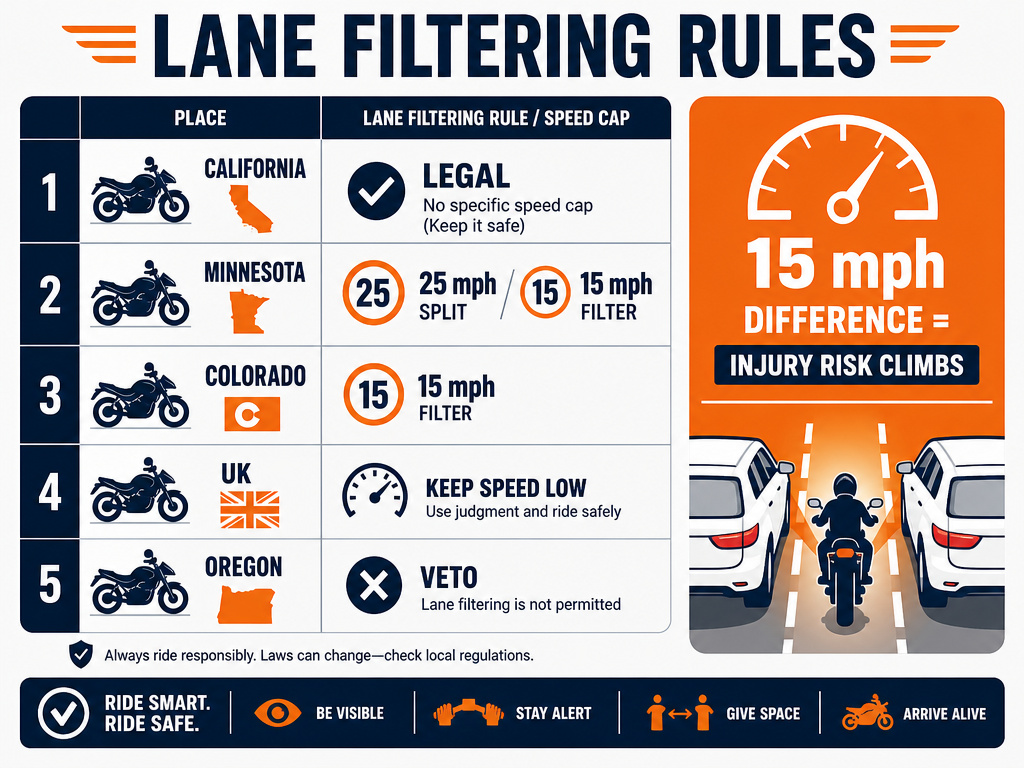
Filtering is legal in Colorado, Minnesota and the UK, each with its own limits, and California’s 2016 Assembly analysis described it as the only state where lane splitting wasn’t illegal. Two terms first. Lane splitting means riding between lanes of moving traffic. The other term, lane filtering, means working through stopped cars to the front of a queue.
The Berkeley study on motorcycle lane splitting looked at nearly 6,000 CHP-reported motorcycle crashes from June 2012 through August 2013. Of those, 997 involved lane splitting. The speed difference between bike and traffic predicted injury better than raw speed did. Above a 15 mph difference, injury risk rose significantly.
About 69% of the lane splitters were within about 15 mph of traffic. About 14% were going at least 25 mph faster. The most common crash? A rider going too fast when a driver tried to change lanes.
The mechanism is plain physics. A big speed gap shrinks the time you have to react when a car twitches into your path, and it adds energy to the hit when you can’t. One honest limit: the study couldn’t estimate the odds of crashing in the first place, only how hurt riders were once a crash happened.
If you’re closing on the cars by more than 15 mph, you’re past the line where Berkeley’s numbers turned ugly. Roll off before you need the brakes.
The written rules disagree, and not by a little:
| Where | What’s allowed | Speed cap |
|---|---|---|
| California (earlier AB 51 text, 2016) | Splitting stopped or slow traffic | 50 mph max, 15 over traffic |
| California (withdrawn 2013 CHP tips) | Splitting, as safety tips only | 10 over; none at 30 mph or faster |
| Minnesota | Splitting slow traffic; filtering stopped | Split: 25 mph, 15 over; filter: 15 mph |
| Colorado | Filtering between stopped cars only | 15 mph; splitting illegal |
| UK (Rule 88) | Filtering slow-moving traffic | “Keep your speed low,” no number |
California’s story is the messy one. An earlier version of AB 51, described in a 2016 Assembly floor analysis, would have capped splitting at 50 mph and 15 mph over traffic. The 2013 CHP tips said 10 mph over and no splitting at 30 mph or faster. CHP later pulled them, saying they were never meant as rules, only common-sense safety tips.
That same 2016 analysis called California the only state where splitting wasn’t illegal. It’s out of date. The Colorado lane filtering law for motorcyclists took effect August 7, 2024. It allows filtering between stopped cars at 15 mph or less, never on the shoulder, and only where lanes are wide enough. CDOT’s case for it is protecting motorcycles from being hit from behind by larger vehicles.
Minnesota’s version took effect July 1 after passing in 2024. The state’s Department of Public Safety says drivers can’t get in a filtering rider’s way but don’t have to make room. The AMA, quoting HF 5247, puts it more firmly: a driver must not intentionally impede a filtering motorcycle. Same law, two readings. Don’t count on a driver moving over.
Easy to miss: In Minnesota, once traffic gets back up to 25 mph, a splitting rider must return to the lane. Stay between the cars past that point and you’ve crossed from a legal split into an illegal pass.
Oregon came close. SB 574 in 2021 would have allowed filtering for two-wheeled bikes only, outside school and work zones and off the shoulder. Gov. Kate Brown vetoed it, citing public safety and noncompliance. My own rule is blunt: if I’m not sure what the law says where I’m riding, I stay in my lane.
Squids, ATGATT, and My 30-Minute Gear Rule
I don’t decide anything about a new piece of gear until I’ve worn it for at least 30 minutes. Pressure points and hot spots tend to show up inside that window. I learned that the slow way, after too many first impressions fell apart a few miles down the road.
That habit matters here because the gear you hate stays on the hook. A hi-vis vest that flaps and pinches at the shoulders ends up in the garage, where it does nothing for your visibility. Safe gear only works if you actually wear it.
Riders shorthand the whole idea as ATGATT: all the gear, all the time. The opposite is a squid, the rider in shorts and a T-shirt pulling wheelies past the coffee shop. The numbers back ATGATT. Of the 134 motorcyclists killed on Colorado roads in 2023, 67 weren’t wearing a helmet, per CDOT.
CDOT also cites NHTSA data (the federal traffic safety agency) showing 26% of motorcycle deaths from 2021 to 2023 involved an impaired rider. Don’t ride after a drink. Not one.
For daytime visibility, Rule 86 points to a light or bright helmet. If you’re buying one thing, get a light or brightly colored helmet that fits you before spending on graphics. Fit still beats color: a white lid that shifts at speed is worse than a dark one that stays put.
For riding after dark, Rule 87 says reflective material bounces other drivers’ headlights back so they see you from farther away. A reflective vest over the jacket you already own covers that cheaply. And Rule 83’s visor check deserves more respect than it gets. A visor that looks fine at noon turns every bug smear and scratch into a starburst the moment oncoming headlights hit it.
Two more opinions I’ll defend. After the helmet, buy gloves before a fancy jacket, because hands go out first in a fall. And sneakers aren’t boots, whatever the “riding shoe” ad says. The last gear rule lives inside the helmet: ride at your own pace, smooth and predictable, so everyone around you can read what you’ll do next.
One Passenger, Two Feet on the Pegs
Three rules cover most passenger trouble: one passenger, a seat, and feet that stay put. UK Highway Code Rule 85 says you can’t carry more than one pillion passenger, who must sit astride a seat facing forward with both feet on the footrests. Provisional license holders can’t carry one at all, and Rule 83 puts both of you in fastened helmets.
The unwritten side falls on the passenger. Wait for the rider’s nod before climbing on, because the rider needs both feet planted and the bike braced for the shift in weight. In a turn, look over the rider’s inside shoulder and let your body go with the bike. At a stop, keep your feet on the pegs, since a surprise foot down shoves weight the rider wasn’t ready for.
I give first-time passengers one instruction. Be a backpack.
Frequently Asked Questions
What are some unwritten rules of motorcycle riding?
Wave back when it’s safe, stop for a rider stuck on the shoulder, and never touch or sit on someone else’s bike. In a group, ride staggered on straights, go single file on curves, and pass one bike at a time. Back into parking spots so you can ride out forward.
What does it mean when a biker gives you two fingers down?
It’s a low wave, a hello between riders. The common story says the two fingers stand for two wheels on the ground, but nobody can trace where it started. Return it with your left hand when you can do it safely.
What is the 12 second rule on a motorcycle?
It’s rider shorthand for looking far enough up the road to spot trouble before you reach it. None of the official sources checked for this guide define it, so treat it as a scanning habit rather than a legal rule. Your following gap to the bike ahead is a separate thing and should stay at two seconds or more.
Is lane splitting legal in every state?
No. Colorado allows filtering between stopped cars at up to 15 mph but keeps lane splitting illegal, while Minnesota allows both, with splitting capped at 25 mph and 15 mph over traffic. California also allows splitting, so check the rules wherever you ride.
Do I have to stop for every broken-down rider?
No law makes you, but the custom runs deep. Pull well clear of the road, ask if they need help, and take a thumbs-up as your cue to leave. A phone and a basic tool roll make you most of the help they need.
Before You Go
Most of the standard unwritten motorcycle rules of the road cost nothing but attention. The one with a hard number attached is filtering. Once you’re closing on traffic by more than 15 mph, Berkeley’s data says the injury odds change, and no wave or hi-vis vest fixes that.
This week, do one thing: sit down with whoever you ride with and run the six hand signals until everyone can call them without thinking. It takes a parking lot and a cup of coffee.
One caution on everything above. Filtering law is moving fast. Minnesota’s law is brand new, so check current rules before riding somewhere unfamiliar.
Bottom line: new riders and anyone joining a first group ride should learn these rules before they need them, and riders who already know them should teach someone who doesn’t.
