
Motorcycle Group Riding Formation Explained
This post contains affiliate links. As an Amazon Associate, we earn from qualifying purchases.
Motorcycle group riding formation uses two main patterns: a staggered formation for straight, open roads and a single-file line for curves, poor conditions, or entering highways. In a staggered setup, riders occupy alternating sides of the lane with specific time gaps between them, while single-file requires at least a two-second following distance. The formation’s goal is to maximize visibility, maintain escape routes, and keep the group compact without side-by-side riding.
That gap, the specific number of seconds between bikes, is where most groups get it wrong. They ride too tight. The official manuals disagree on the exact figure, and that confusion leads to packs that are bunched up and reactive instead of spaced out and prepared. The principles of motorcycle group riding formation explained in those guides are meant to prevent this.
What follows breaks down the two formations, the numbers from the rulebooks (and where they conflict) as part of the motorcycle group riding formation explained, and the critical moments when you must switch from one to the other. By the end, you’ll know how to position your bike, how to adjust for the rider behind you, and what to do when the plan changes mid-ride.
Key Takeaways
- Ride in a staggered formation on straight roads, but switch to single-file for any curve, corner, or highway merge.
- Official guidance on following distance conflicts: sources like Ontario MTO, NZTA, CVMA 44-1, and Harley-Davidson recommend a two-second gap to the rider diagonally ahead, while the MSF states the next rider stays at least one second behind.
- Keep groups small, five to eight bikes is the sweet spot across most safety guides.
- The pre-ride briefing is mandatory. Cover hand signals, the route, and the plan if someone gets separated.
- Never ride side-by-side in the same lane. It eliminates your escape route for road hazards.
The Staggered Formation: Lane Position & Spacing Explained
Forget side-by-side riding. The staggered formation puts each rider in a diagonal line, giving everyone an escape path. The leader picks a side, here’s the first conflict in the rulebooks.
The Motorcycle Safety Foundation (MSF) says the lead rider takes the left third of the lane. New Zealand’s Transport Agency (NZTA) says the leader rides on the right-hand side. Both are correct within their jurisdictions.
In a staggered formation, riders occupy alternating positions within the lane, creating a diagonal line. This pattern provides each rider with a clear space cushion and a visible path to the road ahead, while keeping the group’s overall length shorter than a single-file line. The specific lane position for the lead rider varies by official source.
Which one should you use? Match your local road code if you know it. If not, the left-side lead is more common in North America. The critical part is that the second rider staggers to the opposite side.
The spacing is measured in seconds, not feet. You count the time it takes for you to pass a fixed point after the rider diagonally ahead of you (on the same side of the lane) passes it.
| Rider Position | Lane Position (vs. Leader) | Following Distance (to diagonal rider) | Source |
|---|---|---|---|
| Leader | Left (or Right per NZTA) | N/A | MSF, Ontario MTO, NZTA |
| Second Rider | Opposite side | 1 second (MSF) / 2 seconds (Others) | MSF, Ontario MTO, NZTA, CVMA 44-1 |
| Third Rider | Same side as Leader | 2 seconds | Ontario MTO, CVMA 44-1, Harley-Davidson |
The chart shows the disagreement. The MSF states the second rider stays at least one second behind. Ontario MTO, NZTA, the Combat Veterans Motorcycle Association (CVMA), and a Harley-Davidson resource all specify a two-second distance to the rider two spots ahead.
That two-second gap is the safer default. It gives you more time to react if the lead rider suddenly brakes or swerves. In a driveway session,
Common mistake: Compressing the gap to stay visually connected. This removes your safety cushion. If the rider ahead hits debris, you have nowhere to go.
When to Abandon Stagger and Ride Single-File
Staggered formation is for straight, open roads with good visibility. The moment the road changes, the formation must change. This isn’t a suggestion; it’s in every official handbook.
Switch to a single-file line with at least a two-second following distance when:
- Navigating curves or corners.
- Entering or exiting a highway or freeway.
- Riding in poor visibility (fog, heavy rain, dust).
- Crossing poor road surfaces (gravel, grooved pavement, potholes).
- If the group cannot maintain the posted speed limit.
On a curve, the staggered formation collapses. The inside-line rider naturally slows while the outside-line rider carries more speed, forcing bikes into side-by-side positions. That’s how handlebars get clipped. Single-file gives each rider the full lane width to choose their line and lean angle.
The same logic applies to highway merges. You need to blend with traffic as a predictable unit, not a wide, diagonal block. The Motorcycle Safety Foundation group riding guide is explicit: single-file is preferred for entering and leaving highways.
Where this goes sideways: Staying in stagger on a sweeping country road. The group looks tidy, but the inside rider is constantly braking and the outside rider is running wide. By the third corner, the formation is a mess and riders are stressed.
Planning the Ride: Briefing, Size, and Roles
The motorcycle group riding formation explained is worthless without a plan. A thorough pre-ride briefing is essential to prevent many common group riding problems. This is essential.
Your pre-ride briefing must cover five things:
- The route and planned fuel stops.
- The hand signals you’ll use.
- The designated lead and sweep riders.
- What to do if the group gets separated at a light.
- The plan if a bike has a mechanical issue.
Assign your most experienced rider as the sweep, not the fastest rider. The sweep rider’s job is to ensure no one gets left behind and to assist with breakdowns. They should carry a basic tool kit and a first-aid kit, as recommended by the MSF.
Group size is a balance. Too small and you lose the social benefit; too large and you become a traffic obstruction. Official sources disagree here, too:
- MSF: 5–7 riders
- CVMA 44-1: 8–10 motorcycles
- Harley-Davidson: 6–8 bikes
- NZTA: Split groups larger than 4 or 5
For a casual ride, many sources recommend keeping the group to a manageable size, such as five to seven (MSF) or six to eight (Harley-Davidson). It’s manageable for a single leader and allows the group to stay together through traffic lights. If you have more riders, split into smaller groups with their own lead and sweep, departing a few minutes apart.
Hand Signals and Communication

Hand signals are your low-tech lifeline. They pass critical information through the group when intercoms fail or aren’t available. Everyone must know the basics before rolling out.
The standard hand signals are simple:
- Left arm straight out: Turn left.
- Left arm out and upward, palm forward: Right turn.
- Left arm out, palm down, patting motion: Slow down.
- Left arm out, pointing to the ground: Hazard in the road.
- Tapping the top of your helmet: Police ahead.
Modern bike communication systems like Cardo or Sena are fantastic, but treat them as a supplement, not a replacement. Radios can drop connection, batteries die, and riders without units get left out. The visual signal is universal.
The lead rider should use signals early and clearly. A quick tap of the brake light before actually slowing down gives the group a heads-up. This simple habit, noted in the official NTSB motorcycle resource, prevents concertina braking where the last rider has to brake hardest.
Navigating Intersections and Highways as a Group
Intersections split groups. A clear procedure decided in the briefing keeps everyone safe and legal.
At a stop sign, the group should stop. Proceed through two riders at a time, then re-establish stagger.
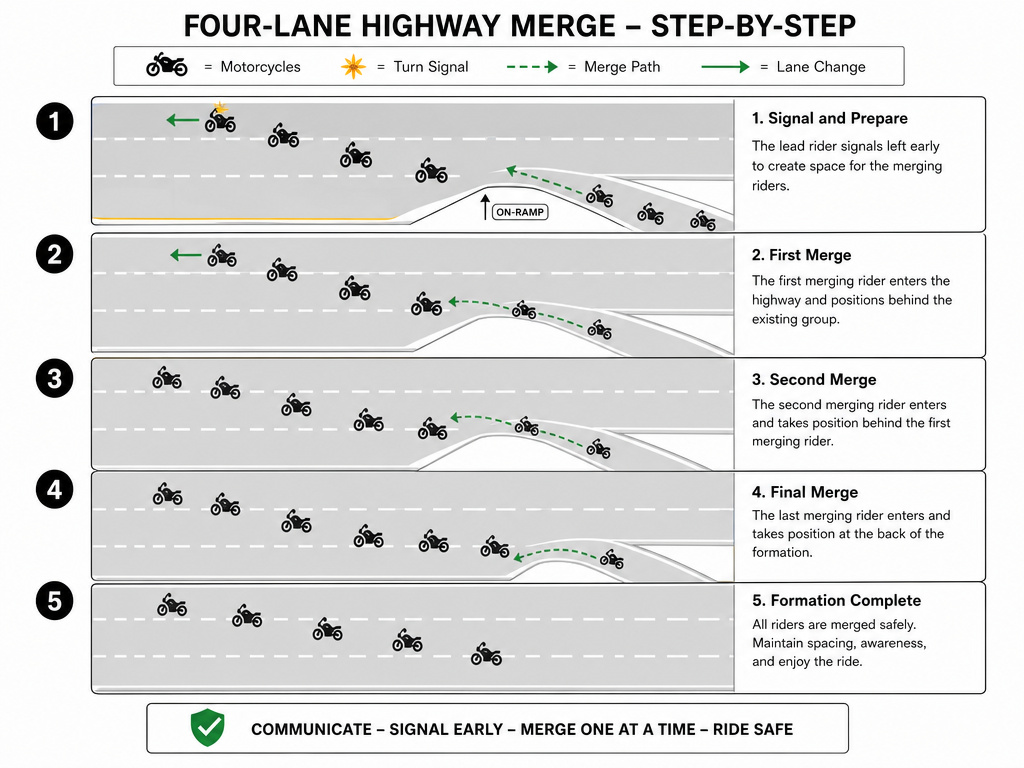
On multi-lane highways, merging should be done single-file. Once in the flow of traffic, the group can shift into a staggered formation. The lead rider should be alert to merging traffic from on-ramps and may need to signal a lane change left to create space.
The lead rider goes first, returns to the lane, and re-opens the gap. Then the second rider passes. Never pass in a pack; you remove the safe following distance for oncoming traffic.
Lane changes as a group require communication. The lead rider signals, changes lanes, and holds position. Each following rider checks their own mirror and blind spot before moving over one by one, maintaining the staggered formation in the new lane. Your lane positioning within that lane should still follow the left/right alternating rule.
Dealing with Problems: Separations and Drop-Outs
Rides rarely go perfectly. A rider gets a flat, the group gets split by a red light, or someone needs to peel off early. Your briefing plan gets its real test here.
If the group gets separated in town, the lead rider should slow down, not stop, to allow others to catch up. If catching up isn’t safe or possible, regroup at the next planned fuel or rest stop. Never run a red light or speed to catch the pack.
If a rider needs to leave the ride, they should signal the sweep rider. The group should not simply close the gap by having the next rider move straight up. According to the MSF, that forces a risky pass within the lane.
Instead, the group should perform a “criss-cross” re-formation. The rider behind the vacancy moves to the opposite side of the lane, effectively skipping ahead diagonally. This maintains the staggered pattern without anyone having to overtake in the same lane. It feels counterintuitive but is the safer method outlined in the IAM RoadSmart organised rides manual.
For mechanical or medical stops, only the sweep rider and one other should stop to assist. The rest of the group continues to the next safe stopping point. This prevents a chaotic cluster of bikes on the shoulder.
Spacing rules (2-second following distance)
In a staggered formation, following distances are measured in seconds, not feet. The most common rule is to maintain a two-second gap to the rider diagonally ahead of you, who is on the same side of the lane. This means the third rider is two seconds behind the lead rider. The rider directly ahead of you, on the opposite side of the lane, should be about one second in front. This staggered timing creates a safe cushion for braking and reaction. If a rider leaves the group, others should smoothly criss-cross to fill the vacant position and maintain the formation.
Navigating curves in formation
When the road starts to bend, the staggered formation should be abandoned. Multiple sources state that single-file riding is required for navigating curves and corners. This is because each rider needs the full width of their lane to choose their own line through the turn, accounting for lean angle and road conditions. The group should switch to a single-file formation with increased following distance before entering the curve. Once the road straightens out and visibility is restored, the group can safely return to a staggered pattern.
Frequently Asked Questions
What is the proper formation for motorcycle group riding?
The proper formation is staggered for straight, open roads and single-file for curves, corners, highway entrances/exits, and poor conditions. In stagger, riders occupy alternating sides of the lane with a time gap between them, never riding side-by-side.
What does a two-fingers-down wave mean?
Two-fingers-pointed-down wave from a rider is a general greeting of solidarity. It’s a casual, low-effort signal that says “keep two wheels down” or simply “hello, fellow rider.” It is not an official group riding signal.
What is the 12-second rule on a motorcycle?
It’s a proactive scanning technique, not a following-distance rule for group riding.
How do you keep a motorcycle group together?
You keep a group together through a clear pre-ride briefing, a manageable group size (ideally 5-8 bikes), and by having the lead rider set a pace that matches the least experienced rider’s comfort level. The sweep rider at the back ensures no one is left behind, and all riders use their mirrors to check on the rider behind them.
Who should lead a motorcycle group ride?
The most experienced rider in the group should lead, not necessarily the fastest. The ride leader must know the route, set a safe pace, communicate clearly with signals, and be mindful of the skill levels behind them.
The Bottom Line
Group riding formation isn’t about looking cool. It’s a systematic way to share the road safely. Stick to the staggered pattern on straights, switch to single-file before any curve, and measure your gaps in seconds, not bike lengths.
The single biggest upgrade to your next group ride happens before you start the engines. Hold that briefing. Assign the sweep. Review the signals. That five-minute conversation does more for safety and cohesion than any piece of gear.
When in doubt, increase your following distance. The two-second minimum is exactly that, a minimum. In rain, at night, or with unfamiliar riders, make it three. Space is time, and time is the only thing that lets you fix a mistake before it becomes a crash.
