
Sweep Rider Responsibilities in a Motorcycle Group Ride
This post contains affiliate links. As an Amazon Associate, we earn from qualifying purchases.
In a motorcycle group ride, According to sources like the OC Dualies, the sweep rider’s job is to be the last rider, provide encouragement and basic roadside assistance, and in off-road events, pull the course-marking ribbon. However, other sources, such as The Cavaliers MC, define sweep as a potential non-riding function in a support vehicle. They are not a guide, tow truck, or paramedic. The OC Dualies club notes that if a slow rider refuses a bailout from the final sweep, they risk being left behind without support.
That “left behind” clause is the part most riders don’t see coming. It reframes the whole role from a safety net to a pace enforcer. The sweep isn’t there to save you from poor planning or a bike that shouldn’t have left the garage. Understanding sweep rider responsibilities in a motorcycle group ride is crucial.
What follows is a breakdown of what the sweep actually does, the tools they need, the situations where no sweep exists, and how to ride so you never need their help.
Key Takeaways
- The sweep rider is a volunteer, not a paid employee, often riding in exchange for a reduced entry fee. They are not responsible for saving you from poor decisions or mechanical neglect.
- On larger rides, depending on the size of the ride, there are often three sweeps: early, mid, and final. The final sweep is often responsible for pulling ribbon and has the authority to insist slow riders take a bailout route.
- Time is the biggest enemy. If you dawdle, take wrong turns, or fall behind the final sweep, you may be bypassed and left without support.
- Some rides are too small to require or support a sweep. These events demand self-sufficiency and riding with a trusted partner.
- A sweep’s kit should focus on communication, basic tools, and first-aid—not on carrying enough parts to rebuild an engine.
What Are the Sweep Rider’s Core Responsibilities?
The job is often romanticized as a guardian angel on two wheels, but the reality of sweep rider responsibilities in a motorcycle group ride is more pragmatic.
A sweep rider is a dual-sport rider, just like you. They often have a lot more experience riding (and racing), but they are not guides, gas trucks, mechanics, tow services, paramedics, doctors, or nurses. Their primary function is to ensure the route is clear and to encourage riders to maintain a reasonable pace.
This definition, from the OC Dualies’ guide, draws a hard line. The sweep is a dual sport rider, just like you, not a professional rescue service. Their core duties break into three areas: support, communication, and route integrity.
Support means basic troubleshooting. They might help tighten a chain, share a tube patch, or offer a sip of water. They are not a rolling parts warehouse. Communication is critical. The sweep relays issues to the ride leader, informs the group of hazards, and communicates with stranded riders. This is where a good pre-ride briefing pays off, establishing clear signals and protocols.
Finally, in organized dual-sport or adventure rides, the final sweep is responsible for pulling the ribbon after the last rider passes. This restores the route and is why they cannot wait indefinitely for a struggling rider—they have a hard deadline.
The part nobody mentions: A sweep cannot help you if you go off course or are bypassed. If you take a wrong turn and get lost, you’ve removed yourself from their coverage. Their responsibility is to the published route, not to every trail in the forest.
The Three Sweeps System and the Bailout Rule
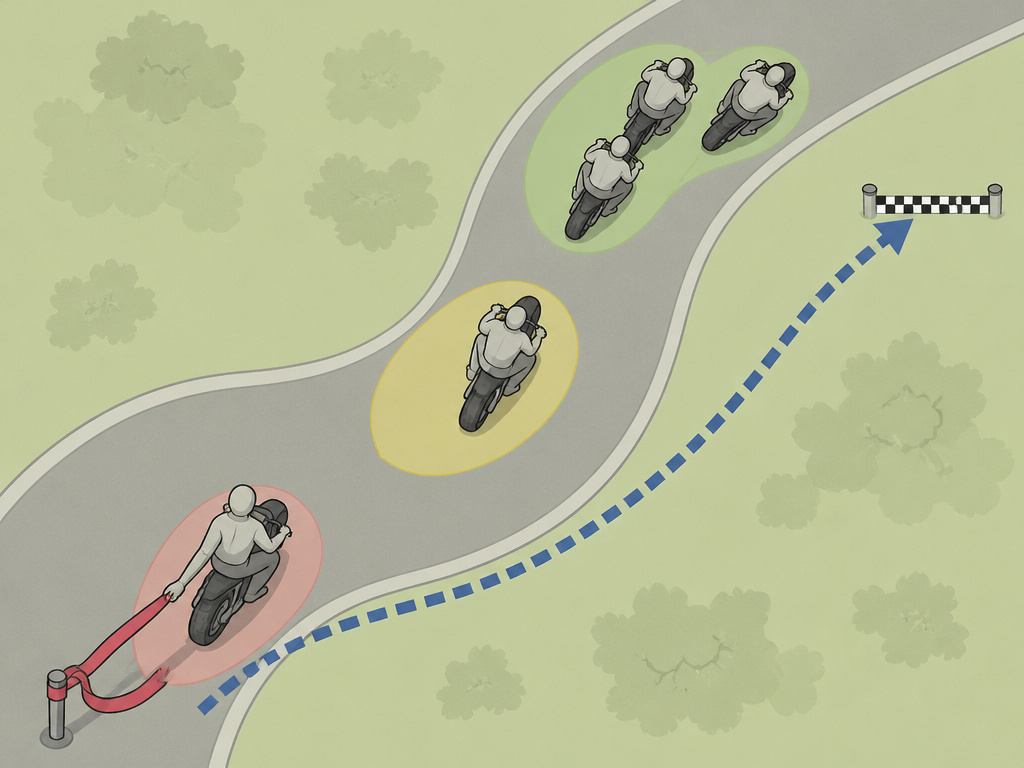
On larger organized rides, the sweep function is often split into a team. This isn’t just about having more helpers; each position has a specific tactical role.
| Sweep Position | Primary Role | Interaction With Riders |
|---|---|---|
| Early Sweep | Rides close behind the main group. | Catches immediate breakdowns. Their presence means you’re already at the back of the pack. |
| Mid Sweep | Patrols the middle of the rider spread. | Offers assistance and is a clear warning to speed up. If the mid-sweep helps you, you are in danger of falling behind schedule. |
| Final Sweep | The last official rider on the route. | Responsible for pulling ribbon. If they catch you, you will likely be asked to take a bailout (shortcut) to the finish. |
The final sweep carries the most authority—and the least flexibility. According to the OC Dualies, if you’re riding slow and are caught by final sweep, you most likely will be asked to take a bailout. Refuse, and you risk being left behind without any ribbon or ride support.
Why? Time is your biggest enemy on most dual sport rides. The final sweep has a concrete task: pull all the markers before dark or before land management permits expire. Waiting an extra 30 minutes for one rider can jeopardize the entire event’s ability to finish the cleanup. The bailout isn’t a punishment; it’s a logistical necessity.
This system underscores a critical piece of group ride etiquette: maintaining a reasonable, steady pace isn’t about pride; it’s about respecting the timeline of the event and the volunteers working it, which is central to sweep rider responsibilities in a motorcycle group ride.
Sweep Rider vs. Support Vehicle: A Fundamental Disagreement
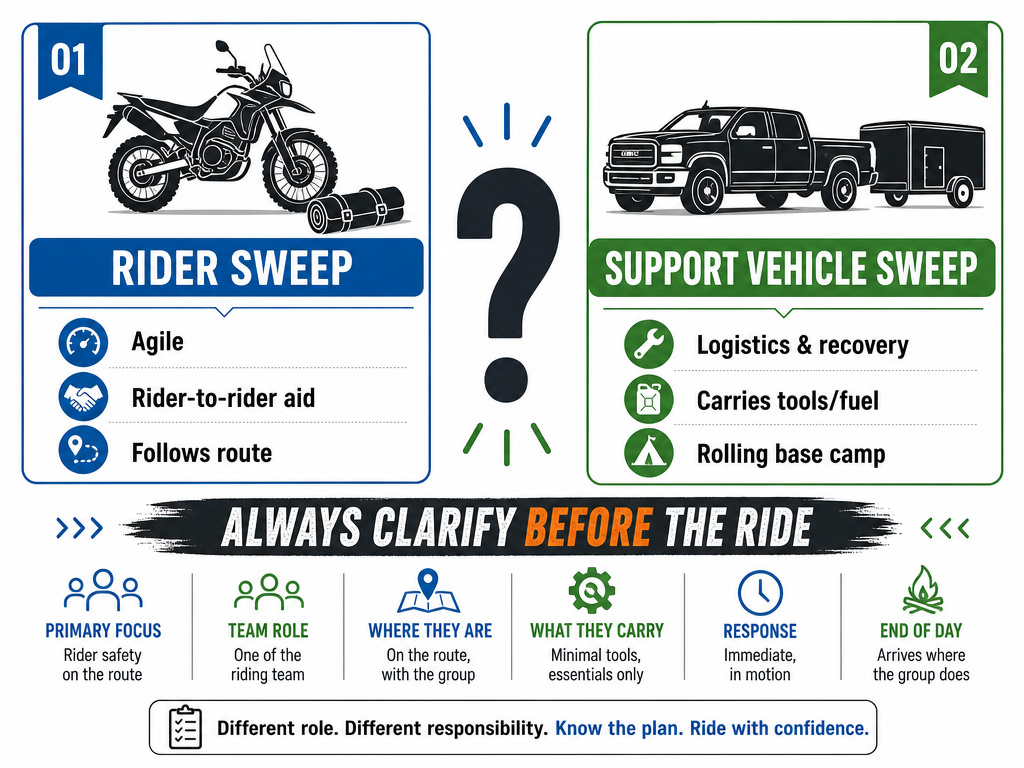
Here’s where sources and riding cultures clash. There isn’t one universal definition of “sweep.”
- The Rider Sweep (OC Dualies / Off-Road): According to the OC Dualies and similar off-road sources, this is a riding position filled by an experienced motorcyclist. Other sources define sweep as a non-riding support role. They follow the route on a bike, assist where possible, and pull ribbon. The focus is on rider-to-rider assistance within the moving column.
- The Support Vehicle Sweep (Some Street Clubs / The Cavaliers MC): This can be a non-rider in a truck or van, carrying tools, fuel, and a trailer. This is a logistics and recovery role, not a riding position. It’s a rolling base camp.
The rider sweep is agile but limited in what they can carry. The support vehicle can fix more but can’t access all terrain. Your ride’s briefing should clarify which type, if any, is provided. Don’t assume.
Where this goes sideways: You expect a pickup truck with a trailer, but you get a fellow rider with a small tool roll. That mismatch leads to frustration. Always ask before the ride: “Is the sweep on a bike or in a truck, and what kind of support can they realistically offer?”
When There Is No Sweep: Small Rides and Self-Sufficiency
Not every ride has a sweep. In fact, relying on one when it doesn’t exist is a quick path to a bad day.
As a matter of economics and logistics, some rides are too small to require or support a sweep. Most of these rides are restricted by permits from land management agencies to 40 or so riders. These events are for experienced riders that are more self-sufficient.
On a small, permit-restricted ride, you are on your own. This reality demands two things:
- Riding in pairs or groups is demanded. On small rides, riding in pairs or groups is demanded, so get yourself a partner you know and trust.
- Your preparation multiplies.
This is also where general motorcycle safety fundamentals become your primary sweep. The Indian Motorcycle owner’s manual emphasizes universal rules: perform pre-ride inspections, never exceed your bike’s weight rating (GVWR/GAWR), and ensure your tires are properly inflated and in good condition. Underinflation can cause a tire to overheat and result in a tire failure.
What Should a Sweep Rider Carry? (The Practical Kit)
It’s about having the right tools for the most common failures.
- Communication First: A fully charged communication system (like a Cardo or Sena) to reach the leader is essential.
- Basic Tool Roll: Focus on versatility.
- T-Handle w/ common sockets (8mm-19mm) and hex bits
- Adjustable wrench & Pliers (Vise-Grip style)
- Tire Repair: Tools and materials for tire repair.
- Bike-Specific Tools: Tools for common bikes on the ride.
- Safety & First-Aid:
- First-Aid Kit: A basic first-aid kit.
- Water: For you and to share.
- Navigation: A GPS with the full route loaded, even if you think you know the way.
Common mistake: Overloading with spare parts. You cannot carry a spare clutch cable for every bike model.
How to Be a Good Sweep Rider (Beyond the Tools)
The right gear is useless without the right mindset. Being an effective sweep is about temperament and technique.
1. Patience is the Primary Skill. You will be dealing with frustrated, tired, and sometimes embarrassed riders. Stay calm, be encouraging, and focus on solutions, not assigning blame. A simple “No worries, we’ll figure this out” sets the right tone.
2. Communicate Constantly and Clearly. Your most important job is linking the tail to the head. Use the intercom systems to inform the leader of stops, hazards, or pace issues. When helping a rider, give them clear, simple instructions. Also, use standard hand signals to communicate with riders ahead of you within visual range.
3. Know Your Limits. The OC Dualies document is blunt: “Sweep Riders are not responsible for saving you from yourself.” You are not a paramedic. If a rider is seriously injured, your job is to secure the scene, call professional help, and relay exact coordinates. Do not attempt procedures you are not trained for.
4. Manage the Group’s Pace. This is an art form. If you see the group compressing because of a slow rider, you might need to signal the rider ahead of you to increase the following distance to prevent a concertina effect. Sometimes, gently encouraging a struggling rider to take a shorter route is the kindest and safest option for everyone.
How to Ride So You Never Need the Sweep
The best interaction with the sweep is a wave as they ride past. Your goal is to be self-sufficient.
- Prep Your Bike Relentlessly: The pre-ride inspection from the owner’s manual isn’t a suggestion. Check tires (pressure and wear), chains, cables, and fluid levels. A failure from neglect is the most frustrating kind for a sweep to encounter.
- Know the Route: Don’t just blindly follow the taillight ahead. Have the route loaded on a GPS or have a printed route sheet. This prevents you from taking a wrong turn and vanishing from the sweep’s radar.
- Manage Your Energy and Pace: Start the ride well-rested and hydrated. Don’t burn all your energy in the first hour. Ride at a pace you can sustain all day, even if it means letting a faster group go. A consistent, moderate pace will always beat a fast-but-exhausted one.
- Ride Your Own Ride: This is the golden rule of group riding. Never let the group pressure you into riding beyond your skill or comfort level. It’s better to arrive late than not at all. A good ride leader will have regroup points for this reason.
Fit first, features second. This applies to your riding, not just your gear. A ride that fits your skill level is safer and more fun than one that constantly stretches you to the breaking point.
Pre-ride Briefing and Sweep Assignment
Before a group ride begins, the ride leader should conduct a briefing that clearly assigns sweep riders. For larger rides, there may be three sweeps: an early sweep, a mid sweep, and a final sweep. Each rider must understand who their sweep is and what their role entails. The briefing should emphasize that sweep riders are volunteers, often more experienced, but they are not guides, mechanics, or emergency services. Their function is to support, encourage, and maintain the route’s integrity, such as the final sweep pulling course-marking ribbon. Every participant is responsible for their own preparedness and for staying on course ahead of the sweep.
Frequently Asked Questions
What’s the difference between a sweep and the ride leader?
The ride leader (or lead rider) sets the pace, chooses the route, and leads the group. The sweep rider is the last person, ensuring no one is left behind and managing issues at the rear. They are in constant communication, forming the head and tail of the group.
Can a new rider volunteer to be the sweep?
Absolutely not. The sweep should be one of the most experienced riders in the group. They need superior riding skill, mechanical knowledge, navigation proficiency, and the temperament to handle stress. A new rider lacks the experience to handle the role’s responsibilities or its potential emergencies.
What should I do if the sweep rider breaks down?
This is the “who watches the watcher” scenario. Ideally, no rider should ever be alone. If the sweep breaks down, the rider immediately ahead of them (the “last but one” rider) should stop. That rider then becomes the de facto sweep and must use communication to inform the leader of the situation. This is why clear communication systems and briefing protocols are critical.
Are sweep riders paid?
Typically, no. The OC Dualies state sweep riders are not normally paid employees but customarily volunteers who provide this service in lieu of a reduced entry fee. Sometimes a club may provide sweeps as a charity fundraiser. Do not expect professional-level service from a volunteer.
How does staggered formation affect the sweep?
In a staggered formation, the sweep usually rides in the left-side track (the position that gives the best view of the group ahead). Their primary job remains the same, but they must also monitor the formation’s integrity, ensuring gaps don’t get too large and signaling the group to close up or single-file as needed.
The Bottom Line
The sweep rider is a volunteer pace-keeper and problem-solver, not a personal sag wagon. Their ability to help is bounded by the route, their toolkit, and the clock—especially the final sweep tasked with pulling ribbon.
Your takeaway is straightforward: prepare your bike and yourself to be as self-sufficient as possible. Pack tools, know the route, and ride a sustainable pace. That preparation is the real guarantee you’ll finish the ride. View the sweep as a helpful resource of last resort, not a fundamental part of your plan. Because on rides with only 40 riders, or if you take a wrong turn, that resource may not exist for you at all.
