
Motorcycle Hand Signals: For Turns, Stops, and Group Rides
This post contains affiliate links. As an Amazon Associate, we earn from qualifying purchases.
Motorcycle hand signals are a set of standardized gestures used by riders to communicate turns, stops, hazards, and group ride commands when electronic signals fail, are unseen, or in group riding scenarios. The three universal signals are left arm extended straight out for a left turn, left arm extended upward at a 90-degree angle for a right turn, and left arm extended downward at a 90-degree angle for stop or slow down. These are codified in state operator manuals like the Mississippi and Washington publications and training materials from the Motorcycle Safety Foundation.
That last part is the key. These aren’t just casual suggestions. The Mississippi Department of Public Safety includes them in its official T-CLOCS pre-ride inspection checklist as a component of rider readiness, right alongside checking tire pressure and brake lights. When your bike’s signals are out, these gestures become your legal and functional replacement.
What follows is the full set, broken into four categories: the three essential basics, the expanded language for group riding, the unwritten rules of biker courtesy, and the critical safety practices that decide whether a signal is seen or missed.
Key Takeaways
- Use the three universal signals for turns and stops, left arm straight out (left turn), up at 90° (right turn), down at 90° (stop/slow), as your primary communication when signals fail.
- In a group, a pre-ride briefing that covers hand signals is mandatory; confusion over a “speed up” versus “pull off” gesture can split a group apart in traffic.
- The “two fingers down” salute is a gesture of respect between riders, indicating “two wheels down” for a safe ride, not a signal for other traffic.
- Hand signals are ineffective at night or in low visibility; rely on your motorcycle’s lights and increase following distance instead.
- Always make signals large, deliberate, and held for several seconds, and confirm the rider behind has seen you with a mirror check.
The Three Universal Turn & Stop Signals
These are the signals you’ll find in every state’s motorcycle operator manual. Their job is simple: replace your bike’s electric turn signals and brake light when they malfunction or aren’t visible. The Mississippi Motorcycle Operator Manual lists checking these lights as part of its T-CLOCS inspection, and for good reason, if they fail, your knowledge of motorcycle hand signals is your backup.
A left turn is your left arm extended straight out horizontally, parallel to the ground. Hold it steadily for several seconds before the turn. A right turn is your left arm extended out, but with the forearm bent upward at a 90-degree angle, forming an “L”. The stop or slow down signal is the same starting position, but your forearm is bent downward at a 90-degree angle.
Common mistake: Flicking a turn signal quickly. Car drivers are not looking for a brief hand flick. A large, held gesture cuts through visual clutter. A one-second flash gets missed.
The physical act matters. Extend your arm fully from the shoulder, not just a forearm wiggle. You’re fighting to be seen in a sea of mirrors and glass. A weak signal is no signal at all. I’ve watched riders in a group get missed because their “slow down” was a subtle wrist dip the guy three bikes back never saw.
Group Ride Formations and Commands
Group riding has its own expanded vocabulary. This is where a clear pre-ride briefing is essential. The leader must confirm everyone knows the signals for formation changes, hazards, and stops.
The core formation signals are for single-file and staggered riding. A pointed index finger aimed at the top of your helmet means “single file”, usually for narrow roads or high winds. A hand patted on top of your helmet, then extended out to the side, signals a return to staggered formation. The ride leader will also use gestures to control speed: a slow, palm-down patting motion means “slow down,” while a vigorous forward windmill motion tells the group to “speed up” or “close the gap.”
| Signal | Gesture | Meaning & When to Use |
|---|---|---|
| Single File | Index finger pointed straight up at helmet. | Use on narrow, curvy, or debris-filled roads. |
| Staggered / Double File | Hand pats helmet, then sweeps out to side. | Resume normal group group riding formation on wider roads. |
| Speed Up / Close Gap | Arm extended, hand making a forward windmill circle. | Group is too spread out; close the distance safely. |
| Pull Off | Arm extended, index finger pointing repeatedly off-road. | Next exit or shoulder; the group is stopping. |
Other essential commands include “fuel stop” (hand pointing to fuel tank), “comfort stop” (closed fist shaken up and down), and “you lead” (a pointed finger swung forward to the next rider). The “follow me” signal is a simple pointed finger at your own chest, then swung forward.
Hazard Warnings and “Cops Ahead”
This is where hand signals can prevent a ticket or a crash. The most common is the “road hazard” signal. For a hazard on the left side of the lane (like gravel, a pothole, or debris), point your left foot down and to the left. For a hazard on the right side, point your right foot down and to the right.
The “cops ahead” warning is a classic. It’s a flat hand, palm down, tapped on top of your helmet. It mimics the old-style police bubble light. Some riders use a closed fist instead. The key is consistency within your group, decide on one version in the briefing.
Where this goes sideways: Mixing up left-side and right-side hazard signals. Pointing with your foot to the side of the hazard is intuitive. Pointing across your body to the opposite side is how riders in front of you end up steering into the problem. Pick the foot on the same side as the hazard, every time.
These signals work because they’re specific and urgent. A general arm wave could mean anything; a foot pointed at a specific spot on the tarmac tells the rider behind exactly where to look.
The Two-Finger Down Salute (Biker Wave) Explained
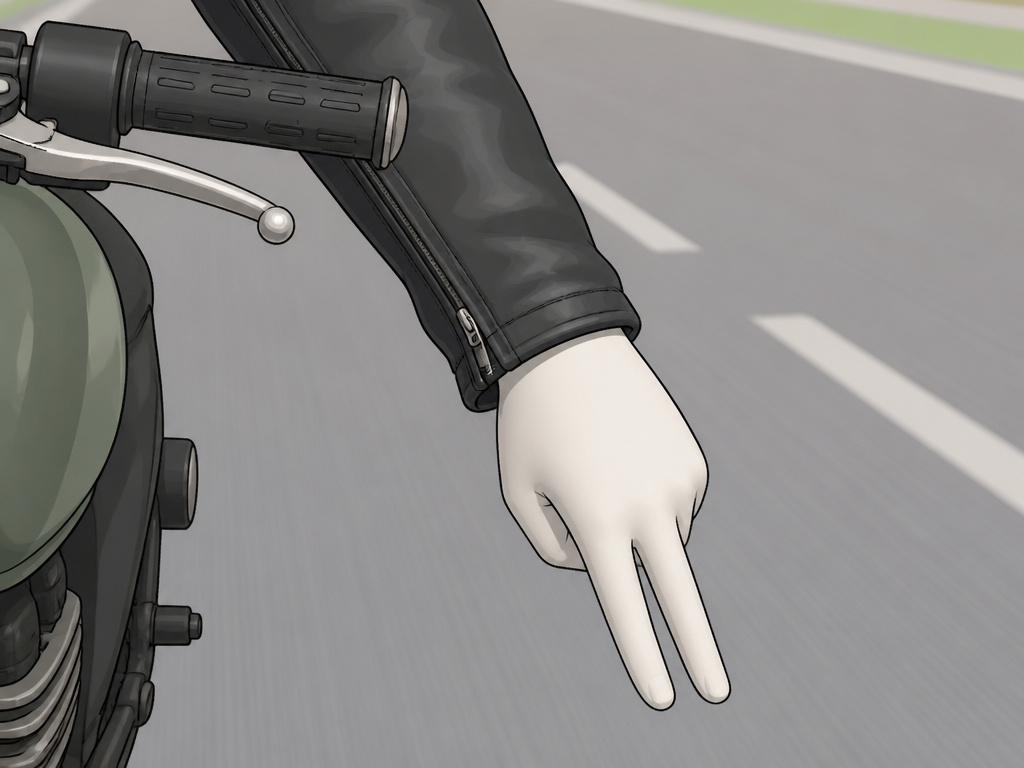
This is the most common “People also ask” question for a reason. When a rider passes you going the opposite direction and extends their left arm down at an angle with the index and middle fingers pointed toward the road, they’re giving the biker wave.
It’s not a traffic signal. It’s a gesture of camaraderie and respect, loosely meaning “two wheels down” or “keep the rubber side down”, a wish for a safe ride. You’re not obligated to return it, but most do. The confusion comes when new riders think it’s a formal signal for the traffic around them. It’s not. It’s rider-to-rider.
Regional variations exist. In some areas, a full open-palm wave is more common. In others, a simple nod of the helmet is the standard. The two-finger version is just the most widespread. The important thing is to not let searching for an oncoming rider to wave at distract you from the road ahead.
Hand Signals for Passengers and Rider-Passenger Communication

Most guides skip this, but if you ride with a passenger, you need a private vocabulary. Your passenger can’t see your hand signals meant for the group behind you. You need a set of simple, pre-agreed taps or gestures.
A common set includes:
- Tap on left shoulder: Prepare for a left turn.
- Tap on right shoulder: Prepare for a right turn.
- Squeeze with arms or tap on torso: I’m braking/stopping.
- Pat on the leg: Hold on, we’re accelerating or maneuvering.
- Point to something: Look at that interesting sight.
Establish these before you roll out. A startled passenger who shifts weight unexpectedly in a corner is a real handling hazard. A quick briefing eliminates that.
When Not to Use Hand Signals: Night and Low-Visibility Riding
This is the critical safety limit that most articles gloss over. Hand signals are virtually useless at night, in heavy rain, or in fog. The Motorcycle Safety Foundation Operator Manual emphasizes increasing conspicuity, and at night, that means lights, not limbs.
If your turn signals fail at night, your priority changes. You must rely even more on your headlight, taillight, and positioning. Signal your intent early by moving to the appropriate part of the lane. Use extra exaggerated head checks. Increase your following and stopping distance dramatically, because drivers behind you cannot see your arm. The legal requirement to signal still exists, but the practical reality is that an unseen signal provides zero safety benefit. In these conditions, getting to a safe place to fix the problem or using alternative transportation is the wiser move.
Troubleshooting Common Confusions
A few signals look similar enough to cause mix-ups, especially in a fast-moving group. Here’s a quick comparison to lock them in.
| Signal Pair | Key Difference | Why It Matters |
|---|---|---|
| Speed Up (Windmill) vs. Pull Off (Pointing) | Windmill is a continuous circle in the direction of travel. Pull off is a stabbing point toward the roadside. | A “speed up” signal when the leader means “pull off” can cause the group to blow past an exit. |
| Right Turn (Arm Up) vs. Single File (Finger Up) | Right turn: entire forearm up at 90°. Single file: just the index finger pointed vertically from helmet. | A new rider might see a single-file signal and think the leader is signaling a right turn for the group. |
| Cops Ahead (Tap Helmet) vs. Comfort Stop (Shake Fist) | Cops: open or closed hand tapping top of helmet. Comfort stop: closed fist shaking near side of body. | Mixing these up is embarrassing at best, and a missed warning at worst. |
The fix is always the pre-ride review. A leader should physically demonstrate these similar signals and ask if everyone sees the difference.
The Rules: Safety and Legal Fundamentals
Hand signals exist within a framework of rules and best practices. The 49 CFR 571.123 motorcycle controls standard (FMVSS No. 123) governs the design and function of your motorcycle’s official controls and displays, creating the standard that hand signals back up. Internationally, the ISO 6727:2021 standard for motorcycle symbols provides a universal visual language for controls and indicators, which these gestures functionally replicate.
Your safety routine should mirror the T-CLOCS inspection mindset. Before a group ride, check tires, lights, and your ability to signal. Are you wearing a jacket that restricts your shoulder movement? Can you give a clear “stop” signal without compromising your grip on the clutch? These are the small, physical details that matter.
- Signal Early and Hold. Initiate your signal 3-5 seconds before the action. Hold it steadily until the maneuver is complete.
- Check Your Mirror. After signaling, glance to see if the rider or driver behind has reacted. If not, be prepared to delay your move.
- One Signal at a Time. Don’t try to signal a turn while also pointing out a hazard. Complete one communication before starting another.
- Prioritize Control. If you need both hands on the bars to manage a curve or strong wind, skip the hand signal. Vehicle control is always paramount.
How to Signal Different Group Ride Stops
On a group ride, clearly signaling the reason for a stop keeps everyone organized. A closed fist tapped on top of the helmet is the universal signal to pull over. To specify the stop type, riders often add a secondary gesture. Pointing to the gas tank indicates a fuel stop is needed. A closed fist shaken near the chest or a pat on the seat signals a comfort or rest stop. For a food or refreshment break, mimicking eating or drinking clarifies the intent. These extra signals help the group prepare, whether they need to open a fuel cap, stretch, or get ready to order.
Common Biker Courtesy Signals
Courtesy signals are the unwritten language of the road between riders. The most common is the low left-hand wave, a simple greeting of recognition. A more critical courtesy is alerting another rider to a forgotten turn signal. This is done by opening and closing your hand repeatedly, mimicking a blinking light, often while pointing at your own signal indicator. Another helpful signal is tapping the top of your helmet, which can warn oncoming riders of police or a hazard ahead. These gestures foster a sense of community and shared responsibility for safety on the road.
Frequently Asked Questions
What does 2 fingers down mean to bikers?
The two-fingers-down gesture is a salute between riders, not a traffic signal. As the left arm is extended down at an angle, the index and middle fingers are pointed toward the road. It symbolizes “two wheels down,” a wish for the other rider to stay safe and upright. It’s purely a cultural sign of respect.
Are motorcycle hand signals a legal requirement?
Yes, in most jurisdictions. When your motorcycle’s electronic turn signals or brake light are not working or visible, the law requires you to use standard hand signals for turns, lane changes, and stops. These signals are your backup communication system, and not using them with faulty lights can lead to a citation.
What is the unwritten biker code?
The “unwritten biker code” refers to a set of informal, respectful practices among riders. It includes gestures like the two-finger wave, stopping to assist a rider broken down on the roadside, not crowding another rider’s lane space, and generally looking out for fellow motorcyclists. It’s less about strict rules and more about a shared sense of community and situational awareness on the road.
Can I use hand signals at night?
You should not rely on hand signals at night. They are extremely difficult for other drivers to see. If your lights fail at night, your primary strategy must shift to maximizing your visibility with your remaining lights (like your headlight), increasing following distance, positioning yourself carefully in the lane, and seeking a safe place to stop and address the problem as soon as possible.
How do I signal with a passenger?
You need a separate, pre-arranged set of physical cues for your passenger, as they cannot see the hand signals you make for traffic behind you. Common signals include a tap on the left or right shoulder to indicate an upcoming turn, a squeeze or tap on the torso to warn of braking, and a pat on the leg to signal acceleration or the need to hold on tighter.
What’s the best way to learn these signals?
The best method is combination study and practice. Review the diagrams in your state’s Motorcycle Operator Manual or the Motorcycle Safety Foundation handbook. Then, practice the gestures while sitting on your stationary bike. Finally, use them deliberately on your next solo ride in light traffic to build the muscle memory, so they’re automatic when you need them in a group or emergency.
The Bottom Line
Hand signals are a rider’s second language. The three basics are mandatory knowledge, if your blinkers die, your arm is the fix. The group riding lexicon requires a pre-ride briefing; never assume everyone knows the same gestures. And remember the hard limit: in the dark or heavy rain, these signals vanish. At that point, your strategy involves brighter lights, more space, and getting home in one piece.
Fit them into your T-CLOCS routine. A quick review before a group ride takes two minutes and prevents the kind of confusion that splits a pack on a busy highway.
