
Motorcycle Group Ride Etiquette: Lead, Sweep, and Signals
This post contains affiliate links. As an Amazon Associate, we earn from qualifying purchases.
Motorcycle group ride etiquette is a set of agreed-upon rules and signals that keep a group of riders safe, organized, and predictable on the road. The core protocol involves a pre-ride meeting, designated lead and sweep riders, riding in a staggered formation on straight roads, switching to single-file on curves, and using standardized hand signals for communication.
The system works because it turns a collection of individual riders into a single, predictable unit that other drivers can understand, which is the core goal of motorcycle group ride etiquette. It also manages the inherent risks of riding close together by giving everyone an escape path and a clear plan for what happens when things change, a rider falls back, the road twists, or the group gets split at a light.
What follows breaks down the why behind each rule, the gear that helps (and sometimes hinders), and how to handle the two most common group-ride failures: the mixed-skill-level ride and the communication breakdown, all central to motorcycle group ride etiquette.
Key Takeaways
- Hold a pre-ride briefing to assign lead/sweep riders, review hand signals, and discuss the route and regroup plan, every time, no exceptions.
- Ride in a staggered formation on straight roads, but switch to single-file with increased following distance for curves, poor visibility, or bad pavement.
- Designate an experienced sweep rider equipped with tools and a phone; their job is to help, not just be last.
- Keep the core group to 5–7 riders; for larger or mixed-ability groups, split into sub-groups or use a marker system to avoid dangerous “convoy” riding.
- Use standard MSF hand signals for critical commands; limit intercom chatter to essential hazards to prevent distraction.
The Non-Negotiable Pre-Ride Briefing
This isn’t an optional chat. It’s the five-minute conversation that prevents a half-day of confusion and risk. The Mississippi Department of Public Safety manual states you should place inexperienced riders just behind the leader. That’s a specific, actionable tactic that comes from a pre-ride assessment.
Your briefing needs to cover five things:
- Route & Stops: The planned route, fuel stops, and rest breaks. Everyone should have the route or know the next stop.
- Lead & Sweep: Introduce your lead and sweep (tail) riders. Both need to be experienced and know the plan. The sweep rider carries the weight; the Motorcycle Safety Foundation advises that at least one rider in each group should carry a basic tool kit, a first-aid kit, and a cell phone.
- Signals: Review the hand signals you’ll use. Stick to the MSF standards, there’s no reason to invent a new language.
- Formation & Spacing: Confirm you’ll ride staggered on straights, single-file on curves, and what the following distance will be (e.g., 2 seconds in good conditions).
- Separation Plan: What does the group do if split at a light? A common approach is for the leader to slow down or pull over at the next safe opportunity to regroup, though IAM RoadSmart advises against stopping on the road to regroup.
Skipping this is how you end up with a rider taking an unexpected exit or braking hard on a curve because they didn’t know it was coming. Using a formal pre-ride briefing checklist makes this routine.
The Staggered vs. Single-File Decision
Formation isn’t about looks. It’s about managing space and sightlines. The default for open, straight roads is the staggered formation. It keeps the group compact and gives each rider a clear view of the road ahead past the bike in front of them.
The staggered riding formation allows a proper space cushion between motorcycles so that each rider has enough time and space to maneuver and to react to hazards. In a staggered formation, riders occupy opposite sides of the lane. For example, the Motorcycle Safety Foundation states the leader rides in the left third of the lane, while the next rider stays at least one second behind in the right third. Motorcycle Safety Foundation
Here’s where sources disagree on a detail. The MSF says the leader rides in the left third of the lane, while RoSPA NZ’s guide says the leader rides on the right. RoSPA NZ’s guide says the leader rides on the right. The principle is the same: the second rider staggers to the opposite third of the lane. The important thing is that your group agrees on which system you’ll use and sticks to it.
| Formation | When to Use | Following Distance | Key Reason |
|---|---|---|---|
| Staggered | Straight roads, good visibility, smooth pavement. | 1–2 seconds to the bike in your direct line of travel. | Maximizes space cushion and forward visibility within a compact group. |
| Single-File | Curvy roads, entering/exiting highways, poor visibility, bad road surfaces. | Minimum 2 seconds, increase following distance in poor conditions; for example, the Gold Wing Touring Association recommends 12 seconds on tight mountain curves. | Gives each rider full lane width to choose their line and react to hazards. |
The switch to single-file isn’t a suggestion. On a curvy road, you need the full lane to lean and adjust your line. Following someone through a corner in a staggered formation puts you in their blind spot and limits your options if they make a mistake. When in doubt, go single-file.
Lead and Sweep: The Anchor Points
The lead and sweep riders are the pillars of the group. They’re not honorary titles; they’re functional jobs with real responsibilities.
The lead rider sets a pace comfortable for the least experienced rider in the group. They watch for hazards, signal early, and periodically check their mirrors to see if the group is intact. If a rider falls behind, the leader’s job is to slowly ease off the throttle to let them catch up, not to speed up. A good lead rider manages the group’s pace and rhythm.
The sweep rider (or tail rider) is the most important safety role. They must be mechanically savvy, carry supplies, and have the patience to never pressure the rider in front of them. Their core duty is to ensure no rider is left behind. If someone has a problem, the sweep stops with them. The group does not stop as a whole on the road, that’s how you create a hazardous convoy. The sweep handles the issue and then catches up. Knowing the full responsibilities of a sweep rider is critical for anyone taking the role.
Where this goes sideways: Putting an impatient or inexperienced rider as sweep. They’ll ride too close to the rider ahead, creating a chain reaction of pressure through the whole group. The sweep must be comfortable riding alone.
Managing Group Size and Mixed Skill Levels
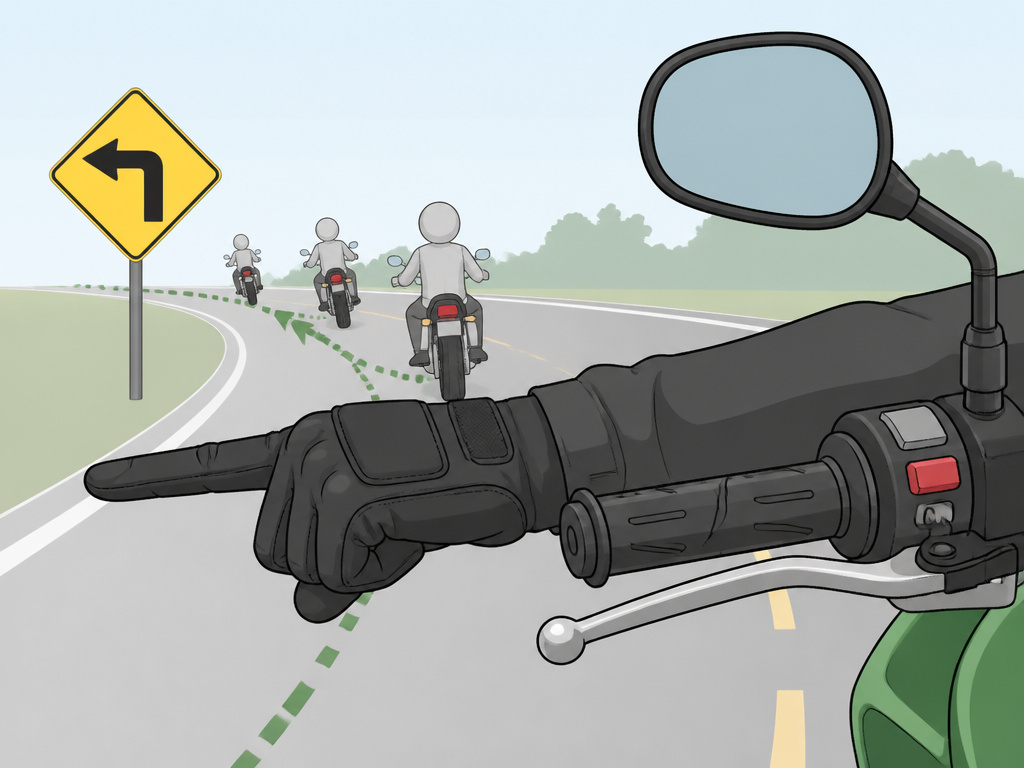
In a group larger than that, the leader can’t effectively monitor everyone, and the formation becomes a long, slow-moving train that frustrates other drivers and is hard to keep together.
For larger gatherings or rides with wildly different skill levels, you have two proven options:
- Split into Sub-Groups: Form multiple small groups of 5–7, each with its own lead and sweep. Space these groups several seconds apart on the road.
- Use the Marker System: This is the method advocated by IAM RoadSmart to avoid “convoy” riding. The leader and a designated tail-end rider are the only fixed positions. At any turn off the main road, the rider behind the leader pulls over in a safe, visible spot to point the direction. They wait until the tail-end rider arrives, then pull out in front of them. This way, every rider can ride their own pace between markers and no one has to stop on the road to regroup.
The marker system is brilliant for mixed-ability rides. The fast riders aren’t held back, and the newer riders aren’t stressed trying to keep a bike in sight at all times. It requires trust and a briefing that covers the route, hand signals, and roles, but it solves the most common point of friction in group rides.
Essential Hand Signals Decoded
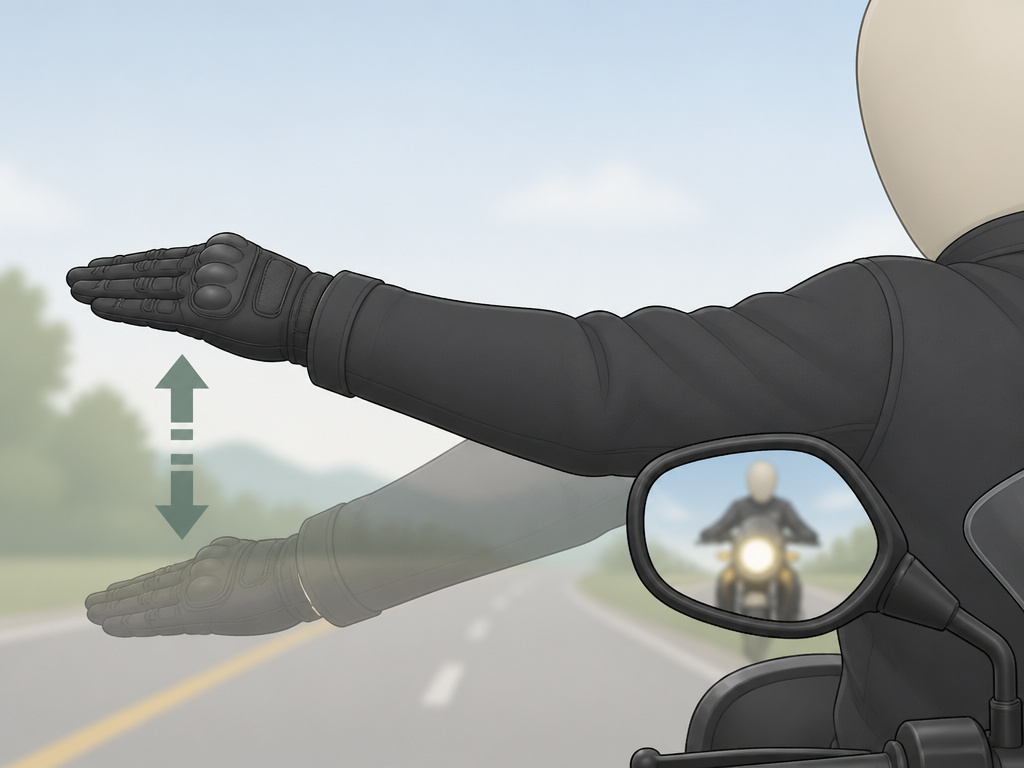
Hand signals are your low-tech, fail-safe communication. Hand signals are a reliable, low-tech form of communication. Use the MSF standards, they’re universal.
- Left Turn: Left arm extended straight out.
- Right Turn: Left arm extended out and bent upward at the elbow (or right arm extended straight out, less common).
- Stop: Left arm extended out and bent downward at the elbow, palm facing rear.
- Slow Down: Left arm extended out, palm down, and moved up and down.
- Single-File: Left arm straight up, one finger extended.
- Staggered / Resume Formation: Left arm straight up, two fingers extended.
- Hazard in Road: Point at the hazard with your left foot (for left-side hazards) or left hand (for right-side hazards).
Common mistake: Over-signaling. Pointing out every piece of gravel or distant pothole creates noise. Signal only essential, immediate hazards like sudden debris, roadkill, or a significant change in road surface. Let the rider behind you deal with the normal stuff.
They are the bedrock of clear signal communication.
Integrating Technology: Intercom Etiquette
Modern communication systems like Cardo or Sena units are game-changers, but they introduce new problems. Used well, they let the lead rider warn of a hidden curve or the sweep rider report a mechanical issue. Used poorly, they become a distracting party line.
A few ground rules:
- The lead and sweep riders should be linked. The lead and sweep riders must be linked.
- Designate a channel for the ride and confirm everyone is on it during the briefing.
- Keep chatter to a minimum. The intercom is for hazards, route changes, and urgent updates, not for commenting on scenery or telling jokes.
- If you need to have a conversation, pull over.
The tech is a tool to support the plan, not replace it. Your group should be able to complete the ride safely even if every intercom battery dies.
Overtaking and Lane Changes as a Group
Passing another vehicle as a group requires discipline. The rule from RoSPA NZ is clear: riders should only pass one at a time. The lead rider goes first, establishes a safe gap in the lane, then the next rider moves over and passes when ready. This continues down the line.
Never swarm a car with multiple bikes passing at once. It’s intimidating, illegal in many places, and removes everyone’s safety cushion. If the passing opportunity disappears for the rider in position, they wait. The group will reform down the road.
The same logic applies to lane changes. The leader signals, changes lanes, and holds position. Each following rider changes lanes individually when safe, re-establishing the staggered formation in the new lane. Don’t “follow the leader” blindly across lanes without checking your own mirrors.
The Post-Ride Debrief (The Most Skipped Step)
The ride isn’t over when you park. A quick two-minute debrief pays dividends for the next one. It’s not about criticism; it’s about calibration.
- Did the route work? Were the stops well-spaced?
- Did the formation hold? Did anyone feel pressured?
- Were communications clear?
It’s also the time to thank your lead and sweep riders. Those jobs add mental load, and acknowledging it matters. This habit is what turns a random group of riders into a practiced, smooth team. It’s the final, often missed, piece of proper group riding formation.
What to do if a rider needs to leave the group mid-ride
When a rider must exit the ride early, the group should not stop on the road to regroup. The departing rider should signal their intention to the sweep rider or nearby riders safely. The remaining riders then re-form the staggered formation by criss-crossing into the next vacant position. Do not recommend moving up within your lane to fill the gap. The lead rider should be aware of the change, and the sweep rider continues to monitor the group. The fixed order within the group segment is now adjusted, and everyone continues the ride with the new formation.
How should a motorcycle group handle intersections and traffic lights
At intersections with stop signs or traffic lights, the group should ride in a single-file formation. This provides each rider space to stop safely and maintain control. Each rider stops individually for the sign or red light, one at a time. Do not block the intersection as a group. When the light turns green or it is your turn to proceed, accelerate smoothly to allow the rider behind you to clear the intersection safely before they proceed. The group will naturally re-form its staggered or single-file pattern once clear of the intersection and any immediate traffic.
Frequently Asked Questions
What does “2 fingers up” mean for bikers?
In the context of group riding, two fingers held up (usually by the lead rider) is the standard MSF signal to “resume staggered formation” after riding single-file. Outside of formal group rides, it’s also a common, general greeting between passing motorcyclists, a simplified version of the classic low-wave.
What is the 12-second rule on a motorcycle?
This refers to a recommended minimum following distance when riding single-file on particularly curvy or technical roads, like mountain switchbacks. The Gold Wing Touring Association guide specifically mentions allowing “a little more room (12 seconds)” in these conditions. It gives you massive buffer to react to slowing traffic or a rider’s mistake ahead on a blind corner.
What does “59” mean to bikers?
“59” is CB (citizens band radio) slang from trucking that some touring riders have adopted. It means “message received” or “all understood.” It’s not a standard hand signal or a universal riding term, so don’t expect everyone in a random group to know it. Stick to standard hand signals for clarity.
Should the group stop on the road to regroup?
Official guidance says no. The IAM RoadSmart manual explicitly states stopping on the road to regroup is a practice to avoid. The MSF advises the lead rider to slow down to let stragglers catch up. Stopping on a shoulder creates a hazard and turns your group into a parked convoy. The marker system or a pre-planned regrouping spot at the next exit or gas station are safer methods.
The Bottom Line
Group riding multiplies the fun but also the risk. The etiquette exists to manage that risk through predictability and clear communication. It’s not about rigid rules for their own sake.
Your one job before the next ride: insist on a briefing. Cover the route, the signals, and the plan for getting split up. Assign a competent sweep rider. That single conversation eliminates most of the problems groups face on the road. Everything else, the perfect stagger, the smooth passes, flows from that foundation.
For larger, more complex events like a charity ride, these fundamentals scale up. They’re the grammar of riding together. Learn them, use them, and the miles become a lot more enjoyable for everyone in the pack.
