
Motorcycle Lane Positioning Guide: Key Takeaways and FAQs
This post contains affiliate links. As an Amazon Associate, we earn from qualifying purchases.
That split distinguishes a philosophy of constant adjustment from one of proactive lane ownership. Your local laws and riding conditions decide which mindset you adopt, but the physical goals, seeing, being seen, having an escape route, don’t change. A motorcycle lane positioning guide will clarify these core principles.
What follows is a breakdown of both systems, the specific scenarios where they agree (like turns and hazards), and the drills that build the judgment to use either one effectively. By the end, you’ll know where to put your bike and why that spot works for the road in front of you.
Key Takeaways
- Official guides disagree: The Ontario MTO handbook mandates a default “blocking position” in a tire track, while the MSF and most U.S. States teach dynamic positioning with no single best spot.
- The MSF manual states the oily strip is usually no more than two feet wide and that, unless the road is wet, the average center strip permits adequate traction to ride on safely.
- Use a two-second following distance minimum; open that to three seconds or more if the pavement is slippery.
- Never lane split, as it is extremely dangerous and places you where drivers don’t expect a vehicle. Lane sharing is only permitted for two motorcycles.
- On a freeway with three or more lanes, avoid the center lane if possible because it offers no blocking position, leaving you vulnerable on both sides.
The Core Disagreement: Blocking Position vs. Dynamic Positioning
You can’t follow two maps at once. For lane positioning, you have two.
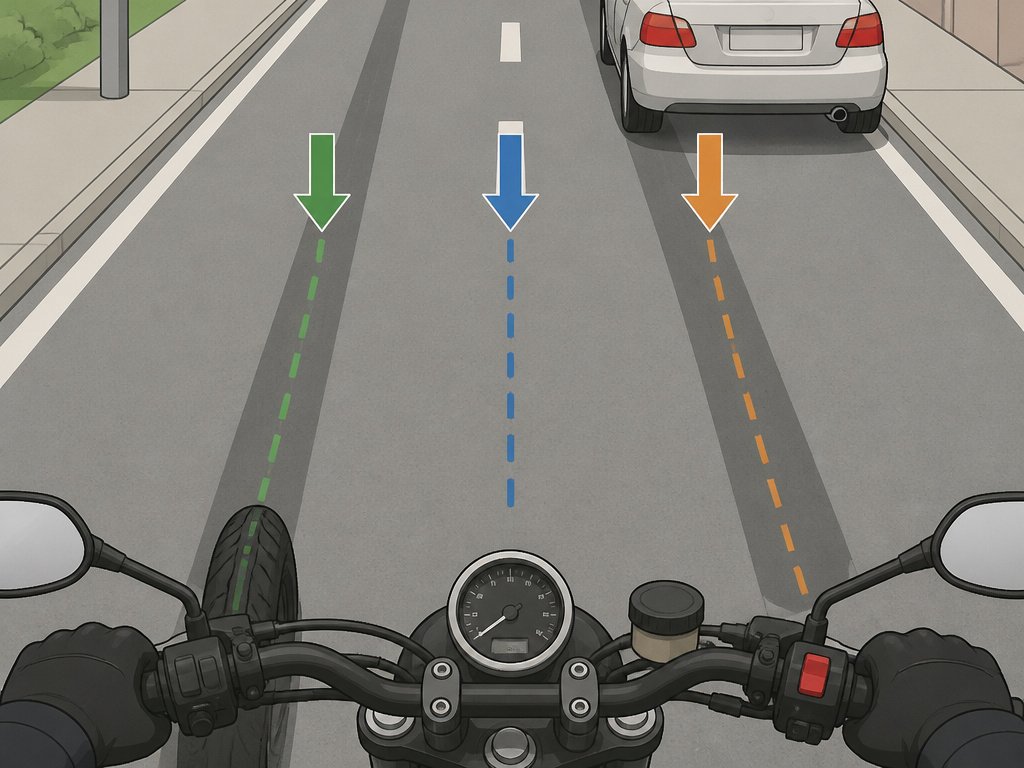
The first map comes from the Ontario MTO motorcycle handbook. It’s prescriptive. The best position is usually in the left or right tire track, the path where a car’s tires roll. This is called the blocking position. It discourages other drivers from trying to squeeze past you in the same lane. If your bike can maintain the speed limit, you should use it. The handbook gives specific assignments: left tire track in the right lane of a two-lane road, right tire track in the passing lane.
The second map is from the Motorcycle Safety Foundation manual and nearly every U.S. State manual that copies it, like the New York State DMV motorcycle manual. This map is fluid. It states plainly: “In general, there is no single best position for riders to be seen and to maintain a space cushion.” Your position is dynamic, changing with every new hazard or traffic shift. The goal is a combination of seeing, being seen, avoiding hazards, and having an escape route.
Where this goes sideways: Picking one system and ignoring the other’s valid points. A rigid blocker might miss chances to improve their view; a constant mover might forfeit a clear, defensible space.
So which is right? Both, for their context. The blocking position is a rule for assertive lane ownership recommended by the Ontario MTO. The dynamic method teaches situational awareness above all. Most riders blend them, using a tire track as a default home base but moving freely as conditions demand, a key insight from any good motorcycle lane positioning guide.
The Oily Strip in the Middle: How Dangerous Is It?
Here’s the other big fracture. The Ontario MTO handbook states that the centre of the lane is not a good driving position because it is coated with oil from other vehicles and gets slippery when wet. Many riding courses repeat this.
The MSF manual counters with a measurement. The oily strip is usually no more than two feet wide. And: “Unless the road is wet, the average center strip permits adequate traction to ride on safely. You can operate to the left or right of the grease strip and still be within the center portion of the traffic lane.”
The data point matters. A two-foot strip means you can ride in the “center” of the lane by staying just to its left or right, avoiding the slickest part while keeping a central, highly visible position, as detailed in a typical motorcycle lane positioning guide. Using a center lane position can help discourage lane sharing by others.
| Agency/Manual | Default Lane Position | Stance on Center Lane | Primary Goal |
|---|---|---|---|
| Ontario MTO | Left or Right Tire Track (“Blocking Position”) | Avoid; oily and slippery when wet. | Proactive lane ownership, deter lane sharing. |
| MSF / Most U.S. States | Dynamic, no single best position. | Safe unless wet; oily strip is ~2 feet wide. | Maximize space cushion and visibility for each specific hazard. |
Lane Positioning by Scenario: What the Manuals Actually Say
Forget theory. Where should your tires go right now? The official handbooks get specific.
On Multi-Lane Roads & Highways
The rules tighten with more asphalt. On a two-lane road (one lane per direction), the Ontario MTO says to ride in the left tire track of your right-hand lane. This gives you space from the shoulder and is the recommended blocking position for the right lane of a two-lane road.
On a freeway with three or more lanes, the same manual offers a clear tactical note: do not drive in the centre lane, if possible, because you do not have a blocking position. In the middle lane, you do not have a blocking position, leaving you more vulnerable. The left or right lane gives you a barrier on one side.
For general highway riding, the dynamic positioning method shines. You might start in the left tire track, move right to increase your distance from merging traffic, then center yourself to maximize the view past a truck.
Approaching Intersections & Making Turns
This is where positioning becomes active. The Ontario handbook details it step-by-step. When approaching an intersection where the curb lane stays the same size, hold your blocking position (left tire track). For a right turn where the lane widens, you must move from the left tire track to the right tire track before the turn. This prevents a car from coming up on your inside in the wider section.
Some riders angle their bike at about 45 degrees across the lane at stops. This creates a larger blocking position and makes the rider more visible. After the turn, you move back to your default blocking position.
These maneuvers are advanced intersection safety. The core idea is universal: position yourself to see, be seen, and protect your space from incursions.
Dealing with Parked Cars, Curves, and Road Hazards
Here, the manuals agree. When passing parked cars, stay toward the left portion of your lane. This gives you a buffer against opening doors or pedestrians stepping out.
For hazards like railroad tracks or pavement seams that run parallel to you, the PennDOT Motorcycle Operator Manual gives a specific angle. Move away, then cross at an angle of at least 45°. Edging across slowly could catch your tire and throw you off balance.
The Non-Negotiables: Space, Speed, and Lane Sharing
Some rules have no disagreement. They are the foundation of defensive riding.
Following Distance: The New York State DMV manual is explicit. A two-second following distance is the minimum. It leaves space to stop or swerve. If the pavement is slippery, or you can’t see ahead, open that to a three-second or more distance. This following distance is a key safety recommendation.
Slow Vehicle Rule: What if you can’t keep up? The Ontario MTO has a direct exception. If your vehicle cannot maintain the posted speed limit, you may drive as close as safely possible to the right-hand curb. But there’s an exception to the exception: if the curb area is dangerous (grates, debris), you may use a blocking position so no one can pass unsafely.
Lane Sharing vs. Lane Splitting: The terms are often confused. Lane sharing is when two motorcycles ride side-by-side in one lane. The New York manual says this is permitted only for two motorcycles. Cars and motorcycles cannot share a lane safely.
Lane splitting is riding between rows of stopped or moving cars. The Ontario handbook states: “This is extremely dangerous. Do not do it.” Most official safety manuals, like Ontario’s, state it is extremely dangerous and advise against it. It places you where drivers don’t expect a vehicle and leaves you with no escape route. Understanding your local lane splitting laws is crucial, but the safety advice is universal: it’s a high-risk maneuver.
How to Practice and Build Judgment
You can’t learn this from a page. You learn it by doing, with a plan.
Start in a low-risk environment, a quiet, wide residential street or empty parking lot. Practice feeling the three positions: left tire track, center portion, right tire track. Don’t just ride in them; stop in them. Look at where you are relative to lane lines. Feel how the view changes.
Then, add a simple drill. On a familiar stretch of road, pick a default position. Every time you see a potential hazard (a parked car, an intersection, an oncoming vehicle), consciously decide: should I move? Where? Why? Say it out loud. “Moving left for better view past the truck.” “Holding center to block this merging gap.” This verbalization builds the mental muscle for space management.
Finally, practice the escape route. In each position, identify where you’d go if the car ahead slammed its brakes or a door opened. Is there an open lane to the side? A shoulder? This constant scan is the heart of defensive riding.
Group riding formation (staggered)
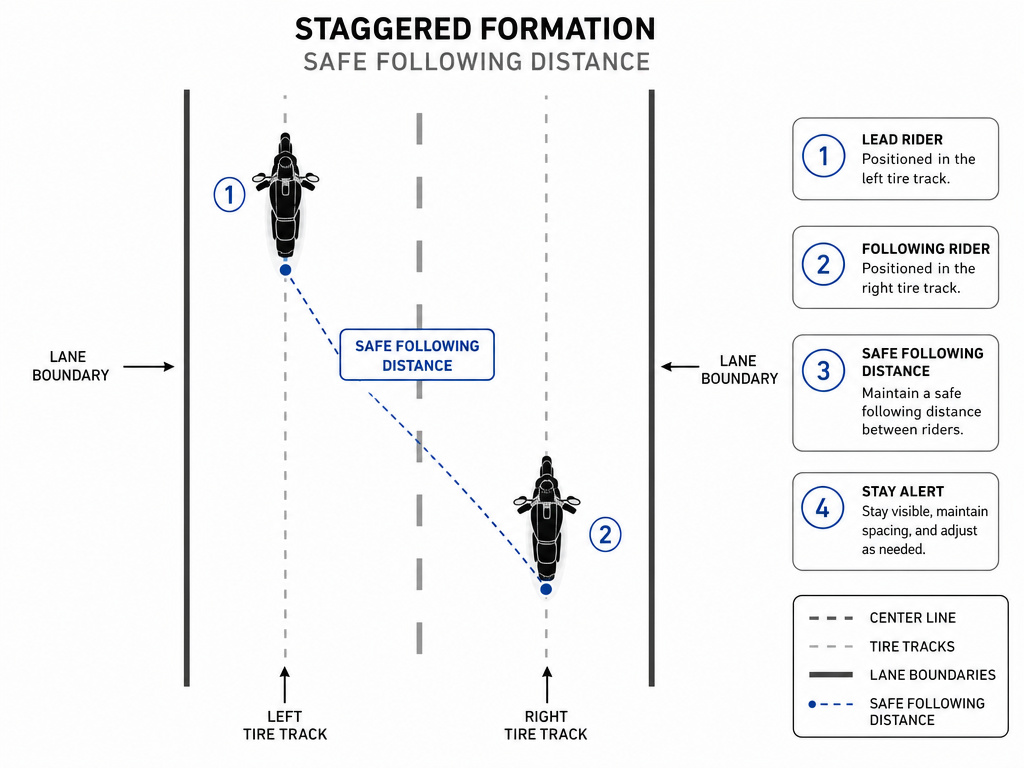
Cars and motorcycles cannot share a lane safely. However, two motorcycles may share a single lane.
Frequently Asked Questions
What is the best lane position for a motorcycle rider?
There is no universal “best” position. According to the MSF and most U.S. State manuals, the best position is the one that maximizes your ability to see, be seen, and have an escape route at that specific moment. It changes with traffic. The Ontario MTO handbook recommends a default “blocking position” in a tire track to deter lane sharing.
Should I always avoid the center of the lane?
Not always. The common warning is about an oily, slippery strip. The MSF manual states this strip is about two feet wide and provides adequate traction unless the road is wet. You can ride in the center portion of the lane by staying just to the left or right of this strip. The New York State DMV notes that riding in the center portion of the lane should put your image in the middle of a car’s rearview mirror.
What is lane splitting, and is it safe?
Lane splitting is riding a motorcycle between lanes of stopped or slow-moving traffic. Most official safety manuals, like Ontario’s, state it is “extremely dangerous” and advise against it. It is extremely dangerous and places you where drivers don’t expect a vehicle. It is different from lane sharing, which is two motorcycles riding side-by-side in one lane.
How does lane positioning help with visibility?
Strategic lane positioning gets you into a driver’s field of view. Riding in the left portion of the lane often places you in a car’s side mirror. The New York State DMV notes that riding in the center portion of the lane should put your image in the middle of a car’s rearview mirror, where a driver is most likely to see you. Moving within your lane also helps you avoid other vehicles’ blind spots.
Before You Go
The real skill is reading the road five seconds ahead and placing your bike in the spot that gives you the most options. Whether you default to a blocking position or flow dynamically, the principle is the same: you are managing space and sightlines.
