
Motorcycle Lane Splitting Laws by State: Legal Map
This post contains affiliate links. As an Amazon Associate, we earn from qualifying purchases.
Lane splitting is legal in California and lane filtering is legal under strict conditions in Arizona, Utah, Montana, Colorado, and Minnesota. Every other state prohibits riding a motorcycle between lanes of traffic. The critical difference is speed: splitting happens in moving traffic, while filtering is only allowed in stopped or very slow traffic, usually with a hard speed cap of 15 or 20 mph. These laws apply only to two-wheeled motorcycles, and violating them can result in traffic citations, points on your license, or even misdemeanor charges depending on the state.
That legal patchwork is why a rider can legally filter to the front of a line in Phoenix but get a ticket for the same move just over the border in Nevada. The rules are built on completely different philosophies of risk and traffic flow, backed by specific studies and safety reports that each state legislature weighed. This variation is directly reflected in motorcycle lane splitting laws by state.
What follows is the map, the exact numbers from each state’s statute, the safety research that changed some laws, and the practical realities of riding, and driving, where these maneuvers are legal.
Key Takeaways
- California is the only state where full lane splitting is explicitly legal by statute (CVC 21658.1), though the CHP advises not to exceed 10 mph over traffic speed or split above 30 mph.
- Filtering states have strict, numeric limits. Arizona allows filtering when traffic is stopped or moving 15 mph or less; Utah has a maximum speed of 15 mph; Montana’s maximum speed is disputed (10 mph vs. 20 mph). Colorado’s law is the strictest, permitting filtering only when both the motorcycle and the passed vehicles are completely stopped.
- The UC Berkeley SafeTREC study of 5,969 crashes found lane splitting safest in traffic ≤ 50 mph with a speed differential ≤ 15 mph, a finding that directly contradicts more conservative CHP guidance.
- If you cause an accident while splitting or filtering illegally, you will likely be found at fault. Even where legal, the burden is on the rider to prove the maneuver was done safely and within the law’s conditions.
- Drivers in filtering states should expect motorcycles to advance between lanes in stopped traffic and avoid sudden lane changes. A quick check of the side mirror before moving over is the best defense against a conflict.
The State-by-State Legal Map
Forget simple “legal” or “illegal.” The real answer to the motorcycle lane splitting laws by state question lives in the specifics, the mph limits, the traffic conditions, and the sunset dates some laws carry. This isn’t theoretical. A Colorado rider filtering past stopped cars at 10 mph is legal. That same rider filtering at 12 mph, or doing it as cars begin to crawl forward, is breaking the law.
Lane splitting is explicitly authorized by California Vehicle Code 21658.1, effective January 1, 2017. The statute defines the practice and authorizes the CHP to develop educational guidelines, but it sets no specific speed limits or differentials in the law itself.
Here is how every state breaks down. The “Conditional” category means filtering is allowed only under the strict, low-speed conditions listed.
| State | Legal Status | Key Condition / Speed Limit | Notes |
|---|---|---|---|
| California | Legal (Splitting) | No statutory limit; CHP advises ≤30 mph traffic, ≤10 mph differential | The only full lane-splitting state. Applies to two-wheeled motorcycles only. |
| Arizona | Conditional (Filtering) | Allowed when traffic is stopped or moving 15 mph or less; roads ≤45 mph | Based on SB1273 (2022). Filtering only, not splitting with moving traffic. |
| Utah | Conditional (Filtering) | ≤15 mph; traffic condition sources disagree (stopped or moving ≤10 mph vs. Only between stopped vehicles); roads ≤45 mph; no freeways | Law sunsets July 1, 2027, unless reauthorized. |
| Montana | Conditional (Filtering) | Sources disagree on max speed (10 mph vs. 20 mph); traffic stopped or moving ≤10 mph | One of the more permissive filtering laws, but still low-speed only. |
| Colorado | Conditional (Filtering) | Sources disagree on conditions (only when vehicles are stopped vs. A 15 mph maximum speed); the statute states filtering is permitted only when both the motorcycle and the vehicles being passed are stopped. | Temporary law (SB24-079) repeals Sept. 1, 2027. DOT safety report due Jan. 1, 2027. |
| Minnesota | Conditional (Sharing) | ≤25 mph; ≤15 mph over adjacent traffic speed | A unique “lane sharing” law, not classic filtering. Complex conditions apply. |
| All Other States | Illegal | Prohibited by statute or not authorized | Includes major riding states like Florida, Texas, New York, and Pennsylvania. |
Where this goes sideways: Assuming “filtering” means the same thing in every state. In Colorado, the official legislative session law states filtering is permitted only when the overtaken vehicle is stopped. The moment that car creeps forward, your legal window closes. In Montana, you can filter next to traffic moving up to 10 mph. That’s a fundamental difference in risk and technique.
Splitting vs. Filtering: The Critical Difference
Most riders use the terms interchangeably. Legislators and traffic engineers do not. The distinction decides whether a maneuver is a legal traffic strategy or a citeable offense.
Lane splitting is riding between lanes of traffic moving in the same direction. It’s what you see on California freeways when traffic is flowing at 30 mph and a motorcycle threads through at 40. The key element is that all vehicles are in motion.
Lane filtering is moving between lanes of stopped or nearly stopped traffic to advance to the front, typically at a red light or in a traffic jam. The motorcycle is moving, but the surrounding traffic is at or near a standstill. Every state that has legalized anything besides California’s full splitting has legalized filtering, not splitting.
Why does the distinction matter? Physics and perception. The speed differential between a moving motorcycle and moving cars creates a complex reaction window for everyone. In stopped traffic, the variables shrink dramatically. This is why the safety data looks so different for each activity, and why states are willing to legalize one but not the other. Good lane positioning is always crucial, but its role changes when you’re moving between lanes versus holding a position within one.
The Safety Data Behind the Laws
The debate over motorcycle lane splitting laws by state is backed by crash studies, some of which are directly cited in the legislation that changed the laws. The numbers tell a story that often contradicts the gut feeling of drivers who see a motorcycle slip past their window.
The most cited study is the UC Berkeley SafeTREC study from 2015, which analyzed 5,969 motorcycle crashes in California. Its headline finding: riders who were lane splitting were significantly less likely to suffer certain injuries than riders who were not splitting. The study concluded safety was associated with splitting in traffic moving at 50 mph or less and not exceeding other vehicles’ speed by more than 15 mph.
Three studies between 2011 and 2015 found lane-splitting motorcyclists in California were 43 percent less likely to be involved in a rear-end crash. This statistic was a key finding cited in Colorado’s SB24-079 to support its own filtering trial.
Other data points lawmakers used:
- A 2009 European study found motorcyclists were seven times more likely to be hit while stopped than to crash while lane splitting.
- A year after the CHP issued lane-splitting safety tips, California saw a 30 percent reduction in motorcyclist fatalities.
- An Australian trial concluded filtering was a “relatively low risk riding activity” and led to a law change there.
This data creates a tension. The Berkeley study concluded safety was associated with a speed differential ≤ 15 mph in traffic ≤ 50 mph. The CHP’s educational guidelines, however, recommend a more conservative 10 mph differential and advise against splitting when traffic is moving faster than 30 mph. Which guidance should a rider follow? The one that’s easier to defend in court is the CHP’s. Their guidelines, while not law, establish a standard of “reasonable and prudent” behavior.
How to Split or Filter Legally (and Safely)
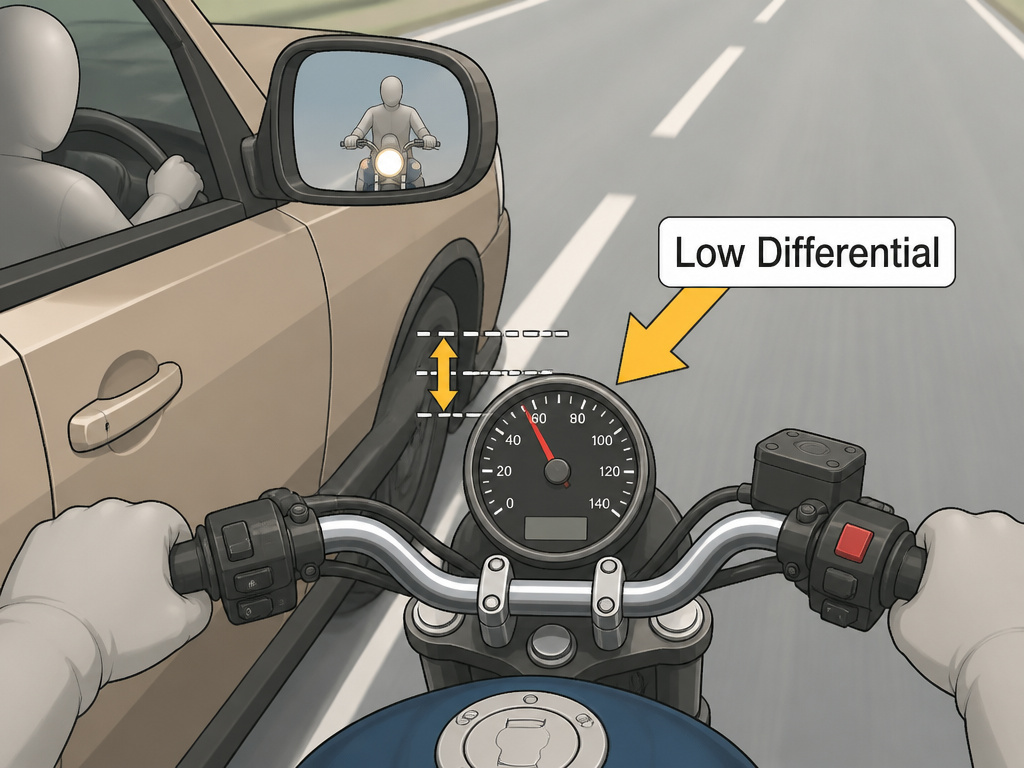
If you’re riding in a state where it’s permitted, the law provides the floor. Your judgment builds the walls. Legal doesn’t mean safe in every situation. This is where the rubber meets the road, literally.
Before you start: You are invisible. Assume no driver sees you. The space between lanes is not a designated traffic lane; it’s a shared margin of error that can vanish if a driver decides to change lanes. Your headlight should be on, and using high beams during the day, as the CHP suggests, isn’t a bad idea.
- Match the environment. Don’t split if lanes are narrow, if large trucks are present, or in poor weather. The CHP explicitly advises against splitting next to semis or buses.
- Watch the differential. Keep your speed close to the flow of traffic. A huge speed gap is the single biggest predictor of a bad outcome.
- Have an escape route. Always know where you’ll go if a car drifts into your space. This is a core defensive riding technique that is essential.
- Stop filtering when traffic moves. In Colorado, this is the law. In other states, it’s just smart. The transition from stopped to crawling is when drivers are most likely to make an unexpected lane change without signaling.
- Never filter on the right shoulder. This is illegal everywhere, including California. Shoulders are for emergencies, not passing.
The sensory reality is a hum or a whine that stays steady, not a rising scream. Your engine note shouldn’t be climbing dramatically relative to the cars around you. If it is, your speed differential is too high.
Where It’s Flat-Out Illegal (and the Consequences)
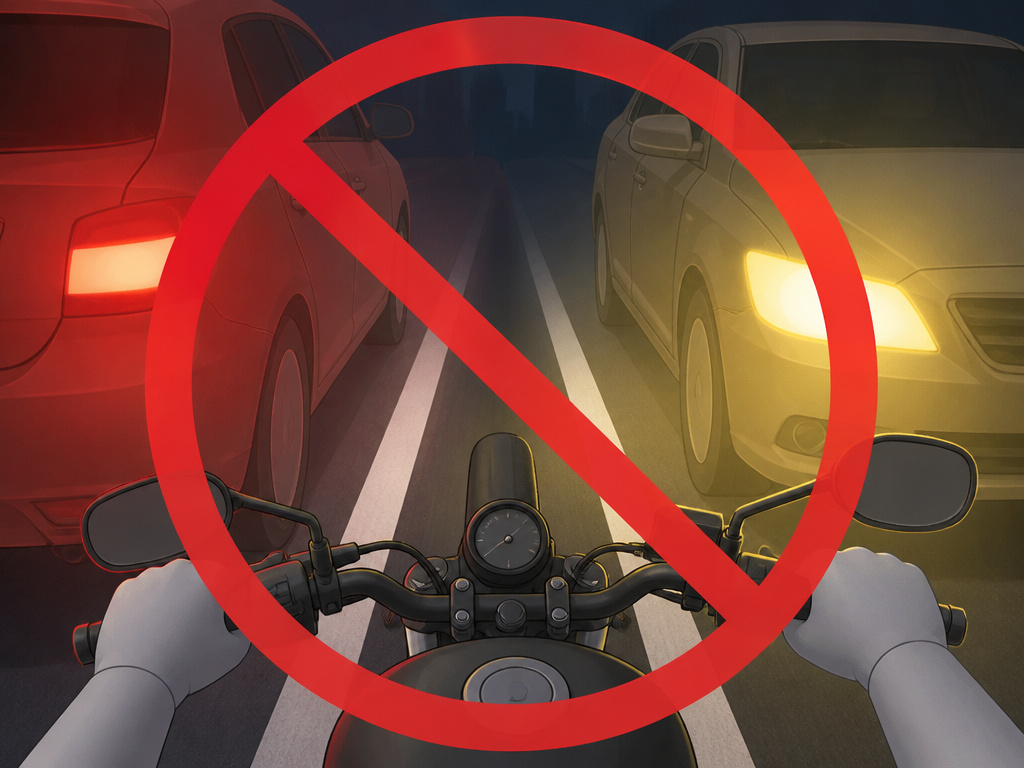
For the vast majority of the U.S., the answer is simple: don’t do it. States like Florida (Fla. Stat. 316.209), Texas, and New York explicitly prohibit operating a motorcycle between lanes of traffic or adjacent rows of vehicles.
The penalties aren’t trivial. They can range from a simple traffic infraction with a fine to a misdemeanor charge, depending on the state and the officer’s discretion. In some jurisdictions, a lane splitting violation can be tagged as reckless driving, which carries heavy fines, license points, and even jail time. It can also severely complicate fault determination in an accident and jeopardize your insurance coverage.
Common mistake: Thinking that because filtering is legal in a neighboring state, the enforcement is lenient everywhere. In a strictly illegal state, there is no officer discretion for a “safe” filter. It’s a violation, full stop.
The practical risk includes the ticket and the presumption of fault. If you get hit while splitting illegally, you’ve automatically boxed yourself in. The other driver’s attorney will argue, successfully, that the accident wouldn’t have happened if you had been in a proper lane. Your own insurance company may balk at covering you. It turns a potential no-fault incident into a guaranteed loss.
What Drivers Need to Know
If you’re in a car, this isn’t just a rider problem. Your awareness, or lack of it, directly affects safety in states where splitting or filtering is legal. The goal isn’t to police riders but to avoid colliding with them.
First, check your mirrors, especially before changing lanes in slow or stopped traffic. A motorcycle can occupy a space that was empty two seconds ago. A quick glance at the side mirror is the most effective thing you can do.
Second, don’t block riders on purpose. In filtering states, they are using a legal strategy to manage their safety and reduce congestion. Deliberately swerving or closing the gap is aggressive driving and could make you liable if a collision occurs.
Finally, understand the why. Riders aren’t just trying to get ahead. Filtering to the front at a light removes them from the most dangerous position on the road: the middle of a pack of cars, where they can be rear-ended. It’s a risk-management tactic. A little patience and awareness from drivers make the system work for everyone. For riders, mastering how to ride a motorcycle in traffic means anticipating these driver blind spots and behaviors.
Frequently Asked Questions
In what states can you do lane splitting on a motorcycle?
Only California explicitly legalizes full lane splitting between moving traffic. Five other states. Arizona, Utah, Montana, Colorado, and Minnesota, allow some form of lane filtering or sharing under strict low-speed or stopped-traffic conditions.
Which states will legally allow lane splitting in 2026?
As of 2026, no new states have passed laws to allow full lane splitting. The legal landscape for filtering may change, however, as Colorado’s temporary filtering law is set to be reviewed (and possibly made permanent or repealed) by September 2027, based on a safety report.
Who’s at fault if a motorcycle is lane splitting?
Fault depends on location and circumstance. If the rider is splitting or filtering illegally, they will almost certainly be found at least partially, if not wholly, at fault for any collision. Where it is legal, fault is determined by who acted negligently. If a driver changes lanes without looking and hits a legally splitting rider, the driver is likely at fault. The rider must prove they were operating within the legal speed and conditions.
Does lane splitting reduce motorcycle accidents?
Studies show it can reduce certain types of accidents. Research from California indicates lane-splitting riders are 43% less likely to be involved in a rear-end collision. Data also shows they suffer less severe injuries when crashes do occur. However, it may increase the risk of other collision types if done unsafely.
Can three-wheeled motorcycles or autocycles split lanes?
No. The lane splitting statute in California and the filtering laws in states like Colorado apply specifically to two-wheeled motorcycles. Three-wheeled vehicles, trikes, and autocycles are excluded and must follow the same lane-discipline rules as cars.
The Bottom Line
The map is clear, but the responsibility is yours. In California, keep the differential under 10 mph and treat every lane change as a potential threat. In a filtering state, know the exact speed and traffic conditions. Colorado’s “stopped only” rule means what it says. Everywhere else, stay in your lane.
The data makes a compelling case for filtering’s safety benefits, which is why the legal frontier is slowly expanding. But law and safe practice are different things. Your best tool isn’t the statute book; it’s the judgment to know when a legal maneuver is still a bad idea. The space between lanes is a privilege, not a right. Treat it that way, and you’ll stay on the right side of both the law and the motorcycle accident statistics.
