
How to Ride a Motorcycle in Traffic: Step-by-Step
This post contains affiliate links. As an Amazon Associate, we earn from qualifying purchases.
Riding a motorcycle in traffic safely requires managing three things: space, visibility, and a planned escape route. Official state manuals, like Georgia’s, mandate a minimum four-second following distance, increasing to five seconds or more at speeds over 40 mph or on slippery roads. Your lane position, centered in the travel lane when conditions permit, discourages cars from squeezing by, while a constant 12-second visual search ahead gives you time to identify and separate hazards.
That four-second gap is your primary tool, but it’s not a fixed number. It’s a buffer that shrinks or expands based on road conditions and traffic density. The space in front of you is the only real estate you control completely; everything else is a negotiation with drivers who likely do not see you. This principle is a core part of how to ride a motorcycle in traffic.
What follows is a street-level breakdown of the techniques that matter in how to ride a motorcycle in traffic: how to measure your following distance, where to place your bike in a lane, and how to build the habit of always knowing your way out. This isn’t about advanced cornering. It’s about the daily, methodical habits that keep you from becoming a statistic.
Key Takeaways
- Maintain a minimum four-second following distance behind vehicles, expanding to five seconds or more at speeds over 40 mph, on slippery pavement, or in heavy traffic where lane-squeezing is likely.
- Search your path of travel 12 seconds ahead, about a city block at urban speeds, to identify hazards early and separate them before they become immediate threats.
- Ride in the center of your travel lane when weather and road conditions permit; this dominant position discourages motorists from attempting to squeeze past you in the same lane.
- Always plan an escape route before you need it, keeping space to your sides and behind you, especially when stopped at a light where a following vehicle might not stop in time.
- More than half of all crashes involve riders with less than five months of experience on their motorcycle, underscoring the need for deliberate practice of these traffic strategies.
The SEE Strategy: Your Mental Checklist for Every Ride
The Motorcycle Safety Foundation builds its entire curriculum around a simple, three-part mental loop: Search, Evaluate, Execute (SEE). This isn’t theoretical. It’s the rhythm you need to establish before you even roll into an intersection.
Search your path of travel 12 seconds ahead. Evaluate what you see to identify potential hazards and escape routes. Execute your decision by adjusting speed, position, or communicating your intent.
Search means looking far enough ahead to give yourself time. At 30 mph in the city, 12 seconds is a significant distance ahead. Your eyes should be constantly moving, far ahead, to your mirrors, to your immediate path. The goal is to spot the parked car with its door slightly ajar, the pedestrian looking at their phone on the curb, or the driver at the cross street who seems indecisive.
Evaluate is where you decide what that information means. Is that puddle just water, or could it be hiding a pothole? Is the driver in the next lane drifting toward your lane? You’re not just looking; you’re assigning risk and prioritizing threats.
Execute is the action. It might be a smooth roll-off of the throttle to increase your following distance, a deliberate shift in your lane position to be more visible in a driver’s side mirror, or covering the brake lever as you approach a high-risk intersection. This cycle never stops. It’s the core of defensive riding.
The 4-Second Rule That Adapts to Speed and Road Conditions
Following distance is your most critical cushion. The Georgia Department of Driver Services is explicit: motorcycles need a minimum four-second following distance behind the vehicle ahead. This isn’t a suggestion. It’s the baseline space required to stop, swerve, or adjust if the car in front of you does something sudden.
You measure it by picking a fixed point the car ahead will pass, a shadow on the road, a crack in the pavement. When their rear bumper crosses it, start counting: “one-thousand-one, one-thousand-two…” If you pass the same point before you reach “one-thousand-four,” you’re too close.
Where this goes sideways: Riding in a driver’s blind spot or matching their speed next to their front pillar. A driver will change lanes without signaling or seeing you, forcing a panic reaction. Adjust your speed immediately to create a gap ahead or behind that car.
That four seconds is the minimum for ideal conditions. The same Georgia DDS manual states you must open up a five-second or more following distance under four specific conditions:
- Riding at 40 mph or more.
- On slippery pavement (rain, gravel, leaves).
- When you cannot see through the vehicle ahead (a large truck or van).
- In heavy traffic where someone may squeeze in front of you.
This conflict between official sources means you must know your local guidelines, but erring on the side of the more conservative four-second rule from the Motorcycle Safety Foundation operator manual is the safer bet. Your safe following distance on a motorcycle is your responsibility, not the driver’s behind you.
Lane Positioning: Claim Your Space and See Ahead
Where you ride in your lane is a communication tool. The Georgia DDS manual advises positioning the motorcycle in the center of the travel lane if weather and roadway conditions permit. This serves one main purpose: to discourage motorists from attempting to squeeze by you in the same lane. It establishes you as a full vehicle entitled to the full lane.
| Lane Position | Primary Use Case | Risk If Misused |
|---|---|---|
| Center (Position 2) | Default for straightaways; claims full lane width. | Can put you in path of oil/fluid drips from cars; reduces escape routes to sides. |
| Left (Position 1) | Increases visibility to oncoming left-turners; prepares for a right-hand turn. | Puts you closer to oncoming traffic; in blind spot of car ahead in left lane. |
| Right (Position 3) | Increases visibility to drivers entering from side streets; prepares for a left-hand turn. | Puts you near curb hazards (drain grates, debris); in blind spot of car ahead in right lane. |
You are not stuck in one position. Move within your lane to maximize your visibility and create space. If a car in the next lane is drifting, move away. When approaching an intersection where a car might turn left across your path, shift to the left portion of your lane (Position 1) to make yourself more visible in their direct line of sight.
The rule is absolute: do not share lanes with other vehicles. Lane sharing, riding between rows of stopped or moving cars, is illegal in most states and eliminates your space cushion. It leaves you vulnerable to a suddenly opened door or a car changing lanes without looking.
Escape Routes: Plan Your Exit Before the Door Slams Shut
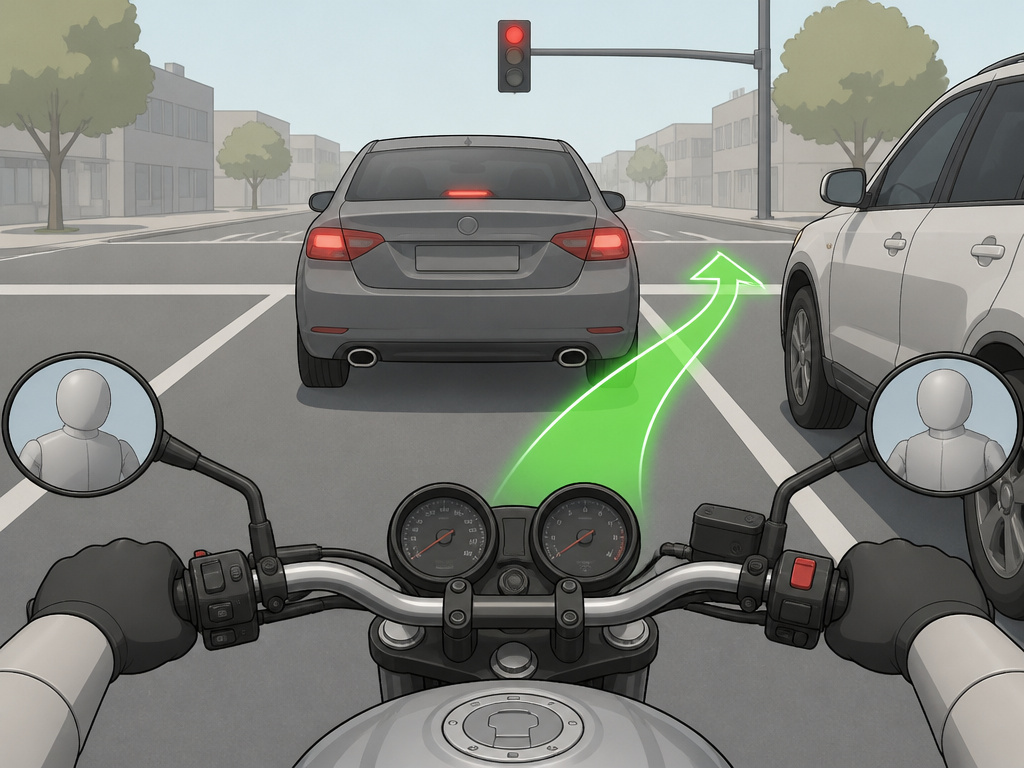
An escape route is the alternate path you take if your current one collapses. The Georgia DDS stresses you must always plan an escape route. This isn’t about dramatic swerves. It’s about never letting yourself get boxed in.
When stopped at a light, keep well behind the vehicle ahead. Leave enough space to pull around them if they stall or roll back, or to get out of the way if you see a vehicle approaching from behind that isn’t slowing down. This space is your most valuable piece of pavement.
As you ride, scan for potential exits:
- The gap between two cars in the next lane.
- The width of a shoulder.
- An opening in traffic ahead. Your escape route shifts every second. The key is to always have one in mind. This habit directly supports the “Execute” phase of the SEE strategy and is the foundation of advanced defensive riding skills like a controlled swerve.
Communication and Visibility: You Have to Be Seen to Be Avoided
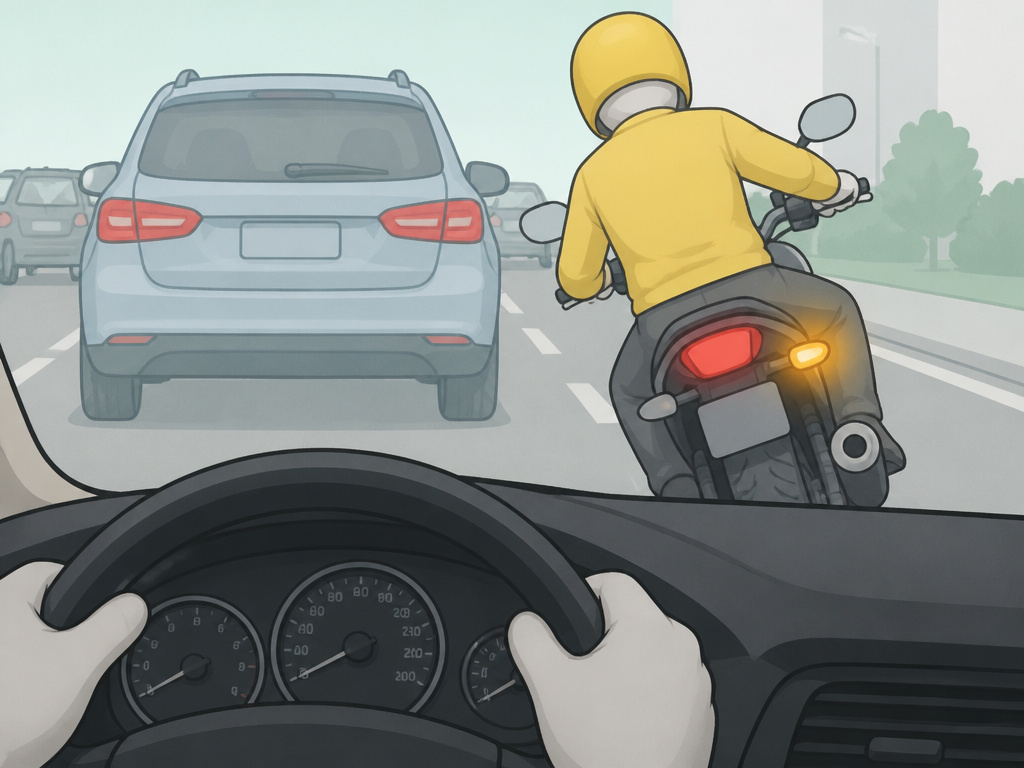
Assume you are invisible. Then work like hell to prove yourself wrong. The MSF manual breaks this down into two actions: be visible and communicate your intentions.
Be Visible:
- Wear proper clothing: Bright colors or reflective material, especially on your helmet and torso.
- Use your headlight: On at all times, day and night. It’s the law in many states for bikes made after 1975.
- Ride in the best lane position to be seen: Often this is the left portion of the lane (Position 1) when dealing with oncoming left-turners, or the right portion (Position 3) for drivers at side streets.
Communicate Your Intentions:
- Use signals early: Activate your turn signal well before a lane change or turn. Cancel it after the maneuver.
- Use brake light deliberately: Tap your brake lightly to flash the light before you actually need to slow down, alerting followers.
- Use lane position: A gradual move toward the side of your lane you intend to turn toward is a clear visual cue before your signal even goes on.
Your goal is to remove the guesswork for drivers. Make your next move as obvious as possible, as early as possible. This is not passive hope. It’s active defensive riding.
The Pre-Ride Inspection You Cannot Skip
A technical failure in a car is an inconvenience. On a motorcycle in traffic, it’s a crisis. The District of Columbia DMV manual is blunt: make a complete check of your motorcycle before every ride. The MSF structures this as T-CLOCS.
Do this check in the same order every time so it becomes habit. It takes two minutes.
T. Tires & Wheels
- Check air pressure (use a gauge).
- Inspect tread for wear and cuts.
- Check for loose spokes or bent rims.
C. Controls
- Check throttle snaps shut freely.
- Verify clutch and brake levers operate smoothly.
- Ensure cables are not frayed.
L. Lights & Electrics
- Test headlight (high and low beam).
- Test both turn signals.
- Test brake light (front lever and rear pedal).
- Test horn.
O. Oil & Fluids
- Check engine oil level.
- Check coolant level if liquid-cooled.
- Look under the motorcycle for signs of an oil or gas leak.
C. Chassis
- Check the chain or belt tension and lubricate (adjust per the manufacturer’s specs).
- Check suspension for smooth movement.
S. Stands
- Ensure the side stand springs up tightly and won’t drop on its own.
This checklist is essential for riding a motorcycle in traffic. Finding a low tire in your driveway is a five-minute fix. Finding it via a sudden wobble in a highway merge lane is a life-altering event.
Managing Specific Traffic Hazards: Grooves, Tracks, and Fatigue
Traffic isn’t just cars. The road surface itself can be a hazard, and your mental state dictates your reaction time.
Railroad Tracks & Pavement Seams: The Pennsylvania manual provides the definitive guide. For tracks that cross your path, ride straight across. Turning to hit them at a perfect 90-degree angle can put you into another lane. For tracks or seams that run parallel to you, move away and cross them at at least a 45-degree angle; edging across can trap your tire.
Rain Grooves & Bridge Gratings: They cause a vague, weaving sensation. Relax, maintain a steady speed, and ride straight across. Fighting the wobble or crossing at an angle is more dangerous than the initial feeling.
Mental Fatigue: Stop-and-go traffic is mentally exhausting, which dulls your SEE cycle. If you feel your focus waning, get off the road. Even a five-minute stop to hydrate and stretch resets your brain. For longer hauls, understanding how to stay alert on a motorcycle is a critical skill separate from handling the bike.
A Structured Progression for Your First Rides in Traffic
The statistics are grim and agreed upon: the MSF, DC DMV, and Mississippi Department of Public Safety all report that more than half of all crashes involve riders with less than five months of experience (the DC manual says six months). This isn’t bad luck. It’s a lack of graduated exposure.
Don’t go from the parking lot to rush hour. Follow a deliberate build-up:
- Quiet Residential Streets: Practice starts, stops, turns, and the SEE cycle with minimal traffic. Focus on smooth braking and low-speed control.
- Arterial Roads in Off-Peak Hours: Ride on multi-lane roads when traffic is light. Practice lane changes, maintaining your following distance, and scanning at higher speeds (40-50 mph).
- Heavy Traffic in Daylight: Once comfortable, tackle busier roads during the day. Experience the density, practice filtering to the front at lights (where legal), and manage your space cushion aggressively.
- Night Riding: Finally, ride the same routes at night. Visibility changes completely. Your headlight is your primary tool, and you must rely even more on your 12-second search.
Each stage should feel boring before you move on. Mastery feels routine, not exhilarating. This progression is outlined in the practical exercises found in the Pennsylvania motorcycle operator manual.
Is Lane Splitting Legal and Safe?
Lane splitting, or riding between rows of moving or stopped vehicles, is not a recommended practice. Official guidance clearly states you should not share lanes with other vehicles and should not ride between rows of cars. Instead, position your motorcycle in the center of the travel lane to discourage motorists from attempting to squeeze by you. In heavy traffic where lane-squeezing is likely, increase your following distance to five seconds or more. When stopped at a light, keep well behind the vehicle ahead to maintain an escape route. Your primary strategy in traffic is to maintain an adequate space cushion and always plan an escape route.
Frequently Asked Questions
What is the 12-second rule on a motorcycle?
The 12-second rule is the “Search” component of the SEE strategy. It means you should continuously scan the road 12 seconds ahead of your current position. This distance gives you enough time to identify a potential hazard, evaluate your options, and execute a safe response, like changing speed or position. At 30 mph, 12 seconds is roughly a city block.
Where do 70% of motorcycle accidents occur?
The consistent theme is that inexperience in traffic, poor space management, lack of hazard identification, and slow reaction times, is the dominant factor, not a specific location like intersections, though those are high-risk.
How should a beginner ride a motorcycle in traffic?
Beginner should follow a strict progression: start on quiet streets to build control, then graduate to busier roads during off-peak hours. The core focus must be on maintaining a minimum four-second following distance, practicing the SEE mental cycle (Search, Evaluate, Execute), and always planning an escape route. Formal training through a Motorcycle Safety Foundation Basic RiderCourse is the fastest, safest path to developing these habits.
What is the 4-second rule for motorcycles?
The four-second rule is the minimum recommended following distance for a motorcycle behind another vehicle. Pick a stationary point the vehicle ahead passes. When their rear bumper crosses it, start counting “one-thousand-one, one-thousand-two…” You should not reach the same point before you count to “one-thousand-four.” This cushion provides time and space to stop or swerve. Increase this distance to five seconds or more in poor conditions.
Before You Go
The official guidance from the Georgia DDS traffic strategies section is clear: your safety hinges on space and an escape plan. The single most effective thing you can do after reading this is your next pre-ride T-CLOCS inspection, followed by a short ride where you do nothing but practice measuring your four-second following distance. Make that count automatic.
Everything else, lane position, communication, scanning, builds on that foundation of managed space. Traffic isn’t something you fight through. It’s a environment you navigate with a set of repeatable, sourced procedures. Your bike is ready. Your gear is on. Now go claim your lane, keep your distance, and always know your way out.
