
How to Ride a Motorcycle on the Highway: Step-by-Step
This post contains affiliate links. As an Amazon Associate, we earn from qualifying purchases.
The difference between a relaxed highway mile and a white-knuckle event often comes down to those three skills. They’re not about advanced cornering; they’re about managing space, visibility, and predictable traffic flow at speeds where mistakes compound fast. This is the core of how to ride a motorcycle on the highway.
What follows breaks down each skill with the exact procedures from state motorcycle manuals, shows where their advice conflicts on the how to ride a motorcycle on the highway question, and gives you concrete drills to practice off the highway first.
Key Takeaways
- Follow at 4 seconds, not 2. The Pennsylvania DOT recommends a four-second following distance, while Ontario recommends two to three; the longer gap is a safer default for highway speeds, but sources disagree on the specific recommendation.
- Entrance ramps are designed for cars. The Ontario MTO notes ramps often have slippery surfaces and tight turns, forcing you to merge slower than traffic, which is a unique motorcycle hazard.
- Wear a DOT-compliant helmet that fits. Per Washington State, a proper fit means no movement on your head; a loose helmet lifts at speed and a tight one causes headaches within an hour.
- Your lane position is a visibility tool. Ride in the left tire track (left side of the lane) to maximize your view ahead and make yourself more visible to drivers in their side mirrors.
- Tire tread is a legal minimum. Michigan law sets the minimum tire tread depth at 1/32-inch; riding on less is illegal and drastically reduces wet-weather traction.
Before You Start: The Non-Negotiables
Before you start: Highway speeds amplify every small problem. A helmet that shifts at 70 mph blocks your vision. Tires with less than 1/32-inch tread can hydroplane in a light rain. A loose jacket flap becomes a parachute. Check these three things in the driveway first.
Your bike needs to be highway-ready, which means a mechanical check goes beyond tire pressure. Pull out a tread depth gauge. Michigan law (MCL 257.705) states the minimum allowable tread is 1/32-inch, measured in multiple grooves around the tire. If you don’t have a gauge, a quarter works, if the top of Washington’s head is flush with the tread, you’re at or below the legal limit. That’s your signal to replace the tire, not take a trip.
Gear matters more at speed. The Washington State manual is blunt: a helmet must fit “snugly all the way around” and not move independently on your head. At city speeds, a slightly loose helmet is annoying. At highway speed, it lifts and buffets, which can compromise safety and comfort. The same goes for your jacket, zipped all the way, with gloves tucked into or over the cuffs. You’re sealing a cockpit.
The 4-Second (vs. 3-Second) Following Distance Rule
Here’s where official advice splits. The Pennsylvania Department of Transportation (PennDOT) is clear: “Normally, a minimum of four seconds distance should be maintained behind the vehicle ahead.” Flip to the Ontario Ministry of Transportation (MTO) handbook, and it advises, “Always keep at least a two- to three-second distance.”
| Source | Recommended Following Distance | Best For |
|---|---|---|
| PennDOT (Pennsylvania) | 4 seconds | Highway speeds, poor visibility, giving maximum reaction time |
| Ontario MTO | 2–3 seconds | General freeway driving in ideal conditions |
Why the gap? It likely reflects different risk calculations and traffic studies when you compare a how to ride a motorcycle on the highway. The four-second rule is the conservative, high-margin choice. On a motorcycle, you need time to identify an escape route. The two-second rule is a common minimum recommendation for all vehicles. Your takeaway: default to four seconds. Drop to three only in flowing, light traffic with perfect visibility.
Pick a stationary object the car ahead passes, a sign, a shadow. Start counting: “one-one-thousand, two-one-thousand…” If you pass the same object before “four-one-thousand,” you’re too close.
This isn’t just about stopping. It’s about giving yourself a cushion of space to see around the vehicle and plan. That space is your primary safety system.
Merging On: The Slippery Ramp Reality
Most car-focused guides say “match traffic speed on the ramp.” The Ontario MTO handbook provides a crucial motorcycle-specific correction: “Entrance ramps can be especially difficult for motorcycles. In addition to tight turns, entrance ramps often have slippery surfaces, causing you to drive more slowly than you would in a larger vehicle.”
That changes everything. You might enter the acceleration lane going 45 mph while traffic flows at 70 mph. The manual’s procedure is your script:
- Check traffic in the lane you want as soon as you can see it.
- Signal early so traffic on the highway sees you.
- Increase your speed to match traffic as the ramp straightens.
- Merge smoothly into the left tire track of the nearest lane.
The “left tire track” is key. It’s the path a car’s left tires take. Positioning yourself there does two things: it keeps you out of the center oil strip and places you in the driver’s side mirror sightline of the car you’re merging behind.
Practice this first. Find a wide, empty parking lot. Use cones or imaginary points to simulate an acceleration lane merging into a “highway” lane. Practice looking over your shoulder, adding throttle smoothly, and moving laterally into the lane. The head check and throttle control must become one motion.
Lane Positioning and the 12-Second Scan
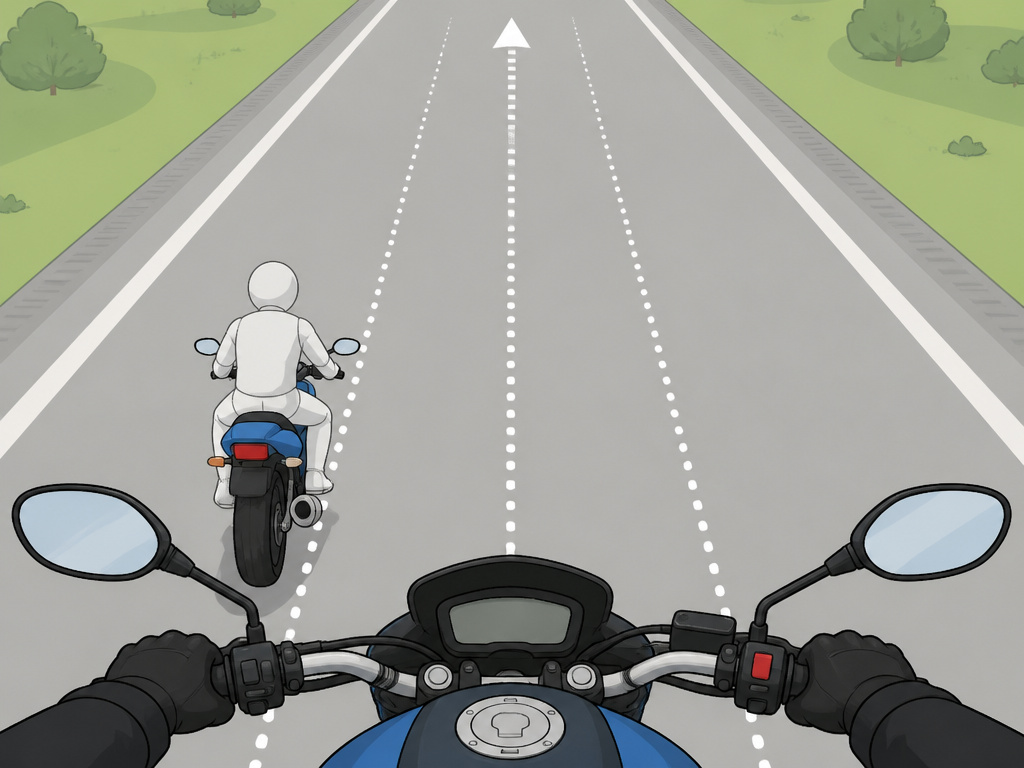
Once you’re on the highway, you’re not just riding down a lane, you’re managing a bubble of space within it. Your position in the lane dictates what you see and who sees you.
| Lane Position | When to Use It | Risk If You Stay There |
|---|---|---|
| Left Tire Track | Default position for most riding. Best forward view, most visible in side mirrors. | Closer to oncoming traffic in adjacent lanes; debris from center of road. |
| Center of Lane | Briefly, to avoid debris or inspect road surface. | Riding in accumulated oil and coolant drip from cars (slippery). |
| Right Tire Track | Preparing to exit, or when being passed on the left. | In the blind spot of cars in the lane to your right; more roadside debris. |
The left tire track is your home. From there, you can see past the car ahead, and the driver in front of you can see you in their side mirror. This position also gives you a clearer escape path to the shoulder if something happens ahead.
This ties into an advanced scanning technique of looking far ahead on the road to identify potential hazards early. Identify potential hazards early: a truck changing lanes, brake lights three cars ahead, debris on the shoulder. That scan starts from your strategic position in the left track.
Handling Trucks, Wind, and Exiting
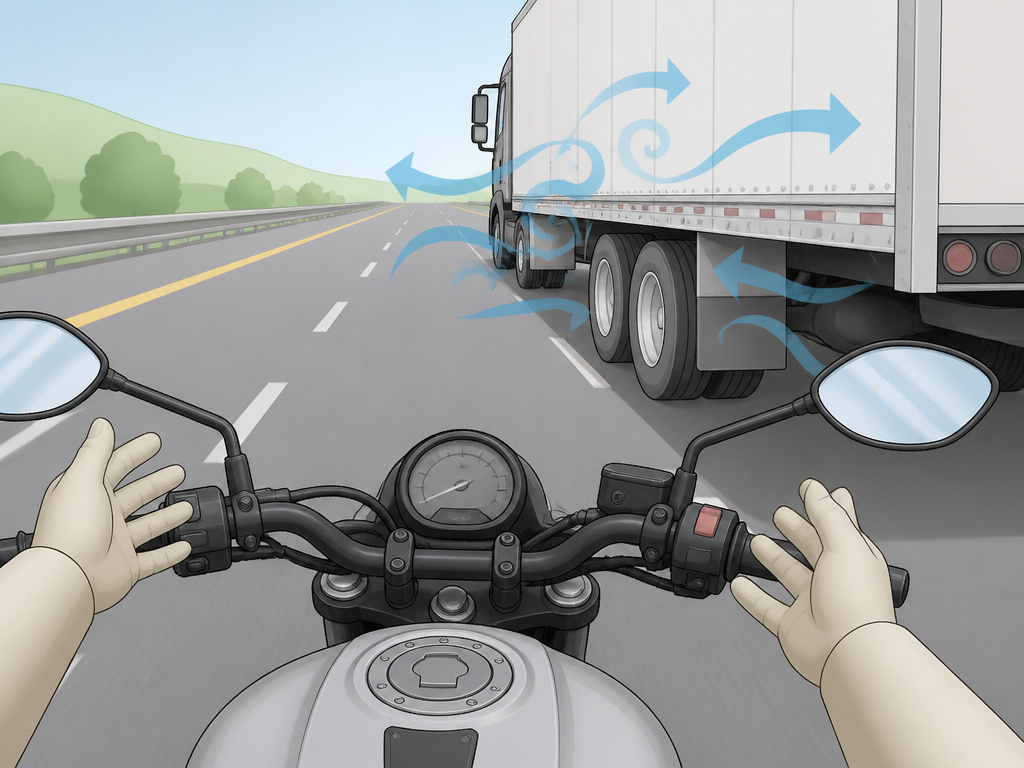
Large trucks can create significant wind turbulence for motorcycles. The fix is simple: loosen your grip. Grip the tank with your knees, keep your arms and hands relaxed, and let the bike make small corrections. Fighting the bars amplifies the wobble.
Where this goes sideways: Passing a truck in the right tire track (right side of your lane). You’re already in turbulent air and closer to the truck’s blind spot. Pass decisively from the left tire track, giving a wide berth.
Exiting requires the opposite focus of merging. The Ontario MTO handbook says: get into the right lane well before the exit, signal, but do not slow down on the highway. Only once you’re fully in the exit lane should you gradually reduce speed. Your sense of speed is numbed at highway pace, check your speedometer. An exit ramp curve can feel much slower than it actually is if you’re not paying attention.
Gear and Mindset for the Long Haul
Highway riding is a test of endurance for you and your equipment. That fancy, top-rated helmet? If it’s so loud it causes discomfort, it’s the wrong helmet for touring. Fit and comfort enable sustained focus. The Washington State manual emphasizes that proper gear must be worn “every ride, every time,” because at highway speed, regular jeans offer little protection in a slide.
Your mental focus is your most important gear. The Motorcycle Safety Foundation operator manual states impairment from fatigue or substances begins well before you feel “tired” or “buzzed.” Schedule regular breaks to combat fatigue. Hydrate. Standing on the pegs for a moment can reset your circulation.
The skills you use here, managing following distance, strategic lane positioning, and smooth control inputs, are the foundation of all safe motorcycle riding in traffic. They translate directly to safer city riding.
Where do most motorcycle accidents happen?
The fact sheet does not contain specific statistics on where accidents occur. However, practical guidance for highway riding focuses on areas requiring extra caution. Entrance and exit ramps are highlighted as potential trouble spots. These ramps often have tight turns and can have slippery surfaces, requiring you to drive more slowly. When merging, you must increase your speed to match traffic and merge smoothly into the left tire track of the lane. When exiting, get into the right lane well in advance, signal, and only reduce your speed once you are in the exit lane. Treating these transition zones with heightened awareness is a key defensive strategy.
Frequently Asked Questions
What is the 12-second rule for motorcycles?
The 12-second rule is a visual lead-time practice. It means scanning the road 12 seconds ahead of your current position to identify potential hazards early. At 70 mph, that’s about a quarter-mile. This advanced awareness, taught in many state curricula like the Pennsylvania motorcycle operator manual, gives you maximum time to react, change lane position, or adjust speed.
How do I stop my helmet from shaking at high speed?
Helmet lift or buffeting is often a fit or aerodynamics issue. First, ensure your helmet is the correct size and shape for your head, it should not move independently when you shake your head. Second, check your motorcycle’s windscreen; sometimes a slight adjustment in height or angle can disrupt turbulent air. For a deep dive, our guide on fixing helmet lift at speed covers common fixes.
Is a motorcycle more dangerous on the highway?
Risk is managed by skill: highway riding requires consistent vigilance and space management, while city riding demands constant hazard recognition and low-speed control.
How do I practice highway skills without going on the highway?
Start with foundational drills in a large, empty lot. Practice rapid but controlled braking to a specific point. Set up cones to simulate merging into a lane, focusing on the over-the-shoulder head check and smooth throttle application. Practice swerving technique around obstacles. These drills build the muscle memory you’ll need when you take those skills to the entrance ramp.
What should I do if my tire blows out on the highway?
The key is to not brake abruptly. Grip the tank, hold the handlebars firmly but without fighting them, and let the motorcycle slow down on its own. Gradually ease off the throttle and guide the bike toward the shoulder as it decelerates. Avoid sudden steering inputs. For a complete procedure, review our article on handling a blowout.
The Bottom Line
Highway riding isn’t about courage; it’s about procedure. Follow the official script: merge from the ramp using the MTO’s steps, default to the PennDOT four-second rule, and live in the left tire track. Your gear is part of the bike’s system, if it flaps, lifts, or distracts, it’s broken for this job.
One rule most guides skip: if you feel your focus wavering, your shoulders tightening, or you’re missing your visual scans, take the next exit. Get a coffee, walk for five minutes, and re-start. Fatigue is a gradual impairment, and the Washington State motorcycle manual is clear: you are the only one who can make the decision to manage your risk. The highway will be there when you’re ready.
