
How Long Does It Take to Learn to Ride a Motorcycle?
This post contains affiliate links. As an Amazon Associate, we earn from qualifying purchases.
It takes about 15 hours of formal training to learn the basic controls and pass a course like the MSF Basic RiderCourse. Building enough skill to ride safely alone on public roads typically requires another 10-15 hours of structured on-road practice, according to ICBC’s recommendation for a total of 20-30 hours for competency. A critical factor in the real timeline is a 30- to 96-day “high-risk period” after training where crash risk actually increases before it declines, according to a study.
That high-risk period is the most important fact most guides skip. Passing a weekend course gives you a license, not immunity. A common question is how long does it take to learn to ride a motorcycle, but the data shows new riders are most likely to crash not in their first week, but a month or two later, when overconfidence meets complex traffic.
What follows breaks down the official timelines, the hidden danger zone, and the specific practice that bridges the gap between a course completion card and genuine road competence.
Key Takeaways
- A formal 15-hour safety course teaches the controls, but real competency, according to ICBC, needs a total of 20-30 hours of practice, including both basic control mastery and on-road experience.
- Crash risk increases during a high-risk period after training, with the duration ranging from 30 days for men under 25 to 96 days for women over 45, according to a peer-reviewed study of over 40,000 riders.
- Competency-based systems (like New Zealand’s CBTA) have no minimum hour requirement, while fixed curricula (like the MSF course) take a set ~15 hours.
- The single fastest way to build skill is deliberate, low-speed practice in a lot, focusing on clutch control, emergency braking, and tight turns.
The Official Timelines vs. Real-World Practice
You’ll see two types of numbers: curriculum hours and recommended practice hours. They are not the same thing.
The Motorcycle Safety Foundation Basic RiderCourse is the benchmark in the U.S. It’s a fixed curriculum of about 5 hours in the classroom and 10 hours on the bike. Finish it, and many states waive their skills test. That’s 15 hours to learn to operate the machine at a basic level in a controlled environment. The MSF Basic Rider Course explained dives deeper into what that training actually covers.
Then come the practice recommendations. The Insurance Corporation of British Columbia’s training guide is pragmatic: it suggests 10-15 hours to master basic controls, followed by another 10-15 hours of on-road practice under supervision. That’s a 20-30 hour total path to what they call competency.
The MSF Basic RiderCourse is a fixed ~15-hour curriculum. New Zealand’s CBTA system has no fixed hour requirement; assessment is based on demonstrated competency whenever the rider feels ready.
Now, compare that to New Zealand. Their transport agency factsheet (NZTA Factsheet 28) recommends at least 120 hours of practice before attempting a practical test for a full license, while their CBTA system (NZ Transport Agency Waka Kotahi) has no mandated minimum practice hours, allowing assessment as soon as the rider feels ready. That’s a fourfold difference from the ICBC guide. One is a guideline for supervised readiness; the other is a pre-licensing benchmark. This table shows how disjointed the official advice can be.
| Authority | Recommended Training/Practice | Context / Goal |
|---|---|---|
| MSF (U.S.) | ~15 hours (5 class, 10 riding) | Fixed curriculum to learn basic operation and pass course test. |
| ICBC (Canada) | 20-30 total hours (10-15 basic + 10-15 on-road) | Supervised practice path to achieve “competency” for solo riding. |
| NZTA (New Zealand) | At least 120 hours of practice | Pre-licensing benchmark before sitting a practical test for a full licence. |
| Nevada DMV (U.S.) | MSF course OR state test (fail twice, course required) | Licensing option; failing the state skills test twice mandates an MSF course. |
Your real-world practice hours matter more than any of these numbers when answering how long does it take to learn to ride a motorcycle. Those first 10-15 hours after your course should be in a dead parking lot. Drill the friction zone of the clutch until you can crawl at walking speed. Practice emergency stops from 20 mph until you do it without thinking. This isn’t about logging time; it’s about building muscle memory for the moments your brain freezes. A good beginner’s guide lays out these exact drills.
The 30- to 96-Day Danger Zone
Here is the unsettling data point that changes the entire conversation. A 2020 study analyzed over 40,000 Florida motorcyclists and found a clear “high-risk period” after initial training. For most groups, the likelihood of a first crash increased for the first 30 to 96 days before it started to decline.
This is a peer-reviewed crash risk analysis published in a scientific journal. The researchers used hazard-based duration modeling, and the pattern was unmistakable. The risk doesn’t peak on day one. It peaks when the novelty wears off, complacency sets in, and riders start venturing into more complex traffic situations without the corresponding skill growth.
| Rider Group | High-Risk Period Duration |
|---|---|
| Men under 25 | 30 days |
| Men 25-45 | 33 days |
| Men over 45 | 83 days |
| Women 25-45 | 33 days |
| Women over 45 | 96 days |
The implication is brutal. The month after you get your license is the most dangerous part. The training course certificate is a learner’s permit for your judgment, not a finish line.
Where this goes sideways: Assuming you’re safe after passing the course. The data says you’re entering the period of greatest statistical risk. That’s when structured, low-risk practice is most critical, not optional.
This is why I tell new riders to plan their first two months like a extended training syllabus. Week one: big-box store parking lot on a Sunday morning. Week three: quiet residential streets at low traffic times. Week six: simple errands on familiar roads. You’re not just riding; you’re deliberately expanding your envelope in a controlled way. Managing that transition is a big part of learning to manage motorcycle riding anxiety.
Fixed Curriculum vs. “When You’re Ready”
The global patchwork of licensing systems falls into two opposing philosophies, and your timeline depends on which one governs you.
Fixed-Curriculum Systems (common in North America):
- Model: MSF Basic RiderCourse, state-approved courses.
- Timeline: Set number of hours (~15 total). You pass by completing the curriculum and meeting a minimum skill standard at the end of that period.
- Mindset: “Put in the time, achieve the standard.”
- Pro: Predictable schedule. Clear structure. Often provides the motorcycle.
- Con: Paces all riders the same. A fast learner might be bored day two; a slower one might not be ready but passes anyway.
Competency-Based Training and Assessment (CBTA) (used in New Zealand):
- Model: NZTA’s CBTA system.
- Timeline: No mandated minimum hours. You train until you and your coach agree you’re competent, then you take the assessment.
- Mindset: “Demonstrate the skill, regardless of time.”
- Pro: Tailored to individual learning speed. Arguably produces more uniformly competent riders.
- Con: Less predictable. Cost can be higher if you need many extra coaching sessions.
The official motorcycle training handbook from the Motorcycle Safety Foundation is the bible for the fixed-curriculum approach. The SMSA Entry-Level Rider Training Standards document outlines the national framework that guides many of these programs.
Most riders in the U.S. And Canada will experience the fixed system. Your job is to supplement it. If your course rushed through low-speed control, you go practice it for two more hours on your own. The course grants a license; the extra practice grants competence.
What “Learning” Actually Looks Like (A Skill Breakdown)
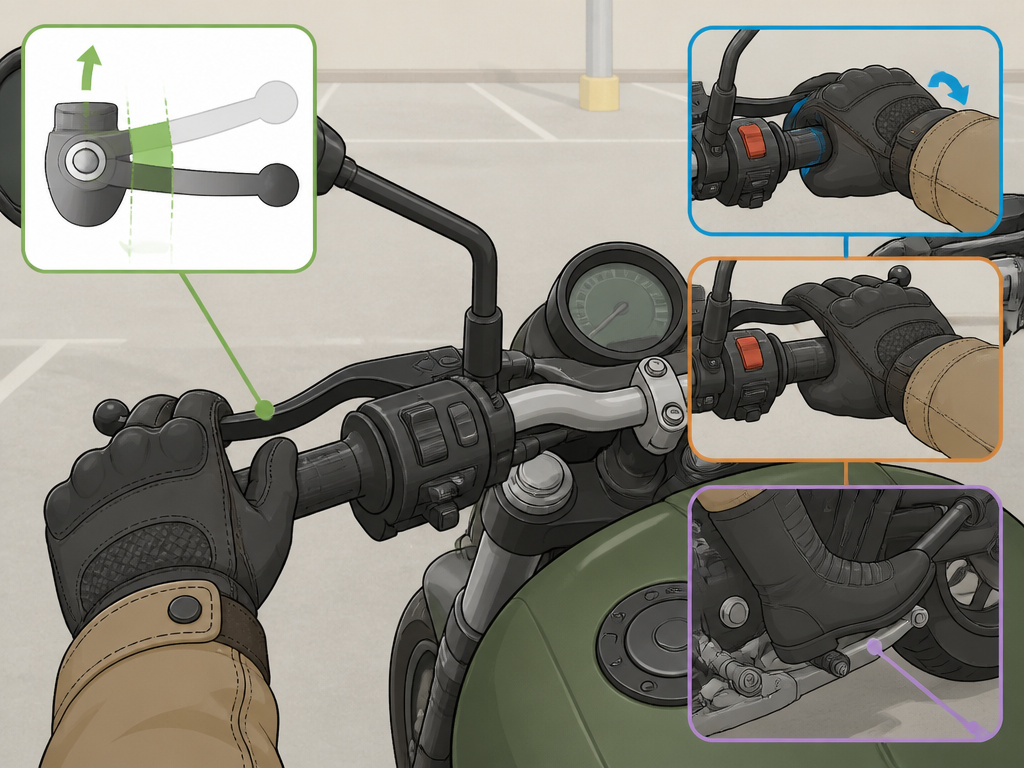
Forget the calendar. Learning to ride is a stack of skills, each with its own timeline. You can’t move to the next floor until the one below it is solid.
Stage 1: Basic Vehicle Control (First 5-10 hours)
This is the purely mechanical phase, almost always best learned in a formal course or a huge, empty lot.
- Finding the friction zone on the clutch without stalling.
- Balancing at a crawl (the hardest, most important skill new riders skip).
- Coordinating throttle, clutch, and brake for smooth stops and starts.
- Simple shifting up to third gear.
- Countersteering to initiate turns above walking speed. A detailed explanation of motorcycle controls is crucial here. You can’t use what you don’t understand.
Stage 2: Managed Environments (Next 10-20 hours)
This is where you apply those controls to real-world physics and simple traffic.
- Emergency braking to a full, controlled stop from 25-30 mph.
- Swerving around a simulated obstacle.
- Taking a curve at a steady speed, looking through the turn.
- Riding in a quiet neighborhood with stop signs, parked cars, and minimal traffic.
- Hill starts without rolling backward or stalling. This is the stage where a good motorcycle gear checklist for beginners becomes essential. Fear of falling shouldn’t distract you from learning to brake.
Stage 3: Complex Traffic & Hazard Management (Ongoing, 50+ hours)
This is the lifelong learning stage, but the first 50 hours here are critical.
- Merging into highway-speed traffic.
- Riding at night (reduced visibility, depth perception).
- Handling heavy crosswinds and rain-slicked roads.
- Predicting and avoiding other drivers’ mistakes (the core of survival riding).
- Long-distance riding fatigue management (the MSF manual advises not riding more than about six hours a day and taking breaks at least every two hours).
The bridge between Stage 2 and 3 is the high-risk period. You have the controls down, so you feel confident. But you lack the experience to read complex, high-speed traffic. That mismatch is what the Florida study measured.
The Gear and Bike Factor
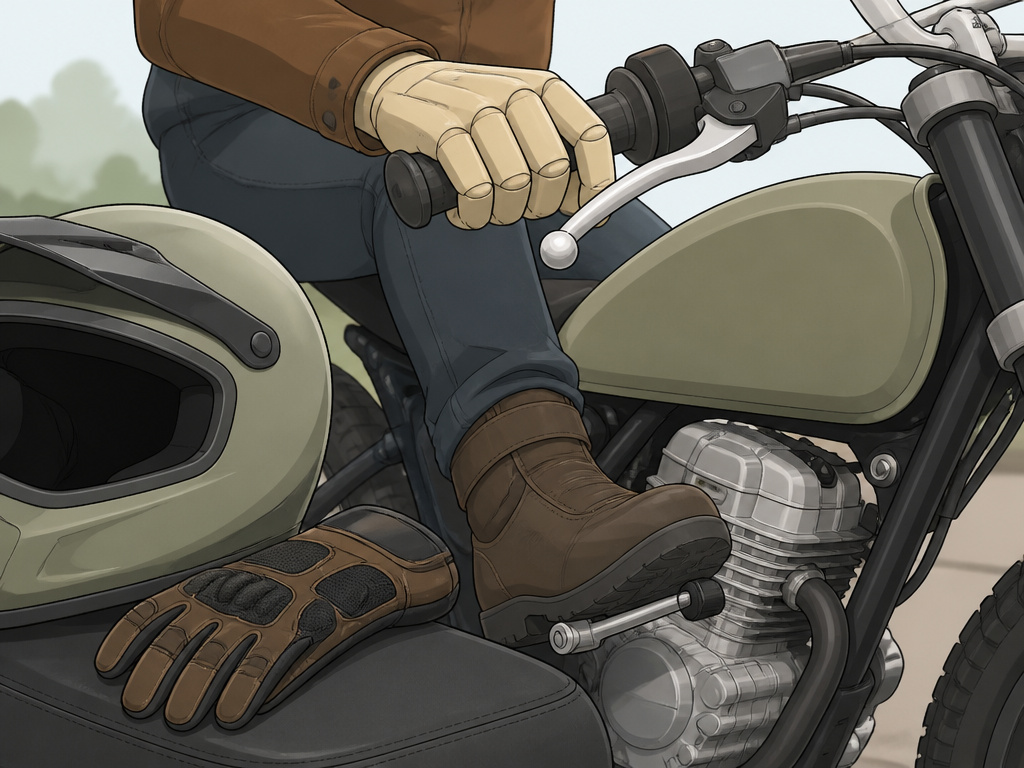
Your equipment is a variable the official timelines ignore. Learning on an inappropriate bike or without proper gear adds time, and risk.
The Bike: A lightweight, low-seat, forgiving motorcycle like a Honda CB300R or a Kawasaki Z400 is a teacher. A heavy, tall adventure bike or a twitchy sportbike is an adversary. The right bike allows you to focus on skill. The wrong one forces you to fight the machine, burning mental energy and practice time on mere survival. Our guide on how to choose your first motorcycle is built on this principle.
The Gear: This isn’t about fashion. Ill-fitting gear is a constant distraction. A helmet that screams after 20 minutes, gloves that bunch in your palm, boots that won’t let you feel the shifter, each one steals a fraction of your focus. Over a two-hour practice session, that’s the difference between learning and just enduring. Fit first, features second. Every piece should disappear when you put it on, so you can focus on the road.
How to Shorten Your Learning Curve (Deliberate Practice)
You can’t cheat the hours, but you can make each hour count for triple. This is deliberate practice.
- Isolate Weaknesses. Can’t do a tight U-turn? Go to a lot and do fifty of them. Focus only on the clutch friction zone and head turn. Don’t just “go ride around.”
- Use a Drill Schedule. Don’t wander. For a one-hour session: 15 mins of slow-speed figure eights, 15 mins of emergency braking from increasing speeds, 15 mins of swerve drills, 15 mins of riding a familiar route with active scanning.
- Record Yourself. Set up a phone to film your low-speed practice. You’ll see the stiff arms, the erratic throttle, the lack of head turn. It’s the fastest feedback loop outside of a coach.
- Practice the Test. Even if you took the MSF course, find the diagram for your state’s motorcycle road skills test and set it up with chalk or cones. The skills it tests, low-speed control, precise stopping, swerving, are the foundation of street riding.
- Add One Difficulty at a Time. Once you’re bored in the lot, add a distraction. Put a podcast in one ear (keep the other free for traffic) and run your drills. It simulates the mental load of real riding.
This approach turns 20 hours of focused practice into the equivalent of 60 hours of aimless cruising. It’s how you compress the high-risk period.
How to choose a beginner motorcycle
Your first motorcycle should build confidence, not intimidate you. A manageable size and weight are crucial for practicing basic control skills during your initial training hours. Engine power should be modest; a motorcycle with gentle, predictable power delivery allows you to focus on learning clutch control, braking, and cornering without being overwhelmed. The goal is to find a motorcycle that feels like a tool for learning, not a challenge to be conquered.
Frequently Asked Questions
Is it hard to learn to drive a motorcycle?
The basic mechanics, clutch, throttle, shifting, are simple and can be learned in a weekend. The hard part is layering on traffic awareness, hazard prediction, and muscle memory for emergencies while managing a narrow, two-wheeled vehicle. That takes months of consistent practice. The initial learning curve is steep but short; reaching genuine safety takes a long time.
How fast can I learn to ride a motorcycle?
Course like the MSF Basic RiderCourse, which is approximately 15 hours total, is designed to teach basic operation and may allow you to pass a course test. “Learning to ride” in the sense of being a safe, competent road user, according to one guide, takes a total of 20-30 hours of practice, which includes both initial training and on-road experience. Rushing this process is the single biggest predictor of entering the high-risk crash period.
I know how to ride a bicycle. Does that help?
Yes, significantly. Balance on two wheels is an unconscious skill. If you have it from cycling, you won’t be fighting the bike’s desire to stay upright at low speeds. This allows you to focus entirely on the controls (clutch, throttle, brakes) and traffic. The translation isn’t perfect, motorcycles are heavier and throttle control is critical, but it removes one major layer of difficulty.
Can I teach myself to ride a motorcycle?
You can, but it is the riskiest and least efficient path. Self-taught riders almost always develop ingrained bad habits (poor clutch control, ineffective braking, bad posture) that a coach would correct in the first hour. These habits then become barriers to learning advanced skills. Also, in states like Nevada, if you fail the state’s skills test twice, you must take an MSF course.
How long does it take to feel confident on a motorcycle?
False confidence often arrives within the first 10-20 hours, coinciding with the start of the high-risk period. Real, justified confidence, based on a known ability to handle surprises, takes much longer, often 6 months to a year of regular riding. A marker is when emergency maneuvers like swerving and hard braking feel instinctual, not panicked.
The Bottom Line
The number is approximately 15 hours to complete a basic course, and a total of 20-30 hours of practice is recommended by some authorities to develop competency. But the calendar that matters is the 30 to 96 days after you get your license. That’s your danger zone.
Your goal in that period is to log focused, deliberate practice that builds real skill faster than overconfidence builds risk. Take the course. Then, schedule your parking lot sessions like mandatory appointments. The timeline is a map with a marked hazard. Now you know where it is.
