
MSF Basic Rider Course Explained: The 15-Hour First Step
This post contains affiliate links. As an Amazon Associate, we earn from qualifying purchases.
The MSF Basic RiderCourse is a 15-hour beginner motorcycle training class split into 5 hours of classroom learning and 10 hours of on-bike practice, typically spread over two days. It teaches fundamental skills like turning, shifting, and emergency braking on a provided motorcycle. Passing the course usually waives your state’s motorcycle road test and may qualify you for an insurance discount.
That’s the official line, and it’s mostly true. The difference between a course experience that ends with a completion card and a frustrating one that gets you turned away often comes down to the small print your state adds. The MSF states motorcycles are provided for use, while Minnesota, for example, allows riders to use their own motorcycle or scooter (51–500cc). The New York State DMV materials do not specify a policy on personal motorcycles. The MSF says you can start at 16; some states say 18. Those details decide whether you walk out with a completion card or get turned away before you even start the engine. This is how the MSF Basic Rider Course explained policy can differ in practice.
What follows is a breakdown of the 15-hour curriculum, the gear you actually need, the common reasons people fail, and the exact steps to turn your completion card into a license as the MSF Basic Rider Course explained. This is the process, not the promotion.
Key Takeaways
- The Motorcycle Safety Foundation states the course is 15 total hours (5 classroom, 10 riding), while the New York State BRC, for example, consists of 16 hours of combined instruction.
- Completing the course waives the riding skills test at your local DMV in most states, but you still need a valid driver’s license and motorcycle learner permit first.
- Gear provision varies: the MSF states helmet and gloves are provided, while states like Minnesota require students to furnish all protective gear, including a DOT helmet, eye protection, long sleeves, long pants, full-fingered gloves, and riding boots.
- The riding evaluation tests low-speed control above all else; the most common reason for failing is botching the tight U-turn or putting a foot down during slow maneuvers.
- The MSF Basic eCourse can be completed in around 5 hours, but the eCourse alone is NOT accepted as a license waiver by any state’s DMV.
What Is the MSF Basic RiderCourse?
Think of it as driver’s ed for motorcycles. The Motorcycle Safety Foundation (MSF) has run this program for over fifty years, training more than 10 million riders. It’s the default, industry-backed standard, sponsored by manufacturers like Honda, Yamaha, and Harley-Davidson.
The MSF Basic RiderCourse is a complete entry-level, learn-to-ride class that consists of at least 15 hours of formal classroom activities and on-cycle riding exercises conducted over two or three days. About five hours are devoted to learning activities in the classroom, and around 10 hours of hands-on practice are included.
The MSF Basic Rider Course explained goal isn’t to make you a track-day expert. It’s to get you from zero to competent enough to pass a state licensing test and practice safely on your own. The curriculum is methodical. You start by finding the friction zone on the clutch, end with swerving around a simulated obstacle. Every exercise builds on the last.
It’s also your best financial shortcut. The course fee varies by location, but it often costs less than renting a bike and paying the DMV test fee separately. The possible insurance discount is just a bonus.
The 2-Part Course Structure: eCourse + On-Bike Range
You don’t just show up and ride. The course has two distinct, sequential parts.
The Mandatory eCourse (About 5 Hours)
Before you touch a motorcycle, you must complete the MSF Basic eCourse online. You must complete this. Your instructor will verify you’ve finished it.
Where this goes sideways: Students who skip or rush the eCourse show up unprepared. They waste the first hour of range time asking about controls the video module already explained, and they fall behind the group pace immediately.
The eCourse covers motorcycle controls, basic riding theory, and introductory safety strategies. You can complete it at your own pace, but budget a solid five hours. It’s not a rubber stamp. The information directly applies to the riding exercises and the written test at the end.
Remember: taking the eCourse alone does not waive any DMV tests. It’s only valid as part of the full hands-on Basic RiderCourse.
The On-Bike Range Sessions (10 Hours Over 2-3 Days)
This is the hands-on part. You’ll spend about ten hours in a parking lot or dedicated training range under the watch of an MSF-certified RiderCoach. Groups are small, with a limited number of students per RiderCoach.
The official MSF Basic RiderCourse curriculum breaks the riding into 17 structured lessons. It starts absurdly simple and gets progressively more complex.
| Lesson Focus | Key Skill Learned | Why It Matters |
|---|---|---|
| 1-4: Familiarization & Basics | Using the clutch friction zone, starting, stopping, shifting. | This is the foundation. Mess up the friction zone and you’ll stall constantly. |
| 5-8: Introduction to Turning | Slow-speed turns, pressing the handlebar to initiate lean (counter-steering). | Low-speed drops happen here if you don’t trust the bike’s balance. |
| 9-14: Emergency Skills | Quick stops, swerving, stopping while in a curve. | These are the collision-avoidance maneuvers that the final test evaluates. |
| 15-17: Combined Maneuvers | Weaving through cones, obstacle avoidance, lane-change practice. | This mimics real-world riding and is the capstone before the evaluation. |
The RiderCoach demonstrates each exercise, then you practice it repeatedly. They give individual feedback. The pace is deliberate. If you struggle with an exercise, the coach will work with you before the group moves on.
Who Is the BRC For? (And Who Isn’t?)
The MSF Basic RiderCourse overview states it’s for beginning riders, ages 16 and up. That’s the national guideline. Your state law overrides it.
Here’s where sources disagree, and it’s the most important check you’ll do:
| Requirement | MSF National Standard | Example: Minnesota Rule | What This Means For You |
|---|---|---|---|
| Minimum Age | 16 and up | Must be 18+ to get the license waiver (16-17 can take it for a permit) | Check your state DMV. If you’re 17 in Minnesota, you can take the course but you won’t get the road test waiver. |
| Motorcycle Provided? | Yes, motorcycles are provided. | Riders may use their own street-legal bike (51-500cc) if insured and inspected. | You might have the option to learn on your own bike, which is great for familiarity. |
| Gear Provided? | Helmet and gloves are provided. | Student must furnish all gear: DOT helmet, eye protection, jacket, gloves, pants, boots. | Never assume. The gear list is your responsibility unless the course site explicitly states otherwise. |
The course assumes you have never ridden a motorcycle. The only real prerequisite is the ability to ride a bicycle, as the balance fundamentals translate directly.
It is not for experienced riders looking to hone high-performance skills. For that, the MSF offers an Experienced RiderCourse. Taking the BRC as an experienced rider will likely be tedious, and you might develop bad habits by over-riding the simple exercises.
What to Bring and Wear: The Non-Negotiable Gear List
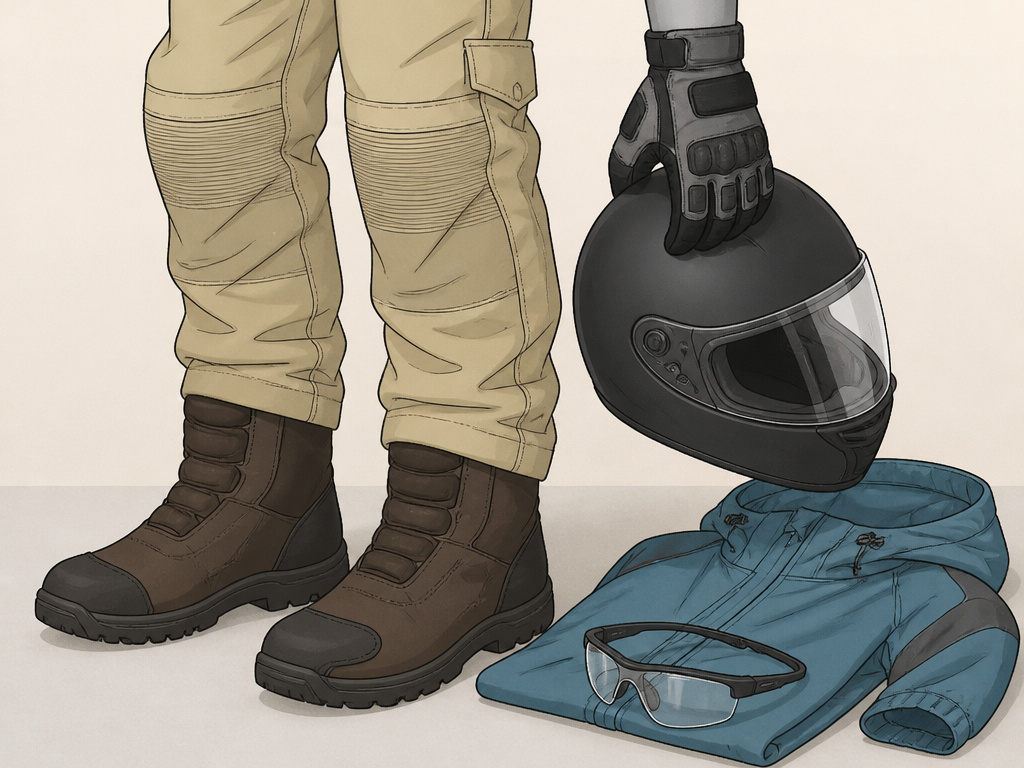
Your gear is your primary safety system. The course happens rain or shine. Coming unprepared is the fastest way to get “counseled out” before you start.
Based on the strictest state requirements (like Minnesota’s), here is the absolute must-have list. Even if your course provides helmets, having your own that fits is better.
- DOT-Approved Helmet: This is the law. Look for the DOT sticker inside the helmet. A full-face helmet is strongly recommended for the best protection.
- Eye Protection: If your helmet doesn’t have a visor, you need shatter-resistant glasses or goggles.
- Long-Sleeve Jacket & Long Pants: Denim or riding-specific textiles. No shorts, no t-shirts. Abrasion resistance matters even at parking-lot speeds.
- Full-Fingered Gloves: Leather or durable synthetic. Your palms will hit the ground first in a tip-over.
- Over-the-Ankle Boots: Sturdy footwear that covers your ankles. Steel toes are not required and can be cumbersome. No sneakers, no canvas shoes.
- Rain Gear: The course runs regardless of weather. A cheap waterproof jacket and pants set from an outdoor store will save your day.
- Your ID, Permit, and Completion Certificate: For the eCourse and for the instructor’s paperwork.
Think of this as your first motorcycle gear checklist for beginners. If you buy gear for the course, buy gear you’ll actually want to ride in later.
The Skills Evaluation: How You Pass (Or Fail)

The course ends with a two-part evaluation: a written knowledge test and a riding skills test. You must pass both.
The written test is multiple choice, drawn directly from the eCourse and handbook material. It’s straightforward if you paid attention.
The riding evaluation is where nerves kick in. It’s not about speed. It’s about control. The MSF road test maneuvers are based on the same skills you’ve been practicing, formatted into a specific test:
- Normal Stop: Stop smoothly within a marked box.
- U-Turn: Execute a tight, controlled U-turn within a 20′ by 40′ box without putting a foot down or crossing the lines.
- Swerve: Swerve around an obstacle without losing control, then stop.
- Quick Stop: Stop as quickly as possible from about 18 mph without skidding or locking the brakes.
- Cornering: Navigate a curved path smoothly, looking through the turn.
You get points off for errors like putting a foot down, stalling, going outside boundaries, or poor technique. Exceed the maximum points lost, and you fail.
Common mistake: Overthinking the test. Students who tense up and stare at the cones in the U-turn box always hit them. Look where you want the bike to go—your head and shoulders will lead it through.
If you are struggling dangerously or cannot perform basic controls after several attempts, the RiderCoach may “counsel you out” for safety. This means you stop participating. Policies on refunds or retakes vary by training provider, so ask upfront.
After the Course: Turning Your Card Into a License
You passed. The RiderCoach hands you a course completion card (often called a DL-389 or similar). This is not your license.
Here is the critical, often-muddled, post-course process:
- Waiver requirements vary by state; for example, in New York, to be eligible for the motorcycle road test waiver, you must possess a current and valid New York State driver license and a motorcycle learner permit. The course does not give you a permit. You get that by passing your state’s written motorcycle permit test at the DMV first.
- Take your completion card to your local DMV. Along with your driver’s license, permit, and any required fees.
- They will waive the road test. Your completion card serves as proof you passed a skills evaluation. They will still process your application, take a new photo, and issue your new license with the “M” endorsement.
The waiver is nearly universal, but it’s a state-by-state rule. Confirm with your local DMV that they accept the MSF BRC card. Most do.
This is why the course is the most efficient path to getting a motorcycle license. You bypass the most stressful part—the DMV’s road test—by doing it in a less pressured, educational environment.
Frequently Asked Questions
How hard is it to pass the MSF course?
The pass rate is high for students who take it seriously. The main hurdle isn’t complexity; it’s managing anxiety and mastering low-speed balance. If you can reliably ride a bicycle and you practice the friction zone drill, you’ll likely pass. The people who fail are usually those who fight the bike instead of trusting the controls.
What if I don’t have a motorcycle to practice on before the course?
Don’t. That’s the point. The course is designed for absolute beginners with zero seat time. Practicing on your own without a permit or proper supervision is illegal and dangerous. The provided training bikes are light, low-powered, and have crash bars to prevent damage. They are the perfect tools to learn on.
Can I take the course if I only want to ride a scooter?
Absolutely. The MSF curriculum includes scooters, and you can request one. In fact, if you struggle with the clutch on a motorcycle, a RiderCoach may suggest switching to a scooter to master the other skills first. The endorsement you earn is the same.
How long after the course until I’m ready for the road?
The course gives you the fundamental skills and the license. It does not give you experience. The real learning timeline starts after you get your own bike. Plan for weeks or months of practice in low-risk areas before tackling heavy traffic or complex roads. An advanced rider course in your first year is a smart next step.
What’s the difference between the MSF course and a state-run course?
Often, nothing. Many “state-run” courses are just the MSF BRC taught at a community college or by a state-contracted provider using the same curriculum and MSF official rider training manual. The key is that the course must be MSF-approved or state-approved to grant the waiver. Always verify with your DMV.
Before You Go
The MSF Basic RiderCourse is the single best investment a new rider can make. It’s not just a test waiver. It’s a structured, safe environment to make your early mistakes. The 15-hour commitment sounds like a lot, but it condenses what would take months of trial-and-error into one focused weekend.
One rule most guides skip: your mental preparation matters as much as your gear. Go in tired, stressed, or overconfident, and the bike will tell on you. Go in ready to listen, to feel the clutch engage, and to look where you want to turn. The skills are simple. Your mindset determines whether you absorb them.
Then, the real work begins. The course teaches you how to operate the machine. The next thousand miles of defensive riding teach you how to survive on the road with it. Start with the BRC, but never stop learning.
