
How to Get a Motorcycle License: The 5-Phase Process
This post contains affiliate links. As an Amazon Associate, we earn from qualifying purchases.
To get a motorcycle license, you must pass a written knowledge test to earn a learner permit, then pass a riding skills test to earn the full license or endorsement. The fastest and most recommended path is to take a state-approved Motorcycle Safety Foundation (MSF) course, which often waives the state skills test and provides essential training.
What follows is the universal 5-phase process, the exact numbers and rules from six different state DMVs, and the one decision that cuts your learning curve in half. This guide explains how to get a motorcycle license.
Key Takeaways
- The fastest and safest path is a state-approved Motorcycle Safety Foundation (MSF) Basic Rider Course; it provides the bike, the training, and often waives the state’s riding skills test.
- A motorcycle learner permit has severe restrictions: typically no passengers, no nighttime riding, and sometimes no freeway use. In New York, your supervising rider must be within 1/4 mile.
- State knowledge tests vary wildly. New York’s is 20 questions; Ohio’s is 40. Always check your state’s official manual, the questions come directly from it.
- If you already have a car driver’s license, you’ll add an ‘M’ endorsement. If you don’t, you’ll get a standalone Class M motorcycle license, which can take longer to process.
- More than half of all motorcycle crashes involve riders with less than five months of experience, according to the MSF manual. That 30-hour practice recommendation from New York? It’s not a suggestion. It’s a buffer against the most dangerous period.
The 5-Phase Process to a Motorcycle License
The journey from zero to licensed when you compare a how to get a motorcycle license process follows the same basic arc everywhere. Where states differ is in the fine print: the number of questions, the hours of practice, and the strings attached to your permit.
Phase 1: Study the Official Manual and Pass the Written Test
Your first stop is your state’s DMV website. Download the official motorcycle operator manual. Every question on the permit test comes from this book.
The written test assesses your knowledge of road rules, traffic signs specific to motorcycles, and safe riding practices outlined in the state’s official manual. Passing scores are defined by statute, such as 14/20 in New York or 75% in Ohio, and are non-negotiable.
Forget general driving knowledge. The test focuses on motorcycle-specific laws and hazards. In New York, you must answer at least two of the four road-sign questions correctly, even if you ace the rest.
The goal here, in the how to get a motorcycle license process, is a learner permit, often called a Temporary Instruction Permit (TIPIC). This card allows you to practice on public roads, but with significant restrictions.
Phase 2: Understand Your Learner Permit Restrictions
You have the permit. Now you need to know what you can’t do. These rules are for your safety and are enforced.
| Common Permit Restriction | What It Means | Example State |
|---|---|---|
| No Passengers | You must ride alone. | California, Ohio, New York |
| Daylight Hours Only | Ride only from sunrise to sunset. | Ohio, Nevada (for some permits) |
| No Freeway/Interstate Riding | Stay off high-speed, limited-access highways. | California, Ohio |
| Supervised Riding Required | A licensed rider must be near you. | New York (within 1/4 mile) |
| Helmet & Eye Protection Mandatory | Must be worn at all times, regardless of state law. | Ohio |
These aren’t suggestions. In New York, your supervising rider must be age 21 or older with a valid motorcycle license and must remain within 1/4 mile of you at all times. In California, your Class M1/M2 instruction permit explicitly bans freeway driving and nighttime riding. Violating these is a traffic ticket and could mean a permit revocation.
This phase is your practice window. How much practice? States disagree.
Phase 3: Get Your Seat Time (Practice Hour Requirements)
Here’s where a simple “practice a lot” guide fails. Official recommendations have real numbers.
- New York DMV: Recommends at least 30 hours of total practice, with a minimum of 10 hours in medium to high-volume traffic.
- Ohio BMV (for minors): Requires 50 hours of total driving for their underlying license, with at least 10 hours at night.
- Maryland MVA & California DMV: Do not specify a required number of practice hours in their official guides.
The New York advice is the most specific and pragmatic. Parking lot drills build control, but traffic practice builds the situational awareness that prevents crashes. The Motorcycle Safety Foundation manual notes that more than half of all crashes involve riders with less than five months of experience. Those first hours are critical.
Phase 4: Pass the Riding Skills Test (Or Take a Course)
This is the big one. You must prove you can control the bike. You have two paths: the state-administered test or a safety course.
Path A: The State Skills Test
You schedule a test at the DMV. You provide a street-legal, registered motorcycle. An examiner watches you perform maneuvers like low-speed circles, quick stops, and swerves. It’s pass/fail. In Ohio, if you fail any part, you must wait two days to retest. In Nevada, if you take the skills test on a motorcycle of less than 90cc, your license will be restricted to 90cc or less (Restriction U).
Path B: The Safety Course Waiver
This is the cheat code most experts recommend. You take a state-approved course, like the MSF Basic RiderCourse.
Where this goes sideways: Safety course waiver policies vary by state. In Nevada, the DMV presents the MSF course as a mandated step after failing the state test twice, not a primary waiver path. In Maryland and Ohio, course completion is a direct waiver for the state test.
The course provides the motorcycle, and the instruction is tailored to the test maneuvers. You pass their internal evaluation, and they give you a completion card to take to the DMV. It’s training and testing in one.
Phase 5: Finalize Your License or Endorsement
You passed. Now, do you get a new card or an update?
- If you DO NOT have a regular driver’s license: You will receive a standalone Class M motorcycle license in the mail. New York says this takes about 2 weeks. Maryland says 7-10 business days.
- If you DO have a driver’s license: You will add an ‘M’ endorsement to it. In New York, you must wait at least 7 days after your road test, then visit a DMV office to pay a fee (e.g., $12.50 in NY, $8.25 in Nevada) to amend your license. They’ll give you a temporary paper license, and your new card arrives by mail.
This is a key content gap many miss. The process and timeline are different depending on whether you’re already a licensed driver.
Motorcycle License vs. Endorsement: What’s the Difference?
This trips up new riders. The difference isn’t about what you can ride; it’s about what other privileges you have.
A motorcycle endorsement (the ‘M’ on your license) is an addition to your existing driver’s license. It means you are licensed to drive cars and motorcycles. You keep one card.
A standalone motorcycle license (Class M) is issued to someone who does not have a regular driver’s license. It only authorizes you to operate a motorcycle. If you want to drive a car later, you must go through the car licensing process separately.
Maryland’s MVA spells this out directly: “If you already have a Driver’s License, the ‘M’ will be added… If you do not have a driver’s license, you will receive a motorcycle license (Class M).”
How State Requirements Differ (A Comparison)
You can’t talk about a national process. The rules change at the border. This table shows how five states handle key requirements.
| State | Minimum Age | Knowledge Test | Mandatory Safety Course | Key Permit Restriction |
|---|---|---|---|---|
| New York | 16 | 20 questions (14 to pass) | No (but waives road test) | Supervisor within 1/4 mile |
| California | 15½ | Varies | Yes, for under 21 | No freeways, no nighttime |
| Ohio | Varies by license type | 40 questions (75% to pass) | No (but waives skills test) | Daylight only, no interstates |
| Maryland | 16 | Varies | Yes, for under 18 | N/A (course-focused path) |
| Nevada | 16 (with conditions) | Varies | Not for adults as primary path | Depends on permit type |
California’s class system is another difference: A Class M1 license allows you to operate any two-wheel motorcycle. A Class M2 is for motorized bicycles, mopeds, and scooters. Make sure you test on the vehicle you actually want to ride.
The Tools and Documents You’ll Need

Before you walk into the DMV, get your paperwork in order. Missing one item can mean a rescheduled appointment.
- Primary ID: A certified birth certificate, valid passport, or permanent resident card.
- Proof of Social Security Number: Your Social Security card or a W-2 form.
- Proof of State Residency: Two documents, like a utility bill and a bank statement, with your current address.
- Payment: For test fees, permit fees, and final licensing fees. Methods vary (check your DMV site).
- If You’re Under 18: A parent or guardian to co-sign, and often a completed driving log or certificate of driver education completion.
Gather these before you start studying. The last thing you need after passing a test is a scramble for a missing document.
What to expect from the motorcycle license vision test
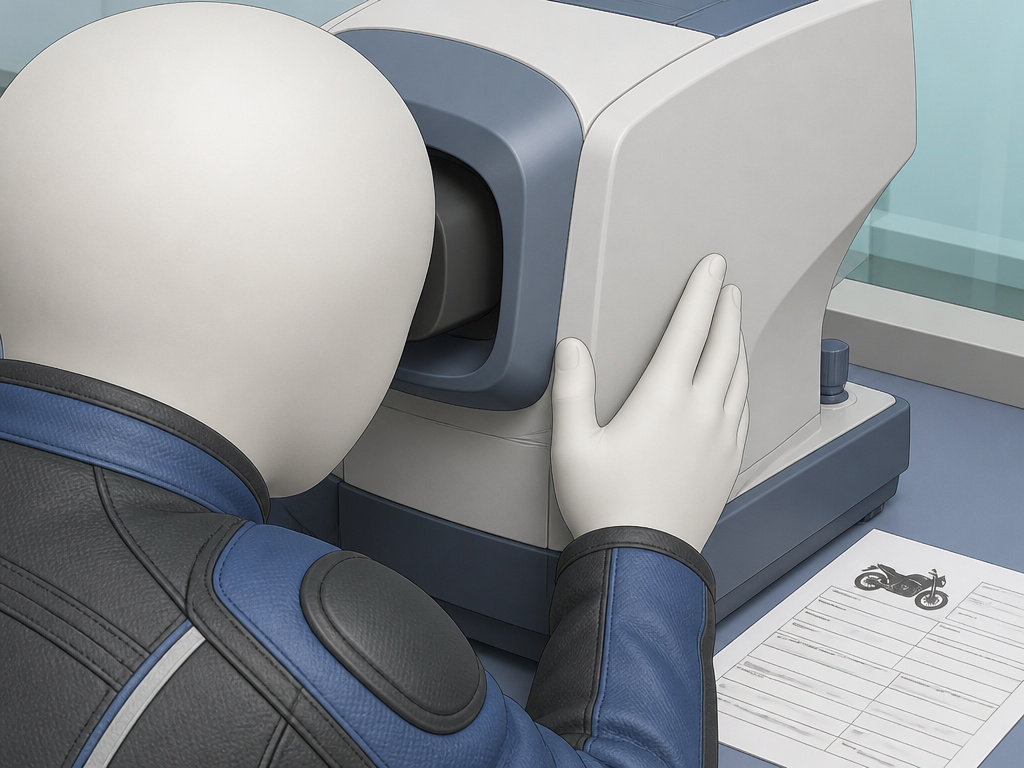
A vision screening is a standard part of the licensing process. You will take this test when you apply for your instruction permit or before your road test. The test checks your visual acuity and peripheral vision to ensure you can see the road, signs, and other vehicles clearly. You will look into a machine or read an eye chart. If you wear glasses or contact lenses to drive, wear them for this test. Failing the vision test means you cannot proceed with your application until the issue is corrected, typically with a prescription from an eye doctor. There are no specific motorcycle-related differences in the vision test itself.
Frequently Asked Questions
Is it difficult to get your motorcycle license?
The difficulty is front-loaded in the learning, not the bureaucracy. The written test is straightforward if you study the official manual. The riding skills test is challenging if you’re unprepared, but a safety course like the MSF Basic RiderCourse is designed to prepare you for exactly those maneuvers. The hardest part for most is the initial skill acquisition, learning clutch control, balance, and low-speed handling. That’s why the course is so valuable.
How long does it take to get a motorcycle license?
From zero to licensed, the timeline is dictated by state rules and your own schedule. If you take an intensive 3-day MSF course, you could have your completion certificate in hand within a week of starting. However, many states have mandatory holding periods for learner permits (6 months for California minors), and DMV mailing times add 1-2 weeks. The timeline depends on state rules, course availability, and your schedule.
Do I need a regular driver’s license first?
No, you do not. You can get a standalone Class M motorcycle license without ever having a car license. The process is often longer for a first-time licensee, as you may need to pass additional tests (like a standard driver knowledge test) and will be subject to stricter rules if you’re a minor. Having a car license simply streamlines the final step into an endorsement.
What is the fastest way to get a motorcycle license?
The fastest way is to enroll in a state-approved Motorcycle Safety Foundation course. These are often weekend-long. You pass their course, and they provide the waiver for the state skills test. You then take your completion certificate to the DMV, pass the written test (which you can often schedule immediately), and get your endorsement. This path condenses weeks of solo practice and test anxiety into a few days of structured training.
Can I use my own motorcycle for the test?
For a state-administered skills test, yes, you must provide a street-legal, registered, and insured motorcycle. For an MSF or other safety course, the motorcycle is provided for you. This is a major advantage of the course, you don’t need to buy or borrow a bike before you’re licensed.
Before You Go
The single rule that reframes everything: treat the license as a byproduct of training, not the goal. A safety course isn’t an extra step; it’s a shortcut that replaces the hardest part, preparing for the state test alone, with professional instruction. The MSF statistic about new riders and crashes isn’t scare talk. It’s the reason New York recommends 30 hours and why the course waiver exists.
Your first move isn’t to the DMV website. It’s to the Motorcycle Safety Foundation site or your state’s safety program page to find a Basic Rider Course near you. Schedule that. Everything else, the manual, the permit test, the paperwork, fits around those two or three days of actual learning. That sequence changes the whole experience from a bureaucratic hurdle to a skills-building investment. The license shows up at the end almost as an afterthought.
