
How to Pass the Motorcycle Road Skills Test: Step-by-Step
This post contains affiliate links. As an Amazon Associate, we earn from qualifying purchases.
To pass the motorcycle road skills test, you need precise low-speed control for maneuvers like the cone weave and U-turn box, a motorcycle that passes a pre-test safety inspection, and the right safety gear. The test measures your ability to handle the bike at low speeds without putting a foot down, going outside boundary lines, or stalling; for example, Virginia’s exercises involve speeds of about 15 mph or less. Fail the test twice in Massachusetts or Virginia, and state law requires you to successfully complete a state-approved rider training course.
The difference between a pass and a fail often comes down to a small margin, such as the distance between your tire and a painted line, or putting your foot down during a tight turn. That margin is built in the weeks before the test, not on test day, which is why it’s crucial to know how to pass the motorcycle road skills test.
What follows is the breakdown of every major state’s test rules, the exact skills they score, and the practice drills that turn a wobbly beginner into a candidate who walks out with a license.
Key Takeaways
- The entire skills test takes about 15 minutes and focuses on speeds under 15 mph, where balance and clutch control matter most.
- Your motorcycle must pass first. An examiner will cancel the test for an unsafe bike, no valid registration, bald tires, or faulty brakes means you go home.
- Wear full protective gear as if you were going for a real ride; for example, Virginia requires a DOT helmet, eye protection, jacket, gloves, full-length pants, and over-the-ankle boots for the test.
- The most common failure points are putting a foot down for balance and crossing a boundary line during the U-turn or cone weave; each mistake adds error points that can sink your score.
The 5 Core Skills Every Test Measures (and Where People Fail)
The test isn’t a mystery. Every state evaluates the same fundamental control skills, just arranged on different parking lot courses. You’re being scored on your ability to manage the motorcycle’s weight and power at walking speeds, where it’s least stable.
The Virginia DMV’s guide notes most exercises involve speeds of about 15 mph or less. That’s the entire game. Speed hides mistakes; slow speed exposes every wobble and every clutch fumble.
Here are the five universal skills, what the examiner watches for, and the specific failure that ends a test run.
| Cone Weave | Serpentine through a line of cones. | Knocking over a cone or putting a foot down. |
|---|---|---|
| U-Turn / Figure-8 | Perform a tight, controlled turn within a painted box. | Touching a boundary line or putting a foot down. |
| Normal Start & Stop | Accelerate smoothly from a stop and brake to a stop in a designated box. | Stalling the engine or stopping outside the box. |
| Quick Stop | Accelerate to a specified speed and brake as quickly as possible without skidding. | Exceeding the maximum allowed stopping distance. |
| Obstacle Swerve | Accelerate, then swerve around an obstacle without braking, maintaining your lane. | Hitting the obstacle or crossing the boundary line during the swerve. |
Where this goes sideways: Riders focus on the “hard” skills like swerving, but fail on the first cone of the weave because they’re looking at the cone itself instead of where they want the bike to go. Your head direction steers the bike. Look at the gap, not the obstacle.
The “putting a foot down” rule is the great equalizer. It’s the examiner’s clear, physical evidence that you lost balance. In a real ride, that momentary dab might save you. In the test, it’s an error point that often adds up to a failure. Practice until keeping your feet on the pegs through a tight turn is a reflex, not a struggle.
Your Motorcycle Must Pass First
Before you demonstrate a single skill, the examiner conducts a safety inspection. This isn’t a formality. The Massachusetts RMV states the road test will be canceled if the examiner believes the motorcycle is unsafe.
Think of it as a tech inspection before a race. Your bike doesn’t need to be showroom new, but every critical system must work.
The Non-Negotiable Checklist:
- Valid Registration & Inspection: Your bike must have a current registration and, if required by your state, a valid inspection sticker. No paperwork, no test.
- Working Lights & Signals: Headlight (high and low beam), taillight, brake light, and both turn signals must function. A quick check before you leave home prevents a send-away.
- Tire Tread & Pressure: Balding tires or visibly low pressure are automatic fails. Tires are your only contact with the ground.
- Functional Brakes: Both front and rear brake levers must engage firmly and return smoothly. The examiner will check.
- No Leaks or Loose Parts: Look for oil or coolant drips under the bike. Ensure all mirrors, footpegs, and controls are tight.
A policy riders often miss: If your motorcycle is registered out-of-state, Massachusetts requires you to show the examiner proof of insurance matching its minimum limits, $25,000/$50,000 for bodily injury and $30,000 for property damage. An in-state registered bike doesn’t need this proof at the test. It’s a specific edge case that has sent unprepared riders home.
Don’t let a $10 bulb cost you a test fee and a month of waiting for a new appointment. Do your own inspection the day before.
The State-by-State Rulebook: Attempts, Gear, and Waivers
You can’t practice effectively if you don’t know the rules of the game, including the specific rules for how to pass the motorcycle road skills test. And the rules change depending on where you take your test. The biggest differences are in how many chances you get before mandatory training, and what protective gear is legally required.
This isn’t bureaucratic noise. In Virginia, if you fail the DMV Motorcycle Skills Test twice, state law requires you to successfully complete a Virginia-licensed Motorcycle Rider Training Course before you can get a license. Ignorance of that rule turns a second failure into a costly detour.
| State | Failed Attempts Before Mandatory Course | Helmet & Eye Protection Rule | Key Waiver |
|---|---|---|---|
| Massachusetts | 2 | Required for test | Course completion (MREP) waives the road test entirely for adults. |
| Virginia | 2 | Required for all test takers | Completing the VA Rider Training Program means no DMV test. |
| Maryland | Not specified on page | Required for all test takers | A Maryland Motorcycle Safety Program Certificate means no skills test. |
| South Carolina | 3 | Required for riders under 21 | Must pass test through an SCDMV-authorized safety course after 3 fails. |
Sources disagree on helmet requirements: Arizona requires a helmet for riders under 18 but only recommends it for adults, while Maryland and Virginia mandate a helmet for all test takers.
Here’s the practical take: Even if your state only “recommends” a helmet for adults, wear one for the test. It removes any doubt, and it’s the single most important piece of motorcycle safety gear you own. The examiner is judging your attitude toward safety as much as your skill.
Practice Like You Test: Drills That Build Muscle Memory
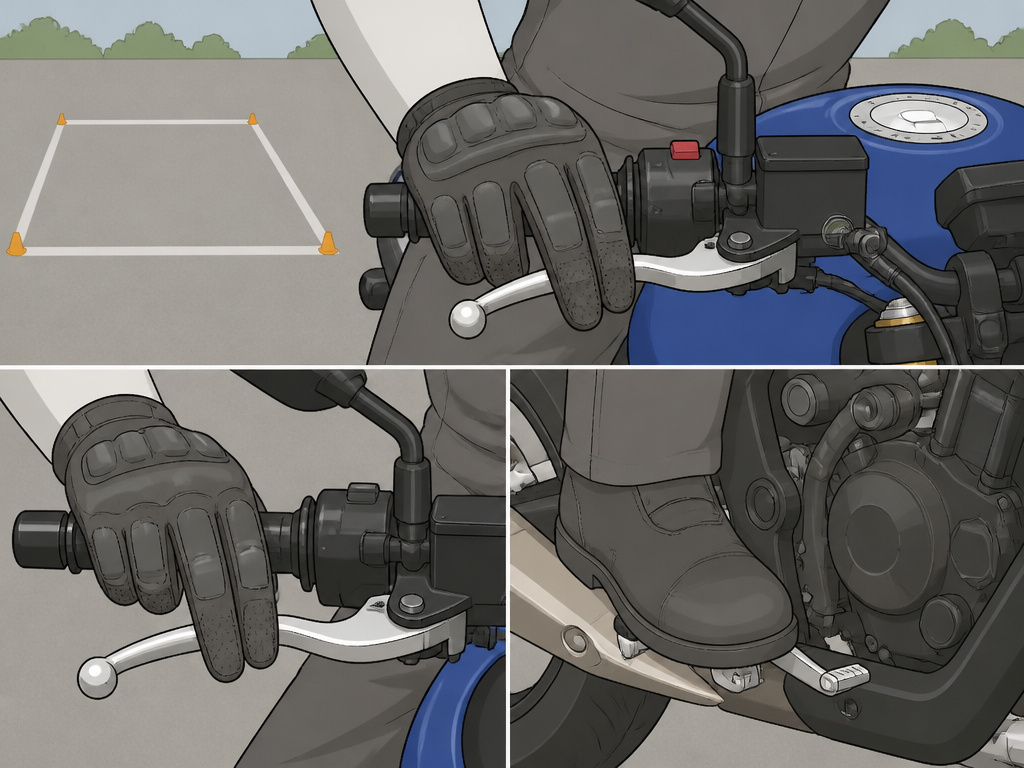
Reading about a U-turn won’t help you execute one. You need parking lot reps. The goal isn’t to become a parking lot champion, but to make the test maneuvers so boringly easy that test-day nerves can’t disrupt them, which is the core of how to pass the motorcycle road skills test.
1. The Cone Weave Drill.
Find an empty lot. Use water bottles or actual cones spaced 15 feet apart. Start with a wide, comfortable weave. Your focus should be two cones ahead, not the one you’re passing. As you improve, tighten the spacing to 12 feet. The skill here is smooth, counter-balanced leaning and gentle bar input, no jerky movements.
2. The Box Turn / Figure-8.
Use chalk, paint, or cones to mark a box roughly 20′ by 40′. Practice making a U-turn within it. The key is the friction zone. Drag your rear brake lightly to stabilize the bike, keep the revs slightly elevated with the throttle, and use the clutch’s friction point to control your speed. Look as far over your shoulder as you can through the turn. Your bike goes where your eyes go.
This is the single best way to build the low-speed control that defines the entire exam.
3. The Quick Stop.
Accelerate to 15-20 mph in a straight line in your practice lot. Pick a marker (a crack, a leaf). When your front tire reaches it, apply both brakes smoothly and progressively, with slightly more pressure on the front. Practice stopping in a straight line without skidding or locking a wheel. This directly translates to the test’s quick stop exercise and is a core braking skill for the street.
4. The Swerve Drill.
Place two objects (cones, bottles) about 6 feet apart to simulate an obstacle lane. Approach at 15-20 mph. Just before you reach the first object, push firmly on the handlebar in the direction you want to go (push left to go left) to initiate a quick, aggressive lean change, then immediately push the other way to straighten. Do not brake during the swerve. This builds the instinct for emergency obstacle avoidance.
Test Day: The Step-by-Step Walkthrough
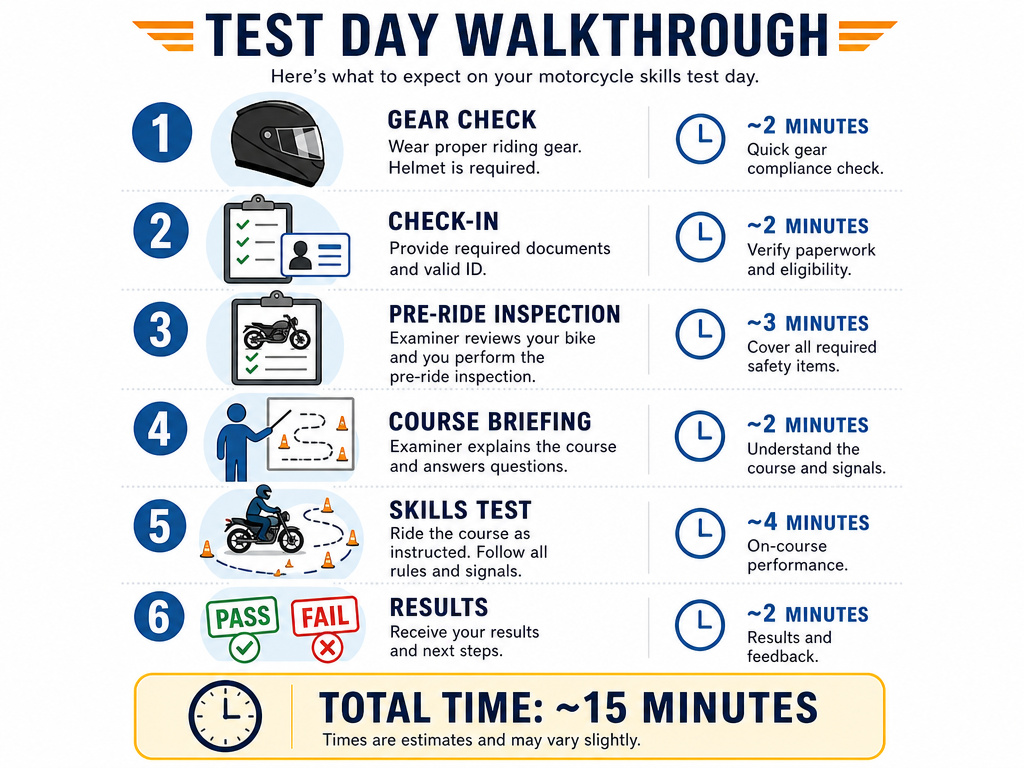
Knowing what happens from the moment you park to the moment you get your results cuts anxiety in half. Here’s the typical sequence.
- Arrive Early, Dressed Ready. Don’t plan to gear up in the lot. Wear your full helmet, jacket, gloves, pants, and boots when you get off the bike. The Maryland MVA explicitly says the examiner will not begin the test if you are not properly dressed for safety.
- Check-In. Have your learner’s permit, completed application (if required), and proof of registration and insurance ready. They’ll verify your identity and collect fees if you haven’t paid online.
- Motorcycle Safety Inspection. The examiner will walk around your bike, checking the items listed in section 2. They may ask you to operate the lights and horn. This is also where they’d ask for out-of-state insurance proof in Massachusetts.
- Pre-Test Briefing. The examiner will explain the course layout, demonstrate the path for each exercise (or have you walk it), and explain the scoring. Listen. Ask questions if something is unclear.
- The Test Itself. You’ll be asked to perform the exercises, one after another. The entire process, as noted by Virginia, takes about 15 minutes. Breathe. Focus on one maneuver at a time.
- The Results. The examiner will usually tell you on the spot. If you pass, they’ll often issue a temporary license or endorsement on the spot. If you fail, they should provide a scoresheet showing where you lost points.
Common mistake: Rushing through the examiner’s instructions to show you’re eager. Stand still, make eye contact, and process what they’re saying. A misheard instruction can lead you to drive the wrong course, which is an automatic failure.
What to Do If You Fail
Failing feels terrible, but it’s a data point, not a verdict. The first thing to do is ask the examiner for your scoresheet. Where did you lose points? Was it the U-turn boundary? The quick stop distance?
State Retake Rules Dictate Your Next Move:
- Massachusetts/Virginia: You have one attempt left before the mandatory training course rule kicks in. This is the time for serious, targeted practice, possibly with a more experienced rider coaching you.
- South Carolina: You have two more attempts at the DMV. Use the first retake after focused practice. If you fail a second time, seriously consider enrolling in an authorized safety course before your third and final DMV attempt.
The smartest move after any failure is to enroll in a formal Motorcycle Safety Foundation course or your state’s equivalent. You’ll get professional instruction on the exact skills you lack, and upon completion, you often get a waiver for the state skills test entirely.
Tips for Testing on a Heavy Motorcycle
Larger motorcycles demand more deliberate control at the low speeds tested. The key is smooth, early input. Initiate your turns and stops gradually, using the friction zone of the clutch to manage power smoothly. Practice slow, tight maneuvers in a parking lot to build muscle memory for balancing the bike’s weight without putting a foot down. Ensure the motorcycle is in excellent mechanical condition, with tires and brakes properly checked, as an examiner can cancel the test for any safety concern. Your confidence comes from knowing how your specific bike responds to subtle controls.
Frequently Asked Questions
How many times can you fail the motorcycle skills test?
It depends entirely on your state. Massachusetts and Virginia mandate a rider training course after two failed test attempts. South Carolina allows three attempts at the DMV before requiring you to pass the test through an authorized safety course. Always check your local DMV/RMV website for the exact rule.
Is the motorcycle road test hard?
It’s challenging if you’re unprepared, but straightforward if you’ve practiced the specific maneuvers. The fail rate is high for candidates who show up with only street-riding experience and no dedicated low-speed practice. The skills tested, slow U-turns, precise braking, cone weaves, are not typically used on the open road, so they require separate, focused rehearsal.
What is the 12-second rule on a motorcycle?
The “12-second rule” is an advanced visual lead-time principle for street riding, not a test skill. It means scanning the road about 12 seconds ahead of your bike to identify potential hazards early. While not on the skills test, cultivating this habit is a cornerstone of defensive riding and will make you a safer licensed rider.
Can you use your own motorcycle for the test?
Yes, in almost all cases you must provide your own motorcycle (or one you have permission to use). It must be street-legal, registered, insured, and pass the examiner’s safety inspection. Some states have restrictions on engine size for learner’s permits, so ensure your bike complies.
The Bottom Line
Passing the motorcycle skills test is a mechanical process. It rewards specific, practiced control over bravery or street experience. Before you worry about throttle control in a turn, master starting from a stop without a stall. Before you attempt the test, know your state’s retake limit, for example, two fails in Massachusetts and Virginia, but three in South Carolina, and let that timeline guide your preparation urgency.
If there’s one drill to run until it’s automatic, it’s the tight U-turn in a box using clutch friction and rear brake. That single maneuver proves low-speed mastery more than any other. When you can do that on a cold morning with someone watching, the rest of the test is just following directions.
