
How to Pass the Motorcycle Permit Test: Step-by-Step
This post contains affiliate links. As an Amazon Associate, we earn from qualifying purchases.
To pass the motorcycle permit test, treat it like a technical exam: study your state’s official manual, take multiple practice tests, and memorize the specific passing score. The test is about rules, not riding skill, and the format varies wildly by state, from 16 questions on Connecticut’s knowledge test to 50 questions on Washington’s permit knowledge test.
The numbers are the first thing that trips people up. You can’t study for a generic “motorcycle test” because the passing score in Massachusetts is different than in New York, and the question count in Washington is triple that of Connecticut. This is why you need to research how to pass the motorcycle permit test for your specific state.
What follows is the garage-bench method: we’ll break down the official test specs for five states as a reference, map out a study plan that actually sticks, and walk through the logistics of your DMV appointment so nothing surprises you. By the end, you’ll have a clear answer on how to pass the motorcycle permit test for your state.
Key Takeaways
- Study your state’s official motorcycle manual, it’s the only source for every test question. Generic advice fails because rules like helmet laws and right-of-way vary.
- Memorize your state’s specific passing score, which is explicitly defined in some states, such as 14/20 in New York and 18/25 in Massachusetts. Other states may not publish a specific percentage. Walking in without knowing your target is planning to fail.
- Take multiple full-length practice tests under timed conditions.
- Bring every required document to your appointment: proof of identity, residency, and payment.
- Consider a safety course like the MSF Basic Rider Course before the test. Some states offer a road test waiver for completing an approved safety course, and the classroom portion often covers material relevant to the permit test.
The State-by-State Test Format Breakdown
Forget “around 20 questions.” The permit test is not a national standard. The New York DMV gives you 20 questions and you need 14 right. Drive across the border to Massachusetts, and the RMV hits you with 25 questions in 25 minutes, requiring 18 correct. Washington’s test has 50 questions. Connecticut’s is only 16.
The NY motorcycle permit test requires a score of 70% (14 out of 20 questions correct) and a specific rule: you must answer at least two of the four road sign questions correctly to pass, regardless of your overall score. Other states have different formats and passing requirements. This is a featured-snippet target for the exact passing criteria.
These aren’t minor variations. They’re different tests. If you study for a 20-question exam and sit for a 50-question test, the longer format requires greater endurance and focus. The table below lays out the hard numbers from the official sources, so you know exactly what you’re walking into.
| State | Test Length | Passing Score | Time Limit | Key Restriction |
|---|---|---|---|---|
| New York | 20 questions | 14 correct (70%) | Not specified | Must get 2 of 4 road sign questions right |
| Massachusetts | 25 questions | 18 correct (72%) | 25 minutes | Online exam has strict camera/proctoring rules |
| Washington | 50 questions | % not specified | Not specified | Permit test is first of four total tests for endorsement |
| Connecticut | 16 questions | % not specified | Not specified | Permit valid for only 60 days, renewable once |
| Minnesota | % not specified | % not specified | Not specified | $29 knowledge test fee |
In Massachusetts, you can’t take the online permit test on a phone or tablet, it’s computer-only with a working webcam. New York has that road-sign sub-score. Connecticut gives you a permit that expires in two months. Washington’s 50-question permit knowledge test is part of the process to obtain a motorcycle endorsement. Know your state’s quirks before you open the manual.
Your Step-by-Step Study Plan
Open your state’s DMV website and download the official motorcycle operator’s manual. That’s step one. Every question on your test comes from that book, not from forums, not from your buddy’s advice, not from a general website. The Massachusetts RMV manual has the rules prohibiting riding alongside vehicles within a lane. Learning how to pass the motorcycle permit test starts with mastering this manual.
Here’s how to use it without drowning in text.
- First Pass: Skim for Structure. Don’t read word-for-word yet. Flip through and note the chapter titles: “Braking,” “Turning,” “Alcohol and Riding,” “Protective Gear.”
- Second Pass: Read with a Highlighter. Now read each chapter. Highlight definitions, specific numbers (speed limits, following distances, blood-alcohol limits), and any sentence that says “it is illegal to…” or “you must…”. These topics are commonly tested.
- Third Pass: Practice Test Attack. Take a practice test. Every wrong answer sends you back to the manual to re-read that specific section. This links the abstract rule to the actual test question.
Where this goes sideways: Studying the manual without taking practice tests. You’ll recognize concepts but fail to apply them to the multiple-choice format, which is how people who “know the material” still fail.
Practice tests help you recognize question patterns. Treat them as part of the study material, not just a final exam.
What to Expect on Test Day
Logistics matter as much as knowledge. The Massachusetts RMV requires specific technology for its online exam: a computer (no smartphones), a working camera, and a room with no other people or electronics. The Massachusetts RMV requires no other adults, children, or pets in the room during the online exam. If you’re taking it in person, you need an appointment and every document on their checklist.
We’ll explain the two paths.
In-Person Test:
- Documents: Bring proof of identity (birth certificate, passport), proof of residency (utility bill, lease), Social Security card, and payment for the test fee. Check your DMV’s website for the exact list. Massachusetts has one, New York has another.
- The Process: You’ll likely take a vision test first. Then you’ll sit at a kiosk or computer in the DMV office.
- The Result: If you pass, you’ll get a temporary paper permit on the spot. Your official permit card arrives by mail, which in Connecticut takes up to 20 business days.
Online Test (where available):
- Setup: You need a quiet, private room. The Massachusetts RMV rules are explicit: no other adults, children, or pets present. All other electronics (phones, smartwatches) must be left in another room. Your face must be fully visible, no hats, masks, or sunglasses.
- Proctoring: The software will take random photos of you during the exam to verify you’re the only person present and not using reference materials. Any violation ends your session.
- Result: A passing score typically grants you a temporary permit you can print, with the official card mailed later.
Common Topics and Tricky Questions
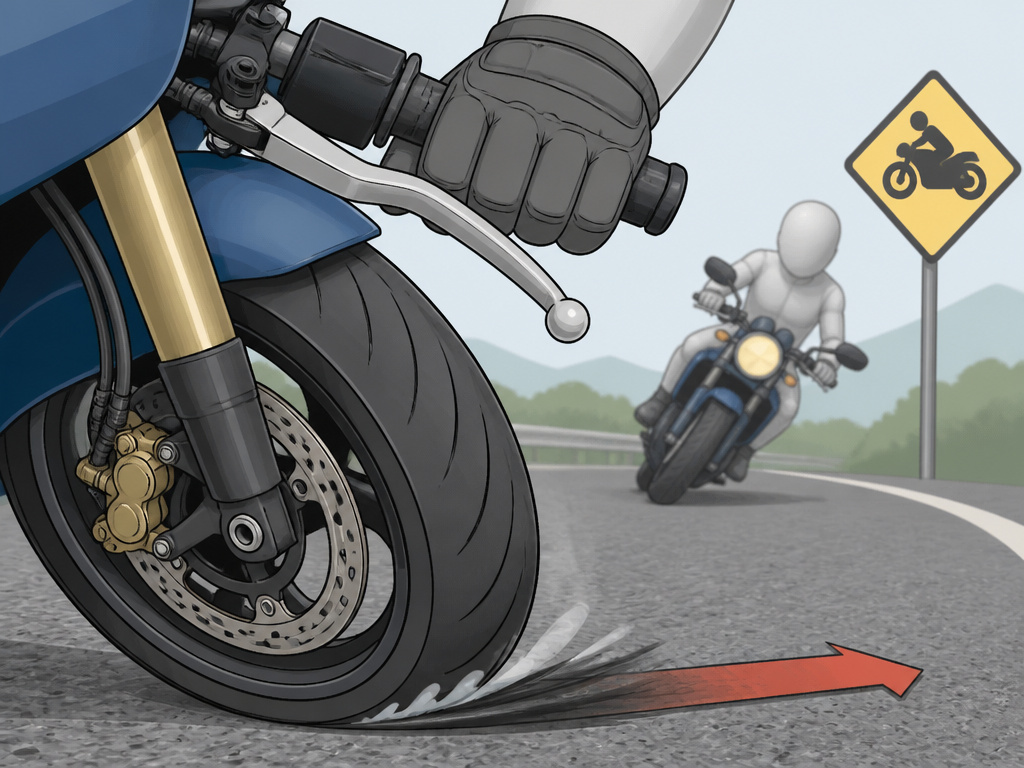
The test isn’t a mystery. It focuses on a predictable set of high-consequence topics. Across states, you’ll always see heavy emphasis on alcohol and drugs, right-of-way rules, proper lane positioning, and braking techniques.
In Massachusetts, the official manual states that motorcycle riders are prohibited from riding alongside motor vehicles within a single marked travel lane. This isn’t just a suggestion, it’s a specific, testable law about lane sharing.
Other common pitfalls include questions about helmet laws (which vary by state and age), the correct procedure for crossing railroad tracks, and how to handle a skid.
Here’s a short list of the most frequently missed concepts:
-
The meaning of specific road signs unique to motorcycles or hazard warnings.
-
Proper procedure for carrying a passenger (when your license allows it).
- How to handle a front-wheel or rear-wheel skid.
Drill these with your practice tests. If you get one wrong, don’t just note the right answer. Go back to the manual and read the whole section to understand the why. That’s how the knowledge sticks.
After You Pass: Understanding Your Permit

Congratulations, you passed. Now read the restrictions on that permit, they are not suggestions. A motorcycle learner’s permit is not a license. It’s a supervised learner’s tag with serious limits, and violating them can mean fines, points, or losing the permit.
The rules vary, but they follow a strict logic: limit risk while you’re learning. Connecticut is perhaps the most restrictive: daylight driving only, no passengers, not valid on highways, and you can only ride within the state. New York requires your supervising rider, who must be 21 or older with a valid motorcycle license, to be within a quarter-mile of you at all times. Massachusetts also restricts permit holders to daylight hours and bans passengers.
This phase is for practice, not pleasure riding. The NY DMV recommends at least 30 hours of practice, with 10 of those in medium-to-high traffic, before attempting the road test. Use this time deliberately. Practice the low-speed control maneuvers that will be on your road test, like figure-eights and tight turns from a stop.
Why a Safety Course is Your Smartest Move
You can grind through the permit test, then grind through learning to ride on your own. Or you can take a Motorcycle Safety Foundation (MSF) Basic Rider Course. For most new riders, the course is the smarter investment. Here’s the mechanical reason why: the classroom portion of the MSF course covers the exact material on the permit test, often in a more engaging way than reading the manual alone.
More importantly, many states offer a road test waiver. Pass the MSF course, and you skip the state-administered skills test entirely. In Minnesota, you must have 100% attendance and pass the course skills test to get the waiver. In New York, your course completion card must be issued within two years. Massachusetts requires riders under 18 to take its MREP course.
Common mistake: Thinking a safety course is just for learning to ride. Its structured curriculum is the most efficient way to pass the knowledge test and build the foundational skills for the road test or waiver.
There’s one major caveat, directly from the Minnesota DPS: if you have already failed a state skills test twice, you are not eligible for the skills test waiver. In that case, you must take all subsequent tests at a DMV exam station. This rule isn’t common in every state, but it shows how prior failures can change your path.
Requirements for Minors vs. Adults
Rules change if you’re under 18. In New York, a minor must wait at least six months from getting the learner permit before they can even schedule the road test. Massachusetts takes a different route, requiring applicants under 18 to take the MREP safety course and complete all junior operator requirements to get a license. While adults can often proceed directly after passing the permit test, minors face these extra steps and waiting periods. Always check your specific state’s rules, as the process for a minor involves more than just passing the written exam.
Frequently Asked Questions
How many questions are on the motorcycle permit test?
It varies drastically by state. New York’s test has 20 questions. Massachusetts has 25 questions with a 25-minute limit. Washington’s permit knowledge test has 50 questions. Connecticut’s is only 16 questions. Always verify the current format on your own state’s DMV website.
What is the passing score for the motorcycle permit test?
The passing score is a percentage, but states define it differently. In New York, you need 14 out of 20 correct (70%), including at least 2 of 4 road sign questions. In Massachusetts, you need 18 out of 25 correct (72%). Other states like Washington and Connecticut do not publish a specific percentage in the sourced materials, you simply need to pass their exam.
Is the motorcycle permit test hard?
The test is straightforward if you study the official manual and take practice tests. The difficulty comes from the volume of state-specific rules and the pressure of the testing environment. Riders who skip the manual and rely on general knowledge or “common sense” often find it challenging because many motorcycle laws are counterintuitive.
Can I take the motorcycle permit test online?
Some states, like Massachusetts, offer an online proctored exam. It requires a computer with a webcam, a private room, and strict adherence to proctoring rules (no other people, no secondary devices). Other states require in-person testing at a DMV office. Check your state’s DMV website for current options.
What happens after I pass the permit test?
You will receive a motorcycle learner’s permit. This allows you to practice riding on public roads but with significant restrictions: typically, you must be supervised by a licensed rider, cannot carry passengers, and may be restricted to daylight hours. Your next step is to gain the required practice hours and then schedule your motorcycle road test or complete a safety course for a waiver.
What should I bring to my permit test appointment?
You must bring documents to prove your identity, residency, and Social Security number. Typical requirements include a birth certificate or passport, a utility bill or lease agreement, and your Social Security card. You will also need payment for the testing fee. The Mass.gov motorcycle permit application page and the NY DMV motorcycle permit guide have exact checklists.
The Bottom Line
Passing the motorcycle permit test is a matter of matching your preparation to your state’s specific blueprint. Download the manual, hit the practice tests until you score above 90%, and walk in with every required document. The test itself is the easiest part of getting a motorcycle license, the real work of learning to ride safely begins the moment you have that permit in your hand.
Use the permit period for deliberate practice. Focus on the braking and low-speed control skills that form the core of the road test. If you have the means, take a safety course early; it’s the fastest path to both the knowledge test and the skills waiver. This isn’t about memorizing answers for a day. It’s about building the foundational knowledge that makes every future ride safer.
