
What Is EN 1621-4 Motorcycle Airbag Standard?
This post contains affiliate links. As an Amazon Associate, we earn from qualifying purchases.
EN 1621-4 is the European standard that defines the minimum performance requirements and test methods for mechanically activated motorcycle airbag vests and jackets. It specifies a minimum intervention time for the inflated bag, sets minimum coverage zones for the torso, and details lab tests for impact protection. A 2021 RAC Foundation report states there is a stated maximum intervention time of 200 milliseconds to achieve British Standard EN 1621-4:2013.
This 200-millisecond number is the article’s entire argument. That’s the line between certified and uncertified gear. It is also a line that independent research says is too slow for half the crashes you’re trying to survive.
The rest is mechanics and paperwork. What follows: the three things the standard actually tests, the five-year legal battle that almost killed it, the real-world failure rates a lab report won’t show you, and the one document you need to see before you hand over your card.
Key Takeaways
- The EN 1621-4:2013 standard applies only to mechanically activated (tether-based) airbag systems — electronic vests from Alpinestars or Dainese fall under different, often brand-proprietary, testing.
- Compliance hinges on a maximum intervention time of 200 milliseconds, but a 2021 safety report found 5 of 15 jackets tested failed to meet it.
- The standard is not a legal requirement for sale in the UK, and its status as a voluntary harmonized standard in the EU means an uncertified vest can sit on a shelf next to a certified one if the manufacturer declares it meets safety requirements through other means.
- You verify certification by looking for the EN 1621-4:2013 label and notified body number inside the garment, not just a brand’s marketing claim.
- Independent crash research by TRL suggests a 100-millisecond threshold is needed for effectiveness in vehicle collisions, which the standard’s 200ms does not guarantee.
The Core Requirements and the 200ms Threshold
The standard is a checklist for lab conditions, which is the core answer to what is en 1621-4 motorcycle airbag standard. It doesn’t judge how well a vest works on a wet road at an intersection; it checks if it inflates fast enough under specified test conditions.
EN 1621-4:2013 covers requirements and test methods for mechanically activated inflatable protectors for motorcycle riders. It specifies the minimum level of protection, the minimum intervention time of inflated bag, and the minimum coverage to be provided.
The intervention time is a key requirement. The RAC Foundation report states there is a stated maximum intervention time of 200 milliseconds to achieve British Standard EN 1621-4:2013. However, TRL research determined that to be effective in a motorcyclist to vehicle collision an airbag jacket must inflate within 100ms.
A vest that passes gets to print “EN 1621-4:2013” on its label. One that doesn’t, doesn’t. The problem is that threshold came from engineering consensus, not crash reconstruction. Later research by the UK’s Transport Research Laboratory (TRL) dug into real-world collisions. Their finding, cited in a 2021 Road Collision Investigation Project safety notice, was stark: to be effective in a motorcyclist-to-vehicle collision, the airbag must inflate within 100 milliseconds.
The standard’s 200ms ceiling is twice as long. That gap isn’t theoretical. The same TRL study looked at fifteen jackets on the market. Seven of them couldn’t hit the 100ms mark. Five failed their own test against the EN standard’s more generous 200ms limit.
Bottom line: The standard sets a baseline, not a gold standard. A certified vest cleared a lab hurdle. It didn’t necessarily prove it will work in the crash you’re most likely to have.
What Else the Standard Tests (And What It Misses)
Beyond the stopwatch, EN 1621-4 has three other jobs. It defines the minimum coverage zones the inflated bag must protect—typically the full back, shoulders, and chest. It requires impact attenuation tests, where a weighted striker hits the inflated protector to measure how much force is transferred through it. And it sets rules for labeling, sizing, and ergonomics so the thing is wearable and its instructions are clear.
The criticisms are more revealing than the requirements. In 2013, the French government filed a formal objection to block the standard’s publication. Their engineers argued the tests were flawed for an inflatable system. They said the standard had no pressure test to verify the bag reached protective pressure at the moment of impact, did not provide for multidirectional testing of the airbag deployment, and applied an impact test designed for rigid armor to a cushion of air. They also noted the standard ignored the thickness of the uninflated airbag when defining protection zones—a bulky vest might actually move the armor away from your body before it inflates.
The European Commission overruled France in 2018, publishing the standard anyway. But the objection stands in the official record. It’s a five-year-old warning label from a government safety agency that the test you just passed might not test the right thing.
Mechanical vs. Electronic: Why EN 1621-4 Covers Only One Type
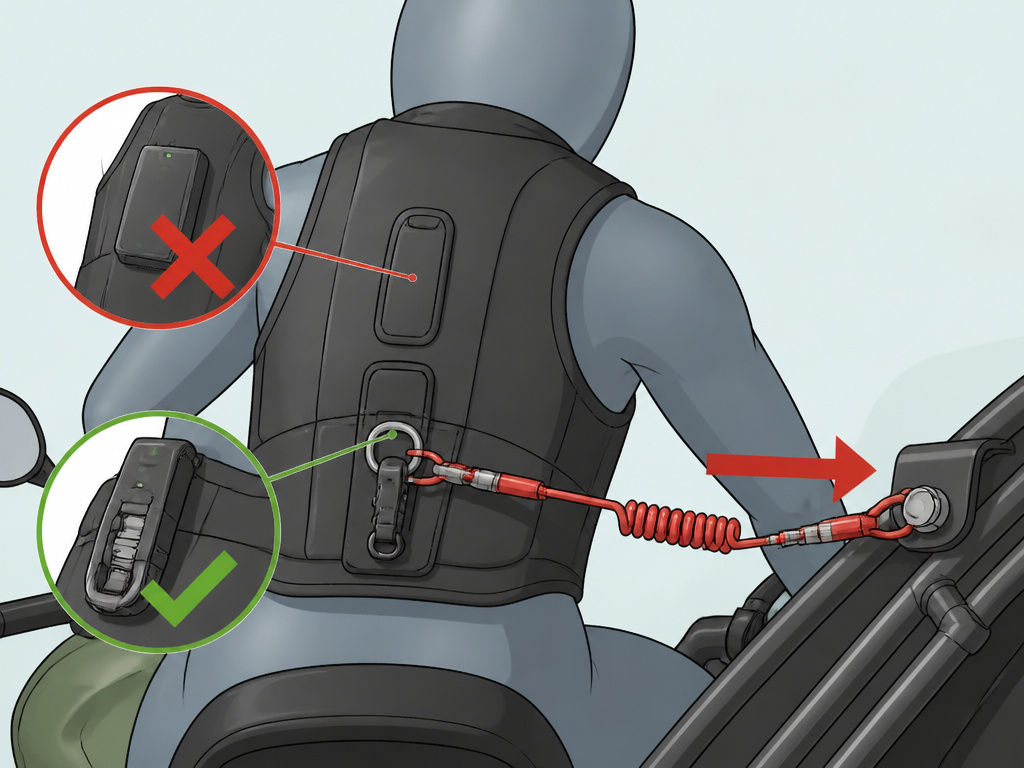
This is the first decision point for any rider. The standard’s scope is explicit: “Inflatable protectors other than mechanically activated are not covered by this standard.”
| System Type | How It Activates | Covered by EN 1621-4? | Primary Concern |
|---|---|---|---|
| Mechanical (Tether) | Physical lanyard pulls a trigger when rider separates from bike. | Yes. This is the standard’s sole focus. | Tether length setup, false deployments from dismounting. |
| Electronic (Sensors) | Accelerometers and gyros in a central unit detect a crash and fire a CO2 cartridge. | No. Inflatable protectors other than mechanically activated are not covered by EN 1621-4:2013. | Battery life, sensor calibration, algorithm reliability. |
That table explains the market. When you look at a Helite Turtle 2 vest, its certification is straightforward—it’s a mechanical system tested to EN 1621-4. When you look at an electronic system, its certification may involve in-house testing, as such systems are not covered by EN 1621-4. The electronic system’s brain is judged by the brand’s own claims, not an independent lab’s stopwatch.
This creates a weird inversion. The simple, dumb tether system has a clear, public standard. The complex, smart electronic system operates in a regulatory gray area. For a deeper dive on this split, our comparison of tethered vs electronic airbag systems breaks down the pros and cons of each path.
The Legal Dispute and What It Means for You
France’s objection wasn’t a minor footnote. It froze the standard’s adoption for five years, from 2013 to 2018. The Commission’s final decision to publish it is a public document that records the dispute. It’s rare to see this kind of engineering debate in the open.
The disagreement centered on whether the standard met the “basic health and safety requirements” of the EU’s Personal Protective Equipment (PPE) Directive. France said no, citing the missing pressure and multi-directional tests. The Commission said France’s arguments were “not sufficiently substantiated.”
For you, the rider, this history does two things. First, it tells you that even national safety experts disagreed on whether this standard was rigorous enough. Second, it shows that compliance is voluntary. A manufacturer can sell an airbag vest in Europe without EN 1621-4 certification, as long as they declare it meets the PPE Directive’s basic requirements through other means. There is no police force for lab standards.
This is why you can’t trust the sales tag. You have to trust the label sewn into the garment itself. Understanding the broader CE marking system for protective gear is the first step to decoding what those labels actually promise.
How to Verify EN 1621-4 Certification (Step-by-Step)
Don’t take the website’s word for it. Don’t take the sales clerk’s word for it. The proof is in the stitching. Here’s how to find it.
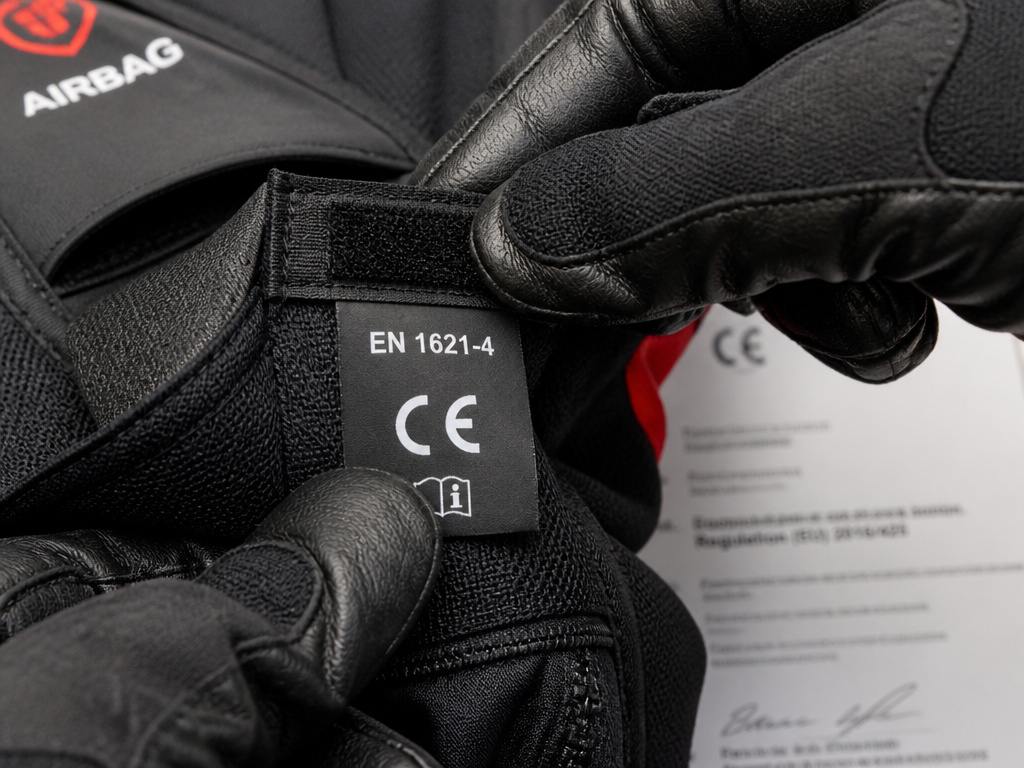
- Locate the compliance label. It’s sewn into the inner liner of the vest or jacket, usually near the lower back or side seam.
- Look for the code “EN 1621-4:2013”. It must say “EN 1621-4:2013“. Just “EN 1621-4” is incomplete. The year matters.
- Find the four-digit notified body number. This is the killer. Next to the standard, you should see a small shield icon with a four-digit number (e.g., 0123). This identifies the independent lab that tested and certified the product. No number? It’s a manufacturer’s self-declaration, not a third-party certification.
- Cross-reference the sizing and protection zones. The label should also indicate the size and the specific body zones (back, chest, shoulders) the certification covers.
Common mistake: Buying based on a brand’s claim of “meeting” or “being inspired by” EN 1621-4. The only phrase that counts is “certified to EN 1621-4:2013” with a notified body number.
If the vest is integrated into a jacket, also check for CE Level 1 and Level 2 ratings for the accompanying shoulder, elbow, and back armor. The airbag is for your torso; the foam armor is for your joints.
Real-World Performance vs. Lab Paper
The lab says 200 milliseconds is the pass mark. The crash investigators say you need 100. What do the manufacturers claim? The RAC Foundation report collected their numbers: Helite claims inflation in under 100ms; RST claims activation in under 60ms.
Those are impressive numbers. They’re also marketing claims, often from in-house testing. The independent TRL data suggests the reality across the market is messier. When they tested 15 jackets, the variance was huge. Some beat the standard easily. Others couldn’t even hit the 200ms benchmark. Three jackets were too slow for a low-side crash, which TRL research determined has a threshold of 320ms.
This variance is the single biggest reason for caution. The standard creates a floor, but a high floor. Yet the market is full of products that can’t clear it. The UK’s Office for Product Safety and Standards has been encouraged to investigate these “sub-standard” jackets. Nothing has changed yet.
When you’re comparing specific models, our roundup of airbag vests with verified certification details which ones have proof of compliance and which ones rest on shakier ground.
Certification process and its importance
The certification process for an airbag jacket involves testing against the standard’s checklist for lab conditions, which defines what is en 1621-4 motorcycle airbag standard. A product that meets these requirements can be certified as compliant. However, compliance with this standard is not a legal requirement for sale in some markets. The importance of certification lies in it being a baseline check. It verifies that a mechanically activated protector meets specified minimums for protection, coverage, and intervention time under controlled test conditions. It does not guarantee real-world performance in every crash scenario.
Performance levels (Level 1 vs. Level 2)
The EN 1621-4 standard specifies a single set of minimum requirements for mechanically activated inflatable protectors. Instead, it specifies a single set of minimum requirements for mechanically activated inflatable protectors. This includes a minimum level of protection, a minimum intervention time for the inflated bag, and minimum coverage. The standard’s focus, as defined by what is en 1621-4 motorcycle airbag standard, is on establishing this baseline pass/fail threshold. When considering a product, look for the EN 1621-4 marking, which indicates it passed the standard’s tests. Be aware that some research suggests the standard’s maximum intervention time threshold may be less stringent than what is considered necessary for effectiveness in certain real-world collision types.
Frequently Asked Questions
Is EN 1621-4 certification a legal requirement?
No. It is a voluntary harmonized standard. A manufacturer can sell an airbag vest in the EU and UK without this certification if they can demonstrate it meets the general safety requirements of the PPE Regulation through other means. However, certification is the clearest and most respected way to prove compliance.
Does EN 1621-4 cover neck protection?
No. The standard’s defined coverage zones are for the torso, shoulders, and chest. Some products may have additional collar systems that inflate, but those features are not assessed under EN 1621-4. Their protection claims are separate from the standard’s certification.
What’s the difference between EN 1621-4 and CE Level 1/Level 2?
They test completely different things. EN 1621-4 tests the inflation system and coverage of an airbag. CE Level 1 and Level 2 (under standards like EN 1621-1) rate the impact absorption of rigid foam or plastic armor for shoulders, elbows, knees, and back. A jacket can have both: CE Level 2 back armor and an EN 1621-4 certified airbag system.
How does inflation time affect safety?
Time is force. In a crash, your body is decelerating toward an obstacle or the ground. The airbag must inflate and create a protective cushion before your body makes contact. Research indicates that in high-speed vehicle collisions, this window may be as short as 100 milliseconds. An airbag that inflates in 200ms may still be too late for the initial impact, though it could help with secondary impacts or rollovers.
Where can I read the full EN 1621-4 standard?
The full standard is a copyrighted document sold by national standards bodies. You can purchase the official text, such as UNE-EN 1621-4:2013, from the Spanish Association for Standardization (UNE) or other bodies like Austria’s ÖNORM.
Before You Go
The standard is a tool, not a guarantee. Its 200-millisecond benchmark is a start, but your buying process shouldn’t end there.
First, verify the certification label inside the garment. If the notified body number is missing, you’re looking at a promise, not a proof. Second, temper manufacturer speed claims with the known variance from independent studies. A claim of “under 60ms” is a data point, not a warranty. Finally, remember the system type. If you’re looking at an electronic vest, you’re moving from public standards to an area of brand trust and proprietary algorithms. Your due diligence there is different—checking battery protocols, firmware update histories, and real-world rider reports on false deployments.
The goal isn’t to find the vest with the fastest claimed time. It’s to find the one with the most credible, verified proof that it will work at all. Everything else is just a jacket.
