
Tethered vs Electronic Motorcycle Airbag Vest
This post contains affiliate links. As an Amazon Associate, we earn from qualifying purchases.
A tethered motorcycle airbag vest uses a physical lanyard that pulls a trigger when you separate from the bike, inflating in roughly 100–200 milliseconds. An electronic motorcycle airbag vest uses internal sensors and an algorithm to detect a crash, inflating in under 60 milliseconds. The tethered system is simpler and cheaper to reset, while the electronic system is faster.
That speed gap is the headline, but it’s not the whole story. The real choice is a trade-off between mechanical certainty and algorithmic versatility, often framed as tethered vs electronic motorcycle airbag vest. The wrong pick for your riding style can leave you unprotected in the exact crash you’re most likely to have.
What follows: a breakdown of how each system actually works, the certified numbers behind their claims, and the long-term cost of owning and trusting each one. By the end, you’ll know which type fits your bike, your budget, and your most probable get-off.
Key Takeaways
- Electronic vests deploy faster (under 60 ms) than tethered vests (~100–200 ms), a difference that matters most in low-speed or complex crashes where you don’t fully separate from the bike.
- Tethered systems have zero electronic dependencies, no batteries, no software, no sensor calibration. Their failure mode is simple and visible: a broken or disconnected lanyard.
- Reset costs diverge dramatically after a crash. A tethered vest needs a $5 CO2 cartridge; an electronic vest often requires a factory service and a multi-week wait.
- Certification is not universal. Look for the EN 1621-4 standard for the airbag itself; some electronic systems also carry garment certifications like EN 17092-6.
- Fit overrides features. A vest that’s uncomfortable or difficult to put on won’t get worn, making its technology irrelevant.
The Core Difference: Trigger vs. Sensor
The divide starts with the first millisecond of a crash. A tethered system is a physical machine. You clip a lanyard from the vest to your bike’s frame. During a crash, when you separate from the bike, the lanyard pulls a pin that triggers a CO2 cartridge. The vest inflates. It’s a direct, kinetic chain.
An electronic system is a computer you wear. A small module packed with accelerometers and gyroscopes analyzes your movement 1,000 times per second, comparing it against an algorithm trained on crash data. When it detects a specific, violent motion pattern, it fires a pyrotechnic or cold-gas inflator. There is no physical connection to the motorcycle.
The technical snippet: Tethered (mechanical) airbag vests operate on a lanyard-actuated trigger mechanism, requiring a physical separation from the motorcycle to initiate inflation via a CO2 cartridge. Electronic (sensor-based) systems utilize an inertial measurement unit (IMU) and a proprietary algorithm to detect crash kinematics, enabling deployment without a tether and offering protection in a wider range of impact scenarios, including low-side falls where rider-bike separation is minimal.
This isn’t just about convenience. That tether defines the core limitation in a tethered vs electronic motorcycle airbag vest comparison: it only works if you are pulled away from the bike with enough force. If you are not pulled away from the bike with enough force, the lanyard may not see the 20 kg of pull force the RTC Touring Evo requires. The electronic system’s sensor is watching for the crash event itself, not your distance from the chassis.
Deployment Speed: Milliseconds Matter
Every manufacturer publishes an inflation time. Those numbers are not all measured the same way, and the difference between 50 ms and 200 ms is more than a spreadsheet stat.
| System Type | Claimed Deployment Time | Representative Model | What That Time Covers |
|---|---|---|---|
| Electronic | Under 60 milliseconds | Klim Ai-1, HELD eVest Pro | Sensor detection + gas inflation |
| Electronic | 50 milliseconds | Alpinestars Tech-Air 3 | Sensor detection + gas inflation |
| Tethered | Less than 0.2 seconds (200 ms) | RTC Touring Evo | Lanyard pull + CO2 inflation |
| Tethered | Roughly 100 milliseconds | Hit-Air MLV | Lanyard pull + CO2 inflation |
| Tethered | From 90 milliseconds | Airobag | Lanyard pull + CO2 inflation |
Manufacturers of some electronic systems, such as Klim and HELD, claim inflation times under 60 milliseconds, while tethered systems like the RTC Touring Evo, Hit-Air MLV, and Airobag claim times ranging from roughly 90 to 200 milliseconds. The Klim Ai-1 and HELD eVest Pro both cite times under 60 ms. The Alpinestars Tech-Air 3 claims 50 ms.
Tethered systems are slower because physics dictates it. The lanyard must first be pulled taut, then it must exert enough force to shear a pin or trigger a mechanism, the RTC vest needs 20 kg of force. Then the CO2 gas must fill the bladder. Some tethered systems, like the Hit-Air MLV, claim deployment in roughly 100 milliseconds. The RTC Touring Evo claims inflation in less than 0.2 seconds (200 ms).
Is 100 ms fast enough? For a clean high-side where you’re launched from the bike, probably. That’s where the electronic system’s speed is a real advantage, not just a spec-sheet win.
The Reliability Debate: Simplicity vs. Intelligence
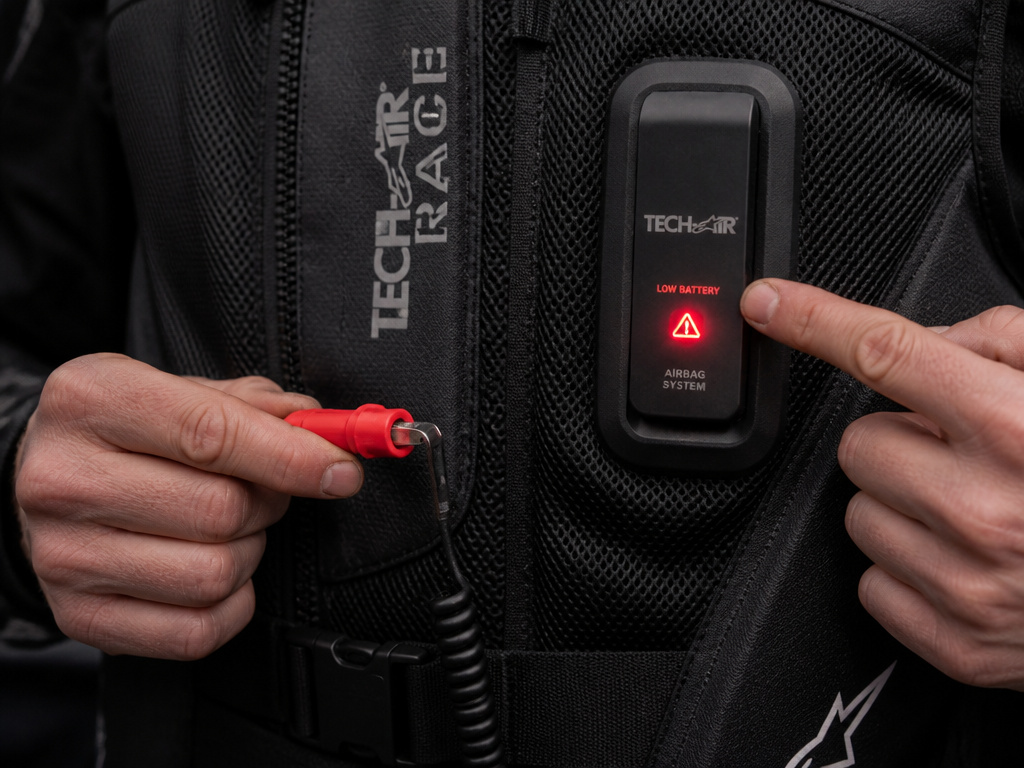
This is where opinions get firm. Proponents of tethered systems point to their mechanical simplicity. No battery to charge. No software to glitch. No calibration required. The system is either connected and armed, or it isn’t. Airobag claims there are no European Union-approved certification processes for electronic airbags due to reliability concerns, while manufacturers like Klim promote their electronic systems’ certifications, such as the Klim Ai-1’s CE Level C certification to EN 17092-6.
Electronic system manufacturers, of course, disagree. They point to their certifications, like the Klim Ai-1’s CE Level C to EN 17092-6, and the millions of kilometers of riding data that train their algorithms. Dainese argues the tether itself is a risk, creating a “physical constraint between rider and vehicle” if it fails to break in a crash.
Where this goes sideways: Assuming an electronic system is “smart enough” to never false-deploy. The algorithms are designed to ignore hard braking, potholes, and knee-down cornering, but they’re not perfect. A false deployment is a violent, startling event that requires service to reset.
Both systems in the debate over tethered versus electronic motorcycle airbag vests can fail. A tethered system can fail if the lanyard is routed incorrectly, gets snagged, or if the rider forgets to connect it, a human-factor error every single ride. An electronic system can fail if the battery is dead or the sensor is damaged. The debate isn’t about which is perfect; it’s about which failure mode you’re more comfortable managing.
The Real-World Cost of Crashes
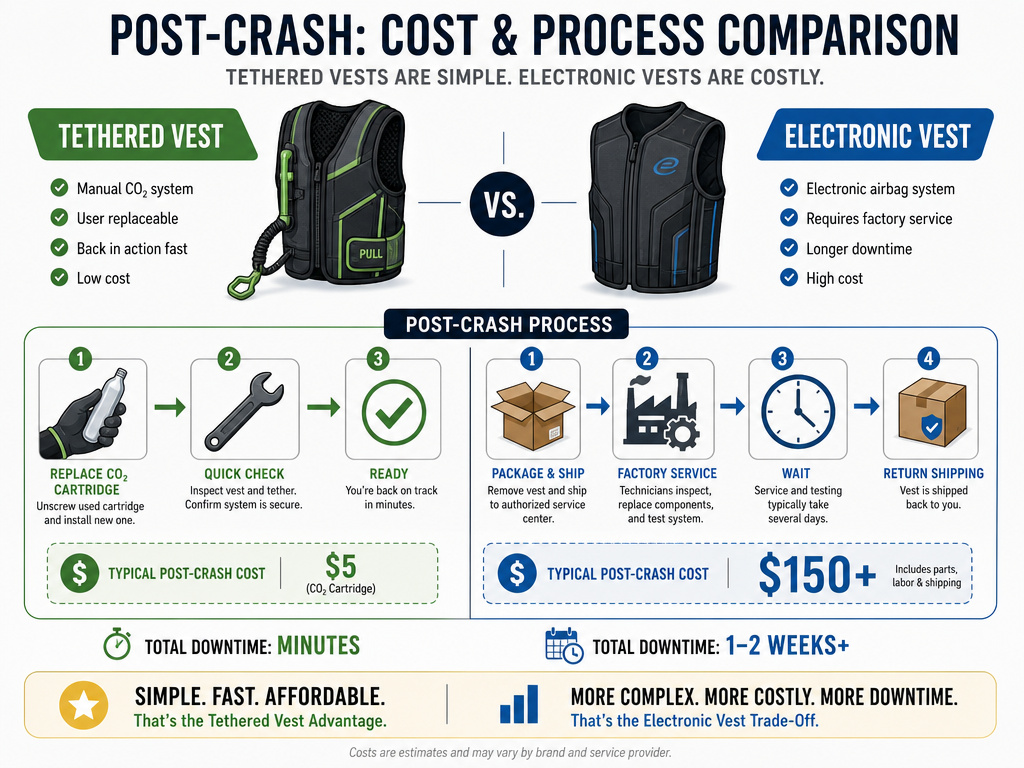
The purchase price is just the entry fee. The real financial test is what happens after the bang. Here, the systems could not be more different.
A tethered system is user-serviceable. If the vest inflates and isn’t physically torn, you reset it yourself.
- Purchase a new CO2 cartridge. The RTC Touring Evo uses a 60 cc, 45 g cartridge. Airobag claims its system can be reactivated for less than $5 USD per activation.
- Screw it in. The process takes five minutes with the included tool.
- You’re ready to ride.
An electronic system almost always requires a trip back to the manufacturer or an authorized dealer. The system logs the deployment and will often lock itself after a set number (usually three).
- Ship the vest for service. This is mandatory for systems like the Alpinestars Tech-Air 3, where “this inflator replacement must be undertaken by an authorized Alpinestars’ Dealer and/or Service centre.”
- Pay for parts, labor, and diagnostics. The system must be sent for service, which incurs a cost and a wait.
- Re-certify the system.
Long-term cost projection (5 years, 2 deployments):
Fit, Compatibility, and Daily Use
A vest in the closet is useless. How each system integrates into your actual riding routine decides whether it gets worn.
Tethered Vest Daily Routine:
- Put on the vest.
- Connect the lanyard to the anchor point on your bike’s frame.
- Ride.
- Crucial step: Remember to unclip the lanyard before you dismount. Forget this, and you may trigger the vest as you walk away.
Electronic Vest Daily Routine:
- Ensure the battery is charged (the Dainese Smart Air offers up to 18 hours).
- Put on the vest.
- Power it on. Wait for the startup sequence and armed indicator.
- Ride.
- Power it off after your ride to save battery.
The tether is a physical reminder that you’re connected. It’s also a hassle if you frequently stop and get off the bike, or if you ride multiple motorcycles. You’ll need to install an anchor point on each bike, and the act of clipping and unclipping becomes a ritual.
The electronic vest is simpler once it’s on your body, but it adds the mental load of battery management. Let the charge dip too low, and you’re riding without protection.
Common mistake: Wearing any airbag vest under a loose-fitting jacket. The vest should be snug, and the jacket should be fitted enough to move with you, not swim around you.
Certification & Protection Levels: Reading the Label
Not all airbags are certified equal. You’ll see two key standards:
- EN 1621-4: This certifies the airbag bladder itself for impact protection. It’s the baseline. The RTC Touring Evo and Airobag both claim this certification.
- EN 17092-6: This is a newer, broader garment certification for motorcycle airbag clothing. It assesses the entire vest, including seam strength, fit, and the integrated airbag system. The RTC Touring Evo also carries this, plus the Alienor Certification AMC-013 protocol.
Then there’s back protector certification. This is separate from the airbag.
- The RTC Touring Evo includes a SAFE TECH 851 back protector rated EN 1621-2 Level 2 (the higher level).
- The Klim Ai-1 includes a memory elastane back protector rated EN 1621-2 Level 1.
- The Airobag includes a TRIFLEX viscoelastic back protector rated EN 1621-2 Level 2.
Some vests may not include a separate back protector, relying instead on the airbag for spinal protection.
Specific brand/model recommendations and reviews
When comparing specific models, focus on the performance data and certified standards each brand publishes. For example, the Klim Ai-1 claims a detection + inflation time under 60 milliseconds and the Alpinestars Tech-Air 3 claims 50 milliseconds, while the RTC Touring Evo inflates in less than 0.2 seconds (200 ms). Some vests, like the RTC Touring Evo and Airobag, include a back protector certified to EN 1621-2 Level 2, while others may use a Level 1 protector. Review how many deployments a system allows before a service lockout; for example, the Dainese Smart Air supports up to three deployments, the Klim Ai-1 chassis is rated for 3 inflations, and the Alpinestars Tech-Air 3 locks after the third deployment. Check if the manufacturer states the vest is for road use only or if it supports light off-road riding.
Real-world user experiences and forum discussions
Reading rider forums reveals practical insights beyond specification sheets. Users of tethered systems often discuss the reliability of the physical connection and the straightforward, user-serviceable reset process after a deployment. The Dainese Smart Air system offers up to 18 hours of battery life. Post-crash service requirements differ; for example, Dainese states you can replace the gas generator independently, while Alpinestars requires service by an authorized dealer. These discussions highlight how each system’s design philosophy translates to daily use and unexpected get-offs.
Frequently Asked Questions
What is the best airbag vest for motorcycles?
There isn’t one “best” for everyone. For a commuter or tourer who wants simplicity and low running costs, a tethered vest like the RTC Touring Evo is a robust choice. For a rider who ventures off-road, does track days, or wants the fastest possible deployment, an electronic system like the Klim Ai-1 or Alpinestars Tech-Air 3 is the better tool. Always match the system to your most common riding scenario.
Are motorcycle airbag vests worth it?
Yes. Studies and real-world data show they dramatically reduce the risk of serious torso, spine, and neck injuries. They are the single most effective piece of protective gear you can add beyond a helmet, jacket, and gloves. Whether the investment is “worth it” is a personal calculation, but the protective benefit is objectively significant.
Can you reuse a motorcycle airbag vest after it deploys?
Yes, both types are reusable. A tethered vest is reused by replacing the spent CO2 cartridge. An electronic vest must typically be sent to an authorized service center to replace the gas inflator and reset the system’s electronic lock. The vest’s outer shell must also be inspected for damage.
How do I maintain my airbag vest?
For tethered vests: periodically inspect the lanyard for fraying, check the CO2 cartridge seal, and ensure the trigger mechanism moves freely. For electronic vests: follow the charging schedule, keep the firmware updated if possible, and store it in a temperate, dry place. For all vests, consult the specific airbag vest maintenance guide for detailed, model-specific care.
Do electronic airbags work off-road?
Many do, but you must check the specific model’s capabilities. Systems like the Dainese Smart Air have a dedicated OFFROAD mode, and the Alpinestars Tech-Air 3 is rated for “light off-road riding (gravel roads only).” The algorithms are tuned to ignore the bumps and vibrations of dirt riding. A tethered vest works off-road exactly as it does on-road, only if you separate from the bike.
The Bottom Line
The choice between tethered and electronic isn’t about which technology is better in a lab. It’s about which one you will use consistently and which one protects you in your crashes.
For the majority of street riders, commuters, weekend tourers, and casual canyon carvers, a tethered vest is the pragmatic buy. Its limits are clear, its costs are predictable, and its operation is dead simple. You trade some coverage scenarios for mechanical certainty.
If your riding includes track days, aggressive off-road sections, or if the idea of a tether feels clunky and restrictive, the electronic system is your path. You pay more upfront and after any crash for the benefit of faster, algorithm-driven protection.
Fit the vest before you buy anything. Then, read the manual. Understand exactly how to reset it after a crash, that process to reset an airbag vest is part of the purchase price. The best airbag is the one you wear every time you swing a leg over the bike.
