
What Is EN 1621 Motorcycle Armor Standard?
This post contains affiliate links. As an Amazon Associate, we earn from qualifying purchases.
The EN 1621 standard is a European test specification for motorcycle limb armor. It defines two protection levels—Level 1 (≤35 kN transmitted force) and Level 2 (≤20 kN)—by dropping a 5 kg weight from a 1-meter height onto armor samples. A CE mark with the EN 1621-1 designation means the protector passed this mandatory lab impact test.
That 15-kilonewton gap between Level 1 and Level 2 is the difference the standard quantifies. It is not a guess or a marketing tier. It is a measured threshold from a repeatable lab procedure that decides how much force your shoulder, elbow, hip, or knee might absorb in a crash.
What follows is a breakdown of that procedure, what the numbers actually mean on the road, and how to use the standard to spot real protection versus a sales claim, starting with the core what is en 1621 motorcycle armor standard question. The explanation includes the test rig, the two armor levels, the coverage zones, and the one critical thing the standard does not test.
Key Takeaways
- The EN 1621-1 standard tests only impact protection for limb joints (shoulders, elbows, hips, knees) through a specific lab drop-test.
- Level 2 armor (≤20 kN) absorbs significantly more energy than Level 1 (≤35 kN), but the standard notes it may be heavier and less flexible.
- A CE mark with “EN 1621-1” is not a guarantee of quality; it only certifies the armor passed the basic impact test under defined conditions.
- The standard’s optional high/low temperature tests mean a certified protector may not perform the same in freezing winter or scorching summer heat.
- In Austria, the ÖNORM EN 1621-1 adoption is cited in law, making compliance a legal requirement, not just a safety recommendation.
What Is EN 1621? The Core Definition
EN 1621 is a series of European standards for motorcycle personal protective equipment. Part 1, which is what riders mean when they talk about “CE armor,” is EN 1621-1. Its full title is “Motorcyclists’ protective clothing against mechanical impact – Part 1: Motorcyclists’ limb joint impact protectors – Requirements and test methods.”
This European Standard specifies requirements and test methods for limb joint impact protectors incorporated or intended to be incorporated into motorcycle riders’ clothing or used as separate items.
Translated from standards-speak, it is a recipe for a lab test designed to answer what is en 1621 motorcycle armor standard. It tells manufacturers and testing houses exactly how to bash a piece of armor and measure the result. The goal is consistency: a Level 2 protector from one brand should, in theory, offer the same baseline impact absorption as a Level 2 from another. It says nothing about abrasion resistance, comfort, or how the armor behaves after its first hit. It is a single-impact snapshot.
The current version is EN 1621-1:2012, which replaced the older 1997/1998 edition. A revision project (prEN 1621-1 rev) was approved in October 2024, meaning the specifics could change in the coming years. For now, the 2012 version is the rulebook.
EN 1621-1 vs. EN 1621-2 and EN 1621-3
This is where riders get tripped up. EN 1621 has three main parts, and they cover different things.
- EN 1621-1: Limb joints. Shoulders, elbows, hips, knees.
- EN 1621-2: Back protectors. This is a separate standard with its own levels (Level 1 & Level 2) and test methods. A back protector CE-marked to EN 1621-2 is tested differently than limb armor.
- EN 1621-4: Airbag systems. This newer part covers inflatable protectors, which is a completely different technology.
When you check your jacket’s armor, you need to see EN 1621-1 on the label for the limb pads, which is the direct answer to what is en 1621 motorcycle armor standard. A back protector should show EN 1621-2. Confusing them is a common mistake, and it matters because the testing forces and pass/fail criteria are not the same.
How the EN 1621-1 Impact Test Actually Works
The test is brutally simple in concept. It simulates a direct impact to the protector and measures how much force travels through it to the hypothetical body underneath. The devil, as always, is in the meticulously defined details.
The lab uses an anvil with a 50 mm diameter hemispherical impact surface. A 5 kg striker mass is dropped onto the armor sample from a height of 1 meter. The test measures the force transmitted through the protector in kilonewtons (kN). To pass, the average transmitted force from multiple impacts must be below the threshold for its claimed level.
| Test Component | Specification | Why It Matters |
|---|---|---|
| Striker Mass | 5 kg | Standardizes the energy of the impact. |
| Drop Height | 1 m | Sets the impact speed and energy. |
| Impact Surface | 50 mm hemisphere | Simulates a rounded, curb-like object. |
| Sample Size | Minimum 3 protectors | Ensures consistency, not a fluke result. |
| Impacts per Sample | 9 total (3 per test area) | Checks performance across the protector’s surface. |
The armor is conditioned before testing. Mandatory tests are done on samples that are dry and wet. The optional tests are the catch: the standard allows for additional testing at high temperature (+40°C) and low temperature (-10°C), but these are not required for certification. A protector could pass the standard lab test at room temperature but stiffen and transmit more force in freezing cold, or soften and bottom out in extreme heat. The certification does not tell you which tests were run.
Where this goes sideways: Assuming all certified armor performs the same in all weather. If you ride in winter, the optional cold test is the one that actually matters for your safety, but most brands do not advertise whether their armor passed it.
Level 1 vs. Level 2: The kN Numbers That Matter
This is the core of the standard. The difference is not subjective; it is a defined maximum transmitted force.
- EN 1621-1 Level 1: Maximum transmitted force must be ≤ 35 kN.
- EN 1621-1 Level 2: Maximum transmitted force must be ≤ 20 kN.
Level 2 armor must absorb more energy, letting significantly less force pass through to your body. The standard itself acknowledges a trade-off, stating that Level 2 protectors “may be, however, weight and restriction penalties associated with level 2 protection.” In plain English: better protection can mean a stiffer, heavier, or bulkier pad.
So which level should you choose? For street riding, many safety experts recommend Level 2 as the target for critical joints like shoulders, elbows, and knees, though the standard notes potential weight and comfort trade-offs. The improvement in impact absorption is substantial. The potential trade-off in comfort is worth it. For casual, low-speed riding, Level 1 is a certified minimum, but it is the minimum. Your gear choices should trend upward from there.
Hip protectors are a slight exception. Because you sit on them, excessive stiffness in a Level 2 hip pad can be genuinely uncomfortable. Some riders prefer a slimmer, more flexible Level 1 hip protector they will actually wear over a bulky Level 2 pad they leave in the drawer. It is a compromise, but an informed one.
Armor Coverage: Type A, Type B, and Zone Codes
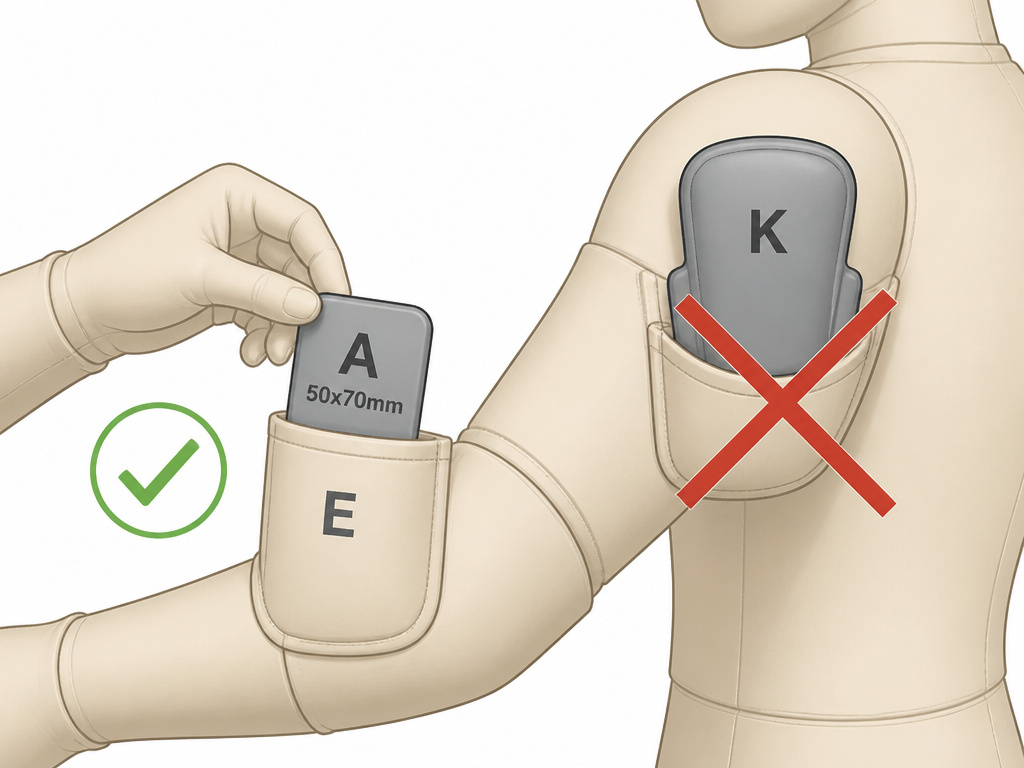
Passing the force test is one thing. Covering the right area is another. EN 1621-1 defines minimum protection zone dimensions for two types of protectors.
- Type A Protectors: Smaller minimum coverage area.
- Type B Protectors: Larger minimum coverage area.
For example, a Type A elbow protector must have a zone of protection at least 50 mm x 70 mm. A Type B would be larger. The type is usually indicated on the armor label or the garment’s CE label, often alongside a letter code for the body zone: S (shoulder), E (elbow), K (knee), H (hip).
You need to match the code to the pocket. A shoulder protector (code S) is shaped and sized for the shoulder zone. Putting a knee protector (code K) in a shoulder pocket likely means it will not cover the intended area correctly, sliding out of position when you move. The certification is tied to that specific zone.
Easy to miss: The armor is certified for a specific body zone. Swapping a knee pad into a shoulder pocket voids the certification’s intent, even if it physically fits. The protection zone is no longer guaranteed.
What the EN 1621 Standard Does NOT Tell You
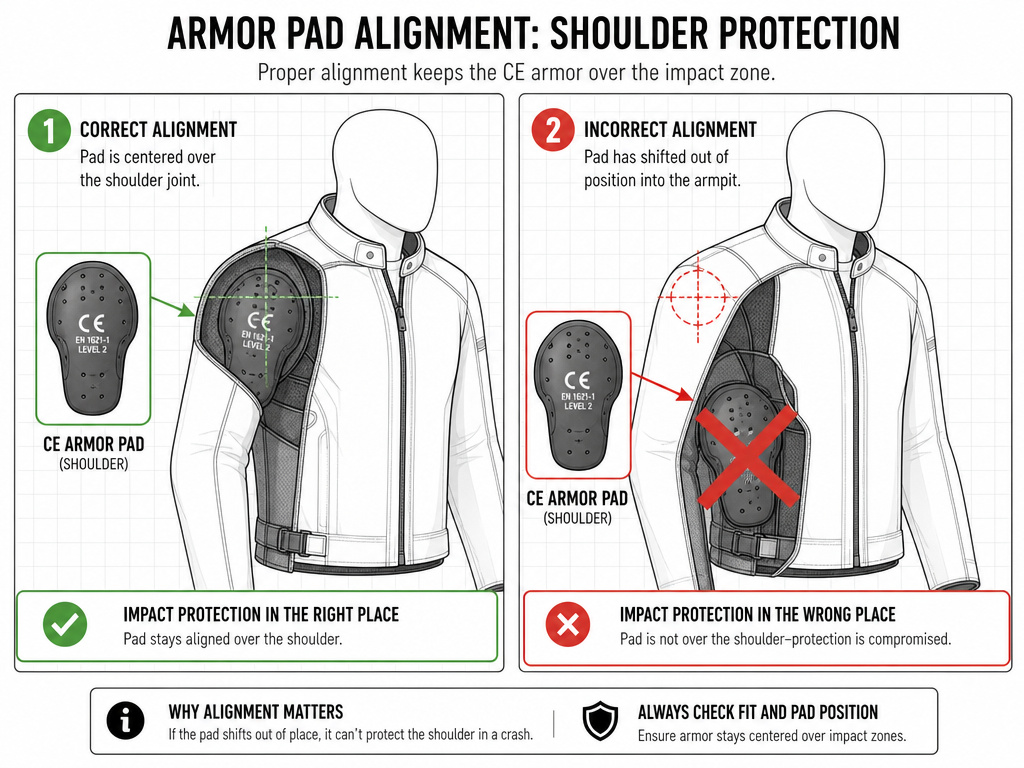
The CE mark and EN 1621-1 label are a starting point, not a finish line. Here is what the standard is silent on, and why that matters for your safety.
It is a single-impact standard. The test hits a fresh sample each time. It does not evaluate how the armor performs after the first hit, or whether it retains its protective qualities over years of use and multiple small impacts. Some materials, like certain soft foams, can pack out and lose effectiveness.
It does not test real-world positioning. The lab test assumes the armor is perfectly placed on a flat, rigid anvil. It does not account for the pad shifting in its pocket when you tuck into a riding position, or whether the pocket itself retains the armor during a slide. This is why ensuring your armor fits correctly is as critical as its certification. A Level 2 pad that ends up in your armpit during a crash is a Level 0.
It ignores abrasion and seam integrity. EN 1621-1 only measures impact force transmission. It says nothing about whether the armor’s cover will shred in a slide, or if the pad itself will disintegrate. For that, you need to look at the garment’s main certification, like EN 17092 for motorcycle jackets, which tests the entire assembly for abrasion, seam strength, and tear resistance.
Certification can be ambiguous. A product may be “tested to” EN 1621-1 standards, which is not the same as being formally “CE certified.” Formal certification involves assessment by a notified body. Check for the actual CE mark alongside the EN 1621-1 reference on the protector itself or the garment’s official label.
How to Use This When Buying Gear
Treat the standard as your primary filter, not your only criterion.
- Look for the label. Inspect the armor itself or the garment’s information tag. You want to see the CE mark and “EN 1621-1” clearly stated, followed by the Level (1 or 2) and the protector type/zone code (e.g., Level 2, Type B, E for elbow).
- Prioritize Level 2 for key joints. Seek out Level 2 protection for shoulders, elbows, and knees. For hips, weigh the stiffness trade-off. Our guide on the best CE armor compares specific, top-performing inserts.
- Check for upgradability. Many jackets come with basic Level 1 foam. See if the armor pockets are designed to accept aftermarket Level 2 upgrades. Brands like Knox and Forcefield make excellent drop-in replacements. Swapping to better armor is one of the most cost-effective safety upgrades you can make.
- Understand the material. EN 1621-1 certifies the performance, not the technology. The pad could be traditional hard shell, soft viscoelastic armor like D3O, or multi-density foam. Each has different feel, weight, and cold-weather performance.
- Fit overrides everything. Before you buy, check if the jacket or pants hold the armor firmly over your joints when you are in a riding crouch. If the armor slides down your arm when you raise it, the certification is irrelevant. Proper fit is what turns lab-rated protection into real-world protection.
The relationship between armor construction methods and the standard is direct: the test defines the outcome, but the material and design determine the comfort and practicality of achieving that Level 2 rating.
The Legal Landscape: Is EN 1621 Mandatory?
In most of Europe and for international sales, compliance with EN 1621-1 is not a legal requirement for selling motorcycle gear. It is a voluntary harmonized standard. However, if a manufacturer chooses to CE-mark their armor, they must comply with it.
There is a major exception. In Austria, the national adoption ÖNORM EN 1621-1:2013 is cited in multiple federal laws (including BGBl. II No. 100/2013 and 111/2014). This gives the standard a binding effect there. For Austrian riders or manufacturers selling there, compliance moves from a voluntary safety benchmark to a regulatory requirement.
For the rest of us, it remains the best common benchmark we have. It is the reason you can compare a protector from an Italian brand with one from a UK brand and have a shared understanding of what Level 2 means. The official BSI Standards Publication for armor is the source document that defines that shared language.
Difference between EN 1621-1 (limbs), -2 (back), -3 (chest)
The EN 1621 series addresses different areas of the body. EN 1621-1 is for limb joint impact protectors, covering shoulders, elbows, hips, and knees. This is the standard riders commonly refer to when discussing armor levels. EN 1621-2 specifically covers back protectors, focusing on impact absorption for the spine. Each part has its own specific requirements and test methods tailored to the protection needs of that body zone. When shopping, ensure the armor for each area is certified to the correct part of the standard.
Relation to other standards (e.g., EN 17092 for garments)
EN 1621-1 armor and EN 17092 for protective garments work together. EN 17092, which classifies jackets, trousers, and suits, requires impact protectors in specific zones like shoulders, elbows, and knees. For a garment to achieve an EN 17092 rating, the armor inserted into those zones must itself be certified to EN 1621-1. Think of EN 17092 as the overall garment standard that specifies where armor must go, and EN 1621-1 as the standard that certifies the armor pieces themselves. A full protective outfit relies on both standards functioning in tandem.
Frequently Asked Questions
What’s the difference between CE Level 1 and Level 2 motorcycle armor?
The difference is the maximum force transmitted during a standardized impact test. Level 1 armor allows ≤ 35 kilonewtons (kN) of force to pass through; Level 2 allows ≤ 20 kN. Level 2 armor absorbs more impact energy, but the standard notes it may be heavier and less flexible than Level 1.
Is CE Level 2 armor good?
Yes, CE Level 2 represents a higher benchmark of impact protection than Level 1. For critical areas like shoulders, elbows, and knees, Level 2 is the recommended choice. It is the highest level of impact protection defined for limb joints under the EN 1621-1 standard.
Can I upgrade my jacket’s armor to Level 2?
Often, yes. Many motorcycle jackets have removable armor pockets. You can frequently purchase aftermarket CE Level 2 protectors from brands like Knox, D3O, or Forcefield that are designed to fit common pocket sizes. Always verify the fit and that the new protector is certified to EN 1621-1 for the correct body zone.
How long does EN 1621-certified armor last?
The standard does not define a lifespan. Armor can degrade due to UV exposure, sweat, repeated impacts, and material fatigue. Manufacturers often recommend replacing soft armor after several years. Inspect it annually: if it is cracked, misshapen, or has hardened, replace it. Our article on armor lifespan covers the signs of degradation.
What does the “EN 1621-4” standard cover?
EN 1621-4 is a separate part of the standard for motorcycle airbag systems. It covers the performance requirements for inflatable protectors that deploy in a crash. It is completely different from the static limb armor tested under EN 1621-1.
Before You Go
The number one mistake is treating the CE mark as a finish line. It is a starting gate. EN 1621-1 gives you a verified, comparable baseline for impact protection—use it to filter out the junk. But the real safety step happens after you buy: making sure that certified armor stays locked over your joints every single time you ride. That is a fit and retention issue no lab test can solve for you.
If your current jacket has floppy, thin foam pads, upgrading to secured, name-brand Level 2 inserts is the single most effective safety upgrade per dollar you can make. Start with the shoulders and elbows. Ignore the marketing that says a jacket is “armored.” Look for the label that says EN 1621-1 Level 2. That is the standard doing its job. Your job is to make sure the armor does its.
