
CE Marking on Motorcycle Gear Explained: Is It Worth It?
This post contains affiliate links. As an Amazon Associate, we earn from qualifying purchases.
CE marking on motorcycle gear means the item conforms to a specific European safety standard and was assessed for conformity by the manufacturer or a Notified Body. For garments, this means meeting the abrasion, seam strength, and impact protection requirements of the EN 17092 series. For armor, it means passing the impact attenuation tests in EN 1621-1. The marking is a legal requirement for sale in the EU and UK, not a quality rating.
That legal requirement changed the entire market. Before April 2018, the vast majority of motorcycle clothing sold in Europe had never been independently tested. You bought a leather jacket because it felt thick, or a textile suit because it looked sturdy. The new regulation reclassified riding gear as Personal Protective Equipment (PPE), forcing manufacturers to prove their claims in a lab. The process of CE marking on motorcycle gear explained this shift to certified safety.
What follows is a breakdown of the regulation, a guide to the labels, and the critical differences between the garment’s overall certification and the armor inside it. You’ll learn how to spot a legitimate claim, what the AAA to C classes actually protect against, and why a CE mark is a starting point, not an end goal.
Key Takeaways
- Look for the four-digit Notified Body number next to the CE mark on Category III gear (like jackets and trousers); its absence means the certification is not verified by an independent lab.
- The EN 17092 garment class (AAA, AA, A, B, C) indicates abrasion resistance time, with Class AAA offering the longest slide protection and Class C the shortest for urban use.
- CE Level 1 vs. Level 2 armor refers to impact protection; Level 2 protectors must absorb more energy and are mandatory in high-risk zones (Zone 1) of a certified garment.
- Manufacturers must keep technical documentation for 10 years after the gear is placed on the market, providing a legal trail back to the test reports.
- A product can be CE certified for its armor only, leaving the garment’s main material untested; always check if the certification applies to the “PPE” or just to “protectors.”
The CE Marking Is a Legal Requirement, Not a Recommendation
This isn’t a voluntary safety sticker like some “tested to” badges you see. Regulation (EU) 2016/425 legally defines motorcycle jackets, trousers, suits, gloves, and boots as Personal Protective Equipment (PPE). Placing non-compliant gear on the market in the EU or UK is illegal. The system’s core purpose is market surveillance, not consumer education.
The regulation splits PPE into three categories based on risk. Almost all motorcycle gear falls into Category III, which covers “risks that may cause very serious consequences such as death or irreversible damage to health.” This classification triggers the highest level of oversight. For Category III products, the CE marking must be followed by the four-digit identification number of the Notified Body that checked the manufacturer’s production system. No number? The certification process did not involve an independent third-party check.
A Notified Body is an independent organization designated by an EU country to assess whether products meet legal requirements before being placed on the market. Their four-digit code links the gear on your back to a specific lab’s audit trail.
The manufacturer’s obligations don’t end at the sale. Under the regulation, they must keep the technical documentation and the EU declaration of conformity for 10 years after the PPE is placed on the market. They also must keep the test report from the Notified Body for the same period. This creates a chain of accountability a market surveillance authority can follow. It means the claim on the tag is supposed to be backed by a file in a cabinet for a decade.
EN 17092: The Garment Standard Explained
EN 17092 is the harmonized European standard that defines how motorcycle garments are tested and classified. It replaced the older EN 13595 series. According to some sources, EN 13595 was intended for professional use, while the newer EN 17092 series specifies requirements for protective garments for motorcycle riders. The new standard, published in 2020, is a multi-part series created to cover the vast range of modern motorcycle apparel.
The standard works on a principle of risk category zoning. It maps the human body onto the garment, identifying areas with different likelihoods of impact and abrasion in a crash.
- Zone 1: High-risk areas (shoulders, elbows, knees, hips, seat). Garment material here must meet the highest abrasion and tear resistance requirements for its class.
- Zone 2: Moderate-risk areas (forearms, thighs, upper back).
- Zone 3: Low-risk areas (chest, lower back, calves).
A Class AAA garment must meet the highest abrasion resistance requirements for its class in the designated zones. A Class A garment must meet the standard level of protection, with material performance requirements defined for different risk zones.
| EN 17092 Class | Intended Use | Key Differentiator |
|---|---|---|
| Class AAA | High-speed road racing, performance riding | Highest level of abrasion resistance and seam strength. |
| Class AA | Sport riding, aggressive street use | High abrasion resistance, slightly less demanding than AAA. |
| Class A | General street riding, commuting | Standard level of protection for typical road use. |
| Class B | Urban/commuter, lower-speed riding | Lower abrasion resistance than Class A. Cannot be used for Class A garments. |
| Class C | Urban/commuter (garments without sleeves) | Lowest level, for sleeveless jackets or protectors worn over clothing. |
The classification is determined by a battery of tests on the garment’s materials and construction. To understand what a label like EN 17092-4:2020 means, you need to read our guide on interpreting gear tags. The number after the dash (-4) specifies the part of the standard, which corresponds to the garment class (e.g., -4 is for Class A). The tests assess:
- Impact Abrasion Resistance: How long the material can withstand a grinding surface at a set pressure before a hole forms. The abrasion resistance performance is recorded during technical tests and varies by class and zone.
- Seam Strength: How much force the stitched seams can withstand before bursting.
- Tear Strength: How much force is needed to propagate a tear in the material.
- Dimensional Stability: Whether the garment shrinks or distorts after cleaning.
The goal of the EN 17092 standard was to create a baseline so that clothing that looks like motorcycle gear actually provides a measurable level of protection, as the ce marking on motorcycle gear explained.
CE Level 1 vs. Level 2: The Armor Inside the Gear
The garment’s shell is one thing. The armor inside is another, and it has its own separate certification. Impact protectors for shoulders, elbows, knees, hips, and the back are tested to EN 1621-1:2012.
This standard measures how well a protector absorbs and dissipates impact energy. A weighted striker is dropped onto the protector from a height, and sensors measure the force transmitted through to a simulated body.
- CE Level 1: The standard pass. The average transmitted force must not exceed 35 kN, with no single measurement over 50 kN.
- CE Level 2: A superior pass. The average transmitted force must not exceed 20 kN, with no single measurement over 30 kN. Level 2 armor must absorb more energy, as it has a lower maximum allowable transmitted force.
Where this goes sideways: Assuming the armor in a CE-certified garment is always Level 2. For a garment to meet EN 17092, Level 2 armor is required only in high-risk Zone 1 areas. Armor in Zone 2 or 3 can be Level 1. Always check the armor itself for markings.
The protector itself will be stamped with its certification, usually showing “EN 1621-1” and either “Level 1” or “Level 2.” Some may also show a “KP” (Knuckle Protection) mark if tested for that specific area. Back protectors are tested to a separate standard, EN 1621-2, which has its own Level 1 and Level 2 ratings.
This separation is crucial for understanding the full CE armor certification, a key point the ce marking on motorcycle gear explained. You can buy a jacket where the garment is CE-certified to EN 17092, and it comes with CE Level 1 armor. Or, you can buy a jacket that is not a certified garment, but includes CE Level 2 armor you can install. The armor’s rating is independent.
How to Read a Motorcycle Gear CE Label

The label sewn into the garment is your primary source of truth. It’s dense with codes, but decoding it tells you exactly what you own. Here is what to look for, in order:
- The CE Mark & Notified Body Number: The CE symbol, followed by a four-digit number (e.g., CE 0123). This confirms it’s Category III PPE and was overseen by an independent body.
- The Standard & Class: This will read something like “EN 17092-4:2020” for a Class A jacket. The number after the dash (-4) indicates the part of the standard, which correlates to the class.
- Pictograms & Codes: Look for icons indicating the type of protection (motorcycle rider), and any optional performance codes like “WP” for water penetration resistance on boots.
- Size & Care Instructions: While not part of the certification, proper care is essential to maintain performance. The label will specify cleaning methods.
For gloves, the label will reference EN 13594:2015 and show a performance level (1 or 2). Level 2 gloves offer a superior pass, indicating higher performance compared to Level 1. A “KP” mark indicates tested knuckle protection.
For boots, specific standards and codes indicate performance in areas like impact protection and water resistance. You’ll see a series of codes like:
- IPA/IPS: Impact Protection Ankle/Shin.
- WP: Water resistance.
These are individual performance results, not an overall class like garments. A boot can have IPA but not WR, for example.
The label is the endpoint of a long process. To understand how those performance numbers are generated, see our article on how gear is tested.
“CE Approved” vs. “CE Certified” vs. “CE Rated”
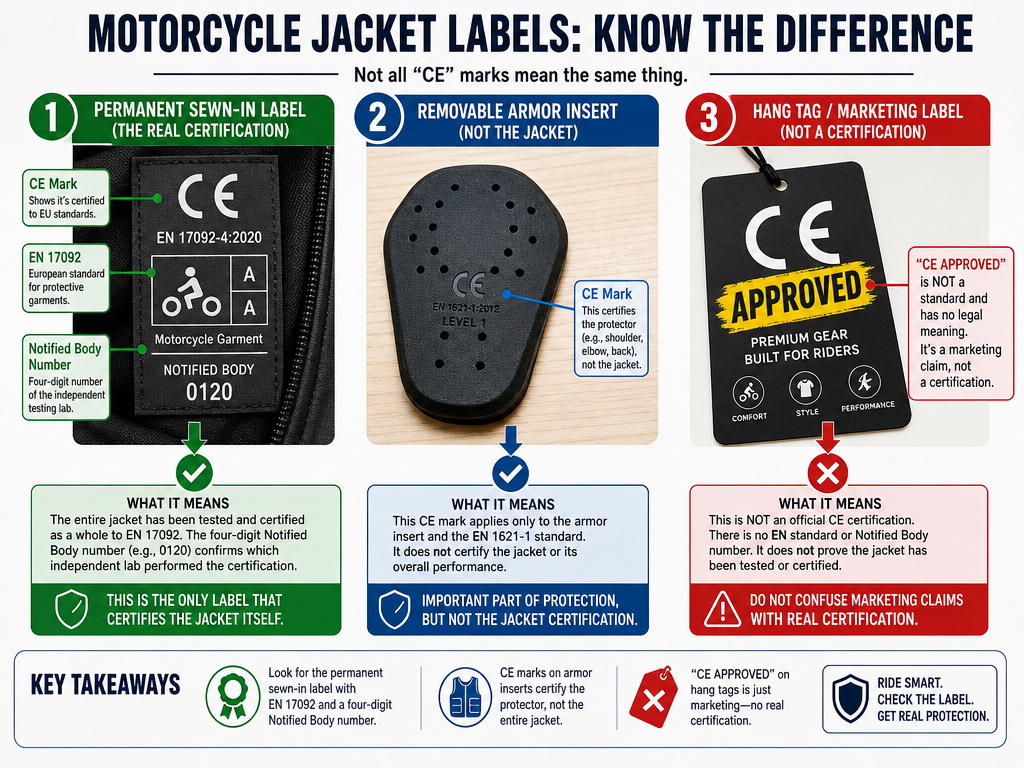
Marketing copy loves to play with these terms. Legally, there is a clear hierarchy that matters for your safety.
- CE Marking: The correct term. It means the manufacturer declares the product conforms to all applicable EU requirements. For Category III gear, this declaration is backed by a Notified Body. This is the only term with legal weight.
- CE Certified: A common colloquialism. It generally means the same as “CE marked,” but it’s not the official language of the regulation. It’s acceptable if it refers to the full product.
- CE Rated: This is a red flag. It’s often used to describe only a component, like armor. A jacket might be advertised as having “CE Rated armor” while the jacket shell itself is not a certified PPE garment. The armor is rated, the jacket is not.
- CE Approved: Meaningless in a legal sense. There is no “approval” body. It’s marketing fluff.
Common mistake: Buying a jacket because the tag says “CE Certified” without checking if that applies to the garment or just the removable armor inserts. The armor may have a CE mark, but the garment’s tag might lack the CE symbol and Notified Body number entirely.
The verification is simple. Find the permanent label sewn into the garment (not a hang tag). Is there a CE symbol followed by a four-digit number? Does it cite an EN standard like EN 17092? If yes, the garment itself is certified PPE. If the only CE mark is on a removable armor insert, the garment is not certified. This distinction is the single biggest source of consumer confusion the new regulation was supposed to fix.
What CE Marking Does NOT Guarantee
The manufacturer’s own instructions make this brutally clear. An Alpinestars garment booklet states: “Protective garments can only provide limited protection… Complete protection can NEVER be guaranteed.” Another clause reads: “Motorcyclists’ protective garments are not intended to, and cannot prevent all injuries.”
The CE marking is a baseline test of materials and construction under laboratory conditions. It does not account for every variable in a real-world crash.
- It’s not a fit guarantee. A poorly fitting jacket will ride up in a slide, exposing skin. Armor that shifts out of place protects nothing.
- It’s not a durability promise. Abrasion resistance is tested on new, clean material. UV degradation, repeated cleaning, and general wear degrade performance over time.
- It doesn’t cover all injury mechanisms. The standards focus on abrasion, tear, and impact. They don’t address crushing forces, hyperextension, or internal organ trauma.
- It assumes proper use. Using a street jacket for off-road riding or ignoring care instructions voids the assumed level of protection.
The certification also has a narrow scope. As the UNIDO technical document on PPE notes, any change to the design, materials, or production that could affect conformity may require re-testing. That seasonal color update or minor panel redesign? If the manufacturer doesn’t re-submit it, the CE mark on the new version rests on an assessment of the old, discontinued product.
Implications for Riders Outside the EU/UK
If you’re in the United States, Australia, or elsewhere, you’ll still see CE-marked gear. Your local regulations likely don’t require it, but the CE mark remains the best objective safety benchmark available globally.
- USA: There is no federal motorcycle clothing safety standard. DOT regulates helmets only. The CE mark is a voluntary manufacturer declaration. Brands selling in both markets often use the same CE-certified products globally.
- Australia/New Zealand: The AS/NZS 1698:2006 standard for motorcycle garments exists but is outdated and rarely used. Most gear sold is CE-certified to the newer, more rigorous EN standards.
- UK Post-Brexit: The UKCA mark is now required for goods placed on the Great Britain market. However, the CE mark is still accepted until December 31, 2024. You will see dual-marked gear (CE & UKCA) during the transition. The technical requirements are identical to the EU’s.
For a rider anywhere, the logic is the same. In the absence of a stronger local standard, a CE mark based on EN 17092 or EN 13594 provides a verified, repeatable measure of protection that an untested item does not. It shifts the choice from subjective assessment to one based on verified test results.
When did motorcycle gear standards change from EN 13595 to EN 17092?
The previous standard for protective motorcycle clothing, EN 13595, was officially replaced by EN 17092. This transition was tied to the introduction of the new PPE Regulation, with an original implementation deadline of April 2018. The vast majority of gear on the market before this date had not been formally tested and certified under the old rules. The new EN 17092 series, which includes standards like EN 17092-4 for Class A garments, directly supersedes the four parts of the old EN 13595 standard. While some sources associate EN 13595 with professional use, EN 17092 now specifies requirements for protective garments for motorcycle riders, forming the basis for the CE certification system you see on jackets and trousers today.
Frequently Asked Questions
What does the CE marking mean on motorcycle gear?
It means the manufacturer declares the item conforms to relevant European safety standards (like EN 17092 for garments) and meets the legal requirements of the PPE Regulation (EU) 2016/425. It is a mandatory legal marking for sale in the European Union and United Kingdom, not an optional quality seal.
What is the difference between CE Level 1 and Level 2 armor?
CE Level 1 and Level 2 refer to the impact protection performance of armor tested to EN 1621-1. Level 2 is the higher standard, requiring the armor to absorb more energy (transmit less force) during a lab impact test. For a full comparison of the differences between CE Level 1 and Level 2 armor, including where each is required, see our dedicated guide.
Is CE-1 or CE-2 better?
CE Level 2 is better. It offers superior impact protection by a defined margin. EN 17092 requires Level 2 armor in high-risk zones (like shoulders and knees) of certified garments. Level 1 armor may be used in lower-risk zones or in non-certified gear.
How do I know if my gear is really CE certified?
Check the permanent label sewn into the garment (not a hang tag). For jackets and trousers, a legitimate certification will show: 1) The CE symbol, 2) A four-digit Notified Body number (e.g., CE 0123), and 3) A reference to a standard like EN 17092-4:2020. If the only CE mark is on a removable armor insert, the garment itself is not certified.
The Bottom Line
The CE mark tells you a product met a minimum legal threshold. It doesn’t tell you it’s the best, or that it will fit you, or that it will last. Your job is to read past the symbol to the specifics: the EN 17092 class, the armor levels, and the Notified Body number.
Fit the gear first. A perfectly certified jacket that’s too tight will compromise its protective design. Then, use the certification to compare options within your fit and budget. Choose the highest garment class (AAA down to A) and Level 2 armor your riding style justifies.
Finally, remember the manufacturer’s own disclaimer—no gear prevents all injury. The CE system gives you a fighting chance with verified equipment. The rest is down to your riding, your maintenance of the gear, and a heavy dose of situational awareness. Trust the test report, but never the guarantee.
