
Iridium Motorcycle Visor Pros and Cons: Worth It?
This post contains affiliate links. As an Amazon Associate, we earn from qualifying purchases.
Iridium motorcycle visor pros and cons: bright daytime glare control and mirror looks, but scratch risk and poor low-light vision. AGV lists one Sportmodular shield at 190 degrees horizontal, 85 degrees vertical, up to 3mm thick, and daytime-use-only US labeling.
That daytime-use label is the part that changes the whole decision. A mirrored shield can cut sun glare, but the same coating can turn dusk, tunnels, and scratched spots into a problem. The specs, owner reports, and one setup decide whether the shield stays useful.
What follows: the field-of-view numbers, the night-use disagreement, the scratch truth, and the buying checks that stop a cool shield from becoming a bad habit.
Key Takeaways
- AGV lists daytime use only for one Sportmodular Iridium Silver shield in the US.
- Owners report scratches and chips from bugs, stones, and careless wiping.
- Study says visors can affect depth perception and contrast sensitivity.
- Carry a clear shield for dusk, rain, tunnels, and night.
- Compare base tint before coating because the mirror look does not equal dark tint.
Iridium Motorcycle Visor Pros and Cons at a Glance
An iridium visor is a mirror-like coating over a tinted shield. The coating cuts glare and changes the look, but the base tint still controls how much light you lose.
An iridium motorcycle visor adds a reflective coating over a tinted shield. AGV lists one Sportmodular Iridium Silver shield with 190 degrees horizontal and 85 degrees vertical field of view, up to 3mm thickness, and a daytime-use label in the US. A peer-reviewed study notes helmet visors can affect stereopsis and contrast sensitivity.
- Cuts glare on bright open roads, which is the main reason riders buy them.
- Looks like a mirror without fully explaining the base tint.
- Scratches and chips show up as bright spots, and those spots scatter light.
- Night use is debated: the manufacturer labels the shield daytime only, while some forum users report using iridium visors at night without major issues.
| Spec or claim | Source | What it means |
|---|---|---|
| 190 degrees horizontal | AGV product listing | Less than study’s 210 degree need |
| 85 degrees vertical | AGV product listing | Less than study’s 102 degree need |
| Up to 3mm thick | AGV product listing | A real barrier, not just tint |
| Daytime use only US | AGV label | Night use is discouraged by maker |
The AGV Sportmodular visor listing gives those numbers for one specific shield. They are product-specific numbers. They show why a product page matters more than a forum photo.
A functional vision and helmet types study found visors can affect stereopsis, or depth perception. It also found reduced contrast sensitivity, the ability to see subtle light differences. The study found that reduced contrast sensitivity when wearing a helmet with a visor violates ISI standards for helmet visors.
The same coating can sit over different base tints, so types of visors matter as much as the mirror finish.
Will a mirrored shield ruin your night riding?
AGV labels one Iridium Silver shield “Daytime use only US – Race use only elsewhere.” That label is a manufacturer warning. It tells you the shield was not designed as an all-day solution.
I don’t make a mirrored shield my only visor. A clear shield is the safer bet when dusk, tunnels, or rain show up.
Some owners disagree with that limit. Forum users report varying experiences with night use, from finding it acceptable to advising caution. I don’t trust a mirrored shield as my only night visor. Tunnels, rain, and dusk change the math fast. That matters.
Do you actually want to swap shields after dark? A clear shield solves that problem, and the clear vs tinted choice is simpler than buying a mirror shield you only wear at noon. Before treating a dark shield as an all-day option, check tinted visor laws in your area.
Do iridium visors scratch too easily?
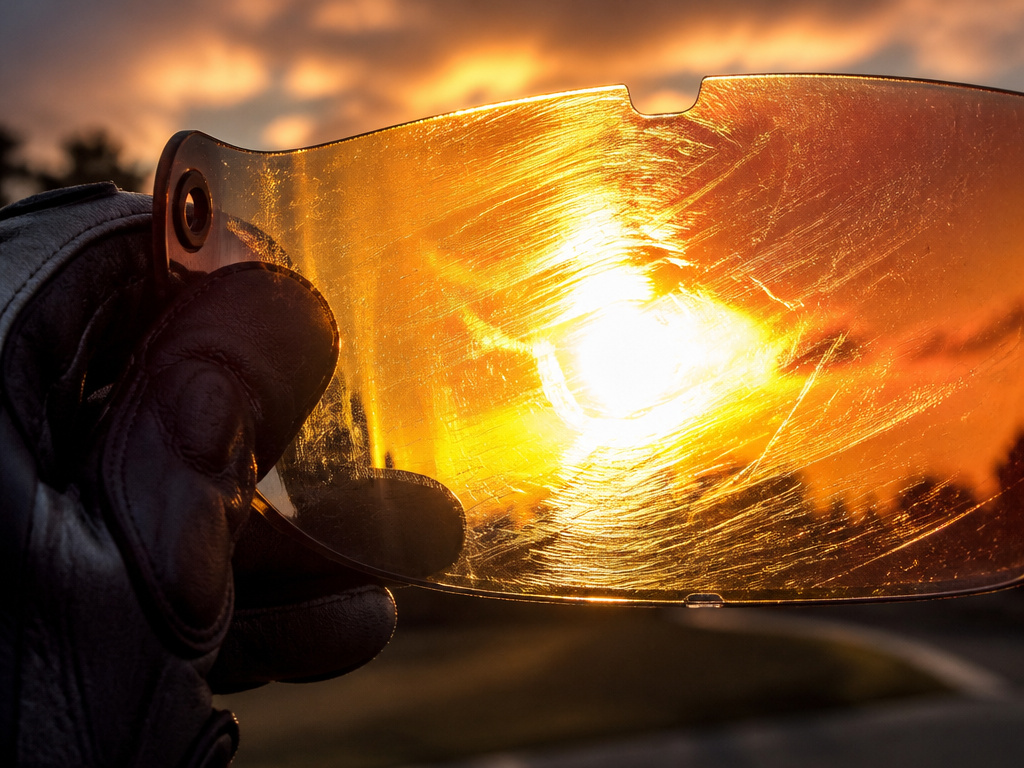
Some owners report needing to replace iridium visors more frequently due to damage. That line stuck with me because it matches my own mistake.
I kept riding with a lightly scratched visor longer than I should have. At sunset on the highway, the glare turned those scratches into a blinding haze. I replace scratched visors immediately now.
Owners report a pattern: bugs, stones, and careless wiping leave tiny nicks. Forum users report that iridium visors can scratch from careless handling. A Sportbikes.net thread discusses the durability of mirrored shields.
Forum users report mixed experiences with the durability of iridium coatings. That disagreement is real. The coating sits on top of the base shield, so a bright spot can mean the coating is damaged.
If scratches appear, owners debate whether to remove scratches or replace the shield. With a mirror coating, replacement wins for most damaged shields.
How do colors and coatings change what you see?

A forum user reports that on an Arai iridium visor, the tint colour is ‘blueish around the extreme left and right fading into a more orangey colour in the middle’. That tint is uneven. The coating behaves differently across the curved surface.
A Hayabusa owner report on high-speed vision says an iridium visor might interfere with clear vision at extreme speeds, including color blurring. That report covers an edge case. It does not apply to every rider. Still, if you ride fast or use sunglasses with the shield, check your own sight before trusting a cool look.
Would you notice it at speed?
A mirrored coating and a polarized lens are separate features. The AGV listing does not describe polarization as a standard iridium trait. Do not assume glare control means polarized glare control.
How do you buy an iridium visor that fits your helmet?
Three checks decide the buy: shield model, helmet size, and use label. Get any one wrong, and the shield may not latch, seal, or stay usable for your riding.
Before you start: Night light reduces the useful tint, so keep a clear shield. Scratches turn glare into haze, so inspect before buying. Local rules can restrict dark shields, so check before riding.
Check your helmet’s shield model first
The SpyderLovers answer is simple: find the model of shield your helmet uses, then search that model. A Sportmodular owner has an easier path because AGV lists the Iridium Silver shield for XL, XXL, and XXXL Sportmodular helmets. AGV also lists the shield as Max Pinlock 120 lens ready. Once you know your exact shield model, compare best helmet visors before ordering. If you ride a Sportmodular, the AGV Sportmodular Iridium Silver visor is the exact match; see it on Amazon.
Match the size and the daytime label
Size affects fit and sealing. A visor that doesn’t seat fully can let in water, wind, and dirt. The AGV label also says daytime use only in the US. If your ride ends after sunset, that daytime label should push you toward a clear shield instead of a gamble.
Build a two-shield kit
I keep a spare clear shield for any ride that can turn into dusk. Some riders pair an iridium shield with a drop-down sun visor for straight-into-sun stretches. Others skip the mirror look and use photochromic visors that darken in sun and clear up when the sun drops. A Pinlock insert is the fix I trust for fog; check availability.
- Find your helmet’s exact shield model, because the wrong model may not latch or seal.
- Check the use label, because AGV marks one Iridium Silver shield daytime use only in the US.
- Inspect the coating under low sun, because a mirror shield can look clean in a shop but show bright spots from tiny scratches.
- Decide if you need a spare clear shield, because light can drop fast in tunnels, rain, or dusk.
The choice gets easier when you match the shield to the light you actually ride in.
| Option | Best when | Watch out |
|---|---|---|
| Iridium | bright open roads | night and scratches |
| Light smoke | shade-to-sun routes | still dark at dusk |
| Clear | rain, dusk, tunnels | glare in sun |
| Photochromic | day-to-night changes | not a mirror shield |
For most riders, a clear shield wins for mixed day-to-night use. Iridium wins only on bright daytime roads.
What cleaning method actually works?
Cleaning is where owners disagree most. There is no single method backed by every rider.
Some use only water and a soft cloth. Some use dish soap and warm water. Some use a non-ammonia glass cleaner and report no problems. Others warn against glass cleaners.
That split is wide enough that I would not call any one method the official rule.
- Water and a soft cloth is the conservative start.
- Dish soap and warm water works for some riders, but rinse well.
- Non-ammonia glass cleaner has happy users and vocal critics.
- A dry glove over dust is the fastest way to create micro-scratches.
Easy to miss: A mirror coating can look fine under shop lights. By low sun, tiny scratches can scatter light across the whole field.
I clean with water and a soft cloth, then dry with a separate cloth. The tell is simple: water should glide off a clean shield. If it beads into dirty trails, the coating has grime or damage.
Which method fits your hands? If you want a product route, compare visor cleaners that say they are safe for coatings.
Iridium vs Tinted or Smoke Visors
Iridium visors differ from standard tinted or smoke visors in their reflective coating. This coating provides a mirrored finish that reduces glare more effectively than a simple tint. However, a study on functional vision notes that any visor can affect depth perception and reduce contrast sensitivity, which is the ability to distinguish subtle light differences. This reduction can violate certain safety standards. Users report that the iridium coating can sometimes exhibit color variations across the lens. While both types are for sun protection, the iridium’s reflective layer is more delicate and requires specific care to prevent damage like peeling or flaking.
Finding an Iridium Visor for Your Helmet
To find the correct iridium visor, you must match it precisely to your helmet model and size. Manufacturers design visors for specific helmet lines, and a visor for one model will not fit another. Check the manufacturer’s official website or product documentation for a compatibility list. For example, one visor is listed as compatible only with a specific helmet in certain large sizes. Always verify the product designation, as some are marked for daytime or race use only. Purchase from authorized dealers to ensure you receive a genuine part that meets the intended specifications and safety standards.
Frequently Asked Questions
Are iridium motorcycle visors worth it?
They are worth it if you ride on bright daytime roads and accept that scratches can shorten the shield’s life. They lose their value when dusk, tunnels, rain, or night become part of your routine.
Are iridium visors road legal?
Daytime-use label is a manufacturer warning. Local rules are separate. Check your area’s rules before treating a dark mirrored shield as an all-day visor.
What is the purpose of an iridium visor?
It adds a reflective coating that cuts glare and changes the helmet look. The base tint still controls how much light you lose, so the mirror effect is not the whole story.
Can you see through an iridium visor at night?
Some owners report night use, but AGV labels one Sportmodular Iridium Silver shield daytime use only in the US. The manufacturer advises against night use, while some forum users report it can be done.
What is the best type of visor for a motorcycle helmet?
For all-day riding, a clear shield or photochromic shield is safer. Iridium works better as a daytime-only option, not as a universal upgrade.
The Bottom Line
If your ride ends after sunset, don’t buy an iridium shield as your only visor. That is the hard line. Keep a clear shield, and use the mirrored shield only when the sun is high and the road is open.
If you already own one, check it at low sun. If the coating shows bright spots or a haze, replace it. Scratches turn a mirror shield into a glare trap.
If you ride a Sportmodular in XL, XXL, or XXXL, the AGV Sportmodular Iridium Silver visor is the exact match. Its daytime label should keep it off your night-only helmet. A Pinlock insert is my fog fix for cold or damp mornings.
If you ride day-to-night, the safer kit is a clear shield and a Pinlock insert. Add a light smoke or photochromic shield for bright days. That setup covers more miles than a single cool-looking shield. If you want the short answer on iridium motorcycle visor pros and cons, buy it for daytime glare and looks. Don’t let it decide your night vision.
