
Types of Motorcycle Helmet Visors: Which One Fits?
This post contains affiliate links. As an Amazon Associate, we earn from qualifying purchases.
The types of motorcycle helmet visors split into clear, smoke or tinted, mirrored or iridium, and photochromic options. Each type changes light transmission, fog control, and legal use. Shoei manuals, Bell Pinlock specs, and ScorpionExo coating limits show the tradeoffs before you buy.
Light transmission sets the safety line. A clear visor can meet helmet approval rules and work day and night. A dark mirrored lens may fail road use and still help on a track.
What follows: four visor families, Shoei and Bell specs, the fogging rule that original equipment manuals disagree on, and cleaning steps that stop scratches.
Key Takeaways
- A clear Shoei visor transmits at least 85 percent light and is rated for day and night.
- A mirrored or photochromic Shoei visor can be daytime only and not approved under ECE-R 22.06.
- Shoei sources disagree on handling a fogged visor: the CNS-3 manual says do not ride with a fogged shield, while the CWR-F2 manual says fog can be eliminated by opening the shield slightly and riding at low speed.
- A fog-resistant insert or genuine anti-fog sheet helps fog, but can cut light by up to 10 percent on a tinted shield.
- A scratched or worn coating is a replacement trigger; ScorpionExo says coating capacity fades in about 2 years.
Types of Motorcycle Helmet Visors: What the Labels Mean
Shoei, Bell, ScorpionExo, and Leatt sort visors by light transmission, coating, fog control, and crash geometry. The type name tells you what the lens does to light. It doesn’t tell you whether the lens will fog on a damp morning.
The type matters.
Motorcycle helmet visors are sorted by light transmission, coating, and fog control. A clear visor lets in minimum 85 percent light. Tinted or mirrored options cut light transmission, so the correct anti-fog insert and local road rules matter. Manufacturer manuals, approval markings, and state equipment rules decide whether a visor is road legal, track only, or unsafe in low light.
- Clear lenses transmit minimum 85 percent light in Shoei Europe data. They are approved under ECE-R 22.05 or 22.06 and work day and night.
- Smoke lenses transmit 56 to 62 percent light in Shoei data. Shoei warns never to use a tinted face shield at night or in low visibility.
- Mirrored or iridium lenses can be harsher. The Shoei NXR 2 CWR-F2PN Spectra Silver visor transmits 22 to 28 percent light. It is not approved under ECE-R 22.06. It is marked Daytime Use Only. Check availability before you swap a clear lens for a mirrored one.
- Photochromic lenses adjust from 23 to 80 percent light in Shoei data. Shoei marks them for daytime sunny to changeable use, and they are not approved under ECE-R 22.06.
- Off-road styles differ. The Leatt Moto 2.5 visor has a breakaway function to reduce forces to head and neck in a crash. See it on Amazon for the full helmet spec.
I treat clear as the default.
Which Visor Type Fits a Commute, a Tour, or a Track Day?
Which lens gets you through a tunnel without slowing you down? A clear lens does. A dark mirrored lens may not.
| Visor Type | Best For | Watch Out |
|---|---|---|
| Clear | Day and night use | Scratches and dirt |
| Smoke or tinted | Bright daytime sun | Night and low light |
| Mirrored or iridium | Strong sun or circuit | Low light and road rules |
| Photochromic | Daytime sunny to changeable | Not for night |
I keep a clear lens installed and swap only when the light demands it. The clear versus tinted motorcycle visor discussion starts with light transmission, not style.
Riders weighing photochromic pros and cons should note Shoei lists dynamic or photochromic visors at 23 to 80 percent light transmission. That range helps in bright sun, but it can lag when you enter a tunnel.
The best photochromic visors list covers that lag. I wouldn’t choose a photochromic lens as the only visor for night riding.
Iridium and mirrored visors are the ones I keep off a street bike unless I also carry a clear spare. The iridium visors warning is blunt: shade looks good, but dusk and tunnels punish it.
For best helmet visors, the short list starts with a clear lens and a correct anti-fog insert.
Style is secondary.
Manufacturer manuals cover stock visors, not tint films. If you compare aftermarket tint film with a full visor replacement, the safety facts stop at the visor itself: light transmission, coating, and fog control.
How Do You Handle a Fogged Motorcycle Helmet Visor?
Cool, damp backroad mornings fogged my visor more than once. Cracking the shield a notch cleared it, and a PinLock insert stopped the repeat.
Worth knowing before you start: Don’t ride with a fogged shield. A fogged lens can wipe out the road in seconds. The Shoei CNS-3 manual says stop. The CWR-F2 manual says open slightly at low speed to clear fog. If you can’t see, pull over.
That disagreement matters. The CNS-3 note treats fog as a stop condition. The CWR-F2 note treats fog as something you can clear by opening the shield slightly and riding at low speed to circulate air. I follow the safer reading. If the lens fogs at speed, I slow down or pull over before trusting the crack-the-shield trick.
A fogged lens turns the road into a milk bottle. Cracking the shield sends a cold draft across your cheek.
Fog is not optional.
The how to prevent motorcycle visor fog notes point to the same fix: insert first, spray last.
- Open the lower air intake on a Shoei CNS-3 or CWR-F2 shield to circulate air. Skipping this leaves warm breath trapped against the lens.
- Crack the shield slightly only at low speed, as the CWR-F2 manual describes. At highway speed, the same crack can turn fog into a blur and wind blast.
- Fit the correct Shoei genuine anti-fog sheet or Pinlock insert. A loose sheet leaves edge fog, and a missing insert can fog a Bell Panovision shield.
- Clean the lens before installing the insert. Dirt under an anti-fog sheet scratches the visor and blocks the seal.
Pinlock: Required or Optional?
Pinlock, a fog-resistant insert system, matters more than a quick wipe. The best Pinlock inserts matter because Bell designs the Star Series Panovision shield for Pinlock DKS163.
The Bell Star Series instruction manual says the Panovision shield is designed for Pinlock DKS163 and fogging may occur if the lens is not installed. Shoei Europe lists PINLOCK preparation: Yes on the NXR 2 CWR-F2PN Spectra Silver visor, but it doesn’t call the lens mandatory.
Sources disagree: Bell’s manual implies the Pinlock lens is required for the Panovision shield to prevent fogging, while Shoei lists PINLOCK preparation as a feature without stating it is mandatory.
Check the Bell Star Series Panovision shield product page on Amazon before you order a lens.
I keep a clear visor on the helmet and a Pinlock insert in my pocket. A scratched dark shield at dusk acts like a blindfold.
| Problem | Likely Cause | Fix |
|---|---|---|
| Fog at low speed | Warm air trapped | Open lower intake |
| Fog at highway speed | Missing insert or sheet | Fit correct insert |
| Haze after wiping | Dry grit dragged across lens | Rinse, then wipe |
| Low light blur | Dark tint or mirror | Swap to clear |
Are Motorcycle Helmet Visors Legal? Tint, VESC-8, and ECE Rules
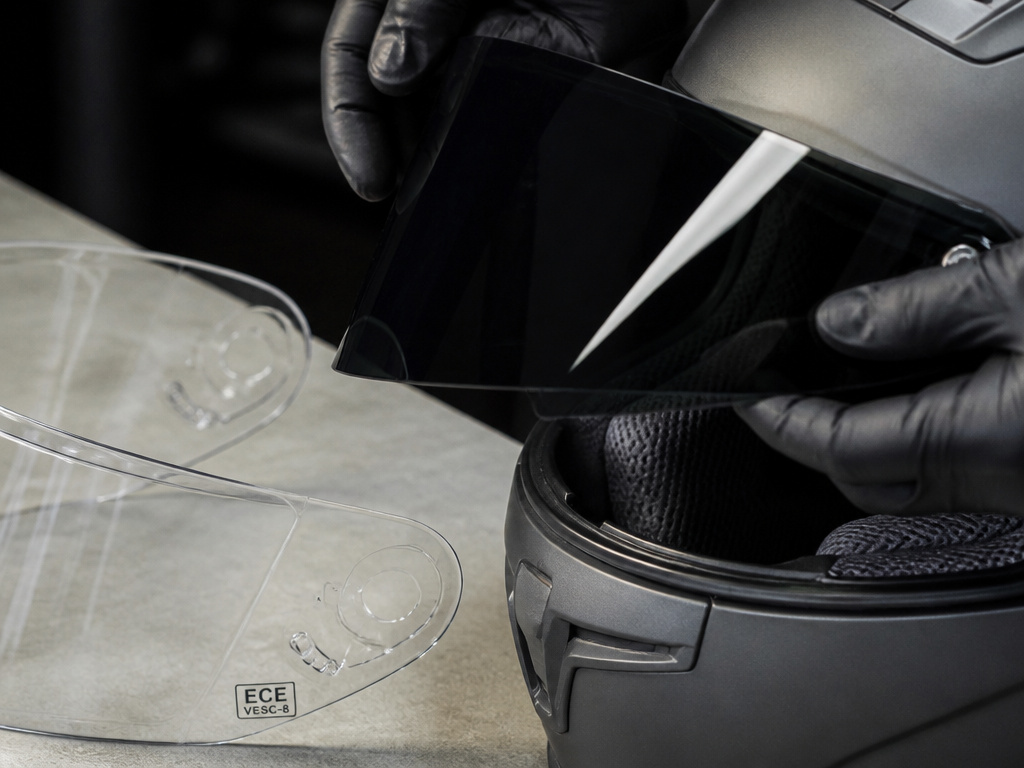
Shoei notes that VESC-8 applies in some U.S. States. That number isn’t a vibe.
VESC-8 is the Vehicle Equipment Safety Commission regulation No. 8 for motorcyclist eye protection. The Shoei CNS-3 manual says a tinted or mirrored shield used with the sun visor doesn’t meet the light transmission requirement in VESC-8.
The Shoei CNS-3 shield manual gives the VESC-8 warning.
Shoei notes that when a mist retardant anti-fog sheet is attached to tinted or mirrored shields/visors, light transmittance decreases by a maximum of 10%. Light transmittance is the share of light that passes through. That drop can push an already dark lens further below a usable line.
Don’t pair a tinted or mirrored shield with the sun visor, sunglasses, or anything else that cuts light.
ECE, VESC-8, and the Marking Problem
ECE-R 22.05 and 22.06 are European helmet approval standards. Shoei Europe lists clear visors as approved under ECE-R 22.05 or 22.06 and rated day and night.
It lists the NXR 2 CWR-F2PN Spectra Silver as not approved under ECE-R 22.06. It also marks it Daytime Use Only. It lists dynamic or photochromic visors as not approved under ECE-R 22.06.
Shoei Europe says smoke or tinted visor approval under ECE-R 22.06 applies only to CWR-1 and CNS-1.
ScorpionExo says never use a dark or tinted faceshield or SpeedView visor in dark or poor visibility. It calls this illegal in most countries. Shoei takes a different angle. It says tinted or mirrored shields may alleviate eye fatigue on a circuit in strong sunlight, but they reduce light transmission and may impair vision.
The circuit note and the road note pull in different directions.
I wouldn’t buy a dark mirrored visor as the only visor.
The tinted visor laws discussion starts with the same problem: light transmission, not attitude.
If you ride in India, check local rules and the government motorcycle visor standard.
Light matters.
How Long Does a Motorcycle Helmet Visor Last?
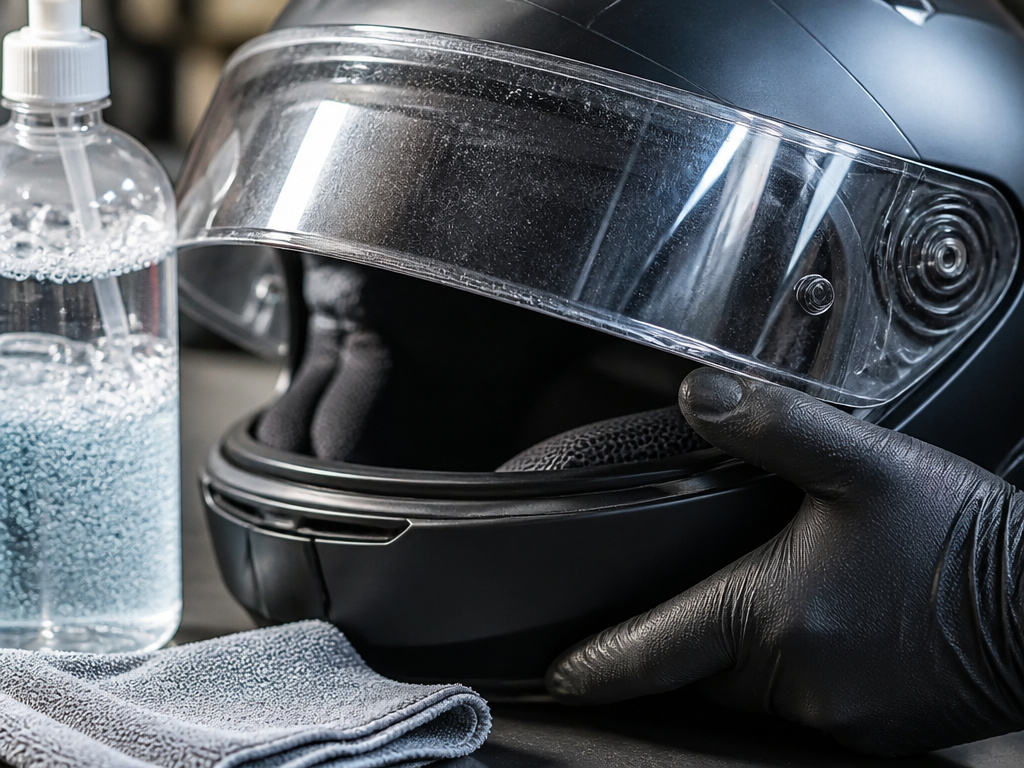
ScorpionExo gives a hard clock. The scratch-resistant coating loses capacity in about 2 years.
ScorpionExo says never use scratched, worn-out, or fogged faceshields and recommends changing the visor at least every two years. That is a safety interval, not a marketing line.
A dry wipe drags grit across the lens and leaves a haze you only notice at night under headlights.
Rinse first.
Cleaning Rules That Protect the Coating
Shoei says clean the CNS-3/CNS-3C shield with a solution of mild, neutral soap and water, and not to use cleaning materials including hot water over 40ºC.
- Rinse first. Dry grit scratches the lens before you see it.
- Use mild, neutral soap and water. Shoei warns not to use cleaning materials including hot water over 40ºC, and to avoid substances like benzine, thinner, gasoline, glass cleaner, or organic solvent cleaners.
- Keep hot water under 40 C. Shoei says don’t use hot water over 40 C on CNS-3 or CWR-F2 shields.
- Don’t place stickers or tape in the field of vision. Shoei says this can obstruct the view.
- Replace a scratched or hazy lens. ScorpionExo says never use scratched, worn-out, or fogged faceshields.
Check availability of the Shoei CNS-3 shield before you ride a scratched lens.
ScorpionExo says clear and smoke shields have scratch-resistant coating. The ScorpionExo EU manual gives the two-year coating clock.
Current reviews on Amazon for the ScorpionExo clear shield can show how owners handle low light.
How Do You Change a Motorcycle Helmet Visor?
A dusty visor sits on the bench, hooks still in the rail, and the rider wonders why the new lens wobbles.
Refer to the specific Shoei CNS-3 manual for visor removal and installation steps.
A clean how to change a motorcycle helmet visor routine starts with hook alignment, not force.
- Remove the protective film before first use. Shoei says this applies to CNS-3 and CNS-3C shields. Skipping it leaves a cloudy view and a sticky edge.
- Open the shield fully. Pull the trigger down, lift and turn upward to release hook A. Hook B releases at the same time.
- Pull the shield in the direction shown in the Shoei manual to release hook C. Repeat on the other side.
- Refer to the specific Shoei manual for visor installation steps.
- Open and close the shield a few times. With the shield fully closed, confirm the tab is clasped by the hook. A loose hook can let the shield come loose while riding.
- On CWR-F2 or CWR-F2R bases, tighten screws to the recommended torque of 0.8 N.m (about 8 kgf.cm).
Shoei recommends 0.8 N.m torque, or about 8 kgf.cm. Too much torque can break the screw head.
I check the tab by feel, because a visor that clicks but doesn’t clasp can still shake.
Check twice.
Shoei recommends leaving the CWR-F2 shield in the fully closed, locked position while riding.
Givi lists flip-up and full-face visor families by part codes. The codes include HX31 Z, HX27 Tourer Z, H5 MVR PIN, H507, Z2685TR, and 22R06 references. A code match matters more than a brand name.
Tear-off shields are separate. The motorcycle helmet visor tear-off systems cover track-style visors.
How to install and check visor compatibility
Installing a new visor usually involves aligning the visor’s pivot points with the helmet’s base plates and securing the screws. Some helmets have a breakaway function for safety. Always check the manufacturer’s guide for your specific helmet model, as visor shapes and mounting systems are not universal. A visor that is not properly installed can come loose or fail to seal, letting in wind and noise. Before riding, ensure the visor opens and closes smoothly and locks securely in the fully closed position. Never ride with a scratched, worn-out, or fogged visor, as this compromises your vision and safety.
Frequently Asked Questions
What are the types of motorcycle helmet visors?
Clear, smoke or tinted, mirrored or iridium, and photochromic visors are the main families. Shoei lists clear visors at minimum 85 percent light. It lists smoke at 56 to 62 percent, Spectra Silver at 22 to 28 percent, and photochromic at 23 to 80 percent.
What is the 2 2 2 rule for motorcycle helmets?
The manufacturer manuals here don’t define a universal 2 2 2 rule. ScorpionExo gives one clear two-year interval. It says the scratch-resistant coating loses capacity in about 2 years, and it recommends changing the visor at least every two years.
Is a tinted or mirrored visor better?
Better depends on light. Shoei says tinted or mirrored shields may help eye fatigue on a circuit in strong sunlight. The same manual warns they reduce light transmission and may impair vision at night or in low visibility.
Do I need a Pinlock insert?
If your visor fogs, yes. Bell says the Star Series Panovision shield is designed for Pinlock DKS163 and fogging may occur without it. Shoei lists PINLOCK preparation as a feature, but the manual still tells riders to use the genuine anti-fog sheet for the applicable shield.
How do I clean a Shoei visor?
Use mild, neutral soap and water. Rinse with pure water and wipe dry with a soft cloth. Shoei says don’t use hot water over 40 C, salt water, acidic or alkali detergents, benzine, thinner, gasoline, glass cleaner, or organic solvent cleaners.
The Bottom Line
The types of motorcycle helmet visors split into clear, smoke or tinted, mirrored or iridium, and photochromic options. Light transmission decides safety. Coating and fog control decide comfort.
If a tinted or mirrored visor makes tunnels or dusk worse, swap to clear immediately. If your lens fogs every morning, stop shopping for sprays. Fit a correct Pinlock or Shoei genuine anti-fog sheet, then clean the lens with mild soap and water.
This week, take the visor off, rinse it, and check the hook rail. A loose hook can turn a clear lens into a road hazard.
If you only ride in bright, dry midday heat, a dark lens may feel fine. The manufacturer warnings still point to low visibility and stacked light reduction.
