
Photochromic Motorcycle Visor Pros and Cons: How to Choose
This post contains affiliate links. As an Amazon Associate, we earn from qualifying purchases.
A photochromic motorcycle visor uses embedded molecules to darken in UV light and clear in shade, offering a single shield for variable conditions. The core trade-off is convenience versus compromise: you eliminate visor swaps and get >99% UV protection, but accept slower transition times, potential non-compliance with ECE-R 22.06, and a performance lifespan of roughly two years before the tint weakens. Understanding the photochromic motorcycle visor pros and cons is key to deciding if it’s right for you.
For riders in constantly shifting light who prioritize a “set-and-forget” solution, weighing the photochromic motorcycle visor pros and cons can justify the high cost. For commuters in stable light, track riders, or anyone who regularly rides at night, a clear visor with a drop-down sun visor or a dedicated tinted spare is a more reliable and often cheaper choice. The technology is a clever compromise, not a magic bullet.
Key Takeaways
- Photochromic visors transmit 23–29% light when dark and around 86% when clear for Shoei models (over 85% for Scorpion), filtering >99% of UV rays, convenient, but often below the 50% daytime VLT required by some standards.
- Manufacturers like Scorpion recommend replacement every two years as the scratch-resistant coating and photochromic effect degrade, making it a recurring investment.
- In cold temperatures, the tint darkens more and takes longer to clear; entering a tunnel creates a dangerous lag where the visor remains too dark for a period of time.
- Most models, including Shoei’s, are marked “Daytime Use Only” and do not conform to ECE-R 22.06, creating a potential legality gray area for road use.
- For true all-weather readiness, pair a photochromic visor with a Pinlock insert, all major models have the preparation pins, and it’s the only way to guarantee a fog-free view.
How a Photochromic Visor Actually Works
The technology isn’t magic; it’s chemistry in a curved polycarbonate shell. Millions of photochromic molecules (like those from Transitions) are embedded directly into the visor material. When ultraviolet light hits them, they change shape, absorbing visible light and darkening the lens. Remove the UV source, and they slowly revert to their clear state.
This isn’t an instant switch. The speed and depth of the change depend on three things: UV intensity, ambient temperature, and the age of the visor. A brand-new Shoei CWR-F2PN visor in bright, cold sunlight might reach its darkest tint of 23–29% light transmission. A two-year-old shield on a warm, cloudy day may barely tint at all.
The photochromic reaction is driven by ultraviolet light. This is why the visor may not darken fully behind a modern motorcycle windscreen with UV-blocking properties, a major compatibility check riders often miss.
The takeaway is predictability. You can’t force it to change faster, and you can’t stop it from changing if the UV is there. Your job is to understand its limits and plan your ride around them.
The Pros: Convenience and Protection
The appeal is obvious. One shield lives on your helmet, adapting from a morning commute in dawn gloom to a midday blast in full sun. You never fumble for a spare visor at a gas stop or ride squinting because you guessed wrong about the weather.
The two tangible benefits are convenience and protection.
First, the convenience is real. A survey of 100 motorcyclists by ICE Ergonomics highlighted visor misuse as a common issue, people riding with visors unsuitable for the light. A photochromic model removes that decision entirely. For touring riders or anyone facing a day of mixed clouds and sun, that’s one less distraction.
Second, the protection is specified and impressive. Every model in our fact sheet blocks >99% of UV-A and UV-B radiation. That’s a permanent, always-on feature, whether the visor is clear or dark. For long-term eye health on sunny days, that’s a significant advantage over a plain clear visor.
Finally, these visors don’t force you to sacrifice fog resistance. Both the Shoei CWR-F2PN and CWR-1 come with Pinlock preparation pins as standard. You can, and should, install a Pinlock EVO insert. This gives you a fully fog-free, light-adaptive shield, something a basic drop-down sun visor inside a helmet cannot offer. When you’re comparing visor types, the photochromic motorcycle visor pros and cons highlight a unique combo of features.
The Cons: Cost, Lag, and Legality
For every benefit, there’s a tangible compromise. The drawbacks aren’t minor; they’re operational limits that dictate where and how you can safely use the visor.
High initial and recurring cost. A photochromic visor typically costs significantly more than a standard clear or tinted shield. Then, you need to factor in replacement. Scorpion’s manual states the scratch-resistant coating can begin to deteriorate after roughly 2 years and separately recommends replacing the VisionGuard shield at least every two years. You’re buying a consumable item with a shorter lifespan.
Slow and temperature-sensitive transitions. The “auto-adjusting” claim has fine print. Sources disagree on transition speed: an academic paper states photochromic response times are generally in the order of minutes, while Scorpion’s testing states darkening to 20% VLT can happen within 60 seconds. In the real world, that means:
- Entering a tunnel: The visor stays dark far too long. Scorpion explicitly warns to open the shield and slow down or stop.
- Cold weather: The tint gets darker and is even slower to clear.
- Peak visors: A helmet accessory that blocks sunlight can disrupt the tint transition entirely.
The legality gray zone
This is the most critical con. The widely cited UN Regulation No. 22 (via Bennetts) and the older BS4110 standard require a visor to transmit at least 50% of light for daytime road use. The Shoei CWR-F2PN transmits 23–29% when tinted. Shoei’s product page explicitly states “Conformity ECE-R 22.06: No” and “Usage: Daytime Use Only,” though Shoei also markets these visors as ‘real all-round visors’.
Where this goes sideways: Assuming a photochromic visor is fully road-legal. The manufacturer’s own spec sheet shows it does not meet the key ECE standard for light transmission, placing the onus on the rider.
While actual prosecution is rare, in the event of an accident in low light, that non-compliance becomes a serious liability. It’s a different risk profile than using a certified clear vs tinted visor chosen for the conditions.
Photochromic vs. The Alternatives

You have three main paths: the adaptive visor, a manual two-visor system, or a helmet with a built-in sun visor. Each wins under specific conditions.
| Option | Best For | Biggest Weakness |
|---|---|---|
| Photochromic Visor | Riders in constantly variable light (e.g., mountain passes, coastal roads). All-day touring without stops. | Slow tunnel transition; high long-term cost; potential legal ambiguity. |
| Clear Visor + Tinted Spare | Budget-conscious riders. Those who ride in predictable, stable light (e.g., consistent day or night commutes). | Requires carrying and swapping visors. Inconvenient for rapidly changing conditions. |
| Helmet with Internal Sun Visor | Commuters and tourers who face daily sun/dusk transitions. Riders who want instant, manual control. | Can slightly reduce peripheral vision; not all helmets offer one; main visor can still fog. |
The drop-down internal sun visor is the photochromic’s direct competitor. It gives you instant tint with a flick of a lever and retains a clear main shield. For most daily riders, a quality helmet with internal visor is a more predictable and safer solution. The photochromic visor’s niche is for the rider who genuinely faces relentless, unpredictable light changes and values a completely hands-off approach.
If your eyesight needs correction, photochromic glasses are another path, working inside any helmet with a clear visor.
Making the Choice: A Rider’s Decision Framework
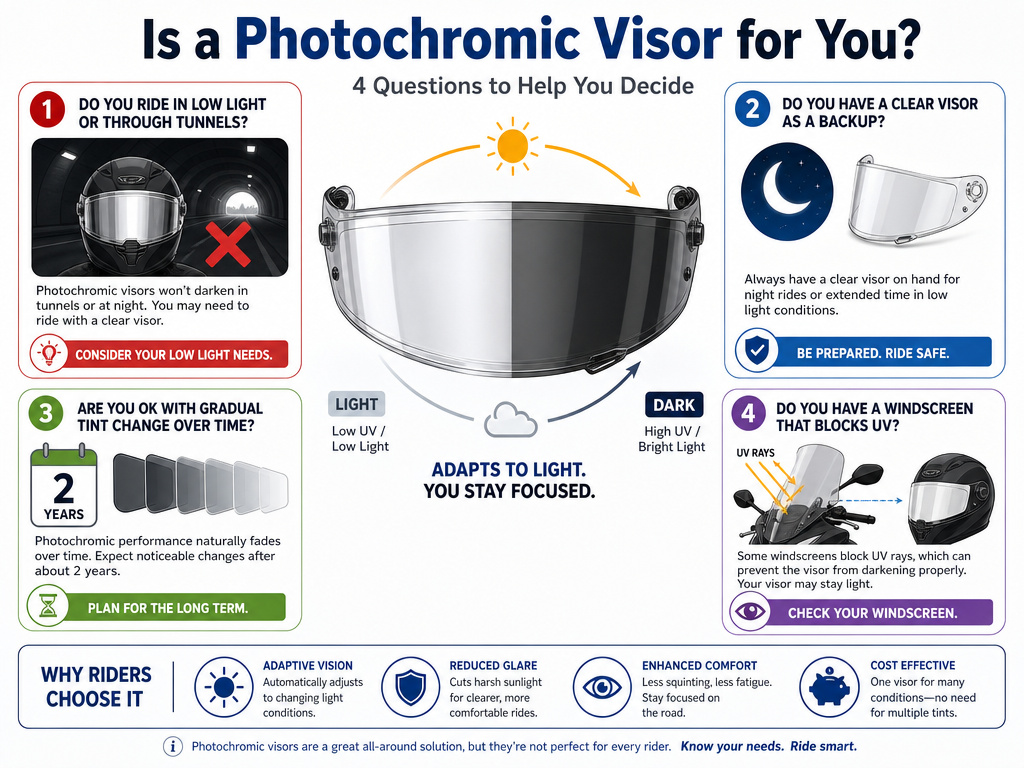
So, is a photochromic visor worth it for you? Answer these four questions.
- What’s your primary riding environment? If your routes are full of tunnels, dense urban canyons, or very cold climates, the transition lag becomes a frequent safety hazard. Cross it off the list.
- How often do you ride at night or in true darkness? If “never,” you sidestep the biggest legality and safety issue. If “occasionally,” you must be disciplined about carrying a spare clear visor, defeating the core convenience.
- Are you willing to treat it as a consumable? Budget to replace it every two years, even if it looks fine. The performance fade is gradual, and a weak tint is worse than no tint at all.
- Does your bike have a UV-blocking windscreen? This is the silent deal-breaker. If your windscreen filters UV, your expensive photochromic visor will barely darken. Test it first.
My stance? For the majority of street riders, the combination of a clear visor with a Pinlock and a helmet that has an internal sun visor is an alternative to consider. It gives you control without compromise. The photochromic visor is a brilliant tool for a specific job: long-distance touring in open, variable terrain where you can plan around tunnels and temperature.
For a detailed look at specific models that pass this test, see our guide to the best photochromic visors.
How do photochromic visors differ between brands?
Brands like Shoei and Scorpion offer photochromic options, but their specifications and guidance vary. Shoei’s models, which they call Transitions visors, state a clear light transmission around 86% and a tinted transmission between 23% and 29%. Scorpion’s VisionGuard shield offers similar ranges, from over 85% clear to 20%+ VLT when dark. A key practical difference is in manufacturer warnings: both Shoei and Scorpion explicitly state their photochromic visors are for daytime use only and may not conform to certain road-legal visibility standards. Scorpion also provides specific care instructions, warning that the shield’s coating can deteriorate and recommending replacement every couple of years.
What do riders say about photochromic visors in real use?
Rider feedback highlights the convenience of an adaptive visor but points out significant limitations. The transition speed is a common theme; while marketing suggests quick changes, users report it takes time, especially when moving from bright sun into a tunnel or shaded area. In these sudden low-light situations, the visor can remain too dark for safety, forcing riders to open it manually. Cold weather also slows the clearing process. Many appreciate the ‘set-and-forget’ nature for all-day rides, but note the darkest tint may not be sufficient for intense midday sun compared to a dedicated dark smoke visor. The high cost and limited nighttime usability are frequently mentioned drawbacks.
Frequently Asked Questions
Are photochromic motorcycle visors legal for road use?
The situation is complex. Models like the Shoei CWR-F2PN are marked “Daytime Use Only” and do not conform to the ECE-R 22.06 standard, which typically requires at least 50% light transmission. When dark, they transmit only 23–29% of light. While enforcement is rare, they may not be technically legal in some jurisdictions, and their non-compliance could be a factor in an accident investigation. Always check your local regulations.
How dark do photochromic visors actually get?
Manufacturer specs provide the real numbers. The Shoei CWR-F2PN and CWR-1 visors have a tinted light transmission range of 23–29%. For comparison, a BS EN 1836:1997 “dark tinted sunglasses” classification covers 8–18% VLT, so photochromic visors are in the dark sunglass range, not an ultra-dark race tint.
What is the lifespan of a photochromic visor?
Manufacturers like Scorpion recommend replacement every two years, suggesting peak performance may degrade around that time. Scorpion’s manual states the coating can begin to deteriorate after roughly two years and recommends replacement at least that often. The photochromic molecules themselves also degrade with UV exposure, causing the visor to darken slower, not get as dark, or not return fully to clear. Proper storage in a cool, dark place can slow this decline.
Can I use a Pinlock insert with a photochromic visor?
Yes, this is a key advantage. Shoei photochromic visors like the CWR-F2PN and CWR-1 come with Pinlock preparation pins. You must use the specific Pinlock insert model designed for that visor. This combination gives you an adaptive, fog-free field of view, which is a significant safety upgrade over dealing with fogging manually.
Is a photochromic visor better than an internal sun visor?
It depends on your priority. An internal sun visor gives you instant, manual control over tint and retains a 100% clear, legally compliant main visor for night riding. A photochromic visor is hands-off and automatic but suffers from transition lag and legal gray areas. For most riders seeking convenience, the internal sun visor is the more predictable and safer choice. Review the pros and cons of internal sun visors for a full breakdown.
The Bottom Line
A photochromic visor is a specialized tool, not universal gear. It solves the problem of variable light elegantly for a rider who rarely encounters tunnels, doesn’t ride at night, and accepts a two-year replacement cycle. For that rider, the convenience is worth the premium.
For everyone else, commuters, night riders, tunnel regulars, or budget-aware buyers, the compromises stack up too high. Your money and safety are better served by a foundational clear visor with a Pinlock, paired with either a dedicated tinted spare or a helmet featuring a robust internal sun visor. That setup gives you clarity, control, and compliance without the lag or the long-term cost. When evaluating any visor recommendations, start with those fundamentals first.
