
Internal Sun Visor in Motorcycle Helmets Pros and Cons
This post contains affiliate links. As an Amazon Associate, we earn from qualifying purchases.
An internal sun visor is a retractable tinted shield built inside a full-face or modular helmet. The main pros are instant sun protection without changing visors or wearing sunglasses. The key cons are potential visual distortion, added weight, and strict legal warnings against using it with a tinted outer shield. For most riders who face changing light, the convenience wins, but you must follow the manufacturer’s prohibitions to the letter.
That last line about prohibitions is where the real choice happens. The manuals from Shoei and ScorpionExo contain specific, legally binding warnings that most riders never read, turning a simple feature into a compliance risk. This is a key consideration when weighing the internal sun visor in motorcycle helmets pros and cons.
What follows is a breakdown of the mechanism, the hard data on vision impact from a peer-reviewed study, the manufacturer warnings you can’t ignore, and a direct comparison to the alternatives, all central to the internal sun visor in motorcycle helmets pros and cons. By the end, you’ll know exactly how to test one in a store and whether your riding style makes it a smart buy or a hidden liability.
Key Takeaways
- Never combine a tinted outer visor with an internal sun visor. Shoei’s manual explicitly states this fails the VESC-8 light transmission standard and can be “very dangerous.”
- Internal visors degrade. ScorpionExo notes the coating on faceshields and sun visors loses capacity in about 2 years, recommending replacement at least that often.
- They can subtly affect vision. A 2023 study found helmet visors can reduce contrast sensitivity and depth perception, potentially due to visor curvature.
- Test the slider mechanism thoroughly. A wobbly or sticky visor that drops mid-corner is worse than no visor at all. Check it in the store before you buy.
- For pure convenience, they’re unmatched. Swapping from a clear to a dark shield takes minutes; flipping a built-in visor down takes a second.
How an Internal Sun Visor Works (Mechanism)
The mechanism is simpler than it looks. A thin, tinted polycarbonate shield is housed in a channel at the top of the helmet’s eye port. A slider, usually on the left side of the helmet shell, connects to this shield via a plastic arm or cable. Pushing the slider forward pulls the tinted shield down along a guided track until it clicks into place just behind the main clear visor. Reverse the slider, and a spring retracts the shield back into its channel.
Technical Snippet: Internal sun visor mechanisms use a guided track system to lower a tinted polycarbonate shield behind the primary face shield. The slider’s gear engages with a tooth track on the visor’s edge. Proper alignment is critical; a misaligned gear causes binding, uneven deployment, or failure to retract fully, leaving a visible edge in the upper sightline.
The quality of this system defines the experience. A cheap mechanism feels gritty, deploys unevenly, and can rattle at speed. A premium one, like those in Shoei or Schuberth helmets, operates with a damped, precise motion and locks solidly. You’re adding a moving part inside a safety device, so the engineering tolerance is tight.
Where this goes sideways: Buying a helmet online without testing the slider. A mechanism that feels stiff in the showroom will only get worse. By the hundredth use, a poorly made plastic gear can wear or skip, leaving the visor stuck halfway down. That’s a ride-ender.
The Pros: Why Riders Love Them
The benefit is sheer, undeniable convenience. You’re riding into a low afternoon sun, squinting. With a gloved hand, you nudge a lever. A second later, the world darkens to a comfortable shade. No pulling over, no fumbling for sunglasses, no swapping a hot, dark smoke visor for a clear one at a tunnel entrance.
This solves a real problem on long, variable rides. Think mountain passes where you dart in and out of forest shadows, or coastal highways where glare off the water comes and goes. It eliminates the need to pack a spare tinted visor or manage a pair of sunglasses under helmet. For commuters, it’s a godsend on east-west routes at dawn or dusk.
The other advantage is integration. A built-in visor sits closer to your eyes than most sunglasses, offering a wider, gapless field of tinted coverage. It doesn’t press on your ears or temples, and it can’t fall off.
Bottom line: If your rides regularly mix bright sun and shade, the convenience is worth the trade-offs. It’s a feature that gets used daily.
The Cons and Trade-Offs
The drawbacks aren’t deal-breakers, but they are physical and measurable. First is weight. Housing the mechanism and the extra shield adds mass at the very top of the helmet. That can subtly alter the center of gravity. The Harley-Davidson Evo X17 modular helmet, for example, has an average weight of 3 lbs. 12 6/8 oz. (1,720 grams); every ounce counts over six hours.
Second is internal space. The channel that houses the retracted visor steals a few millimeters of liner thickness at the forehead. For riders with a round head shape already in a snug intermediate-oval helmet, that can create a pressure point. It’s not common, but it’s the reason you must try a helmet on, not just order your usual size.
The third is complexity and potential failure. You’ve added a moving part with small plastic gears. While major brands engineer them for longevity, they can break. More commonly, they get gummed up with dust, sunscreen, or moisture, leading to a sluggish, sticky action. Cleaning them isn’t always user-serviceable.
Finally, there’s the optical layer. You now have two polycarbonate shields between your eyes and the road. Even if both are in optical class 1 (the highest clarity grade, as specified by AGV), you have two surfaces to collect dust, two surfaces that can fog, and two surfaces that might slightly distort light.
| Trade-Off | Physical Consequence | When It Matters Most |
|---|---|---|
| Added Weight | Alters helmet balance, increases neck fatigue. | On long touring days or for riders with existing neck strain. |
| Reduced Liner Space | Can create forehead pressure points. | For riders with a head shape that already fits a helmet snugly. |
| Mechanical Complexity | Slider can wear, bind, or fail; difficult to clean. | In dusty environments or after years of daily use. |
| Dual-Layer Optics | Increased potential for fogging, glare, or minor distortion. | In cold, humid weather or at night with oncoming headlights. |
The Legal and Safety Warnings Nobody Reads
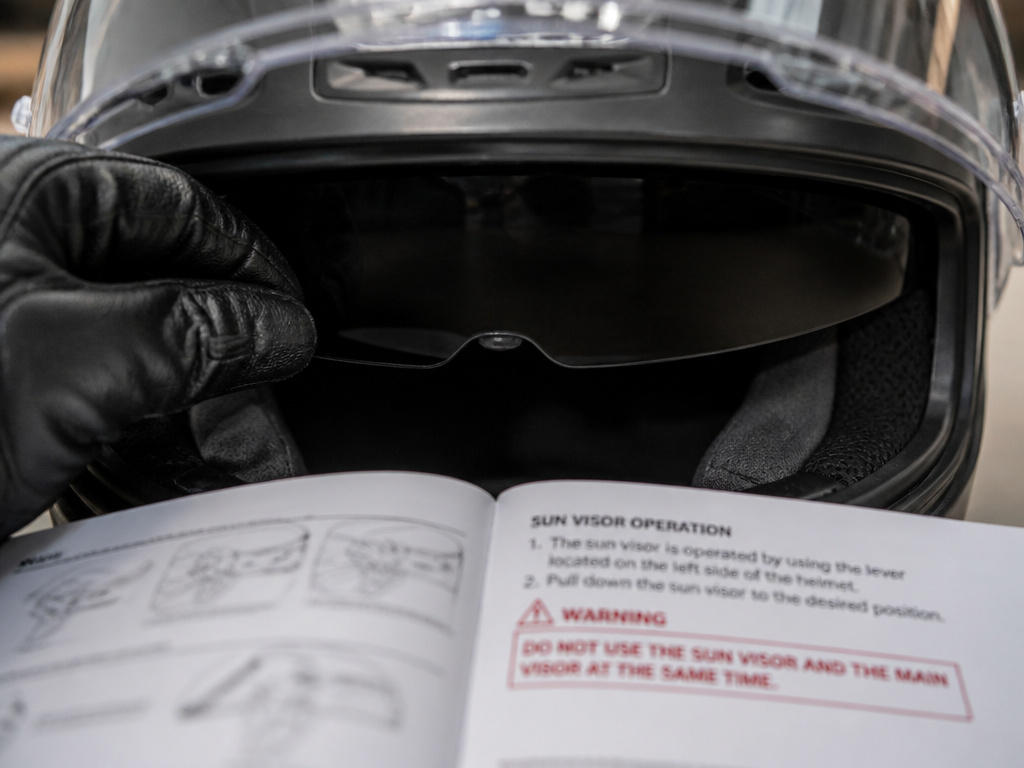
This is the most critical section. The convenience of an internal visor collides with written law and explicit manufacturer warnings. You can’t plead ignorance if it contributes to an accident.
The Shoei user manual is brutally clear: “Do not use a tinted or mirrored shield/visor together with the helmet’s internal sun visor, sunglasses or any other product that reduces light transmittance. This may obstruct your view and can be very dangerous.” It goes further, stating that if you do this in the U.S., “the requirement for the light transmission ratio specified in VESC-8 is not met.”
Specific Warning with Consequence + Timeline: VESC-8 (Vehicle Equipment Safety Commission regulation No. 8) is referenced in the laws of 36 U.S. States. Combining a tinted outer shield with an internal sun visor likely puts you out of compliance with those state laws. In a traffic stop or, worse, an accident investigation, that non-compliance could affect liability.
ScorpionExo’s warning is similar but focuses on conditions: “DO NOT wear a dark or tinted faceshield (including the retractable SpeedView® Sunvisor) in dark or poor visibility riding conditions.” The peer-reviewed vision obstruction paper gives a scientific basis for these warnings. It found that helmet visors can reduce contrast sensitivity and depth perception (stereopsis), potentially due to visor curvature creating aniseikonia, a difference in perceived image size between eyes.
The practical rule is simple: Use your internal sun visor only with a clear outer visor. The internal visor is for variable conditions, not for stacking darkness.
How They Affect Your Vision (The Research)
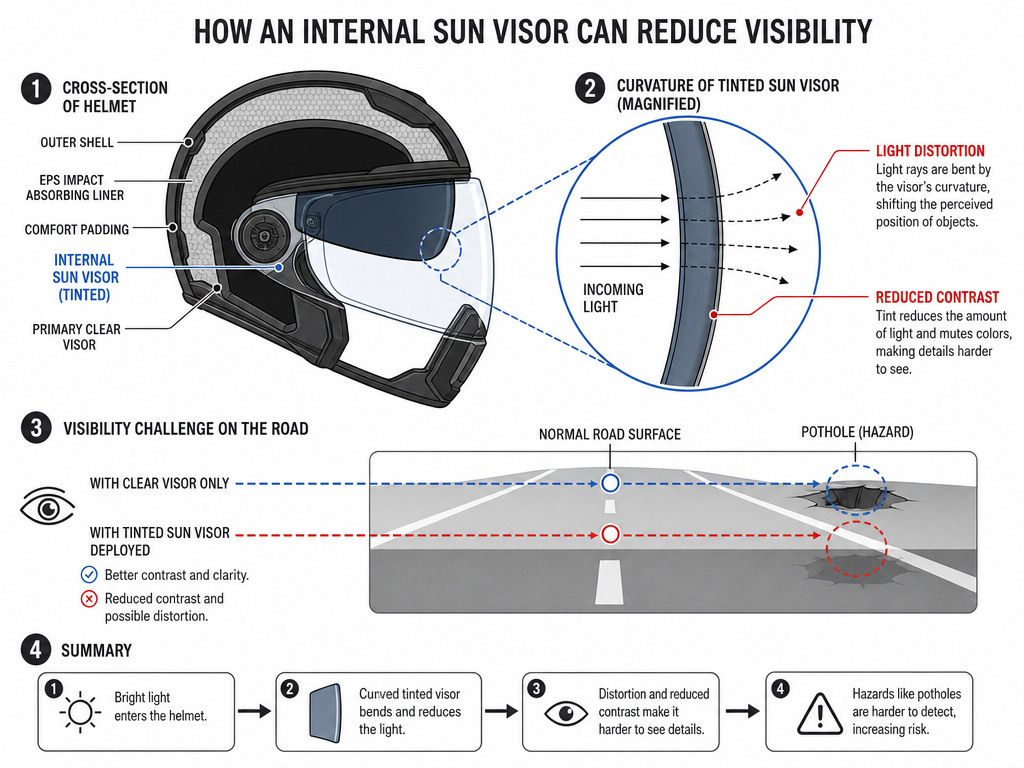
Beyond legal warnings, there’s a measurable, if subtle, effect on what you see. The study cited above provides hard data. It found that wearing a full-face helmet reduced stereopsis (depth perception) and contrast sensitivity compared to wearing no helmet. The researchers theorize the curvature of the visor may act like a weak lens, creating a slight aniseikonia.
What does that mean on the road? Your ability to judge the precise distance to a pothole or the speed of a merging car could be marginally impaired. Your eyes might take a fraction longer to distinguish a grey animal against grey asphalt in low light. These aren’t catastrophic effects, but they’re real. The study concluded this reduction in contrast sensitivity violates the ISI standards for helmet visors.
This is why visor quality matters. A cheap, optically imperfect visor, whether primary or internal, amplifies these effects.
Expert Tip / Personal Take: I’ve ridden helmets with cheap internal visors that had a faint wave or distortion line across the top of the tinted area. At noon, you don’t notice. In the flat light of dusk, that line can obscure the detail of a road surface crack. It’s the kind of flaw you only find after you’ve bought it.
Internal Visor vs. The Alternatives
You have three other main options for sun protection: external visor swaps, sunglasses, and photochromic visors. Here’s how they stack up.
External Visor Swap (Clear vs. Tinted)
- Pros: Optimal optical clarity (one layer), no mechanism to break, often the least expensive option upfront.
- Cons: Requires you to stop and swap visors, which means carrying a spare and handling dirty, possibly scratched shields at the roadside.
- Best for: Riders who plan their rides around light conditions, or who prefer the darkest possible tint (darker than most internal visors).
Sunglasses
- Pros: Can be prescription, high-quality optics, choice of tint and style.
- Cons: Can press on ears/nose, can fall off, create gap at temples, fog up, and are one more thing to forget.
- Best for: Riders who already wear prescription glasses or who spend most of their ride in consistent, bright sun.
Photochromic Visor
- Pros: Fully automatic adjustment, no moving parts, legal everywhere a clear visor is legal.
- Cons: Reaction time (takes seconds to change), may not get as dark as a dedicated tint in extreme sun, can be less effective in very hot or cold temperatures.
- Best for: Riders who encounter rapidly changing light frequently and want a “set it and forget it” solution.
The Verdict: The internal visor wins on speed and integrated convenience. It loses on ultimate optical purity and adds mechanical complexity. For a commuter or tourer facing variable light, it’s the best tool.
Maintenance and Replacement Reality
An internal sun visor isn’t a “lifetime of the helmet” component. It’s a wear item. ScorpionExo’s manual is the most direct: “Faceshields and sun visors lose their coating capacity in about 2 years and recommends replacement at least every two years.”
The coating they refer to is the anti-scratch and often anti-fog treatment. As it wears, the visor becomes more prone to fine scratches, which create glare at night. Cleaning also becomes trickier. You must use only mild soap and water (under 40ºC, per Shoei) and a soft cloth. Never use solvents, glass cleaner, or abrasive wipes.
The mechanism itself needs occasional attention. If the slider gets stiff, a tiny drop of silicone-based lubricant on the track (not on the visor itself) can help. For most riders, though, the entire internal visor assembly is not user-replaceable. It requires a trip to a dealer or direct contact with the manufacturer.
This ties into the broader helmet replacement cycle. ScorpionExo and AGV/Dainese advise replacing your helmet every 5 years from purchase, regardless of impacts. However, ScorpionExo also notes that faceshields and sun visors lose their coating capacity in about 2 years and recommends their replacement at least every two years. If your internal visor mechanism fails in year 4, you’re facing a repair that may cost a significant fraction of a new helmet.
How to Test One Before You Buy
Don’t buy a helmet with this feature blind. In the store, follow this checklist:
- Fit the helmet first. Ignore the visor until the shell and liner fit your head shape perfectly. A great visor on a poorly fitting helmet is worthless.
- Deploy and retract it 10 times. Feel for grit, binding, or uneven movement. It should be smooth and positive.
- Check the sightline. With the visor down, look straight ahead and then scan your peripheral vision up. Can you see the top edge of the tinted shield? A good visor disappears from your field of view.
- Look for distortion. Face a straight line (a shelf edge, a tile grout line) and move your head side to side. The line should not bend or wave as it passes behind the tinted area.
- Test the lock. Many visors have a detent to hold them partially open for ventilation. Ensure it holds securely and doesn’t slip.
If anything feels cheap, vague, or optically imperfect, walk away. The feature should feel robust, because it’s something you’ll rely on for years.
Frequently Asked Questions
Which motorcycle helmet has the best internal sun visor?
Brands like Shoei, Arai, and Schuberth are consistently praised for the quality and optical clarity of their internal sun visor systems. Models like the Shoei RF-1400 (with the Pro Shade) and the Schuberth C5 are benchmarks. The “best” is the one that fits your head shape perfectly and has a mechanism that feels solid to you, always try it on.
Is a bike helmet with a visor better than one without?
For street riding, a full-face helmet with a visor is fundamentally safer than an open-face helmet without one. The visor protects your eyes from wind, debris, and insects, which are major distractions and hazards. An internal sun visor is an added convenience feature on top of that essential primary face shield.
What does it mean when a motorcyclist taps his helmet twice?
This is a common hand signal among riders warning of police ahead. It’s a courtesy to alert other motorcyclists to slow down and check their speed.
Are internal sun visors safe?
When used according to the manufacturer’s instructions, specifically, only with a clear outer visor and never in dark conditions, they are a safe and convenient feature. The safety warnings exist because combining them with a tinted outer shield reduces light transmission to potentially illegal and dangerous levels.
Before You Go
The internal sun visor is a triumph of convenience, but it operates under strict, fixed rules. That single mistake, which seems harmless, is where the legal warnings and optical risks converge.
For the rider who spends hours in changing light, the trade-off in weight and complexity is worth it when you compare an internal sun visor in motorcycle helmets pros and cons. The ability to adapt in a second is a genuine quality-of-life improvement. Just buy from a brand that prioritizes optical quality, test the mechanism like your vision depends on it, and plan on that internal component being a wear item. Treat it like a helmet ventilation system or a breath deflector, a useful tool that requires understanding and maintenance, not magic.
