
How to Wear Sunglasses Under a Motorcycle Helmet
This post contains affiliate links. As an Amazon Associate, we earn from qualifying purchases.
That warning against combined tint is the line that separates a simple comfort tip from a real safety calculation. It’s not about whether the glasses physically fit, which is a key part of learning how to wear sunglasses under a motorcycle helmet. It’s about whether the total light reduction, visor plus sunglasses, drops below the legal threshold for visibility, especially at night.
What follows is a breakdown of that conflict, a step-by-step method to test any sunglasses in your helmet, and how to handle the switch from day to night riding without breaking the law or your concentration.
Key Takeaways
- The Shoei CNS-3 helmet manual explicitly warns against using sunglasses with a tinted or mirrored visor, stating it fails the VESC-8 standard for light transmission in the USA.
- In Brazil, CONTRAN Resolution 203/2006 legally defines approved protective glasses as those that allow the “simultaneous use” of sunglasses, creating a direct conflict with OEM safety advice.
- Always perform a thorough wear test with your helmet and sunglasses on before riding; pressure on the temples can quickly become a headache.
- For night riding, a crystal-clear visor is mandatory in jurisdictions like Brazil; wearing sunglasses under it may reduce light transmission, and manufacturers like Shoei warn against using any tinted protection (which could include this combination) at night.
- If you need prescription lenses, photochromic (transition) lenses or dedicated prescription riding sunglasses are safer than stacking multiple pairs of glasses.
The Step-by-Step Fit Test You Can’t Skip
Putting on a helmet with glasses feels fine for thirty seconds. The real test starts at minute five. That’s when a slight pinch at the temple turns into a hot spot, and a loose frame starts to slide down your nose. A fit test that simulates the first twenty minutes of a ride is the core of learning how to wear sunglasses under a motorcycle helmet, going beyond simply trying them on. It involves simulating the first twenty minutes of a ride while you’re still in your living room.
Start with the helmet off. Put your sunglasses on and feel where the temple arms press against your head. Now, pick up your helmet. Hold it by the chin straps, open the visor fully, and look straight ahead. Tilt the helmet forward about 45 degrees and gently work it over your head and the arms of your glasses. Don’t force it. If you have to jam the helmet on, the glasses are too bulky.
Once the helmet is seated, close your eyes for ten seconds. Open them. Your vision should be completely unobstructed. Your glasses frames should not block your peripheral view. Now, move your head side to side and up and down. The helmet should not push the glasses into your nose or ears. The same rule applies to your glasses.
Where this goes sideways: Skipping the seated test. The weight of the helmet changes everything. Sit on your bike, or a chair that mimics your riding position, and wear the helmet with glasses for an extended period. If you feel any focused pressure, those glasses will cause a distraction headache before you reach the highway.
The goal is zero interaction. The glasses and helmet should exist independently. If they don’t, you need a different pair of frames or a different helmet, which is a fundamental part of how to wear sunglasses under a motorcycle helmet. Several readers who wear glasses have told me their helmets pinch at the temples. I have seen the same thing when I tested with glasses on for about an hour. Now I mention the temple fit and stem channels in every helmet review I write. It’s that common.
| Test Step | What to Check | Fail Sign |
|---|---|---|
| Initial Donning | Helvet slides on without forcing glasses | You have to bend temple arms to get helmet on |
| Peripheral Vision | Clear sight lines left and right at eye level | Glasses frames create a blind spot in your periphery |
| Pressure Points | Even pressure around head, no hot spots | Sharp pain at temples or behind ears quickly |
| Stability | Glasses stay put when you shake head gently | Frames slide down your nose or tilt sideways |
Choosing the Right Sunglasses (It’s Not About Style)
A pair of riding sunglasses has three jobs: block glare, stay put, and not get in the way. The wrong pair does one job well and fails the other two catastrophically. Look for frames with thin, flexible temple arms. Thick, rigid plastic arms are the number one cause of helmet fit issues. Wire frames or nylon frames are the default choice for a reason, they bend.
The lenses must be impact-resistant. Regular fashion sunglasses can shatter. You want polycarbonate lenses. They don’t have to be marketed as “sport”; many affordable safety glasses from hardware brands use the same material. If your vision-correcting sunglasses shatter, you instantly fail that legal requirement.
Polarized lenses are excellent for cutting highway glare, but be cautious. Some riders report a strange “rainbow” effect or difficulty reading LCD instrument panels through them. Test them with your bike’s display before you commit. For the most streamlined fit, consider a dedicated pair of helmet-compatible glasses from brands that design for this niche. They often have curved temples that follow the shape of your head.
The Legal and Safety Conflict: What the Manuals Warn
This is where the simple advice ends and the real world begins. You can find a pair of sunglasses that fits perfectly. You can also find yourself in direct conflict with your helmet’s safety instructions and possibly the law, depending on where you ride.
Now, look at Brazilian law. CONTRAN Resolution 203/2006 defines “motorcyclist protection glasses” as equipment that “allows the user the simultaneous use of corrective glasses or sunglasses.” The law explicitly permits wearing sunglasses behind an approved, clear visor or goggles. This creates a direct contradiction: one country’s traffic code allows it, while a major helmet manufacturer’s safety guidance forbids it for a specific model.
| Jurisdiction / Source | Position on Sunglasses + Visor | Key Standard / Law |
|---|---|---|
| Shoei (OEM Manual) | Prohibits use with tinted/mirrored visor or internal sun visor. | VESC-8 (USA) / General Safety Warning |
| Brazil (CONTRAN) | Explicitly permits behind approved clear visor or goggles. | Resolution 203/2006, Article 3 |
| UK Government | Law mandates primary eye protector standard; does not prohibit additional eyewear. | UNECE 22.05/22.06 or British Standards |
| Georgia, USA (DDS) | Advises ensuring face shield does not interfere with glasses. | State Rider Manual Guidance |
The safe path is to understand both sides, rather than declaring one wrong. If you ride in the USA with a Shoei helmet, heed the manual’s warning. If you ride in Brazil, you can follow the law but should still be conscious of total light reduction. The principle is the same everywhere: you must see clearly to ride safely.
Sunglasses vs. Tinted Visor vs. Internal Sun Visor
You have three main tools to fight sun glare: your sunglasses, a tinted helmet visor, or a helmet with a built-in internal sun visor. Each has trade-offs, and mixing them introduces the legal and safety risks we just covered.
A tinted visor is simple. You flip it down and the world darkens. The problem is timing. You must carry a clear visor for night riding, as the Shoei manual and Brazilian law both mandate a clear visor at night. Switching visors on the roadside is a hassle. A tinted visor also does nothing if the sun is at your side.
An internal sun visor is a flip-down shade built into the helmet. It’s incredibly convenient for changing light conditions. However, these visors are usually a medium tint. Combining them with sunglasses, as the Shoei manual warns against, stacks tint and could dangerously reduce visibility.
Your sunglasses are the most flexible option. You can take them off instantly. You can wear them with a clear visor, which is the safest legal configuration for day and night (provided you remove them at night). The downside is the fit challenge and the risk of loss or damage. For most riders who encounter variable light, a clear visor with a pair of sunglasses that fit under helmets is the most practical and legally sound system. It keeps your primary eye protection, the visor, at the correct, legal light transmission level at all times.
Managing the Day-to-Night Transition
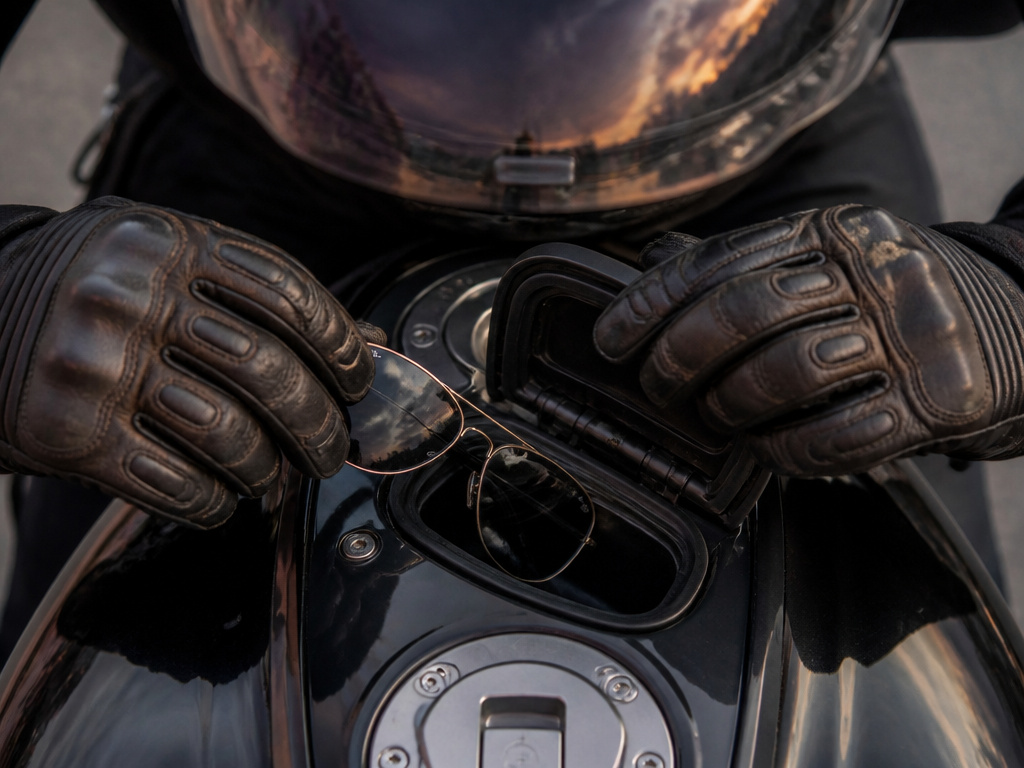
Riding into dusk with sunglasses on is a classic rookie mistake. The world gradually darkens, but your perception adapts, making it hard to notice how much detail you’re losing until it’s too late. You need a plan before the sun sets.
The safest method is the swap stop. Plan your route so you have a safe place to pull over before full darkness. Remove your sunglasses and stow them. If you have a tinted visor, you must have already switched to a clear one.
For riders with prescription needs, this is where photochromic lenses earn their keep. These transition lenses adjust their tint based on UV light. Worn behind a clear visor, they darken in the sun and clear up as light fades. They are a single solution that avoids the stacking-tint problem and the need to stop. Not all photochromic lenses work equally well behind a helmet visor, as some require direct UV light to activate, so test them before relying on them.
Another option is a helmet with an internal sun visor. As discussed, you must not wear sunglasses with it. But as a solo tool, you can flip it up instantly when light fades, with no need to change outer visors or remove eyewear. It’s a clean, if less flexible, solution.
Prescription Solutions: Don’t Stack Glasses
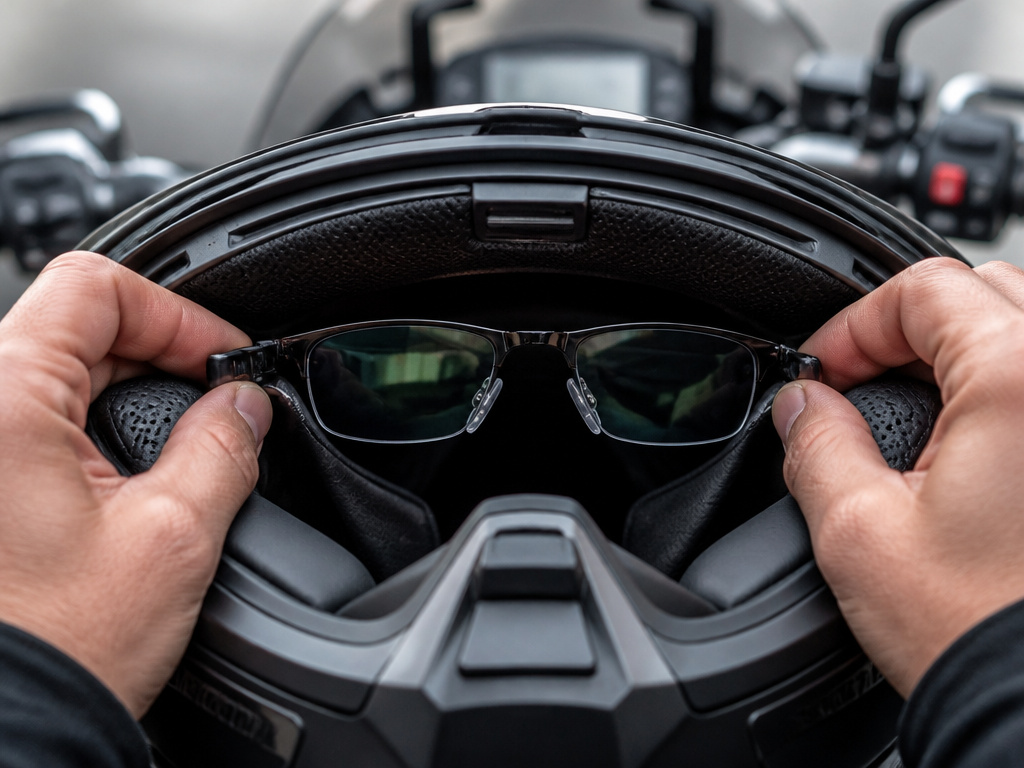
If you need vision correction, wearing regular glasses under sunglasses is a bad plan. It doubles the fit problems, doubles the points of failure, and almost guarantees lens fogging. You have two professional paths.
First, prescription sunglasses. Get a pair made with thin, polycarbonate lenses in a frame you’ve already tested for helmet fit. This is your all-in-one solution. Second, photochromic prescription lenses. These are the most elegant answer for riders who face changing light, as they are corrective lenses and variable tint in one.
Contact lenses are the other mainstream option. They solve all fit and fogging issues instantly. If you tolerate them, they are arguably the best technical solution.
Whatever you choose, avoid the illegal shortcut. The Brazilian regulation is very clear on this point: “The use of sunglasses, corrective glasses, or occupational safety glasses (EPI) alone, as a substitute for protective glasses, is prohibited.” Your primary eye protection must be the approved visor or goggles. Your prescription lenses or sunglasses go behind that approved protector, not instead of it.
How to Choose a Motorcycle Helmet for Wearing Glasses
If you need glasses to ride, your helmet must fit properly over them.
Frequently Asked Questions
Is it safe to wear regular sunglasses under a motorcycle helmet?
It can be safe if they fit perfectly without pressure points and have impact-resistant polycarbonate lenses. The greater risk is legal and optical: combining them with a tinted visor may reduce total light transmission below safety standard minimums, as warned by manufacturers like Shoei. Always use them with a clear visor.
What are the best sunglasses to wear under a motorcycle helmet?
The best sunglasses have thin, flexible temple arms (often wire or nylon), polycarbonate impact-resistant lenses, and a wrap-around style that doesn’t block peripheral vision. Look for models specifically marketed as sport or helmet-compatible. Avoid thick plastic arms and wide hinge designs.
Do sunglasses go over or under helmet straps?
Sunglasses always go under the helmet’s chin straps. The straps must be snug against your skin, not over the temple arms of your glasses. If the straps are over your glasses, the glasses will be pulled painfully into your face, and the helmet’s security in a crash could be compromised.
What about wearing goggles instead of a visor with sunglasses?
Motorcycle goggles are certified eye protection. You can wear sunglasses under them, and this is explicitly permitted under laws like Brazil’s CONTRAN resolution. Ensure the goggles fit over your glasses frames without a gap, and test for fogging, as the sealed fit can reduce airflow.
Before You Go
The rule isn’t just “make it fit.” It’s “make it fit within the rules.” The physical challenge of fitting sunglasses under a helmet is straightforward once you know the test. The real work is understanding manufacturer warnings and local laws. That Shoei manual warning against combined tint is an engineering judgment that the total system fails a defined safety test, not legal fine print.
So here’s the blunt take: if you ride with a clear visor and a well-fitted pair of polycarbonate sunglasses, you’re on solid ground. The moment you add a tinted visor or drop an internal sun shield on top of those sunglasses, you’re in a gray zone that your helmet maker may explicitly call dangerous. That’s a line worth noticing.
For the majority of street riders, the simplest system is the most robust. A clear, scratch-free visor meets all legal standards for primary eye protection day and night. A single pair of quality sunglasses, removed at dusk, handles the glare. It’s not the most high-tech solution. But it’s the one with the fewest hidden failure points. And on the road, that’s what actually matters.
