
How Often to Change Motorcycle Oil: Intervals Explained
This post contains affiliate links. As an Amazon Associate, we earn from qualifying purchases.
Change your motorcycle’s oil when your manual says to, or at least once a year if you ride very little. There is no universal mileage number, a Ducati Hypermotard 950 goes 9,000 miles between services, while a 2009 Honda XR650L manual calls for changes every 2,000 miles. The correct interval for your bike is a combination of mileage, time (usually 12 months), and whether you ride in severe conditions like dust, rain, or stop‑and‑go traffic.
That gap between 2,000 and 9,000 miles is the whole conversation. It’s not about guessing. It’s about reading the schedule written for your specific engine, because the engineers who built it also wrote the maintenance rules that keep it from seizing. They know how hot the oil gets, how much shear the transmission puts on it, what the clutch needs to not slip, and precisely how often to change motorcycle oil.
What follows: the specific numbers from the factory schedules, the three things that shorten those intervals, the signs your oil is done even if the odometer says otherwise, and the one mistake that costs more than an engine.
Key Takeaways
- Your owner’s manual holds the only correct interval for your specific bike, a 2009 Honda XR650L manual specifies every 2,000 miles, while a Ducati Hypermotard 950 schedule says 9,000 miles.
- Always follow the “whichever comes first” rule, if your manual says “every 6 months or 4,000 miles,” you change the oil at 4,000 miles or at 6 months, even if you’ve only ridden 500 miles.
- Severe conditions require more frequent changes, riding in dust, constant rain, sustained high heat, or exclusively short trips means you should change oil more often than the “normal” schedule.
- Use JASO MA‑rated oil for any bike with a wet clutch (most street motorcycles); car oil lacks the friction modifiers the clutch needs and will cause slippage.
- The first (“break‑in”) service is non‑negotiable, perform it exactly at the mileage and time specified in your manual (e.g., Ducati’s first service is at 620 mi/1000km or within 6 months).
The Core Intervals by Manufacturer
Forget the “3,000‑mile rule.” That’s for cars. Motorcycle intervals are all over the map because engines, cooling, and stress levels differ wildly. A liquid‑cooled sportbike running synthetic oil has a different life than an air‑cooled dual‑sport.
According to Ducati, the Time Service must be performed the first time after 12 months from the previous service and then every 12 months, regardless of mileage. This is a fixed calendar mandate on top of any mileage schedule.
Your manual is the final word. But since most riders don’t have every factory PDF memorized, here’s how the major players break down. This table shows you why “often” is a meaningless term.
| Manufacturer & Model | Standard Oil Service Interval | Key Condition |
|---|---|---|
| Ducati Hypermotard 950 (MY19‑24) | 9,000 miles / 15,000 km | Whichever comes first: mileage or 12‑month Time Service. |
| Ducati Panigale V4 (MY18‑24) | 7,500 miles / 12,000 km | Includes over 20 checks; part of a larger “Oil Service” package. |
| Suzuki V‑Strom 1050DE (2023) | Per manual chart; severe use requires more frequent changes. | Manual explicitly states to perform maintenance more often under severe conditions. |
| Honda XR650L (2009 Manual) | 2,000 miles / 3,200 km or 6 months | “Regular” interval after initial 600‑mile break‑in service. |
| Polaris/Indian General | Resets after 50,000 miles | When the vehicle goes beyond 50,000 miles, return to the 500 mile chart and start the interval process over. |
The takeaway isn’t to memorize this table. It’s to see the spread. A modern Ducati with a high‑performance liquid‑cooled engine and synthetic oil from the factory is designed for 9,000‑mile runs. An older, air‑cooled single‑cylinder thumper like the Honda is built to a 2,000‑mile rhythm. If you put the Honda interval on the Ducati, you’re wasting money and creating unnecessary waste. If you put the Ducati interval on the Honda, you’re flirting with wear and sludge.
Where this goes sideways: Assuming “synthetic oil means I can go longer.” The interval is set for the oil type the manufacturer expects. If they filled it with synthetic and say 7,500 miles, that’s the synthetic interval. Switching from conventional to synthetic in an old bike that calls for 2,000‑mile changes doesn’t magically grant you a 7,500‑mile passport. It might handle the heat better, but the contamination rate from combustion and clutch debris hasn’t changed.
The “Whichever Comes First” Rule That Actually Matters
Time is the silent killer of motorcycle oil. Condensation forms inside the crankcase from temperature cycles. Additives that prevent corrosion and neutralize acids get used up just sitting there. This is why every manual has a time clause, usually 6 or 12 months, alongside the mileage figure.
Common mistake: Logging only mileage. If your manual says “every 4,000 miles or 6 months” and you put 1,200 commuting miles on in a year, you still change it at the 6‑month mark. The oil has aged out.
This rule exists because oil deteriorates from oxidation and moisture absorption, not just from use. A bike that sits for a year with old oil can have a surprisingly corrosive soup in the crankcase by spring. The first start‑up then circulates that through bearings and journals.
The fix is simple. Write the next service date on a piece of tape on your fork leg or in your phone’s calendar. A time‑based schedule is easier to track than a mileage‑based one for low‑use bikes.
What “Severe Conditions” Actually Means (And Shortens Your Interval)
Manufacturers define “severe” or “adverse” conditions to give you an out. If you ride in them, you’re instructed to halve the standard service interval. This isn’t a suggestion. It’s the factory saying the oil is working harder and breaking down faster.
Here’s the official list, compiled from Suzuki, Honda, and Kawasaki manuals:
- Frequent short trips (under 5 miles where the engine never fully warms up).
- Extended idling or stop‑and‑go traffic (like daily urban commuting).
- Riding in extremely dusty or sandy conditions.
- Operation in sustained high ambient temperatures (constant desert riding).
- Operation in sustained high humidity or frequent rain.
- Aggressive riding, high‑speed operation, or competitive use.
If your riding life checks one of those boxes, your oil change frequency should double, directly impacting the how often to change motorcycle oil calculation. A 4,000‑mile interval becomes 2,000. A 12‑month interval might become 6 months. The oil is being thermally stressed, contaminated with fuel blow‑by from cold runs, or loaded with abrasive particulates that get past the air filter.
Why‑layer: Short trips are severe because the engine oil never gets hot enough to boil off accumulated fuel and water vapor from combustion. This leads to fuel dilution (which thins the oil and lowers its viscosity) and acidic corrosion. The oil looks clean but is chemically spent.
How to Check If Your Oil Needs Changing Right Now
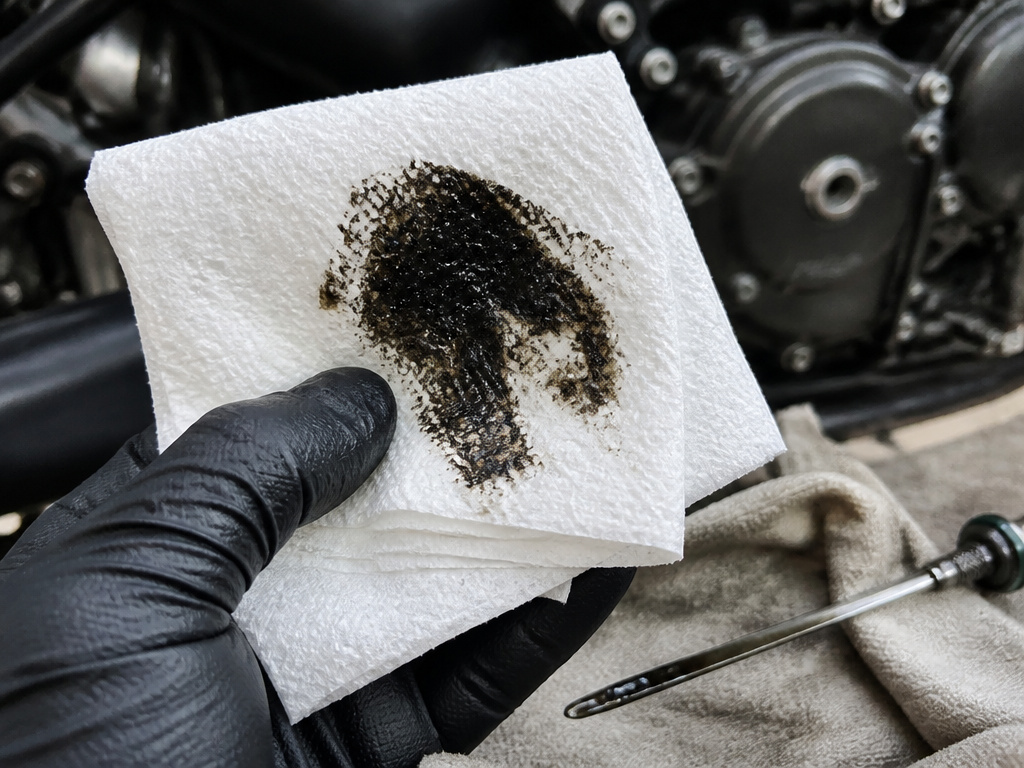
Sometimes the schedule and the oil disagree. Your eyes and nose are decent diagnostics. You don’t need a lab kit.
Worth knowing before you start: These checks are secondary. They confirm a problem or indicate an emergency change is needed. They do not override the scheduled interval from your manual. Oil can be chemically degraded and thin without being black or gritty.
Choosing the Right Oil: Specs Over Brand

The brand you recognize matters less than the specification on the bottle that matches your manual. Pouring in a premium synthetic that’s the wrong viscosity or lacks a critical rating can do more harm than good.
Your manual will call for three things:
- Viscosity Grade (e.g., SAE 10W‑40): This is the oil’s thickness at different temperatures. Use exactly what’s recommended.
- API Service Classification (e.g., API SN, SP): This denotes the oil’s performance level for gasoline engines. Meet or exceed it.
- JASO MA/MA2 Certification (CRITICAL): This is the motorcycle‑specific rating. Oils with JASO MA or MA2 certification are formulated for wet clutches. They have the right friction modifiers to prevent clutch slippage. Most car oils have friction‑reducing additives (marked as “Energy Conserving”) that will make your clutch slip and burn out.
Choose oils that consistently meet the required specifications, such as the correct viscosity grade, API classification, and JASO MA/MA2 certification. The label must say JASO MA or MA2.
A Step‑By‑Step Guide to the DIY Oil Change
If you’re cutting your intervals in half for severe use, doing it yourself saves real money. It’s a 30‑minute job with basic tools. Here’s the sequence that prevents mess and mistakes.
Before you start: Have a new oil filter, the correct amount and type of oil, a drain pan, a socket set, and a torque wrench ready. Work on a level surface when the engine is warm, not hot, so the oil flows easily.
- Remove the filler cap. Removing the filler cap breaks the vacuum, allowing the oil to drain freely. Do this first.
- Place the drain pan and remove the drain bolt. It’s usually on the bottom of the engine crankcase. Let it drain completely for at least 10 minutes.
- Remove and replace the oil filter. Use a strap wrench or proper filter socket. Lubricate the new filter’s rubber gasket with a dab of fresh oil before hand‑tightening it. Do not overtighten.
- Reinstall the drain bolt with a new crush washer. Torque it to the spec in your manual (common range is 20‑30 ft‑lb). Skipping the new crush washer is how leaks start.
- Refill with the specified amount of oil. Use a funnel. Pour in about 90% of the stated capacity, then check the dipstick.
- Start the engine and check for leaks. Let it run for a minute, then shut it off. Wait another minute for oil to settle, then check the level on the dipstick and top up to the correct mark. Do not overfill.
For a full walkthrough, our step‑by‑step oil change guide has detailed photos and torque specs for common models.
How much does a motorcycle oil change cost?
The cost of an oil change is not a fixed number. It depends on whether you do it yourself or have a dealer or independent shop perform the service. A DIY oil change primarily involves the cost of oil and a filter. Using a shop adds labor charges, which can vary significantly by location and the specific model of motorcycle. The total expense for a professional service can also be higher if the oil change is performed as part of a larger scheduled maintenance visit, such as a first service or a time-based annual check. Always factor in the cost of the correct oil and filter for your bike when budgeting for this routine maintenance.
Frequently Asked Questions
What is the 12‑second rule for motorcycle oil?
The “12‑second rule” is an old‑school test where you drip oil from the dipstick onto a hot engine part and see how long it takes to bubble off. It’s unreliable and messy. A better method is the feel test: rub a drop between your fingers. If it feels slick, it’s likely okay. If it feels watery, gritty, or has lost its slippery feel, it needs changing regardless of mileage.
Can I use car oil in my motorcycle?
You should not use car oil in a modern motorcycle with a wet clutch. Most car oils contain friction‑modifying additives labeled “Energy Conserving” that can cause clutch slippage and failure. Always use a motorcycle‑specific oil with a JASO MA or MA2 certification. For the full breakdown on oil types, see our guide on synthetic versus conventional motorcycle oil.
How do I know if I’m riding in “severe conditions”?
You’re riding in severe conditions if most of your trips are under 5 miles, you ride daily in heavy stop‑and‑go traffic, you frequently ride in dusty or wet environments, or you operate the bike in consistently very hot weather. Any of these factors mean you should perform oil changes at half the standard mileage or time interval listed in your manual.
Do I need to change the oil filter every time?
Yes. Modern motorcycle oil filters are full‑flow and trap particles that cause wear. A new filter is cheap insurance. Changing the oil but leaving the old, contaminated filter in place immediately mixes the fresh oil with the sludge and debris held in the filter media.
How often should I check my motorcycle oil level?
Check your oil level at least once a week during riding season, and always before a long trip. Use the sight glass or dipstick with the bike held level. Maintaining the proper level is as critical as changing it on time. Learn the right way in our article on how to check motorcycle oil level.
The Bottom Line
Stop looking for one number. Your motorcycle’s service intervals are printed in the manual, and they are a combination of miles ridden, months passed, and conditions endured. For a modern bike on synthetic, that might be 7,500 miles or one year. For an older machine or one living in city dust, it could be 2,000 miles or six months.
The single most important thing you can do this week is find your manual, look up the oil service schedule, and write the next due date, based on both mileage and calendar, on your garage wall or in your phone. Then, use a guide to the best motorcycle oil that meets your bike’s specs to fill your cart. The engine you save will be your own.
