
Motorcycle Oil Viscosity Explained
This post contains affiliate links. As an Amazon Associate, we earn from qualifying purchases.
Motorcycle oil viscosity is its resistance to flow, graded by the SAE J300 standard. The numbers on a bottle, like 10W-40, describe how the oil behaves at cold and hot temperatures. The “W” means winter, and the number before it (10W) indicates cold-weather flow. The number after (40) is the oil’s thickness at 100°C. Choose the grade your motorcycle’s manual specifies; using the wrong viscosity reduces protection and can damage the engine, transmission, and wet clutch.
The manual tells you what to buy, but not why it matters. That second number decides whether your engine’s bearings get a consistent oil film at full operating temperature. The first number decides whether that oil can even reach them on a cold morning before you’ve revved it twice. This is the essence of motorcycle oil viscosity explained.
What follows: a walk through the numbers, a look at the JASO standard that keeps your clutch from slipping, the real-world consequences of getting it wrong, and a decision guide that moves past “check the manual” to “here’s how to read the chart for yourself.”
Key Takeaways
- The first number before the ‘W’ (e.g., 10W) rates cold-weather flow; a lower number like 5W or 10W flows faster for easier cold starts.
- The second number after the dash (e.g., 40) is the oil’s kinematic viscosity at 100°C, defining its high-temperature protection thickness.
- Wet-clutch motorcycles require a JASO MA or MA2 rating; oils without it, like many car oils, can cause clutch slippage within a few hundred miles.
- Shear stability is critical; an oil can have the right initial SAE grade but shear down and thin out prematurely inside a motorcycle’s gearbox.
- Follow your manual’s recommended grade first, then adjust for extreme climates, use a thicker hot number (e.g., 50) for sustained high heat, and a thinner cold number (e.g., 5W) for frigid winters.
What Do the Numbers and Letters Actually Mean?
You see 10W-40 on a bottle. The “SAE” before it means the Society of Automotive Engineers, and the “J300” after is the standard that defines the test. This isn’t marketing, it’s the core of motorcycle oil viscosity explained. It’s a measurement system.
The “W” stands for winter. The number before it is the oil’s cold-temperature performance rating. A 10W oil has a maximum cold cranking viscosity, think of it as the effort needed to turn the engine over, at a specified low temperature, as defined by SAE J300. A 5W oil has a lower threshold, meaning it flows more easily in the cold. This is why manuals for cold climates often recommend 5W or 0W grades.
The number after the dash is the oil’s kinematic viscosity at 100°C, measured in centistokes (cSt). This is the oil’s thickness at your engine’s normal operating temperature. The number after the dash is the oil’s kinematic viscosity at 100°C, measured in centistokes (cSt), with higher numbers indicating thicker oil at operating temperature.
Technical Snippet: The SAE J300 standard classifies engine oil viscosity. A 10W-40 oil must meet two sets of criteria: a maximum cold cranking viscosity (e.g., 7,000 cP at -25°C for 10W) and a specific kinematic viscosity range at 100°C (12.5 to <16.3 cSt for grade 40). Multi-grade oils use viscosity index improvers to achieve this wide operating range.
So, 10W-40 is a multi-grade oil. It behaves like a thin 10-weight oil when cold for easy starting, and a thicker 40-weight oil when hot for proper lubrication. A single-grade oil, like an SAE 40, doesn’t have this range. It’s too thick when cold and can be too thin when extremely hot. That’s why multi-grades are the default for modern engines.
The JASO T 903 Standard: Why Motorcycle Oil Isn’t Car Oil
Your motorcycle’s manual doesn’t just say “10W-40.” It says “10W-40 meeting JASO MA” or “JASO MA2.” That second part is essential for most bikes, a key point in any motorcycle oil viscosity explained guide.
JASO is the Japanese Automotive Standards Organization. Their T 903 standard exists because motorcycle engines share oil with the gearbox and wet clutch. Car oils don’t. According to JASO, low-friction car oils designed for fuel economy can cause clutch slippage and transmission gear pitting wear in motorcycles. The standard was created to test and classify oils for this specific, shared-sump environment.
There are two main classes you need to know: JASO MA/MA2 and JASO MB.
- JASO MA and MA2: These oils have friction characteristics designed for wet clutches. They provide positive clutch engagement. MA2 is a newer, more stringent standard within the same friction profile.
- JASO MB: These are lower-friction oils. They are not suitable for wet-clutch motorcycles and will cause slippage.
Where this goes sideways: Using a car oil with friction modifiers in a wet-clutch bike. The clutch plates, bathed in this slippery oil, can’t grip. You’ll feel it as a loss of power, high revs without acceleration, and a burning smell. It happens within a few hundred miles of riding.
The JASO standard also sets physical and chemical limits. For example, oils filed under JASO T 903 must have a phosphorus content between 0.08 and 0.10 mass %. This controlled level helps with anti-wear protection while remaining compatible with catalytic converters.
Some oils are explicitly not meant for this system. Schaeffer Oil states its Extreme V-Twin 20W-50 is not recommended for applications that specify JASO MA, MA-2 or MB oil, as it can cause clutch slippage. This is a high-zinc racing oil formulated for separate-sump Harley-Davidson style engines, not a modern sportbike. The label tells you; you have to read it.
Consequences of Using the Wrong Viscosity
Getting the viscosity wrong doesn’t mean your engine seizes instantly. It fails quietly, over time, in specific ways. The symptoms depend on whether the oil is too thick or too thin for the temperature you’re riding in.
Oil is Too Thick (High Cold Number):
- Symptom: Hard starting, slow cranking, battery strain.
- Mechanism: The oil is like cold syrup. It can’t flow quickly through the narrow oil galleries to reach the camshaft, bearings, and piston skirts before you start the engine. This causes dry starts and wear every single time you turn the key on a cold morning.
- Timeline: Wear accumulates with each start. You might not notice until the engine develops a tap or loses oil pressure.
Oil is Too Thin (Low Hot Number):
- Symptom: Low oil pressure, excessive valvetrain noise, overheating, increased wear.
- Mechanism: At operating temperature, the oil film is too weak to separate moving metal parts. The oil film in bearings collapses, leading to metal-on-metal contact. It also can’t carry away heat as effectively.
- Timeline: In extreme cases, like using a 30-grade oil in a bike that demands a 50 for track use, you could spin a bearing in a single hard riding session.
Oil Shears Out of Grade:
This is the hidden failure. An oil can meet the SAE 40 grade on the bottle but fail inside your engine. The mechanical shearing forces in the gearbox can break down the viscosity index improver additives. The oil permanently thins out.
| Symptom | Likely Cause | What’s Happening Inside |
|---|---|---|
| Clutch slippage under acceleration | Oil lacks JASO MA/MA2 rating | Friction modifiers prevent clutch plates from gripping. |
| Gearbox becomes notchy, hard to shift | Oil has sheared, viscosity too low | Thin oil doesn’t cushion gear teeth, leading to increased friction and wear. |
| Increased engine noise (ticking/tapping) | Oil too thin or sheared | Insufficient oil film at cam lobes, followers, and bearings. |
| Oil pressure warning light at idle (hot) | Oil severely sheared or wrong grade | Pump can’t maintain pressure with oil that’s too thin. |
The gearbox is the culprit. It’s a brutal environment that car oils never see. That’s why shear stability, an oil’s ability to resist this thinning, is a top spec for motorcycle oil. Brands highlight it: AMSOIL calls its formula shear-stable to maintain viscosity under the extreme pressure of wet-clutch transmissions. Brands highlight shear stability; for example, AMSOIL calls its formula shear-stable to maintain viscosity under the extreme pressure of wet-clutch transmissions.
How to Choose the Right Viscosity: A Practical Guide

Your owner’s manual has the answer. Start there. The engineers who built your engine know the clearances, oil pump capacity, and cooling system. The recommended grade is the baseline.
But you can understand why they chose it. This decision guide covers the variables.
Step 1: Lock in the JASO Rating.
Is your bike’s clutch bathed in engine oil? If yes, and for most street bikes, the answer is yes, you must use a JASO MA or MA2 oil. This is the first filter. No compromise.
Step 2: Match the Hot Number (Second Number) to Your Climate and Use.
The manual’s recommendation (e.g., 40) is for typical conditions. You can adjust for extremes.
- Sustained High Heat & High Load: If you ride in desert climates, tow a trailer, or do frequent track days, consider a heavier hot number. A switch from 10W-40 to 10W-50 provides a thicker protective film at high temperatures. The Mobil 1 V-Twin 20W-50, for example, has a kinematic viscosity of 20.8 cSt at 100°C, significantly thicker than a 40-grade.
- Normal Street Riding: Stick with the manual. A 10W-40 like Motul 7100 (13.2 cSt @ 100°C) or Mobil 1 Racing 4T (13.1 cSt @ 100°C) is the sweet spot for protection and efficiency.
Step 3: Match the Cold Number (First Number) to Your Winter.
This is about the coldest temperature you’ll start the bike in.
- Freezing Winters (Below 32°F/0°C): A 5W- or even 0W- grade is better. The lower cold number means easier cold starts and less wear. The AMSOIL Synthetic Metric 10W-30 has a cold cranking viscosity of 4,640 cP at -25°C, which is excellent for cold mornings.
- Mild Winters: A 10W- or 15W- grade is fine. A 15W oil is rated down to -20°C, which covers most temperate climates.
Step 4: Decide on Oil Change Philosophy.
Drain intervals are a major point of disagreement among manufacturers. You must reconcile this.
- AMSOIL recommends its synthetic metric oil for use up to twice the manufacturer-recommended change interval or one year, whichever comes first.
- Motul is more conservative. For its 7100 10W-40, the drain interval is according to manufacturers’ recommendations. For its 5100 10W-40, it’s up to 16,000 km, depending on manufacturer’s recommendations or individual use.
Drain intervals are a point of disagreement: AMSOIL recommends its synthetic metric oil for use up to twice the manufacturer-recommended change interval or one year, while Motul states its 7100 10W-40 drain interval is according to manufacturers’ recommendations.
Common mistake: Picking an oil based on brand loyalty alone. A premium synthetic that doesn’t match your manual’s viscosity or JASO requirement is the wrong oil, no matter how good the marketing is.
Reading an Oil Spec Sheet: Viscosity Index and HTHS
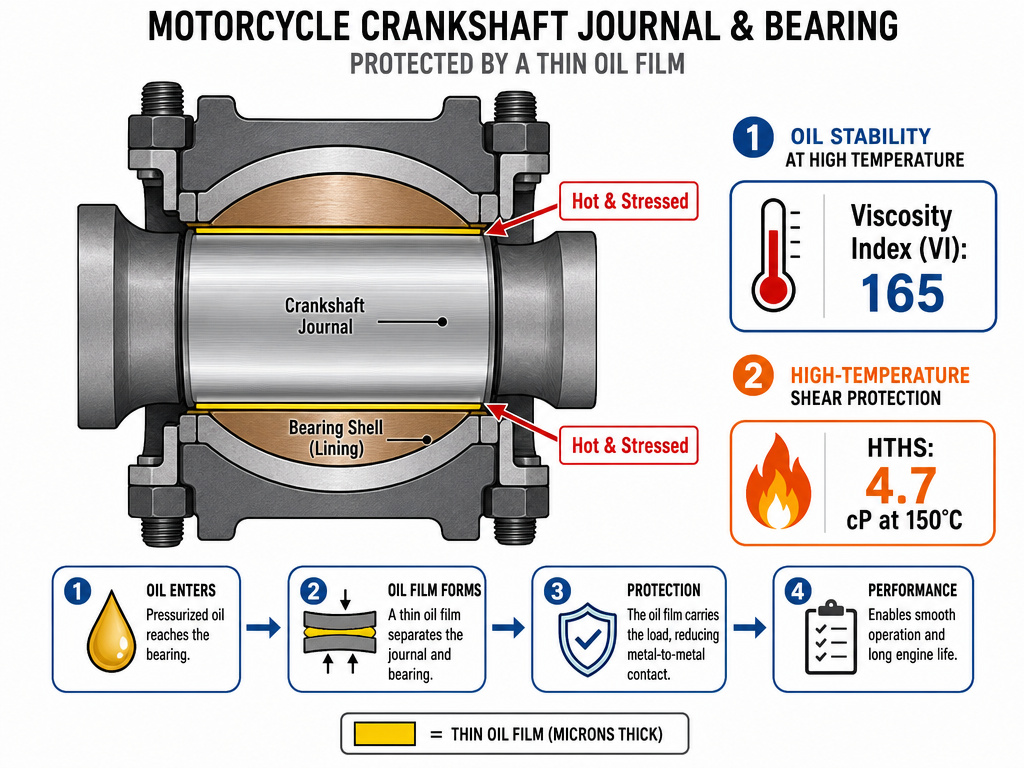
Once you look past the SAE grade, two specs tell you about an oil’s quality and behavior: Viscosity Index (VI) and High-Temperature High-Shear (HTHS) Viscosity.
Viscosity Index (VI) measures how much the oil’s viscosity changes with temperature. A higher VI (e.g., 165) means the oil thickens less when cold and thins less when hot compared to an oil with a lower VI (e.g., 140). It indicates a solid base oil and solid viscosity index improvers. AMSOIL’s 10W-40 has a VI of 165. Mobil 1 V-Twin 20W-50 has a VI of 142.
High-Temperature High-Shear (HTHS) Viscosity is the critical one. Measured at 150°C, it simulates the oil film thickness in high-stress areas like crankshaft bearings and between gear teeth under load. Higher is generally better for protection.
- AMSOIL 10W-40: 4.7 cP at 150°C
- Motul 7100 10W-40: 3.8 mPa.s at 150°C
- Schaeffer Extreme V-Twin 20W-50: 5.31 cP at 150°C
A high HTHS number means the oil is less likely to squeeze out from between loaded surfaces, maintaining the protective film. This is the number that fights wear when your engine is hottest and working hardest.
Multi-Grade vs. Single-Grade Oil
A multi-grade oil, like the 10W-40 or 20W-50 examples listed, is designed to perform across a wide temperature range. The first number with the ‘W’ indicates its cold-temperature flow characteristics, while the second number indicates its viscosity at operating temperature. This dual rating means one oil can protect your engine during cold starts and maintain proper film strength when hot. Single-grade oils, which have only one viscosity rating, do not have this versatility. For modern motorcycles, which experience a wide range of operating conditions, multi-grade oils are the practical choice to ensure proper lubrication from startup to redline.
Viscosity Index Explained
The Viscosity Index is a number that measures how much an oil’s viscosity changes with temperature. A higher VI means the oil’s thickness changes less as it heats up or cools down. For instance, Mobil 1 Racing 4T 10W-40 has a viscosity index of 161, while Mobil 1 V-Twin 20W-50 has a viscosity index of 142. The oil with the higher VI will maintain a more stable viscosity across temperature swings. This stability is crucial for consistent engine protection. Oils formulated for motorcycles often target a high VI to ensure they remain thick enough to protect gears and bearings at high temperatures but still flow readily for cold starts.
Role of Additives like Viscosity Index Improvers
Additives are blended into base oils to achieve specific performance goals. Viscosity Index Improvers are polymers that help an oil maintain its viscosity at high temperatures, which is how multi-grade oils achieve their wide operating range. However, these polymers can be susceptible to shearing, or breaking down, under the extreme mechanical stress found in a motorcycle’s transmission. That’s why motorcycle-specific oils emphasize shear-stable formulas. Other key additives include those that prevent rust and corrosion, and importantly, motorcycle oils are formulated without certain friction modifiers that could lead to clutch slippage in a wet-clutch system.
Frequently Asked Questions
Can I put regular 10W-40 car oil in my motorcycle?
You can, but you shouldn’t in a bike with a wet clutch. Most 10W-40 car oils contain friction modifiers to improve fuel economy. These additives will cause clutch slippage in a motorcycle. They also may not have the shear stability needed for the gearbox. Always look for the JASO MA or MA2 specification on the bottle.
Which oil is thicker, 10W-30 or 10W-40?
10W-40 is thicker at operating temperature. The “40” refers to a higher kinematic viscosity at 100°C compared to a “30”. The cold-weather “10W” performance is identical. The 40-weight oil maintains a thicker protective film in a hot engine.
Should I run a higher viscosity oil for track days or hot climates?
Yes, if your engine tolerates it. Many manuals list an alternative grade for severe service. Moving from a 40- to a 50-grade oil (e.g., 10W-40 to 10W-50) increases the oil film strength at high temperatures, providing better protection for bearings and pistons under extreme heat and load. Check your manual first.
Can I use 5W-30 in my motorcycle?
Only if your owner’s manual explicitly lists it as an acceptable viscosity. A 5W-30 oil is thinner when hot than the typical 10W-40 recommendation. Using it in an engine designed for thicker oil can lead to reduced oil pressure and increased wear. The 5W cold rating is great for winter, but the 30 hot rating may not be suitable for summer riding.
Can I mix different brands or viscosities of motorcycle oil?
Manufacturers like Motul state their oils can be mixed with synthetic or mineral lubricants in an emergency. However, it’s not a best practice for a full change. Different additive packages can interact. Mixing viscosities (e.g., a quart of 10W-40 with a quart of 20W-50) will result in an unknown, intermediate viscosity. It’s always better to drain and refill with a single, correct product.
The Bottom Line
Motorcycle oil viscosity is a set of measured thresholds, not a vague suggestion. The right grade is the one that forms a thick enough film at your engine’s hottest point while still flowing to the top end on the coldest morning you’ll start it.
Stick with the manual’s JASO rating and viscosity as your default. The manual got it right. Deviate only when your riding conditions are permanently outside the norm, constant desert heat or deep winter commuting, and then, only by one grade step. The cost of a wrong guess is measured in bearing wear, not just a messy oil change.
For the large majority of street riders, a high-quality synthetic 10W-40 with a JASO MA2 rating, like Motul 7100 or Mobil 1 Racing 4T, is the answer. It covers the temperature range, protects the wet clutch, and has the shear stability to survive the gearbox. Change it on the manual’s schedule, and your engine’s internals will never know the difference.
