
Motorcycle Service Intervals Explained: Brand vs. Brand
This post contains affiliate links. As an Amazon Associate, we earn from qualifying purchases.
Motorcycle service intervals are the manufacturer’s schedule for inspecting, adjusting, and replacing wear-prone components like oil, filters, spark plugs, and brake fluid. They are defined by two triggers: a mileage count (e.g., 5,000 miles) or a time period (e.g., 12 months), whichever comes first. Harley-Davidson and Ducati, for example, use different logic. Harley’s schedule repeats cyclically after the final interval, while high-performance Ducatis have far longer intervals between major valve checks.
That “whichever comes first” clause is the entire game. It turns a simple mileage count into a calendar, and it’s the reason a bike that sits for two years still needs a brake fluid flush even if the odometer hasn’t moved. The specifics, 5,000 miles or 15,000 miles, 12 months or 24 months, come straight from the manufacturer’s service manual for your exact model and year. This is the core of motorcycle service intervals explained.
What follows is a breakdown of the two-trigger system, a look at real intervals from Harley and Ducati manuals, and how to apply this motorcycle service intervals explained when your bike’s history is a mystery.
Key Takeaways
- Follow the “mileage or time, whichever comes first” rule for every service item. A bike parked for two years needs its brake fluid changed.
- Valve clearance checks are essential on performance engines. A Ducati Panigale V4 calls for one every 24,000 km, but skipping it risks burning a valve with no warning noise.
- Severe service conditions, like stop-and-go traffic, dusty roads, or short trips, shorten all intervals. Honda’s manual explicitly states this.
- Harley-Davidson’s schedule resets to the 5,000-mile interval after completing the final 50,000-mile service. Most manuals don’t mention this reset.
- The factory owner’s or service manual is your only authoritative source. Online forums guess; the manual states.
The Two-Trigger Rule: Mileage vs. Time Intervals
Every service task has two clocks: one on the odometer and one on the calendar. The shorter clock wins. This isn’t a suggestion. It’s the engineering department’s calculation of how long a fluid lasts before it absorbs too much moisture or a component wears from vibration and temperature cycles alone.
Brake fluid is hygroscopic, it absorbs water from the air through the reservoir and rubber hoses. Harley-Davidson mandates a brake fluid flush every two years or sooner if moisture content reaches 3 percent. Ducati’s schedule calls for a brake and clutch fluid change every 24 months. The interval is time, not mileage.
Here’s where riders get it wrong. They see “Oil Service: 15,000 km” and think they’re safe for three years of light riding. They’re not. The “Time Service” line in the same manual overrides that. Ducati’s official bulletin states the Time Service “must be performed the first time after 12 months from the previous service and then every 12 months,” regardless of distance covered.
| Service Item | Typical Mileage Trigger | Typical Time Trigger | Why Time Matters |
|---|---|---|---|
| Engine Oil & Filter | 5,000–15,000 km | 12 months | Acid buildup and additive depletion occur with age. |
| Brake/Clutch Fluid | – | 24 months | Hygroscopic fluid absorbs moisture, lowering boiling point. |
| Coolant | At DESMO Service (Ducati) | 48 months (Ducati) | Anticorrosion additives break down over time. |
| Spark Plugs | 30,000 mi (Harley) | 2 years (Harley) | Electrodes erode and gap widens, affecting ignition. |
The best way to internalize this is to do a walk-around. Trace the force path from the throttle to the tire, touching each component. You’ll remember that the brake fluid in the reservoir you just looked at needs changing in two years, not in 10,000 miles.
What’s Actually in a Service? Oil, Desmo, and Annual Checks
Manufacturers bundle operations. Knowing what each bundle contains tells you what you’re paying for, or what you need to do yourself.
Oil Service: This is the basic interval. For a Ducati Scrambler 800, it’s every 12,000 km and includes the oil and filter change plus over 20 other checks like brake pad wear and chain tension. For a Ducati Multistrada V4, it’s every 15,000 km.
Desmo Service / Valve Check: This is the big, expensive one specific to Ducati’s desmodromic valve system. The valve clearance check involves measuring and potentially adjusting the clearance between the valve stem and the rocker arm. On a Panigale V4, it’s due every 24,000 km and takes a technician about five hours. Skip it, and a tight valve won’t close fully, leading to lost compression and a burnt valve. There’s no rattle or tick beforehand, it just fails.
Annual / Time Service: This is the catch-all for low-mileage riders. Per the Ducati NHTSA motorcycle service bulletin, it’s required every 12 months and includes safety system checks, fluid inspections, and general bolt-tightening. It ensures a bike that’s been sitting is still roadworthy.
Harley-Davidson groups things differently. Its 1,000-mile initial service is thorough. Then, major intervals (5,000 mi, 10,000 mi, etc.) each have a specific list. Items like spark plug replacement are listed under “Services As Required” with both a mileage (30,000 mi) and time (24 months) trigger.
Common mistake: Assuming an “oil change” is just an oil change. On modern bikes, connecting the dealer’s diagnostic tool to reset the service reminder and check for fault codes is often part of the bundled service. A DIY changing your oil saves money but may leave a persistent service light.
Brand vs. Brand: Harley-Davidson, Ducati, and the Engineering Divide
Comparing a Harley-Davidson Touring bike to a Ducati Hypermotard is comparing a workbench to a scalpel. Their service intervals reflect that.
Harley-Davidson intervals are shorter and more frequent, emphasizing accessibility and rider inspection. The official maintenance checklist update for all models shows a focus on regular, thorough checks. Ducati intervals are longer but more intensive, trusting tightly toleranced components to last but requiring skilled technician labor for adjustment.
| Brand & Model | Oil Service Interval | Major Valve Service Interval | Key Fluid Time Interval |
|---|---|---|---|
| Harley-Davidson (General) | 5,000 mi | Not a standard service | Brake Fluid: 2 years or 3% moisture |
| Ducati Hypermotard 950 | 15,000 km / 9,000 mi (per Hypermotard manual) or 18,000 km / 9,300 mi (per general Ducati document, depending on model) | 30,000 km / 18,000 mi | Brake/Clutch Fluid: 24 months |
| Ducati Panigale V4 | 12,000 km | 24,000 km | Brake/Clutch Fluid: 24 months |
| Ducati Multistrada V4 | 15,000 km | 60,000 km (per Multistrada V4 schedule) | Brake/Clutch Fluid: 24 months |
The spread is vast. A Ducati Multistrada V4 can go 60,000 km between valve checks, while an older air-cooled bike might need them every 30,000 km. This is why the model-specific Ducati Hypermotard service manual is required to explain motorcycle service intervals correctly. The Hypermotard 796 manual specifies a different “Mileage Service OIL” interval (12,000 km) than the Hypermotard 950 manual (15,000 km).
The Severe Service Shortcut: When the Manual Says “Do It Sooner”

Your commute might be destroying your bike on paper. Manufacturers define “severe service” conditions that legally and mechanically shorten all intervals.
Harley-Davidson’s chart lists them explicitly: “extreme temperatures, dusty environments, mountainous or rough roads, long storage conditions, short runs, heavy stop/go traffic or poor fuel quality.” If your riding matches any of these, the manual tells you to perform maintenance more frequently.
Short runs are the silent killer. An engine that never reaches full operating temperature accumulates fuel dilution in the oil and moisture in the exhaust and crankcase. That 5,000-mile oil change intervals becomes a 3,000-mile interval. The same logic applies to chain lubrication, a bike ridden in the rain needs the chain cleaned and lubed immediately after the ride, not at the next scheduled 500-mile mark.
Where this goes sideways: Ignoring the “severe service” clause because your mileage is low. Oil contaminated by fuel and water from constant cold starts loses its lubricity faster than oil degraded by highway miles. The result is accelerated cam and bearing wear, showing up as low oil pressure or noise at 20,000 miles instead of 50,000.
The Schedule Reset You Won’t Find in the Manual
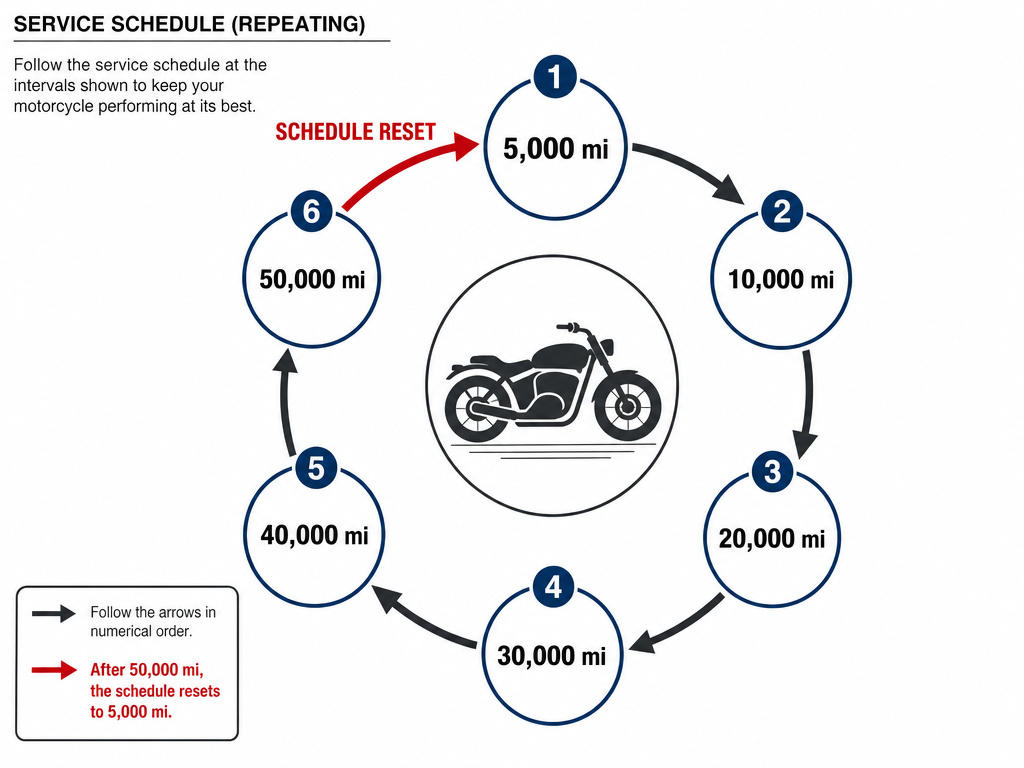
Here’s a nuance most owners miss. What happens after you complete the final service interval in the chart? Harley-Davidson’s manual has a clear note: “After completing the final service interval, repeat the service schedule starting at the 8000 km (5000 mi) interval.”
Your 2020 Street Glide hits 50,000 miles. You do the 50,000-mile service. The next service is not at 55,000 miles. It’s the 5,000-mile service all over again. This reset ensures cyclical maintenance of core components.
Other manufacturers, like Ducati, don’t explicitly state a reset in the provided sources. The schedule may simply continue with the longest interval repeated (e.g., Oil Service every 15,000 km indefinitely) or may not be defined beyond a certain point. This ambiguity is why maintaining your own log is critical. Don’t assume.
Baselining a Used Bike: The “Assume Nothing” Service
Buying a used bike with spotty records? Your first task is a baseline service. This means performing every service item that is due by either mileage or time, regardless of what the seller claims.
- Change all fluids. Engine oil, filter, primary fluid, transmission fluid, brake fluid, coolant, and shaft drive oil if applicable. This is essential.
- Inspect wear items. Check chain wear and sprockets, brake pad thickness, and tire replacement windows. Replace the air filter.
- Perform the most overdue major service. If the bike is at 28,000 km and the valve check is due at 24,000 km, get the valve check done. This is the single biggest financial pill but also the most critical for engine longevity.
This process gives you a known starting point. From there, you can follow the manual’s schedule faithfully. A good set of essential tools makes this DIY-friendly.
The Cost of Compliance: DIY vs. Dealer for Major Intervals
A Ducati Desmo Service at a dealer can cost several times more than a DIY oil change. The dealer’s bill includes labour, parts (gaskets, shims, fluids, filters), and diagnostic procedures.
Doing it yourself saves the labour cost but requires specialty tools (shim kit, feeler gauges, torque wrenches), the factory service manual, and mechanical confidence. Getting one valve shim size wrong can cause a burn-down.
For most riders, the pragmatic mix is DIY for fluid changes, chain maintenance, and brake pads, and the dealer for valve checks and major internal work. Purchasing a complete oil change kits streamlines the most frequent task.
Bottom line: If you’re not comfortable pulling the cam covers and interpreting a clearance spec, pay for the major service. A mistake here totals the engine.
Symptom-based maintenance (signs that outrank the schedule)
Your motorcycle will often tell you it needs attention before the scheduled interval arrives. A spongy brake lever or a drop in the fluid reservoir indicates the brake fluid may have absorbed too much moisture, requiring a flush regardless of the two-year mark. Difficulty starting, rough idling, or reduced power can signal fouled spark plugs needing replacement ahead of the mileage or time limit. Perform maintenance more frequently if you ride in severe conditions like extreme temperatures, dusty environments, or heavy stop-and-go traffic. Any new noise, vibration, or fluid leak demands immediate investigation, as these symptoms always override the calendar and odometer.
Frequently Asked Questions
What are the recommended service intervals for motorcycles?
There is no universal answer. Intervals are set by each manufacturer for each model and engine type. You must consult your specific owner’s or service manual. Common mileage intervals for oil changes range from 12,000 km (e.g., Ducati Scrambler) to 15,000 km (e.g., Ducati Multistrada V4). Time intervals for fluids like brake fluid are commonly 24 months.
What is the most important service interval to never skip?
The valve clearance check. On bikes where it’s required (most high-performance and many standard motorcycles), skipping it can lead to catastrophic engine failure with no audible warning. The valves tighten with wear, fail to close, and burn. The repair cost exceeds the service cost many times over.
Do service intervals differ for chain drive vs. Shaft drive?
Yes, in one key area: final drive maintenance. Chain-drive bikes require regular chain wear check, cleaning, and lubrication, often every 500 miles. Shaft-drive bikes eliminate this but require a gear oil change in the final drive unit at longer intervals, typically around 30,000 miles.
How do I know if my bike is under “severe service” conditions?
If your riding consists mostly of trips under 10 miles where the engine doesn’t fully warm up, you ride in extreme dust or stop-and-go traffic, or you frequently ride in very hot or cold temperatures, you are in a severe service category. The manual advises more frequent maintenance. When in doubt, err on the side of shorter intervals.
Can I service my motorcycle myself without voiding the warranty?
In most regions, yes, as long as you follow the manufacturer’s specified procedures, use parts that meet their specifications, and keep detailed records (receipts for oil/filters, photos, a logbook). However, some countries or specific warranty terms may require dealer service. Check your warranty booklet.
Before You Go
One rule cuts through all the brand specifics: if you don’t know the last time a service was done, assume it’s overdue and do it. That applies to the bike you just bought, the one that’s been sitting, or the one you’ve been riding on a hope and a prayer. Fluids age. Clearances tighten. The schedule exists because those things happen predictably.
The motorcycle oil change frequency in your manual is a guide, not a gospel. Your specific conditions, dusty roads, winter storage, a track day, override it. Trust the wear, not the label. Keep a simple log, do the walk-around, and let the manual’s two clocks tell you what’s next.
