
How to Lube a Motorcycle Chain: Ducati’s 8-Step Method
This post contains affiliate links. As an Amazon Associate, we earn from qualifying purchases.
To lube a motorcycle chain, position the bike on a rear stand, spin the wheel opposite its direction of travel, and spray lubricant between the chain’s internal and external links just upstream of the rear sprocket. Official Ducati and Yamaha manuals specify intervals of 400 km (250 mi) and 1000 km (600 mi) respectively; Ducati advises lubricating when the chain is warm, not cold, and both agree to wait before riding.
The difference in those numbers is a real disagreement between manufacturers on what “regular” maintenance means, and it flips the standard advice you’ll hear in a garage. One says every 400 clicks, the other says every 600. This is especially true for how to lube a motorcycle chain. Choosing the wrong one for your bike wastes time or wears out a chain prematurely.
What follows is the procedure from the OEM service bulletins, not garage lore, for how to lube a motorcycle chain. You’ll get the exact spray technique, the argument over cleaning brushes, the tool that measures stretch with a yellow zone starting at 0.7%, and the one timing rule every manual agrees on but most riders ignore.
Key Takeaways
- Lubricate when the chain is warm, not cold. Lubricating when the chain is warm helps the new lubricant penetrate, as the old lubricant is more fluid.
- Wait 10–15 minutes after spraying before wiping excess and do not ride immediately. Fluid lubricant flings off if not allowed to set.
- Interval wars: Ducati says every 400 km (250 mi); Yamaha says every 1000 km (600 mi). If you ride in high ambient temperature (105°F/40°C) or after long highway trips at high speed, Ducati advises lubricating more frequently than its base interval.
- Spray inside the chain links, not on top. Aim at the point just before the chain meets the rear sprocket (upstream of the sprocket meshing point).
- Overtightening is a serious problem. Excessive chain tension overheats the links, consumes the lubricant film, and can cause micro-cracks in the rollers.
The Interval No Two Manuals Agree On
Open a Ducati manual and you’ll find a 400 km (250 mi) lubrication interval. Open a Yamaha manual for a similar bike and it says 1000 km (600 mi). Both are correct for their respective manufacturers, and they should not be treated as interchangeable.
The Ducati specification for how to lube a motorcycle chain comes from a Technical Service Bulletin filed with the NHTSA. It states to lubricate at least every 400 km, or more frequently if used in high ambient temperature (105°F/40°C) or after long highway trips at high speed. The Yamaha owner’s manual for a common model sets a base interval of 1000 km, adding that you should also lube after washing the bike or riding in the rain.
So which one wins? For most street riders on a Japanese bike, the 1000 km rule is safe. If you own a Ducati, a high-performance bike, or you regularly pin the throttle on interstates or in desert heat, the 400 km rule is your baseline. The takeaway is to pick the manual for your bike and treat the other as a warning about harsh conditions.
Common mistake: Choosing an interval from a forum instead of your owner’s manual. A chain’s service life is rated for about 20,000 km only if maintained per the OEM schedule. Deviate from that schedule and the 20,000 km figure is fiction.
Warm Chain vs. Cold Chain: The OEMs Have a Side
The classic garage advice is to clean and lube a cold chain. The logic seems sound: you’re not rushing, you won’t burn yourself, and the cleaner can work. Every major manufacturer’s service bulletin I’ve read says the opposite.
Ducati’s directive is explicit: “Lubricate the chain without waiting for it to cool down after use.” Their reasoning is that the residual heat makes the old lubricant more fluid, allowing the new spray to penetrate deeper into the pin-and-bushing area behind the O-rings. Applying lube to a cold, stiff chain mostly coats the outside plates where it doesn’t help and just makes a mess.
This isn’t a Ducati quirk. The principle is mechanical, not brand-specific. A warm chain has expanded slightly, opening microscopic gaps for the lubricant to wick into. A cold chain has contracted, sealing those gaps. The difference shows up as wear inside the O-rings over time.
The 8-Step Spray Lubrication Sequence (Ducati’s Method)
This isn’t a generic “spray and go” list. These steps are copied from the Ducati service bulletin verbatim, because the order and aim matter more than the brand of can.
- Position the motorcycle on a rear paddock stand. This is essential. The rear wheel must spin freely.
- Quickly spin the rear wheel in the direction opposite to the direction of travel. For a typical chain drive, this means spinning the wheel backward.
- Spray the lubricant inside the chain, between internal and external links, at the point immediately upstream of the sprocket meshing point. This is the critical shot. As the chain moves toward the sprocket, centrifugal force will pull the fluid lubricant into the gap between the pin and bushing.
- Repeat, aiming the spray pattern at the central part of the chain to lubricate the rollers. This lubricates the rollers.
- Spray the external plates lightly. Spray the external plates lightly.
- Wait 10–15 minutes after spraying. The solvents need time to evaporate and the lubricant to set. This wait is in the bulletin.
- Wipe off excess lubricant from the external plates with a rag. Removing the excess prevents lubricant from flinging off.
- Do not use the motorcycle immediately. Riding right away throws fluid lubricant everywhere. The bulletin is adamant.
Forget any step and you’re just making the chain look shiny. The sequence exists to get lube inside the sealed areas where the actual metal-on-metal wear happens. Your goal is to replenish the grease behind the O-rings, not to paint the side plates.
| Step | Action | Why It Matters |
|---|---|---|
| 1 | Bike on rear stand | Allows free wheel rotation for even application. |
| 2 | Spin wheel backward | Presents the chain’s inner link gaps to the spray nozzle. |
| 3 | Spray upstream of sprocket | Centrifugal force pulls lube into pin/bushing interface. |
| 4 | Spray central rollers | Lubricates the contact point with sprocket teeth. |
| 5 | Light spray on side plates | Rust prevention, secondary. |
| 6 | Wait 10-15 minutes | Lets solvents flash off; lube begins to adhere. |
| 7 | Wipe excess | Prevents lubricant fling onto tire and components. |
| 8 | No immediate ride | Prevents throwing fluid lubricant everywhere. |
The Cleaning Controversy: To Brush or Not to Brush?

You should clean a dirty chain before lubing it. Everyone agrees on that. The fight is over how. The KTM owner’s manual is blunt: “The best way is to use lots of water, but never use brushes or solvents.” Ducati and Honda manuals describe washing the chain but don’t prohibit brushes.
The KTM stance likely protects their O-rings. A stiff-bristled brush can nick or roll an O-ring, breaking its seal. Once that seal is compromised, the factory grease inside leaks out and road grit works its way in. The chain wears out much faster.
My take is to follow the KTM rule even if you don’t ride a KTM. Use water to clean the chain, and avoid brushes or solvents as some manufacturers warn. Avoid gasoline, kerosene, or harsh solvents near O-rings. The goal is to remove caked-on grime, not to sterilize the metal. After washing, dry the chain thoroughly with compressed air or a ride around the block to evaporate water before applying your chosen chain lube.
Choosing a Lubricant: Specs Over Marketing
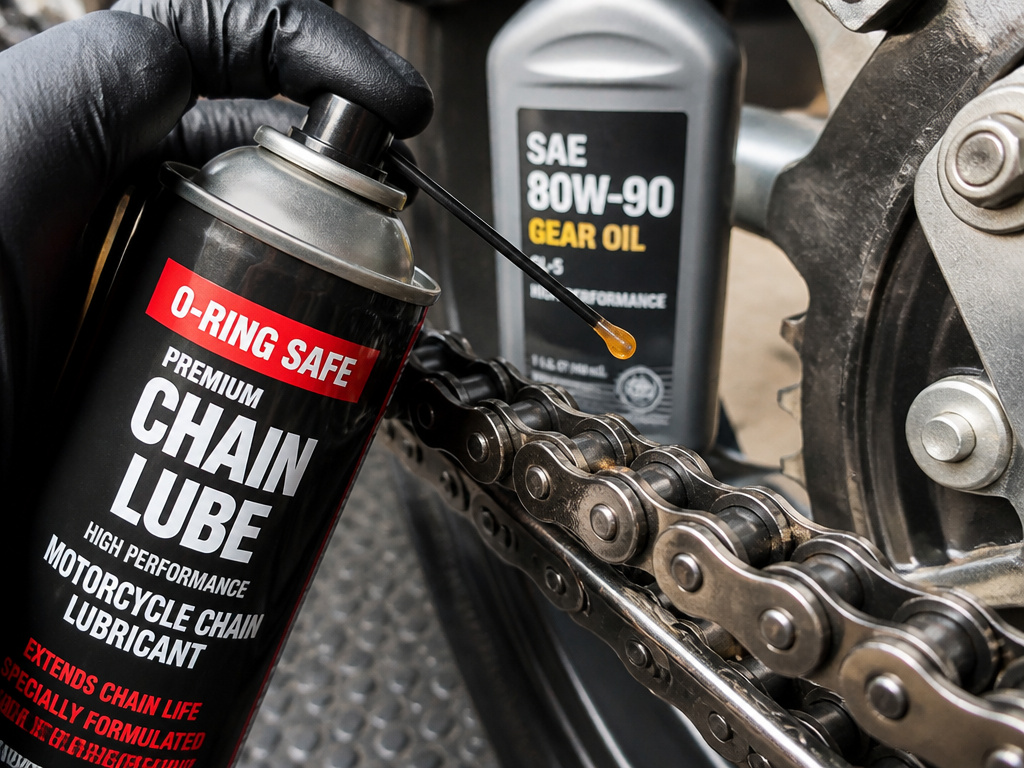
The Ducati bulletin specifies “mineral oil SAE 80W-90 or specific chain lubricants.” That SAE 80W-90 is a gear oil grade—a thick, sticky fluid designed for high-pressure sliding contact. It’s a clue to what the chain needs: a lubricant that stays put.
Most spray chain lubes are this base oil suspended in a fast-evaporating solvent carrier. When you spray, the solvent washes the old lube out of the gaps and then flashes off, leaving the thick oil behind. The key warning from Ducati is to “ensure lubricants do not contain any additives that might damage the O-rings.” Some extreme-pressure or anti-wear additives in general-purpose oils can degrade the rubber in O-rings over time.
Stick with lubricants marketed for O-ring or X-ring chains. Use specific chain lubricants formulated for O-ring chains. The debate between chain wax vs lube is mostly about clean vs. Tenacious—wax is cleaner, traditional spray is often more durable in wet conditions.
The Chain Stretch Gauge You Didn’t Know You Needed
Lubrication postpones wear; it doesn’t stop it. A chain elongates as the pins and bushings wear, a condition called “stretch.” Ducati’s service bulletin describes a special tool (part no. 889450134) that measures this wear with a color code.
The tool is a go/no-go gauge. You hook it on a roller.
- Green: The tool won’t fit. Chain length is close to nominal. Keep riding.
- Yellow: The tool partially fits. Chain stretch is between 0.7% and 1.2%. Plan for replacement soon.
- Red: The tool slides in fully. Stretch is 1.2% or more. Replace the chain immediately.
Without the tool, you can measure stretch with a ruler. Tension the chain on the bike by putting it in gear, or off the bike with a 20 kg weight. Measure 20 pins (center-to-center of the first and 21st pin). On a new 520 chain (5/8″ pitch), the nominal length for 20 pins can be calculated. If the measured length exceeds the nominal length by between 0.7% and 1.2%, the chain is in the yellow zone. This kind of checking for chain stretch is more reliable than guessing by sag.
The Silent Killer: Overtightening
A tight chain doesn’t slap. It feels precise. It’s also self-destructing. The Ducati bulletin warns that “excessive chain tensioning could cause an increase in the work load between the pins and the bushings, overheating of the chain, and early consumption of the lubricant film.”
The physics are simple. A too-tight chain puts a constant bending load on the output shaft of your transmission and the countershaft bearing. It increases the work load between the pins and bushings, causing overheating. Excessive tension causes overheating and early consumption of the lubricant film. The first visible symptom is often “deep scratches on the roller surface,” which are micro-cracks starting to propagate.
Always set chain slack to the specification in your owner’s manual, measured at the tightest point in the chain’s rotation. It’s almost always looser than you think.
When to Break the Rules: High-Stress Exceptions
The standard procedure assumes street riding. The manuals call out exceptions that demand a different approach.
Off-Road Use: Ducati specifically warns that for off-road use, “there may be excessive wear of the links due to contact with the chain guide shoe. The friction could… Cause chain overheating that would alter the heat treatment of the links.” In off-road use, there may be excessive wear due to contact with the chain guide shoe. You need to clean and lubricate more frequently for off-road use.
High-Temperature / High-Speed Highway Trips: The “more frequent” clause in the Ducati interval exists for a reason. Sustained high RPMs generate more heat. If you’ve just completed a long interstate blast in summer heat, consider that your 400 km interval just became a 300 km interval. The official NHTSA final drive chain maintenance bulletin explicitly links high ambient temperature and high-speed travel to accelerated lubricant breakdown.
The Automatic Option: For riders who log high mileage and hate the routine, an automatic chain lubricator can make sense. These systems drip a small amount of oil onto the chain continuously. The trade-off is a perpetually oily rear wheel and the need to refill a reservoir, but they can extend chain life for tourers.
How to clean a motorcycle chain before lubrication
Before applying lubricant, the chain must be clean. Position the motorcycle on a rear paddock stand to allow the rear wheel to spin freely. There is disagreement on the best cleaning method. Some manufacturers describe washing the chain, while others explicitly warn against using brushes or solvents, stating the best way is to use lots of water. The goal is to remove dirt, grit, and old lubricant from the rollers and side plates. After cleaning, ensure the chain is dry before proceeding to the lubrication step. A clean surface allows the new lubricant to properly penetrate and adhere to the chain’s working parts.
What tools and supplies are needed to lube a motorcycle chain
You will need a few basic items. A rear paddock stand is required to lift the rear wheel off the ground. For lubrication, use a specific chain lubricant. Some manufacturers specify using mineral oil or a special O-ring chain lubricant, and stress that the lubricant must not contain any additives that might damage the O-rings. You will need the lubricant in a spray can for the recommended application technique. Have a clean rag on hand for the final step of wiping off excess lubricant after the specified waiting period. The process does not require complex tools, but using the correct supplies is critical for protecting the chain.
Frequently Asked Questions
What is the best way to lubricate a motorcycle chain?
The best way is the manufacturer’s specified way: with the chain warm, using a spray lubricant designed for O-rings, applied to the inside of the chain just before it meets the rear sprocket while the wheel is spun backward. The critical steps are the 10–15 minute wait and wiping excess before riding.
How often should a motorcycle chain be lubed?
There is no universal answer. Ducati specifies at least every 400 km (250 mi). Yamaha specifies every 1000 km (600 mi). You must consult your owner’s manual. In all cases, lubricate more frequently if riding in rain, after washing, or in high-temperature/high-speed conditions.
What lubricant is best for motorcycle chains?
Use a lubricant specified for O-ring or X-ring chains. Ducati recommends mineral oil SAE 80W-90 or specific chain lubricants that contain no O-ring-damaging additives. Brands like Motul, DuPont, and Maxima make reputable products. Avoid generic oils with unknown additives.
Is it necessary to lube a motorcycle chain?
Yes, absolutely. An unlubricated O-ring chain will wear out its internal grease quickly. Once that’s gone, the pins and bushings wear rapidly, causing chain stretch. A loose, worn chain can skip teeth or snap, causing a crash. Regular lubrication is the cheapest insurance for your drivetrain.
Can I use gear oil on my motorcycle chain?
You can, but spray lubricant is better for most owners. SAE 80W-90 gear oil meets Ducati’s specification and is effective, but it’s messy to apply without a dedicated applicator brush or bottle. Spray lubricants with a solvent carrier are easier to apply correctly to the chain’s interior.
The Bottom Line
Lubricating a chain is a timed, mechanical procedure to replace the grease that wears out inside the sealed pins. The single most important rule is the one that feels wrong: lube it warm, wait fifteen minutes, then wipe it down. Everything else—the 400 km vs. 1000 km debate, the brush argument, the stretch gauge—flows from that.
If you take one thing from this, let it be the post-lube wait. That step prevents the mess and allows the lubricant to work. Everything else is just arguing about the calendar.
