
Motorcycle Chain Wax vs Chain Lube: Which Should You Buy?
This post contains affiliate links. As an Amazon Associate, we earn from qualifying purchases.
Motorcycle chain wax is a tacky, dry-film lubricant that resists dirt and fling, while chain lube is a wetter, oil-based fluid designed to penetrate and protect under high load. For most street riders on sealed O-ring chains, a quality wax like Maxima Chain Wax provides cleaner, longer-lasting protection. For high-load street performance or unsealed chains, a wet lube with extreme pressure additives like Motul Chain Lube Road is the better choice.
The difference isn’t academic. A quality O-ring chain can last 20,000 to 30,000 miles with proper care, but can fail as soon as 5,000 miles with a lower quality chain and neglect. Both products claim to protect your chain, but their ingredients, behavior, and failure modes are specific, which is the core of the debate over motorcycle chain wax vs chain lube. You’re not just picking a spray can; you’re picking a maintenance ritual.
What follows is a breakdown of the specs, a look at where the manuals and the riders disagree, and a final call on which one to reach for based on where and how you actually ride.
Key Takeaways
- A quality O-ring chain lasts 20,000–30,000 miles with proper care, but can fail at 5,000 miles with neglect, your lube choice directly impacts which end of that range you hit.
- For dusty or wet road touring, a chain wax like Maxima Chain Wax wins, its dry film resists grit and wash-off better than wet lubes.
- For high-performance street riding with heavy loads, a wet chain lube with Molybdenum Disulfide (MOS2) provides superior extreme-pressure protection at the pin and bushing.
- Clean the chain first, every time. Applying any lubricant over road grime creates a grinding paste that accelerates wear, regardless of product type.
- Always replace sprockets with the chain as a matched set; a new chain on worn sprockets is a waste of money and metal.
The Core Differences: Wax vs Lube at a Glance
This isn’t about marketing. It’s about chemistry and physics. Chain wax and chain lube are built from different base materials, which dictates how they behave on your chain, what they protect against, and what they attract.
Chain wax formulations, like Maxima Chain Wax (74920), combine high-grade lubricants with special wax additives in a solvent carrier. They dry to a tacky, non-oily film. Chain lubes, like Motul Chain Lube Road (C2), are 100% synthetic fluids with additives like Molybdenum Disulfide (MOS2) and PTFE, designed to stay viscous and penetrate under centrifugal force.
The solvents in a wax carrier let it seep into chain crevices before evaporating, leaving behind a waxy solid. A wet lube stays fluid, relying on adhesion and viscosity to cling to the metal. This fundamental split creates the trade-offs you see on the bike.
| Characteristic | Chain Wax (e.g., Maxima, PJ1) | Chain Lube (e.g., Motul C2, generic wet lube) |
|---|---|---|
| Primary Base | Wax & additive suspension in solvent | Synthetic oil with EP (Extreme Pressure) additives |
| Final State | Dry, tacky film | Wet, oily coating |
| Best For | Dusty conditions, street touring, cleanliness | High-load street riding, unsealed chains, maximum pin lubrication |
| Dirt Attraction | Low (dry film doesn’t trap grit as readily) | High (sticky oil acts as a dirt magnet) |
| Fling & Mess | Low (once cured) | High (can spin off onto wheel, swingarm) |
| Water Resistance | High (wax repels water) | Varies (some wash off easily) |
The “dry film” of a wax is why it’s championed for off-road and adventure riding. Grit doesn’t stick to it as aggressively. A wet lube’s job is different, it’s there to be squeezed under monumental pressure between the chain’s pins and bushings, a job where its fluidity and special additives matter most.
Why the Chemistry Matters: A Look at the Spec Sheets
If you skip this, you’re trusting marketing. The technical data sheets (TDS) from manufacturers don’t lie. They show why these products behave so differently under heat, load, and weather.
Take Motul Chain Paste (109291). Its TDS lists a dropping point of 260°C. That’s the temperature at which the grease-based paste softens and drips. It also has a base oil viscosity of 220 cSt at 40°C. This tells you two things: it’s built to stay put under high heat (like from a hard-run sportbike), and its thick base oil is meant for adhesion.
Contrast that with Maxima Chain Wax (74920). Its data sheet shows a flash point of just 100°F (37.8°C). That’s the temperature its solvent carrier can ignite. It’s not a weakness, it’s a clue. That low flash point means the solvents evaporate quickly at room temperature, which is how the wax sets up fast into its dry film. It also has a VOC content of 740 g/l, which is the solvent load. This is why ventilation during application isn’t just a suggestion.
Here’s what you’re actually buying with common additives:
- Molybdenum Disulfide (MOS2): Found in products like Motul Chain Paste and Chain Lube Road. It’s a solid lubricant that plates onto metal under extreme pressure, reducing friction and wear at the critical pin/bushing interface. This is the key ingredient for high-load protection.
- PTFE (Teflon): Found in PJ1 Blue Label and Dupont Chain-Saver. It reduces friction on sliding surfaces and helps create a dry, slick film. It’s great for reducing drag and keeping things clean, but isn’t the primary extreme-pressure warrior MOS2 is.
- Wax Additives & Polymers: These are the body of chain waxes. They create the flexible, water-repellent coating that shields the chain from the elements and contaminants.
Choosing a product without knowing its active ingredients is like buying a helmet for its paint job. The Motul Chain Lube Road (C2) datasheet doesn’t just say “high resistance to flinging.” It gives you the kinematic viscosity (75 mm²/s at 40°C) and density (0.82 g/cm³). Those numbers are why it stays on a spinning chain better than a generic oil would. This is the difference between a spec and a slogan.
The Great Debates: Where Manuals and Riders Disagree
For every rule in a manual, there’s a forum thread of riders who found an exception. On three key points, the official guidance and real-world experience don’t always line up. Your chain’s health sits in the middle of the motorcycle chain wax vs chain lube question.
Does Chain Wax Harm O-Ring Seals?
This is the most persistent worry. Brands like Maxima and PJ1 state their waxes are safe for O-ring and X-ring chains, and the RevZilla Common Tread guide echoes this. However, a technical note from DID Chain warns that some solvent carriers can cause temporary O-ring swelling if applied excessively without proper drying time.
However, a technical note from DID Chain, a major chain manufacturer, introduces a caveat. It warns that some solvent carriers in aerosol waxes can cause temporary swelling of O-rings if applied excessively without proper drying time. The risk isn’t permanent degradation, but a momentary compromise of the seal that could let the factory grease seep out.
Where this goes sideways: Flooding a cold chain with wax from six inches away. The excess solvent pools against the O-rings before it can evaporate, which is what can cause the swelling DID mentions. The fix is simple: apply to a warm chain from the recommended distance, let it dry fully, and wipe off excess.
Many sources state modern chain waxes are safe for sealed chains when applied correctly, but a note from DID Chain advises checking chain manufacturer recommendations due to potential temporary O-ring swelling from solvents. The disagreement is over what “correctly” means. The conservative take is to follow the DID advice: check your chain manufacturer’s recommendations if you’re concerned.
Should You Lube a Warm Chain or a Cold One?
Here, two reputable sources give opposite advice. The RevZilla guide advises applying lube to a perfectly clean and dry chain, while the Motorcycle.com guide recommends applying to a slightly warm chain with a light coat of oil. The one universal rule both sides agree on is that the chain must be clean.
Who’s right? It depends on your goal. For a wax, applying to a warm (not hot) chain helps the solvent flash off and the wax to set evenly. For a wet lube, some riders believe a warm chain helps the oil wick into tighter tolerances. The one universal rule both sides agree on? The chain must be clean. Applying anything over dirt is the real mistake.
Is the Purpose to Prevent Rust or Prevent Wear?
This debate over motorcycle chain wax vs chain lube cuts to the core of what you think a chain lubricant does. The American Motorcyclist Association (AMA) frames chain lube primarily as a corrosion inhibitor, while archived performance articles from outlets like Sport Rider frame its primary role as an extreme-pressure agent.
Archived performance articles from outlets like Sport Rider frame it differently: chain lube’s primary role is as an extreme-pressure agent to prevent metal-on-metal wear at the pin and bushing interface under the high loads of acceleration and deceleration.
Both are correct, but they prioritize differently. A wax is a brilliant corrosion inhibitor, its dry film is a shield. A wet lube with MOS2 is a better extreme-pressure agent, its chemistry is designed for the points of highest stress. Your riding conditions tell you which priority matters more.
Making the Choice: Street, Dirt, and Long-Term Value

Your garage isn’t a laboratory. You need a decision that works where you ride. This is where the theoretical differences become practical rules.
For the Street Rider (Commuting, Touring, Sport Riding)
Most street riders are on O-ring or X-ring chains. Your enemy is road grime, rain, and the high loads of street acceleration.
- The Case for Wax: If your riding is mostly dry or you tour in variable weather, a chain wax is the cleaner, longer-lasting choice. Tests by Motorcycle Consumer News showed waxes had superior ‘stay-put’ characteristics in rain with less wash-off. You’ll spend less time cleaning your rear wheel and swingarm. A product like Maxima Chain Wax or Dupont Chain-Saver (which forms a dry, wax-like film that does not attract dirt) can help maintain cleanliness.
- The Case for Wet Lube: If you ride a high-performance bike hard, carry a passenger, or ride predominantly in wet climates where corrosion is the main threat, a premium wet lube is better. The Cycle World guide notes that for street use, a lube with molybdenum disulfide provides the best protection against high loads and shock. You’ll deal with more flung grime, but a wet lube with extreme-pressure additives like Molybdenum Disulfide is designed to protect under high load. Motul Chain Lube Road is a benchmark here.
The part nobody mentions: A “clean” wax can still fling. Owner forums note that in real-world use, especially in wet conditions, wax products can still fling a fine, dusty residue. It wipes off easier than oily grime, but it’s not magically mess-free.
For the Dirt & Adventure Rider
Your world is dust, mud, sand, and water. Attracting abrasives is your chain’s fastest path to an early grave.
- The Verdict: Wax, almost always. The Cycle World review states it plainly: wax-based lubricants are favored off-road because their tacky, dry-film nature resists picking up sand and fine grit. A wet lube in these conditions acts like a lapping compound, holding abrasive particles against the chain and sprockets, accelerating wear dramatically. Cleanliness isn’t about looks here; it’s about component life.
The Cost Equation Over 20,000 Miles
Which is cheaper? The math is surprising. A can of quality wax and a can of quality lube often cost within a dollar of each other. The difference is in frequency and ancillary costs.
You might use less product over time. However, the real cost saver is in reduced wear. By attracting less abrasive dirt, a wax can help your chain and sprockets reach their full 20,000-30,000 mile potential. A chain and sprocket set costs hundreds of dollars. The lubricant that helps you get there is the cheapest part of the equation.
Putting a new chain on worn sprockets, as noted in our general chain guide, is a false economy. The old sprockets’ hook-shaped teeth will destroy the new chain prematurely. The real value of your lube choice is measured in sprocket sets, not spray cans.
The Right Way to Apply Either Product
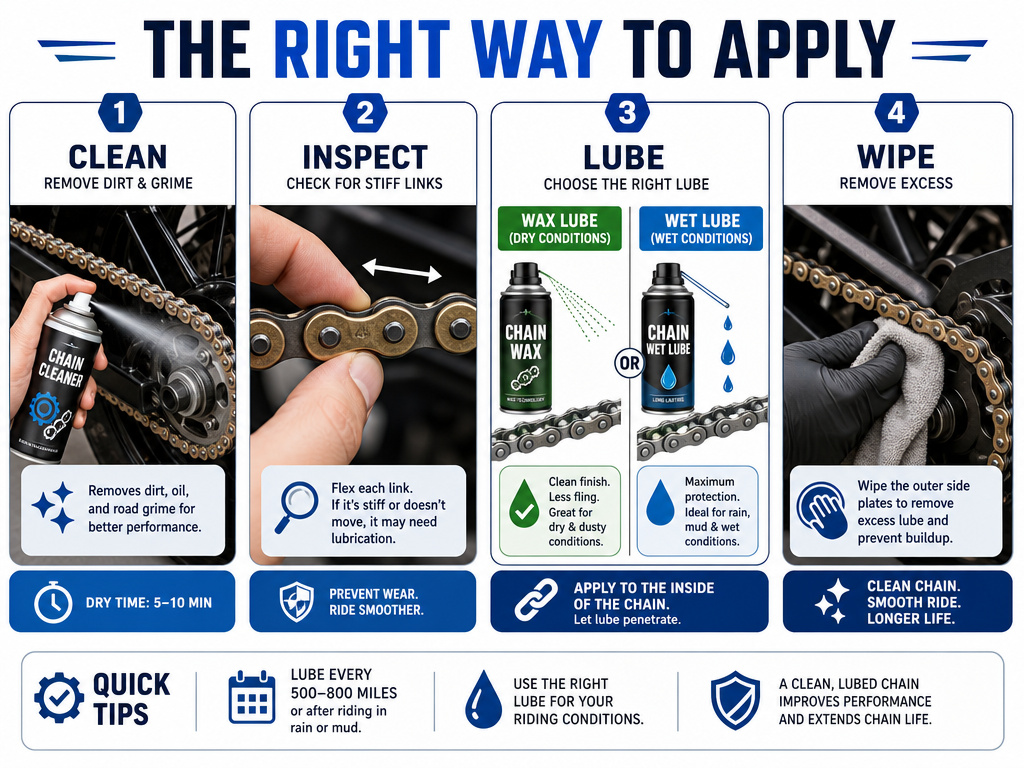
The best lubricant fails if applied wrong. This process is essential.
- Clean the Chain Thoroughly. This is the most skipped step. Spray the chain down with kerosene or a dedicated chain cleaner and scrub with a brush. You must remove all old lubricant and grit. A clean, dry chain is the only correct starting point.
- Check Chain Condition. Before lubing, check for wear. Look for stiff links, excessive side-to-side play, or a “stretched” feel. If your chain is making chattering and rattling noises even when lubricated and tensioned correctly, it’s replacement time, not lube time.
- Apply Per Product Instructions.
- For Wax: Shake can vigorously. Apply to a warm (not hot) chain from about 6-8 inches away, targeting the inner rollers as you slowly rotate the wheel. Avoid soaking the O-rings. Let it dry for the full time listed on the can (usually 10-15 minutes minimum) before riding.
- For Wet Lube: Shake can. Apply to a clean chain, focusing on the inside where the rollers meet the sprockets. A slightly warm chain can help penetration. Allow the recommended setting time (often 5-10 minutes) so the carriers evaporate and the lubricant thickens to resist fling.
- Wipe Off Excess. After the product has set, wipe the outer side plates with a rag to remove any excess that will attract dirt. Lubricate the inside of the chain; the outside plates don’t need a coating.
Skipping the cleaning step creates an abrasive paste. Rushing the drying time guarantees fling. These aren’t suggestions; they’re the mechanics of how the products work.
What are some good chain wax and lube products?
Several established products illustrate the different approaches. Maxima offers a Chain Wax with high-grade lubricants and special wax additives in a solvent carrier system, suitable for O-ring, X-ring, and standard chains. Motul provides a Chain Paste that is a 100% synthetic grease-based lubricant with a high content of Molybdenum Disulfide, designed for sealed and non-sealed chains. PJ1 Blue Label Chain Wax is a high solids formula containing PTFE. Dupont Chain-Saver specifies PTFE as the active ingredient, forming a dry, wax-like film that does not attract dirt. Motul also makes a Chain Lube Road that is 100% synthetic with high resistance to flinging, containing both MoS2 and PTFE. The choice depends on whether you prioritize a dry, clean film or a more tenacious, wet lubricant for high loads.
Frequently Asked Questions
Should I use chain lube or wax on my motorcycle?
Use chain wax if you ride in dusty conditions, prioritize a clean bike, or do mostly street touring. Use chain lube if you ride a high-performance bike aggressively, frequently ride in heavy rain, or have an unsealed chain. For most riders with modern sealed chains, chain wax offers the best balance of protection and cleanliness.
What is better for my bike chain, chain lube or wax?
Neither is universally “better.” Chain wax is better at resisting dirt accumulation and staying clean. Chain lube is often better at providing extreme-pressure lubrication for high-load situations. Your riding environment and chain type determine which is better for you.
Can chain wax damage O-rings?
Modern chain wax formulations from major brands like Maxima and PJ1 are designed to be safe for O-ring and X-ring chains. However, excessive application that pools solvent against the seals can cause temporary swelling. To avoid any risk, apply wax thinly to a warm chain as directed and allow it to dry completely before riding.
How often should I apply chain wax vs chain lube?
Reapplication intervals depend on riding conditions. Chain wax typically lasts 300-500 miles in dry conditions but should be reapplied after riding in rain or through deep water. Always inspect the chain; if it looks dry or you hear increased noise, it’s time.
Is it okay to mix chain wax and chain lube?
It is not recommended. Mixing different lubricant chemistries (wax carriers with oil bases) can lead to poor adhesion, gumming, or reduced effectiveness. If you want to switch products, thoroughly clean the chain to remove all residue of the old lubricant before applying the new one.
Before You Go
The data points to one clear rule: match the lubricant to the threat. If abrasive dirt is your main enemy, wax is your shield. If crushing load and corrosion are the threats, a wet lube with the right additives is your weapon.
My garage shelf holds both. The Maxima Chain Wax can is for the dry months and the after-work commutes where I just want a clean machine. The Motul Chain Lube Road is for the weekend rides that stretch the bike’s legs, where the loads are higher and the protection needs to be absolute. Having both isn’t indecision; it’s recognizing that one tool rarely fits every job.
Your chain’s lifespan is a ledger. Every clean, correct lubrication adds credit. Every skipped cleaning or mismatched product adds debt. The choice between wax and lube is just the first entry. Make it count.
