
How to Get Motorcycle License in Colorado: Step-by-Step
This post contains affiliate links. As an Amazon Associate, we earn from qualifying purchases.
To get a motorcycle license in Colorado, you add an “M” endorsement to a valid Colorado driver license. Two routes get you there: pass the written test, hold an instruction permit and pass the DMV skills test, or finish a MOST course and bring the waiver card to an in-person appointment.
That waiver card is the hinge of the whole process. Finish a MOST course and the DMV skills test drops out of your path. So when you work out how to get motorcycle license in Colorado, the real choice is between learning in a structured class or practicing on a permit and testing at a license office.
Here is what follows: which endorsement letter you need, both routes side by side, the six requirements on the testing path, what a permit lets you do, the rules for riders under 18, the gear nobody checks, and the spots where official sources contradict each other.
Key Takeaways
- Take the MOST course if you can get a seat. The Colorado State Patrol calls it the best option, and the waiver card replaces the DMV skills test.
- Book an in-person appointment either way. The DMV won’t add the endorsement by mail, online or phone.
- Riders under 18 must hold the permit 12 months and be at least 16 before the endorsement goes on.
- Test on a trike and you get a “3” endorsement that covers three wheels only.
- Bring a registered, insured motorcycle to the DMV skills test. No paperwork, no test.
Which Colorado Endorsement Do You Need: M or 3?
The letter on your license decides what you’re allowed to ride. Colorado issues two of them, and picking the wrong one boxes you in.
Colorado issues two motorcycle endorsements on a regular or commercial driver license. The general “M” endorsement covers two- and three-wheel motorcycles. The limited “3” endorsement covers three-wheel motorcycles only and appears when the skills test is passed on a three-wheeler. Colorado no longer issues new motorcycle-only licenses, so a valid Colorado driver license comes first.
That last point trips up a few riders. The DR2336 handbook says the “M” will no longer be issued as a separate class of license. It lives on your regular license or your CDL. No car license, no motorcycle endorsement.
Some vehicles that look like motorcycles don’t need an endorsement at all. Here’s how state law and the handbook sort them:
| What You Ride | License Needed | Where It’s Stated |
|---|---|---|
| Two-wheel motorcycle | Driver license plus “M” | C.R.S. 42-2-103 |
| Three-wheel motorcycle | Driver license plus “M” or “3” | DR2336 handbook |
| Autocycle | Regular license, no endorsement | C.R.S. 42-2-103 |
| Low-power scooter | Regular license; no interstates or sidewalks | DR2336, C.R.S. 42-2-103 |
The handbook defines a low-power scooter as 50cc or less, or electric at 4476 watts or less with a 40 mph top speed. Under C.R.S. 42-2-103, those scooters can use roadways and bike lanes but stay off interstates, limited-access highways and sidewalks.
My take on the “3”? Skip it unless you’re certain you’ll never want two wheels. If there’s any chance, test on a two-wheeler. Settle that question before choosing a first bike, because the endorsement follows the vehicle you test on.
Riding with the wrong license class gets charged under C.R.S. 42-2-101(4).
Written Test or MOST Course: Which Route Wins?
Take the class. That’s my answer for nearly every new rider. The testing route still works for how to get motorcycle license in colorado, and it suits one specific kind of rider, so here’s the honest breakdown of each.
Route 1: Written Exam, Permit, Skills Test
The Colorado DMV motorcycle endorsement requirements lay this route out in four moves. Pass the written exam. Buy a motorcycle instruction permit. Schedule an appointment and pass the motorcycle drive skills test. Then buy a new license with the endorsement on it.
The written part of how to get motorcycle license in colorado covers handbook material, and a few evenings with a motorcycle permit test prep routine handles it. The riding part is where this route gets hard. You practice on your own with a qualified supervisor, then show up and prove it in the road skills test.
Route 2: MOST Course and the Waiver Card
MOST stands for Motorcycle Operator Safety Training, Colorado’s state-run rider program. The Colorado State Patrol MOST program page calls it your best option for an endorsement. CSP says riders who pass simply take their completion card to a license office with no further testing.
The DMV’s version adds a detail CSP leaves out. You still need an appointment, you must present the original MOST license waiver card, and you still buy a new license. No extra test, in other words, but you’re not walking in cold either. A law firm summary (Fang Law Firm) says MOST offers basic, experienced and three-wheel courses. If you’ve read about the national MSF Basic Rider Course, know that Colorado’s DMV treats MOST cards and MSF cards differently. More on that below.
Route 1 vs Route 2: Where Each One Wins
| Factor | Route 1: Testing | Route 2: MOST |
|---|---|---|
| DMV skills test | Required | Replaced by waiver card |
| Permit step | Yes, after written exam | Not in DMV’s Option 2 steps |
| Your own bike for testing | Registered and insured | Not in DMV’s Option 2 steps |
| Biggest expense | DMV fees | Course tuition |
So who should test instead of train? A returning rider with years of seat time and a licensed friend over 21 to ride with. Everyone else goes MOST.
I’d point any brand-new rider at the class. Practicing alone on a permit means your bad habits get rehearsed until they feel normal, and nobody’s standing there to catch them.
How to Get a Motorcycle License in Colorado by Testing: The 6 Requirements

Six boxes stand between you and the endorsement on the testing route, per the DR2336 handbook. Miss one and the appointment ends early.
Before you start: Ride the test bike in an empty lot before test day. The handbook tells you to know the machine and all its controls, and an unfamiliar clutch is how a slow turn ends with the bike on its side. Wear an approved helmet, eye protection and protective clothing for the ride to the office. The handbook says most crashes happen on trips under five miles, a few minutes after starting out.
Here’s the sequence, with what goes wrong at each step:
- Driving record review. The DMV checks your record first. If your regular license isn’t valid, you stop here, because a valid Colorado license is the entry ticket.
- Physical aptitude review. Short and simple.
- Vision test. Bring the glasses or contacts you actually ride in. Fail this and the written test never starts.
- Motorcycle written test. Study the DR2336 motorcycle handbook PDF cover to cover, not just the licensing chapter. The handbook adds that you also pass the basic written test if you don’t already hold a valid driver license.
- Motorcycle skills test. Take it at a State Driver’s License Office or with a certified third-party tester. You supply a properly registered and insured motorcycle, so sort out registering your motorcycle weeks ahead, not the night before.
- Fees. Pay them and buy the new license with the endorsement on it.
The DMV’s own page slots the permit purchase between steps 4 and 5. Keep it handy, because the permit is what lets you practice legally.
How hard is the skills test? Honestly, I can’t give you a number. No published pass rate turned up for either Colorado test, so anyone quoting one is guessing. What I can tell you is where nerves show up: slow-speed control. Your left hand cramps from feathering the clutch, and the front tire starts to wobble the second your eyes drop to the cone instead of where you want to go.
Where this goes sideways: Borrowing a friend’s bike with lapsed registration for test day. The handbook requires a properly registered and insured motorcycle, so the test doesn’t happen and you rebook from scratch.
What Can You Legally Do on a Colorado Motorcycle Permit?
The written test is done, the permit’s in your wallet and the bike’s in the garage. Can you ride it to work tomorrow? Only with company.
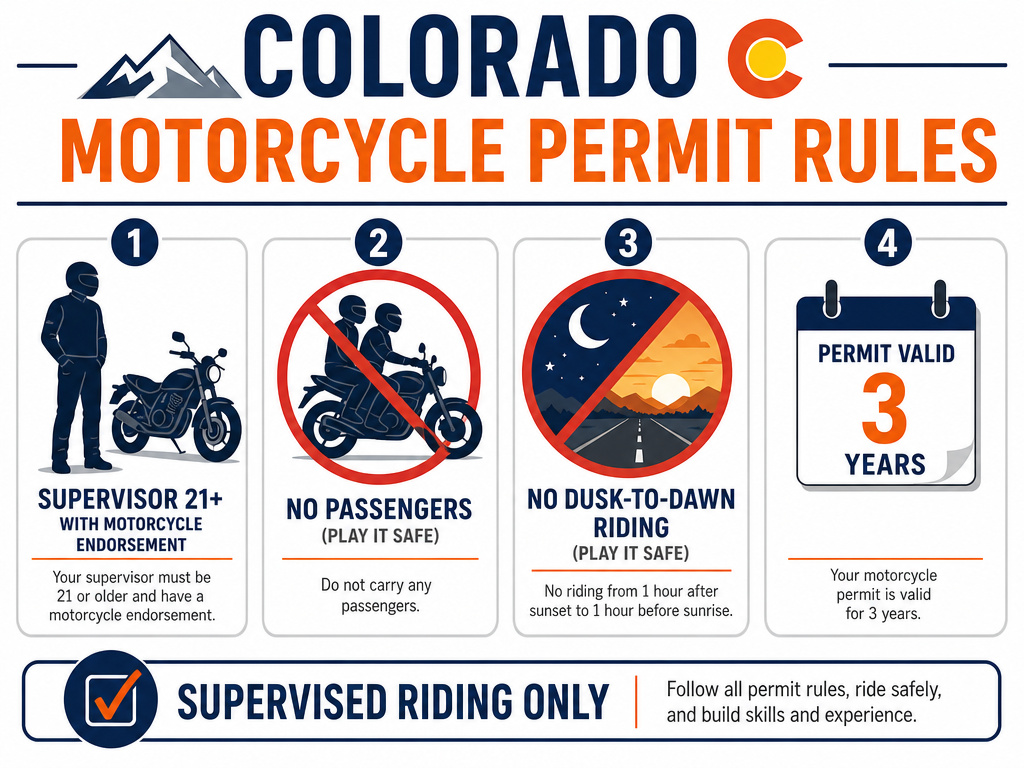
The handbook says a permit allows you to ride under the “immediate, proximate supervision” of an adult at least 21 who holds a Colorado license endorsed for motorcycles. C.R.S. 42-2-106 sets the same 21-plus requirement. According to the research brief’s reading of the statute, though, it sets no distance and no line-of-sight requirement. That gap matters if you’re wondering whether your supervisor has to be on the next bike or just nearby.
Then there’s the passenger and night question. The sources split three ways:
- Denver Trial Lawyers (a law firm page) says permit holders can’t carry passengers or ride between dusk and dawn. It doesn’t mention supervision at all.
- C.R.S. 42-2-106, as read in the research brief, requires supervision but contains no passenger or dusk-to-dawn limits.
- The DR2336 handbook excerpt describes supervision and shows no passenger or night limits either. Those rules might appear elsewhere in the handbook; I couldn’t confirm it.
My stance: treat the passenger and night limits as real until the DMV tells you otherwise in writing. Following them costs you nothing. I wouldn’t carry a passenger on a permit anyway. Not with that little seat time.
One more thing in your favor. According to the research brief’s reading of C.R.S. 42-2-106, motorcycle permits expire three years after issue. The one-year expiry applies to commercial vehicle permits only. Plenty of time to practice properly.
Under 18? Three Sources Give Three Age Rules
Three official-looking sources give three different answers for riders under 16. Here they are side by side:
| Source | Under-16 Permit Rule |
|---|---|
| C.R.S. 42-2-106 | 15+ with driver ed finished within 6 months |
| C.R.S. 42-2-106 | 15 and a half with a 4-hour awareness program |
| DR2336 handbook | Ages 15 to 16 must finish MOST first |
| DMV endorsement page | Under 16 must finish CSP-approved training |
| Denver Trial Lawyers | Anyone under 18 needs an approved course |
The statute routes and the handbook’s MOST requirement could overlap or flat-out conflict. I can’t resolve it from here, and neither can a blog post. If your kid is 15, call a driver license office and ask which rule they’ll apply before you pay for anything.
What Every Source Agrees On
The rest of the minor rules line up across the DMV page and the handbook:
- Hold the permit 12 months and be 16 before the endorsement goes on.
- A parent or guardian signs an affidavit when the permit is issued. The DMV page calls it the DR 2460M Affidavit of Liability (Motorcycle), with the liable party signing and the parent or guardian giving permission.
- Riding with anyone other than the MOST instructor or the signing parent takes that parent’s permission. The other adult still needs a motorcycle-endorsed license.
- The DR 2324 Drive Time Log Sheet you needed for the car license? Not required for the M or 3.
The part nobody mentions: Under C.R.S. 42-2-106, the cosigning parent must stay in close proximity while the minor rides. The cosigning parent may name an alternate supervisor who’s 21 or older and licensed for motorcycles.
The Helmet Rule for Under-18 Riders
C.R.S. 42-4-1502(4.5), quoted in the handbook, requires every rider and passenger under 18 to wear an approved motorcycle helmet. That covers low-power scooters too. A teen on a 50cc scooter and a teen on a sportbike follow the same rule.
The Gear the DMV Never Checks
Nothing in the licensing process looks at your gloves. The clerk checks your eyes, your paperwork and your registration. Your hands are your problem.
The handbook still recommends an approved helmet, face or eye protection, and protective clothing. It also says one of every five reported motorcycle crashes results in head or neck injuries. That’s the one gear stat in the official study material, and it’s the right place to start spending.
The first gloves I ever owned were thin, unlined fashion leather. A walking-pace tip-over on gravel split the palm seam, and I picked grit out of my hand for a week. Since then I check glove stitching the way a woodworker checks a chair joint. The leather rarely fails first. The seam does.
So here’s my order of purchase for a new rider, helmet first, gloves second:
- Helmet. An approved full-face helmet is where I’d start a new rider. Fit beats price tag.
- Gloves. Hands go out first in a fall, so this comes before the jacket.
- Boots. Something over the ankle. Sneakers aren’t boots, whatever the marketing says.
Fit tells you more than any spec sheet. A helmet that fits pulls your cheeks into a slight chipmunk squeeze, and it doesn’t rotate when you twist it by the chin bar. If it slides, it’s too big. Simple.
Skip the premium graphics and the top-tier price bracket for your first helmet. A mid-range lid that fits right and that you’ll wear every ride does more for you than a showpiece that gives you a headache.
Buy the helmet and gloves before the class, not after you pass. Safe gear only works if you actually wear it.
Fees, Out-of-State Cards and the 2025 MOST Law
SB25-187, signed June 2, 2025, kept MOST alive and changed who runs the details. It took effect August 6, 2025, as Session Laws chapter 343.
Here’s what it did:
- Keeps MOST under the Colorado State Patrol until September 1, 2030.
- Lowers the minimum age for MOST instructors from 21 to 18.
- Has MOST vendors meet standards set by the State Patrol instead of the transportation department.
This follows DORA’s 2024 sunset review, which recommended continuing the program. The program moved from CDOT to the State Patrol on January 1, 2018, under SB 17-243. The research brief also notes that SB25-187 allows the State Patrol chief to fund a tuition benefit, which is passed on as lower course prices. The bill page shows no amount, so don’t count on a discount until a provider quotes one.
Fees are messy. The DMV permit and endorsement fees differ across the law firm pages, and no current DMV fee schedule in my research settles it. Check the DMV fee page the week you book. What I’m confident about: course tuition is the biggest cost on Route 2, well above the DMV fees. A law firm estimate exists, but nobody has confirmed the current price.
What most people get wrong: Assuming an MSF card from another state transfers. Colorado’s DMV doesn’t accept out-of-state MSF cards unless they came from a military base and you hold a valid military ID, so you’re retaking training or testing here.
Leaving Colorado instead? A search snippet from the State Patrol says some other states accept Colorado MOST completion cards. Check with the new state before you move, and the general guide to getting a motorcycle license covers the steps that look similar across states.
Ride without the endorsement and it gets expensive. Denver Trial Lawyers and Fang Law Firm both describe penalties that include a fine plus court costs, up to 40 hours of community service, up to four license points, and possible suspension. Those are law firm summaries, not the statute itself. Still. Not worth finding out.
How much does a motorcycle permit, license, and endorsement cost in Colorado?
The fact sheet does not give a confirmed current fee schedule, so treat any dollar figure you see online as a rough guide. Secondary sources put the permit at around $16, but other sites list slightly different amounts, and no official DMV fee table settles it. Check the DMV fee page before your appointment.
Here is what you will pay for, whichever route you take. Both options end with buying a new license that carries the endorsement. The testing route also has you purchase a motorcycle instruction permit along the way. Fees are one of the six listed requirements on the testing path.
Training is a separate cost. One law firm cites roughly $400 to $500 for a typical MOST course, though it flags the current price as unconfirmed. Ask the provider for the exact total, and ask whether gear or a loaner bike is included, since you need a registered and insured motorcycle for the skills test if you skip the course.
Where can I take a motorcycle safety course in Colorado?
Colorado’s training program is MOST, short for Motorcycle Operator Safety Training, run under the Colorado State Patrol. The sources here do not list specific provider names or addresses, so look up the current approved vendors through the State Patrol’s MOST page and pick the one closest to you.
One law firm says MOST offers a basic rider course, an experienced rider course, and a three-wheel motorcycle course. Pick the one that matches the bike you plan to ride.
The payoff is real. Pass the course and you get a completion card. Take the original card to your driver license office appointment and buy the new license with the endorsement. The State Patrol says no further testing is needed, and the DMV describes the card as replacing the skills test. Colorado does not accept out-of-state MSF cards, except ones earned on a military base. Riders under 16 must finish approved training before getting a permit.
Frequently Asked Questions
How hard is it to get your motorcycle license in Colorado?
The paperwork is simple: a valid Colorado license, the right age, and either the testing route or a MOST waiver card. No published pass rate turned up for the written or skills test. The hard part for new riders is slow-speed control, which is exactly what a training course drills.
How much is a motorcycle class in Colorado?
No source in my research confirms a current MOST price. A law firm page gives an estimate but it’s unverified, and SB25-187 allows the State Patrol to fund a tuition benefit with no amount set. Get a quote directly from a MOST provider before you budget.
What are the requirements to obtain a motorcycle license in Colorado?
You need a valid Colorado driver license and must be at least 16. Then either pass the driving record review, physical aptitude review, vision test, written test, skills test and fees, or finish MOST and present the original waiver card. Both routes end with an in-person appointment.
How long is a Colorado motorcycle permit good for?
According to the research brief’s reading of C.R.S. 42-2-106, motorcycle permits expire three years after issue. The one-year expiry applies only to commercial vehicle permits. Riders under 18 still need to hold the permit at least 12 months before adding the endorsement.
Can I use my MSF card from another state in Colorado?
Not usually. The Colorado DMV doesn’t accept out-of-state MSF cards, with one exception: cards earned on a military base, backed by a valid military ID. Everyone else takes the Colorado testing route or a MOST course.
Before You Go
One step to take this week: look up MOST class dates near you before you book anything at the DMV. Class seats are the bottleneck on the route I recommend, and the DMV appointment comes after the waiver card anyway.
If you’re 15, or parenting a 15-year-old, the order changes. The statute, the handbook and the DMV page disagree on what comes before the permit. Call a driver license office, ask which rule they apply, and write down who told you.
That’s how to get a motorcycle license in Colorado without wasted trips: pick your endorsement letter, pick your route, and show up with a registered bike or an original waiver card.
Bottom line: brand-new riders should take MOST and skip the DMV skills test; experienced returning riders with a licensed 21-plus supervisor can test instead, and nobody should put a “3” on their license unless they’re sure they’ll never ride two wheels.
