
Types of Motorcycle Helmets: The Main Styles Explained
This post contains affiliate links. As an Amazon Associate, we earn from qualifying purchases.
A motorcycle helmet is a protective shell with energy-absorbing liner and a retention strap, designed to reduce head injuries in a crash. The six primary types are full-face, modular, open-face, half, dual-sport, and off-road helmets, each offering different levels of protection, comfort, and features suited to specific riding styles.
Your choice among the types of motorcycle helmets isn’t just about looks or airflow. It’s a direct trade-off between coverage and convenience, governed by physics and verified by standards like the U.S. DOT/FMVSS No. 218 and the European ECE 22.05. A full-face helmet provides the most complete protection, while a half helmet leaves your jaw and face exposed. The right one fits your head shape snugly, carries a legitimate certification label, and matches the kind of riding you actually do.
What follows: a breakdown of all six styles, the hard numbers behind their safety ratings, and a clear guide to matching a helmet to your bike and your miles.
Key Takeaways
- A DOT-certified full-face helmet reduces your risk of fatal injury by 37 percent compared to wearing no helmet, according to U.S. Federal research.
- Novelty helmets that weigh under a pound and lack a thick inner liner fail safety tests and should never be worn on the road.
- Follow the manufacturer’s recommendations for helmet care: replace it after a major impact, and be aware that the product instruction manual must recommend the service life.
- Helmet fit is essential. A helmet that shifts on your head at speed won’t protect the right spot in a crash. Check our helmet head shapes guide to find your match.
- For most street and highway riding, a full-face helmet is the baseline. Step down to an open-face or modular only if you’ve weighed the specific risks to your face and jaw.
The 6 Main Helmet Styles at a Glance
Your first decision is how much of your head you want to cover. This table breaks down the core styles you’ll see on the road and trail.
| Helmet Type | Best For | Key Trade-Off |
|---|---|---|
| Full-Face | Street riding, highway travel, maximum protection | Highest protection and quietest, but least ventilation and can feel claustrophobic. |
| Modular (Flip-Up) | Touring, commuters who need to talk or drink without removing the helmet | Convenience of an open-face with the option of full-face protection; hinge adds weight and a potential failure point. |
| Open-Face (3/4) | Cruiser riders, short trips, maximum peripheral vision and airflow | Lightweight and great visibility; zero chin or face protection. |
| Half Helmet | Legal minimum coverage, cruiser culture, hot weather | Lightest and coolest; protects only the top of the head, leaving face, jaw, and ears exposed. |
| Dual-Sport | Adventure touring, riding that mixes pavement and dirt | Versatile shape with a visor and good ventilation; can be noisy and less aerodynamic at high street speeds. |
| Off-Road / Motocross | Motocross, trail riding, serious off-road use | Maximum airflow, wide vision, and designed for goggles; no street-legal visor, very loud on pavement. |
The U.S. Department of Transportation’s Federal Motor Vehicle Safety Standard No. 218 (FMVSS No. 218) establishes minimum performance requirements for all motorcycle helmets sold in the country. This includes tests for impact attenuation, penetration resistance, and retention system strength. Helmets meeting this standard must have a label on the back with the manufacturer, model, “DOT,” “FMVSS No. 218,” and “CERTIFIED.”
The shape of the types of motorcycle helmets decides what gets hit. In any forward crash, your chin bar is the first point of contact. Studies of injury patterns show a disproportionate number of impacts occur right where a full-face helmet has its strongest piece. An open-face or half helmet leaves that entire zone unprotected.
Full-Face Helmets: The Maximum Protection Baseline
This is the one to beat. A full-face helmet wraps your entire head in a single shell, with a fixed chin bar and a visor that seals against the eye port. It’s the design used in every professional racing series for a reason.
The shell and dense EPS foam liner work as a system. Upon impact, the shell spreads the force over a larger area, while the foam crushes to decelerate your head gradually. The fixed chin bar is integral, meaning it’s part of the same structural unit. This matters because a 2011 NHTSA analysis of crash data found that from 2000 to 2002, an average of 35 percent of helmeted riders who died still suffered a head injury. Many of those injuries were to the lower face, a zone only a full-face design covers.
Where this goes sideways: Choosing a full-face helmet a size too big because it feels comfortable in the shop. At highway speed, wind will catch under the chin bar and try to lift the helmet, straining your neck and creating roar-level noise. A proper fit means the cheek pads press firmly.
I learned this the hard way early on. I picked a helmet that felt roomy in the store. On the highway at about 60 mph, it started to shift and howl with wind noise. That movement isn’t just annoying, it means the helmet won’t stay in the correct position during a crash. Now, I know a helmet should feel snug, with the cheek pads applying gentle, even pressure. For a deep dive on the top options, see our guide to the best full face helmets.
Modular vs. Full Face: The Convenience Compromise
A modular helmet, often called a flip-up, has a chin bar that hinges upward. You get the full-face protection while riding and the easy access of an open-face when stopped. It’s a popular choice for tourers and commuters.
The hinge is the critical component. It must lock securely in the down position. The international ECE 22.05 standard tests modular helmets both open and closed, but the U.S. DOT standard only tests them in the closed, locked position. This creates a potential gap: a hinge that feels solid at a stop might not hold under the extreme forces of a crash. The convenience is real, but it adds complexity and weight.
| Aspect | Modular Helmet | Full-Face Helmet |
|---|---|---|
| Protection (Chin Bar) | Good (when locked); hinge is a potential weak point | Excellent; one-piece structure is strongest |
| Convenience | High; easy to talk, drink, or use glasses without removing | Low; must remove helmet for most interactions |
| Weight | Heavier due to hinge mechanism | Lighter |
| Noise | Often noisier due to more seams and vents | Generally quieter with better aerodynamics |
| Best Use Case | Touring, commuting, riders who make frequent stops | Sport riding, daily commuting, maximum safety priority |
My stance is clear: if you buy a modular, you must ride with the chin bar locked down. I’ve seen too many riders cruising with it flipped up, completely negating the primary safety feature they paid for. The debate between these two styles is nuanced, which is why we have a dedicated full face vs modular comparison.
Open-Face and Half Helmets: Understanding the Risk
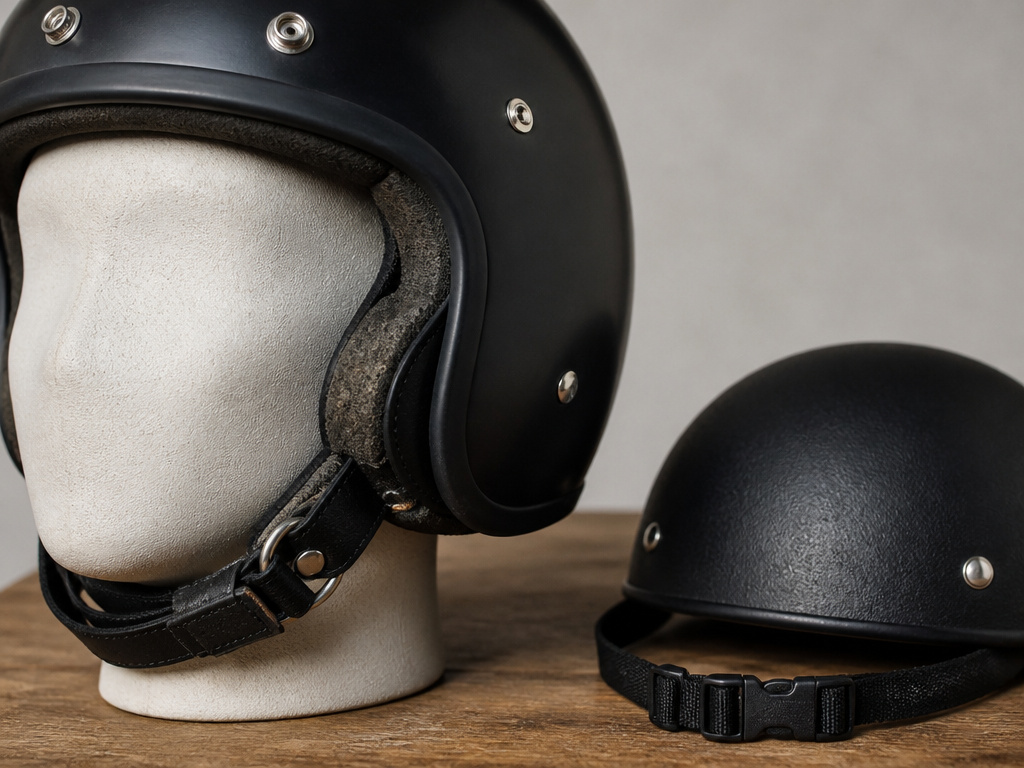
These styles prioritize freedom and a classic look over full protection. An open-face or three-quarter helmet covers the top, back, and sides of your head, stopping above the ears and leaving the entire face open. A half helmet, or beanie, only covers the top of the skull.
The numbers from the NHTSA helmet selection guide are stark. A compliant helmet generally weighs about 3 pounds and has an inner liner at least 1 inch thick. An unsafe novelty helmet may weigh a pound or less. That missing weight is protective material. The agency explicitly warns that designs like “German Army or skullcap style may be a clue to an unsafe helmet.”
Easy to miss: The chin strap on a certified helmet has sturdy rivets. On a novelty helmet, the buckle is often thin plastic that can snap in a crash. If the strap feels flimsy, the rest of the helmet is certainly not up to standard.
The choice to wear an open-face or half helmet is a conscious acceptance of greater risk. They are “merely applicable” for lower-speed environments, as the Chinese standard GB 811-2022 categorizes its similar “Type B” helmets specifically for electric bicycle riders, not motorcyclists. For a balanced look at the trade-offs, our open face helmets and half helmets articles detail the pros and cons.
Off-Road and Dual-Sport Helmets: Built for the Dirt
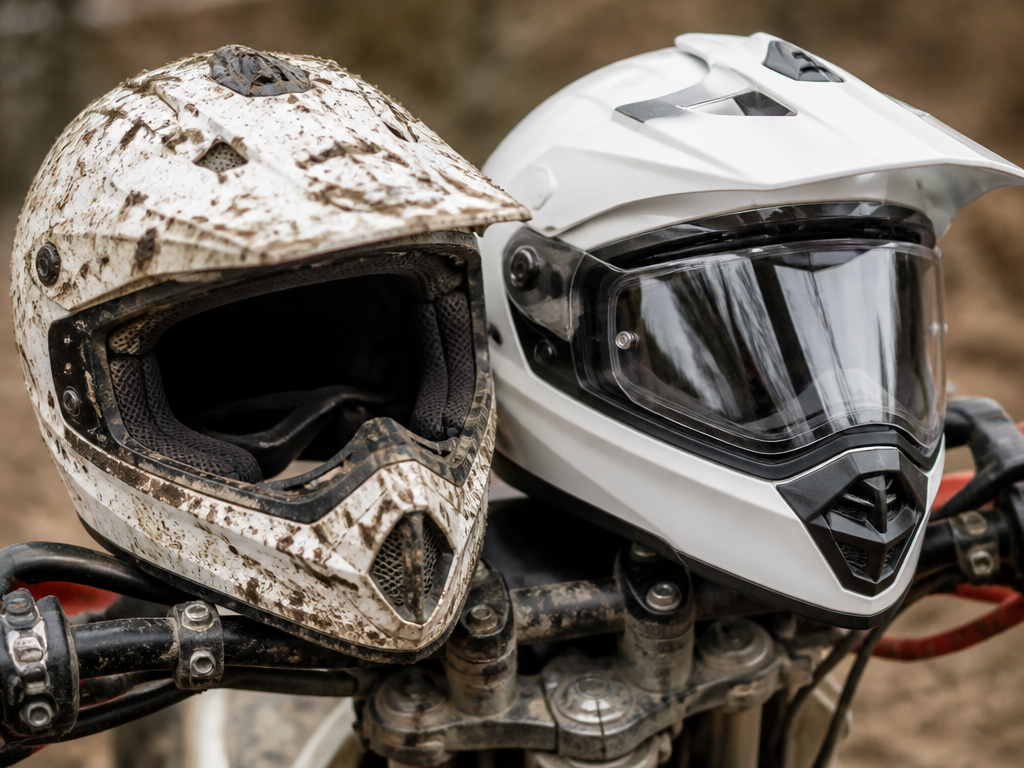
These helmets are specialized tools. An off-road or motocross helmet is designed for maximum airflow, with a large eye port for goggles and an extended chin bar to deflect roost. It has no integrated visor or face shield. A dual-sport helmet is a hybrid, blending the visor and sun peak of an off-road lid with the sealed eye port and sometimes a flip-down internal sunshield for street legality.
The shell construction debate is fiercest here. The FIM racing homologation program for top-tier competition mandates a one-piece shell “without any seam.” In contrast, baseline performance standards like FMVSS No. 218 (DOT) and ECE do not explicitly prohibit multi-piece shell designs as long as they pass impact and penetration tests. For the weekend trail rider, a DOT-certified off-road helmet is fine. For serious competition, the one-piece shell is an absolute safety requirement.
The peak on a dual-sport helmet serves a real function off-road, shading the sun and deflecting branches. On the highway at speed, it can catch the wind and strain your neck. Many riders choose a dual-sport helmet for its versatility, but it’s a compromise in both environments. Understand the key differences in our off-road vs dual sport breakdown.
Safety Standards and Certification Labels
A helmet is only as good as the standard it meets. The label on the back is your first checkpoint.
- DOT (USA): The U.S. DOT helmet standard regulation (FMVSS No. 218) relies on a manufacturer self-certification process; the NHTSA does not approve helmets but conducts random audits. Helmets made after May 13, 2013, must have a label with “DOT, FMVSS No. 218, CERTIFIED.” Older ones may just say “DOT.”
- ECE 22.05/22.06 (Europe): The ECE 22.05 regulation document is a common international standard requiring independent laboratory testing and approval. It is a common international standard requiring independent laboratory testing and approval.
- GB 811-2022 (China): This standard introduces a formal split not found elsewhere. Type A helmets are for motorcycle and e-bike riders, while Type B helmets are “merely applicable to electric bicycle riders.” It’s a legal admission that lower-impact scenarios need different, and lower, performance thresholds.
Common mistake: Assuming a sticker makes a helmet safe. The NHTSA warns that fake DOT labels are sold online to put on novelty helmets. Check the helmet’s weight (about 3 lbs), liner thickness (over 1 inch), and strap rivets. If anything seems off, it likely is.
The official U.S. Safety standard is publicly accessible, but dense. For most riders, trusting a brand that submits its helmets for additional, voluntary certification like Snell or FIM is a good practice.
How to Choose and Care for Your Helmet
Choosing the right type is the first step. Making sure it fits and lasts is the next.
1. Fit First, Features Second.
Your helmet must be snug. When you grip it and try to rotate it on your head, your skin and scalp should move with the helmet. There should be no pressure points that cause a headache after 20 minutes. Use our helmet fit guide to identify your head shape (round oval, intermediate oval, long oval) before you shop.
2. Follow the 2-2-2 Replacement Rule.
This is a straightforward, easy-to-remember guideline from industry experts:
- 2 Years: Replace your helmet according to the manufacturer’s recommended service life.
- 2 Seconds: After any crash where the helmet impacts the ground, replace it immediately. The EPS foam crushes once to absorb energy; it’s done.
- 2 Major Signs: If you see a cracked shell, loose or peeling interior lining, or a frayed/damaged chin strap, retire the helmet.
3. Clean and Store It Properly.
Use mild soap and water on the shell and liner. Never use corrosive solvents or harsh chemicals, as they can degrade the materials. The Chinese GB 811-2022 standard explicitly states this in its manual requirements. Store the helmet properly, as the product instruction manual must advise.
A final, often overlooked component is the visor. The right helmet visors, whether clear, tinted, photochromic, or pinlock-equipped, are critical for vision and comfort in all conditions.
How much safer is a certified helmet?
Wearing a helmet that meets the proper safety standard is a critical choice. Data shows that a helmet certified to the DOT FMVSS No. 218 standard reduces the risk of dying in a crash by 37 percent. Even with a certified helmet, head injuries can occur, but the protection is substantial. This is why unsafe novelty helmets, which fail safety tests, should never be used. A proper helmet has a sturdy construction and a solid chin strap that must be fastened. Always check for the correct certification label and follow the manufacturer’s instructions for use, fit, and replacement after any major impact.
Frequently Asked Questions
What are the three main types of motorcycle helmets?
The three broad categories are full-face (covers entire head), open-face (covers top and sides, no chin bar), and half helmets (covers only the top of the skull). Modular, dual-sport, and off-road helmets are specialized variations within or between these categories.
What is the 2 2 2 rule for motorcycle helmets?
It’s a simple guideline for when to replace your helmet: after 2 years of regular use, within 2 seconds of deciding it’s been in a major impact, or if you spot 2 or more major signs of damage like a cracked shell and a frayed strap.
Are modular helmets as safe as full-face helmets?
When the chin bar is locked in the down position, a certified modular helmet must pass the same DOT helmet standard regulation impact tests as a full-face helmet. However, the hinge mechanism adds a potential failure point and weight that a one-piece full-face design does not have. For absolute maximum safety, a full-face helmet is the stronger choice.
What’s the difference between a dual-sport and an off-road helmet?
An off-road helmet is built purely for dirt: huge airflow, a goggle-only eye port, and a pronounced sun peak. A dual-sport helmet is a hybrid, adding a sealed eye port with a street-legal visor (and often a flip-down sunshield) to make it usable on pavement, though often at the cost of some off-road airflow.
How can I tell if a DOT sticker is real?
Real DOT-certified helmet will also have substantial weight (around 3 lbs), a thick (1+ inch) inner liner, a sturdy chin strap with solid rivets, and no rigid decorations extending more than two-tenths of an inch from the shell. If the helmet feels dangerously light or flimsy, the sticker is likely fake.
The Bottom Line
Start with a full-face helmet. The data from the NIH helmet injury study and decades of crash analysis make the case indisputably: it offers the best chance of walking away. Only move to a modular, open-face, or half helmet if you’ve consciously accepted the increased risk to your jaw and face for the benefits of convenience, airflow, or style.
Then, get the fit right. A Shoei RF-1400 or Arai Regent-X that molds to your intermediate oval head is safer than a loose, premium helmet that costs more. Finally, trust the label, but verify the helmet. Know that standards like the European helmet testing protocol and the upcoming ISO head protection standard are constantly evolving to close gaps.
Your head houses everything you are. Cover it with the most helmet you’re willing to wear, and make sure that helmet is built for the real world.
