
Half Helmet for Motorcycle Riding Pros and Cons
This post contains affiliate links. As an Amazon Associate, we earn from qualifying purchases.
A half helmet for motorcycle riding trades full-face protection for visibility, airflow, and lighter weight, but the data is blunt: riders in half-coverage helmets were 2.57 times more likely to sustain head injuries than full-face wearers, and a loosely fastened strap nearly doubled that risk again. The pros are real. The cons are measurable.
That 2.57 odds ratio comes from a 2011 case-control study of 916 crash-involved riders in Taiwan, and it means the open face isn’t a style preference the statistics ignore. It’s the variable that shifts injury severity from manageable to potentially catastrophic, and it compounds when the retention system fails, a key point in any discussion of the half helmet for motorcycle riding pros and cons.
What follows: the specific injury numbers, the fit protocol that keeps a half-shell on your head, the certification labels that separate legal gear from decorative novelty, and the pairing gear that closes the gaps the open face leaves.
Key Takeaways
- Half-coverage helmets carry 2.57x the head-injury risk of full-face helmets in peer-reviewed data, and 2.10x for brain injuries specifically.
- A loose chin strap nearly doubles risk again (OR 1.94), making fit and retention more critical than brand.
- Novelty helmets are not half helmets. They skip the EPS liner, weigh two-thirds less, and carry a 5.4% death risk versus 2.4% for full-face users.
- FMVSS No. 218 requires 105 degrees of peripheral clearance to each side; a half helmet meets this but doesn’t protect the jaw.
- Pair a half shell with goggles, ear protection, and a neck covering to recover some of the protection the open face removes.
What the Injury Data Actually Says
2.57 times. That’s the odds ratio from the 2011 International Journal of Epidemiology study comparing half-coverage helmet wearers to full-face wearers for head injuries. The 95 percent confidence interval ran from 1.50 to 4.40, meaning the true risk sits somewhere in that range with 95 percent certainty. For brain injuries specifically, the multiplier was 2.10 (95 percent CI 1.01 to 4.38).
A separate 2020 study across eight level-I trauma centres in Taiwan found that riders wearing non-standard helmets (half or open-face) had a 49.84 percent rate of severe injuries (ISS 8 or higher), compared to 40.16 percent for those in standard helmets. The BMC Public Health helmet study also flagged that loosely fastened helmets increased head-injury risk by 1.94 times. That last number matters for half shells specifically, because the open front means the strap is the only thing keeping the helmet on during a slide, a critical factor in the half helmet for motorcycle riding pros and cons.
The FMVSS motorcycle helmet standards published by NHTSA state that wearing a compliant helmet reduces the risk of death in a crash by 37 percent. But “compliant” here means meeting the federal performance floor. It doesn’t mean the helmet covers your chin.
Before you start: A half helmet that meets FMVSS No. 218 will pass impact and penetration tests on the crown and sides. It will not protect your jaw, teeth, or orbital bone from a direct strike. The shell must cover at least the area above the test line, and rigid external projections cannot exceed 0.20 inch (5 mm). Check your helmet’s DOT label for the precise model designation and month/year of manufacture before you ride.
The Comfort Gains That Keep Riders Choosing Half Helmets
You’re stopped at a red light on a 90-degree July afternoon. The full-face helmet you wore in May is now a small oven, and you can feel the visor fogging before the light turns. You swap to a half shell, and the wind hits your face. You can hear the engine, the cross-traffic, the guy on the next bike shouting about his carburetor.
That’s the real draw. A functional vision and motorcycle helmet study notes that half-face helmets allow a maximum visual field of 210 degrees horizontal and 102 degrees vertical. You don’t look through a visor frame. You see the sky at the edge of your vision without a plastic border cutting it. For low-speed urban riding, parking lots, and short backroad hops in warm weather, that awareness has value.
Airflow is the second honest pro. No enclosed face means no heat buildup around your mouth and nose. You’re not breathing into a dead-air pocket. For riders in moderate climates (not extreme heat, not deep winter), a half shell stays comfortable longer on a 60-70 degree day than any full-face can.
Weight matters too, though the distinction between a legitimate half helmet and a novelty shell is critical here. A legitimate half helmet still has an expanded polystyrene liner. It’s not two-thirds lighter than a full-face. But it is lighter than a heavy touring lid with a drop-down sun visor, and over a four-hour ride that difference in neck load is real.
I still insist on a full day of mixed highway and backroad riding before judging any helmet. A half shell that feels perfect at 20 minutes can nag you by hour three, usually around the temples where the padding compresses unevenly. A short loop hides that.
Where Does the Open Face Actually Cost You on the Road?
Wind noise at highway speed past an unprotected face is not a minor annoyance. You’ll feel the buffeting against your cheeks and jaw, and the constant pressure dries your eyes and lips within twenty minutes. On a 90-mph stretch, the wind blast against your face is loud enough that you stop hearing your engine. That’s a safety problem. You lose the auditory cues that tell you when to shift or when a car is closing from behind.
Debris is the other obvious gap. A rock kicked up by the truck ahead of you hits your face, not a visor. Bugs, gravel, road salt spray, rain at speed. None of it gets deflected. You blink, you flinch, and a flinch at 70 mph means your eyes come off the road for a half-second.
The Bell Helmets manual puts it plainly: “Helmet models that cover less of the head provide less impact protection and may be more susceptible to helmet ejection, which can result in injury or death.” Ejection. The word they chose. A half shell has less surface area gripping your skull, so in a tumble or a slide, the forces trying to pull it off are proportionally greater.
What most people get wrong: Assuming a half helmet is “basically a full-face with the chin bar removed” in terms of protection. It isn’t. The face opening changes the geometry of impact distribution. FMVSS No. 218 tests the crown and sides, but a blow to the jaw or orbital area in a half shell contacts your face directly, not a shell.
Is Your Half Helmet Legal, Certified, and Actually DOT-Compliant?
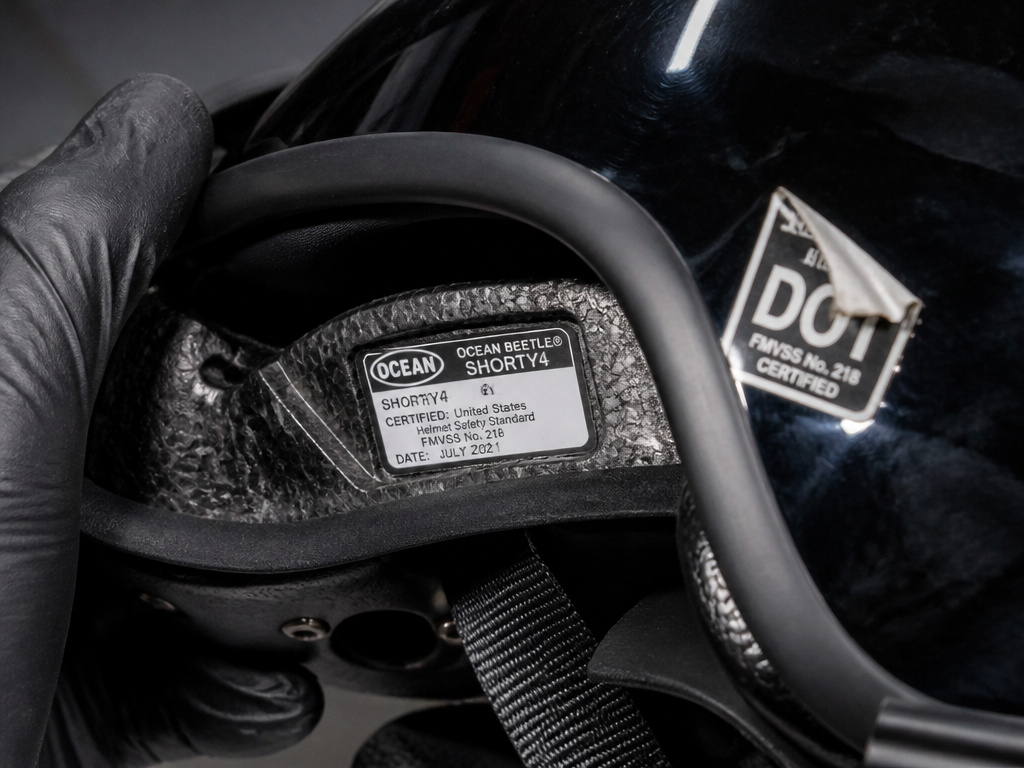
FMVSS No. 218 sets the federal floor. FMVSS No. 218 sets the federal performance floor for motorcycle helmets. The retention system must hold under a 250-pound (113.4 kg) test load without the adjustable portion moving more than 1 inch (2.5 cm). Peripheral vision clearance must be at least 105 degrees to each side of the mid-sagittal plane.
But here’s where it gets messy. A helmet can carry a “DOT” sticker and still be a novelty shell. The novelty helmet fatality research documents that novelty helmets lack the EPS liner entirely, weigh approximately two-thirds less than compliant helmets, and carry a 5.4 percent risk of death compared to 2.4 percent for full-face users. The adjusted fatal injury risk ratio was 1.95 (95 percent CI 1.11 to 3.40). Many novelty shells have fraudulent DOT stickers applied by users.
The UNECE motorcycle helmet regulation is the European standard, and Manitoba, Canada’s regulation accepts Snell M2010/M2015, FMVSS 218, and UNECE R22 as equally valid. But these standards use different test protocols. Snell historically mandates stricter impact attenuation thresholds than FMVSS 218, which can mean harder shells. A helmet certified to one is not automatically certified to the others.
| Standard | Test Philosophy | Key Difference for Half Helmets |
|---|---|---|
| FMVSS No. 218 (DOT) | Minimum performance floor; tests crown and sides | Does not require chin or face coverage; retention test at 250 lb |
| Snell M2015/M2020 | Stricter impact thresholds; multiple impact sites | Higher attenuation demands can mean stiffer shell feel |
| UNECE R22.06 | European homologation; includes oblique impact testing | Tests angled impacts that a flat-drop FMVSS test misses |
If you’re shopping for DOT-approved half helmets, check the certification label for the precise model designation, the manufacturer’s name, and the month and year of manufacture. All three must appear permanently and legibly. If the label is a sticker someone slapped on after purchase, walk away.
The Fit Check That Matters More Than the Brand Label
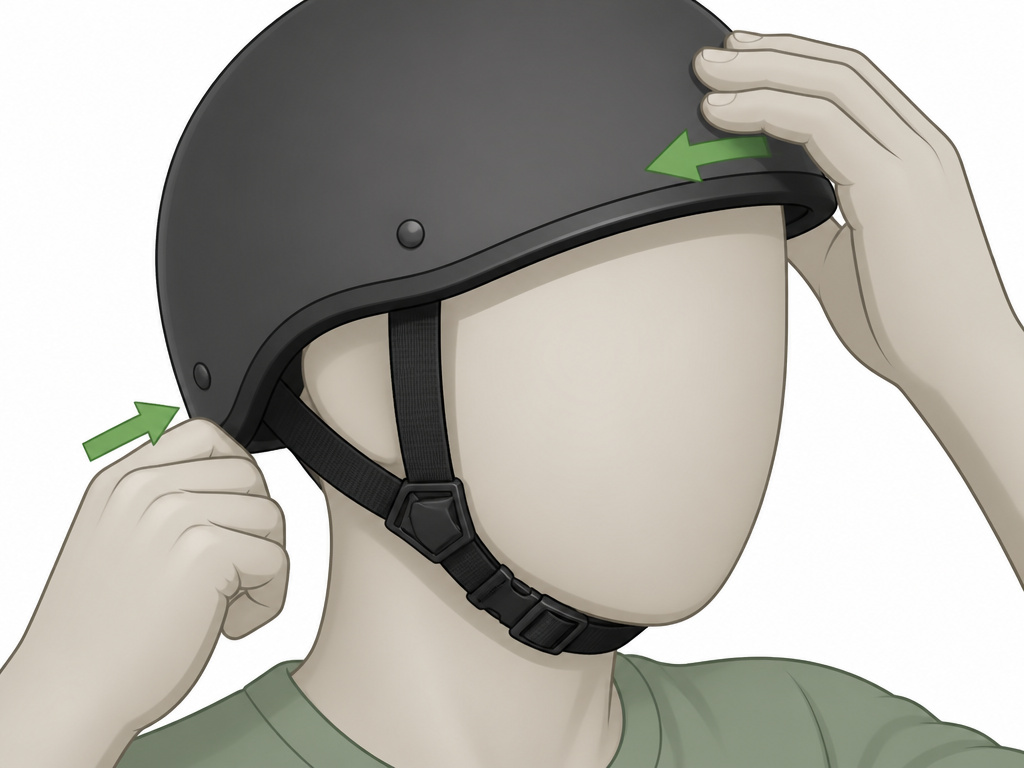
Fit first, features second. A well-fitted mid-priced half shell from Bell or HJC protects you better than a loose premium lid from Arai or Shoei. The chin strap is your entire retention system when the front of the helmet is open.
The Bell manual describes a two-part test: with the chin strap snug under your chin, grab the helmet at the rear base and pull it forward. Then grab the front and try to roll it rearward. If it comes off, it doesn’t fit and you should not wear it. Period. Do this with the strap fastened, not loose.
I’ve watched riders skip this step in a showroom, nod at the salesperson, and walk out with a helmet that shifts when they turn their head. That 1.94 odds ratio for head injury with a loosely fastened helmet? It’s not theoretical. It’s the strap you didn’t tighten at a rest stop because it felt snug enough at 30 mph.
The FMVSS retention test applies a load without the adjustable portion moving more than 1 inch (2.5 cm). Your chin strap at home faces a fraction of that. If it slipped under the lab’s preliminary load, it will fail in a real tumble.
- Check the helmet sits low on your forehead so you can see the edge in your upper field of vision (Bell’s instruction, and it’s correct).
- Fasten the chin strap tight, not “comfortable.” Comfortable at rest means loose at speed.
- Re-check the strap periodically while riding. If it’s gone slack, stop and re-tighten before continuing.
- Do not wear someone else’s helmet or buy a used one. The liner compresses to the first owner’s skull shape.
The part nobody mentions: FMVSS No. 218 requires a label warning that the helmet “can be seriously damaged by some common substances without damage being visible to the user.” Solvents in a general-purpose cleaner, adhesive from a decal, or the petroleum base in a cheap visor spray can degrade the shell’s structural integrity invisibly. Bell says soap and water only. They’re not being precious. They’re protecting the EPS bond.
Gear Pairing to Close the Protection Gap
A half helmet is an open system. You compensate with the rest of your gear. This isn’t optional if you’re riding beyond a parking lot.
Eye protection comes first. The Bell manual warns: “Failure to use proper eye protection can cause an accident and result in serious injury or death.” Tinted goggles or lenses should not be used at night or in poor visibility. A scratched lens reduces visibility especially after dark. Replace it.
Ear protection is the second pairing that most riders skip. Wind noise past an open face at highway speed is loud enough to cause permanent hearing damage over time, and it masks the engine and traffic sounds you need. A set of molded earplugs under a half shell drops wind noise by enough to let you actually hear a siren behind you.
A neck gaiter or balaclava covers the exposed skin on your jaw and neck. It won’t stop a rock, but it reduces wind burn, keeps debris off your skin, and adds a thin layer of abrasion resistance in a slide.
For riders comparing open-face helmets versus half shells, the open-face adds a visor and some cheek coverage, which changes the half helmet for motorcycle riding pros and cons equation. It splits the difference. But it still leaves the jaw exposed, and the ejection risk the Bell manual flags remains.
If you’re weighing full-face helmets against a half shell for regular highway use, the data above makes the case. A full-face covers the jaw, the chin, the orbital bone. The three-quarter vs full-face question is where most riders land when they want airflow but still want a visor. And modular helmets offer a flip-up chin bar, though they add weight and a hinge that’s a potential weak point.
The complete range of types of motorcycle helmets goes from full-face down to novelty shells. A half helmet sits in the middle: better than nothing, worse than a visor and a chin bar. If you ride short distances in warm weather at moderate speeds, the best half helmets in the DOT-certified range give you a real trade-off. Just know what you’re trading.
How does a half helmet compare to a 3/4 or modular helmet?
The key difference is coverage. A half helmet leaves your face and the back of your head exposed. A 3/4 helmet adds a fixed chin bar and more rear protection, while a modular helmet has a chin bar that flips up. Research directly links less coverage to higher risk. One study found riders in half-coverage helmets were 2.57 times more likely to have a head injury than those in full-face helmets. A helmet manufacturer’s manual states that models covering less of the head provide less impact protection and may be more susceptible to ejection in a crash. The increased airflow and visibility of a half-shell come with a clear trade-off in protection that more covered designs mitigate.
What do riders say about using a half helmet?
Rider anecdotes often highlight the feeling of freedom, the unobstructed view, and the ease of conversation at stops. However, these personal stories sometimes conflict with manufacturer guidance. Bell Helmets manual instructs riders to replace a helmet immediately after any impact and to never rigidly attach anything to the outside of the helmet, while many riders in communities dispute this, opting to inspect and continue using a helmet after a minor drop or commonly rigidly mount accessories. Bell Helmets manual recommends replacing your helmet at least every five years, while many riders in communities dispute this as a conservative guideline, often using helmets longer based on inspection.
Frequently Asked Questions
Are half helmets safe for motorcycle riding?
Half helmet that meets FMVSS No. 218 will pass the federal impact and penetration tests on the crown and sides. It reduces the risk of death by 37 percent compared to no helmet at all. But peer-reviewed data shows half-coverage wearers face 2.57 times the head-injury risk of full-face wearers. “Safe” depends on your speed, your route, and whether the chin strap is tight. At 75 mph on a highway, the open face is a gamble.
Which helmet is better, half or full?
For most riding, a full-face helmet provides measurably better protection. The data is consistent across multiple studies. A half shell wins on airflow, peripheral vision (210 degrees horizontal), and weight for short urban trips. If you choose a half shell, pair it with goggles, ear plugs, and a neck covering to close some of the gaps.
Why do bikers wear half helmets?
Comfort, visibility, and the feeling of being connected to the environment. You hear your engine, you feel the wind, you see the sky without a visor frame. For riders doing short hops or cruising at moderate speeds in warm weather, a half shell removes the “fishbowl” feeling of a full-face. Style plays a role too, though style doesn’t change the injury statistics.
Can you wear a half helmet on the highway?
You can, if it’s FMVSS No. 218-compliant and properly fitted with the chin strap tight. The legal requirement in most US states is a DOT-certified helmet, and a half shell can meet that. But the ejection risk increases at highway speed, and the open face means wind buffeting, debris, and noise all hit you directly. If you do ride the highway in a half shell, wear goggles and ear protection.
How often should you replace a half helmet?
The Bell Helmets manual says replace your helmet at least every five years, and replace it immediately after any impact even if no damage is visible. Many riders dispute this as conservative, arguing that a minor drop without a head inside doesn’t compromise the EPS. There’s no agreed-upon field test for internal liner damage. If you’re unsure, the FMVSS label itself instructs: “If helmet experiences a severe blow, return it to the manufacturer for inspection, or destroy it and replace it.”
The Bottom Line
A half helmet for motorcycle riding is a legitimate choice for specific conditions: short distances, warm weather, moderate speeds, and a rider who commits to the pairing gear that closes the gaps. It is not a legitimate choice for highway commuting, group rides at speed, or anyone who won’t check their chin strap at every rest stop.
If any of those three things fails, the helmet is done.
Skip the novelty shells entirely. They’re not half helmets. They’re decorative lids with a fraudulent sticker, and the fatality data on them is not close to the data on a DOT-certified half shell. If you want the open-face feel without the open-face risk, look at a three-quarter helmet with a visor. It’s the middle ground the data actually supports.
