
Three Quarter vs Full Face Motorcycle Helmet
This post contains affiliate links. As an Amazon Associate, we earn from qualifying purchases.
A full-face helmet encloses your entire head with a fixed chin bar, while a three-quarter helmet covers the top and sides but leaves the chin and face exposed. For most riding, especially at highway speeds, a full-face helmet is the safer, more practical choice. A three-quarter helmet offers more airflow and an open feel, suited for low-speed cruising.
That split in protection is crucial when considering a three quarter vs full face motorcycle helmet. It represents the difference between walking away from a slide and a long hospital stay. The chin bar on a full-face helmet is its single most important feature, and no removable face mask changes that fact.
What follows is a street-level breakdown of the three quarter vs full face motorcycle helmet: the safety numbers that matter, the real-world comfort trade-offs, and the specific riding scenarios where one choice clearly beats the other. We’ll also untangle the confusing claims around 3-in-1 “convertible” helmets.
Key Takeaways
- Full-face helmets protect your jaw and face, which are the most likely points of impact in a crash. No removable mask on a three-quarter helmet changes that fundamental safety equation.
- Match the helmet to your actual riding. A three-quarter helmet works for short, low-speed urban trips. For highway miles, touring, or any riding above 45 mph, the full-face is the only sensible choice.
- Wind noise is a real health hazard. A full-face helmet significantly cuts wind blast compared to an open-face design, protecting your hearing on long rides.
- Certification confusion is a trap. Some 3-in-1 helmets are only certified as half-shells; their added face pieces are for comfort, not safety. Always check the manufacturer’s fine print.
- Your first upgrade should be earplugs. If you choose a three-quarter helmet for its openness, wearing proper earplugs is essential for any ride over an hour.
The Chin Bar Is the Whole Game
Look at any crash statistic. The majority of impacts in a motorcycle accident occur on the chin and jaw area. A full-face helmet has a fixed, integrated chin bar designed to absorb and distribute that force. A three-quarter helmet does not. That’s the entire argument, stripped down.
A removable plastic face mask clipped onto an open-face shell does not replicate this protection. The structure isn’t integrated, the attachment points aren’t load-bearing, and in a real strike, it will likely detach. This isn’t speculation. The manufacturer of the Harley-Davidson Pilot 3-in-1 X04, a helmet made for them by Scorpion, states explicitly on its product page that the added face mask and rear sleeve “are for comfort only and do not provide any safety features.” Yet, on the nearly identical ScorpionEXO Covert X page, the helmet is presented as a single DOT-certified unit with three configurations, while the Harley-Davidson Pilot 3-in-1 X04 (also made by Scorpion) specifies its base half-shell is certified and add-ons are for comfort only.
Where this goes sideways: Assuming a 3-in-1 helmet’s “full” mode is as safe as a true full-face helmet. The certification often applies only to the base shell, and the add-ons are untested in a crash.
That’s a critical disagreement from the same manufacturer. It means you must read the spec sheet, not the marketing copy. If safety is the priority, a true full-face helmet from brands like Shoei, Arai, or AGV is the only starting point that doesn’t have an asterisk.
Sensory Reality: Wind, Noise, and Weather
Helmets aren’t just worn; they’re experienced. The difference between a full-face and a three-quarter helmet hits you in the senses within the first minute of a ride.
On a cool morning, the open design of a three-quarter helmet feels freeing. You get unfiltered airflow. You can sip a coffee at a stoplight without lifting a visor. That’s the appeal. But get on a highway, and that freedom turns into a liability. The wind blast becomes a physical push against your face. Constant, buffeting noise fills your ears, a loud and fatiguing experience. After an hour, that fatigue can become significant.
A full-face helmet like the AGV K3 is engineered to manage this. Its aerodynamic profile is designed to achieve a dynamic weight of zero at a cruising speed of 130 km/h (about 81 mph), reducing neck strain. The sealed environment cuts wind noise dramatically. Is it quieter? Yes. But more importantly, it’s less mentally draining, so you can focus on the road.
The Shoei GT-Air 3 takes it further, with wind tunnel data showing it reduces lift by 11% and drag by 6.5% at 100 km/h compared to its predecessor. You feel that as stability, not just silence.
| Sensory Experience | Three-Quarter Helmet | Full-Face Helmet |
|---|---|---|
| Wind on Face | Direct, unfiltered, can be harsh above 45 mph. | None. Managed airflow through vents. |
| Noise Level | Very high. Requires earplugs for any extended ride. | Significantly reduced. Still loud, but manageable. |
| Weather Protection | Poor in rain/cold. Requires separate goggles/face shield. | Excellent. Integrated visor seals out elements. |
| Field of Vision | Unobstructed peripheral vision. | Slightly reduced, but modern visors like the AGV K3’s Ultravision offer a 190° horizontal field. |
The three-quarter helmet wins on maximum airflow and that open feeling. The full-face wins on every metric that affects comfort and endurance on a real ride.
The .080 vs .105 Trade-Off That Burns Out Electric Motors
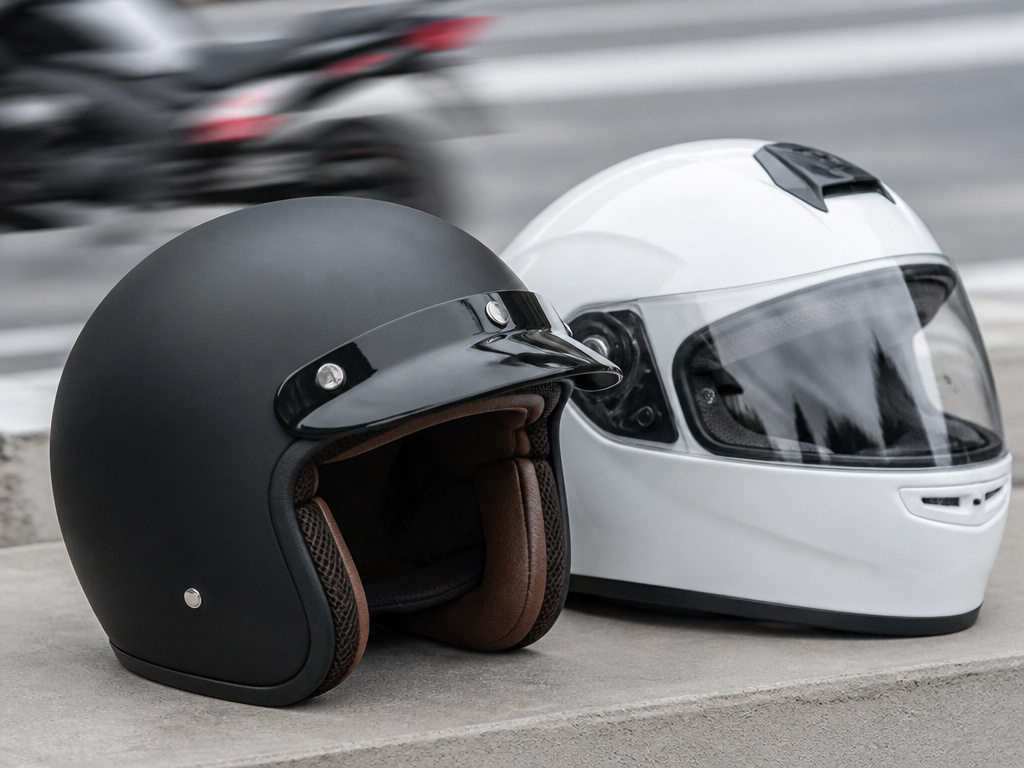
This is about matching the tool to the job. A three-quarter helmet is not “unsafe” in an absolute sense, but rather mismatched for certain jobs. Think of it like using the wrong fuel grade; it might run, but it’ll damage the engine over time.
When a Three-Quarter Helmet Fits:
- Short, low-speed urban errands: Trips under 30 minutes where you’re rarely above 35-40 mph.
- Cruiser-style riding on backroads: The classic look and feel are part of the experience, and speeds are moderate.
- Riding in extreme heat at low speeds: The maximum ventilation can be a genuine benefit when moving slowly in stop-and-go traffic.
The Shoei J-Cruise 3 is a premium example built for this niche, marketed as perfect for “urban cruising and even long touring.”
When You Must Use a Full-Face Helmet:
- Any highway or freeway riding: Speeds above 50 mph make wind, noise, and potential impact forces too great for an open-face design.
- Commuting or touring: If you’re in the saddle for more than an hour, the fatigue reduction of a full-face helmet is a safety feature.
- All-weather riding: An integrated visor and sealed chin bar keep rain, cold, and bugs out. A three-quarter helmet with goggles is prone to fogging in the rain.
- Performance or sport riding: The aerodynamic and protective requirements are essential.
I still insist on a full day of mixed riding before judging gear. A helmet that seems perfect for 20 minutes can nag you by hour three. A long day shows what a short loop hides.
The mismatch in the three quarter vs full face motorcycle helmet debate happens when riders buy a three-quarter helmet for its style or cool factor, then start using it for hour-long highway commutes. That’s the equivalent of running regular fuel in a high-compression engine. It works until it doesn’t, and the failure point is your face.
Practical Upgrades: Making a Three-Quarter Helmet Safer
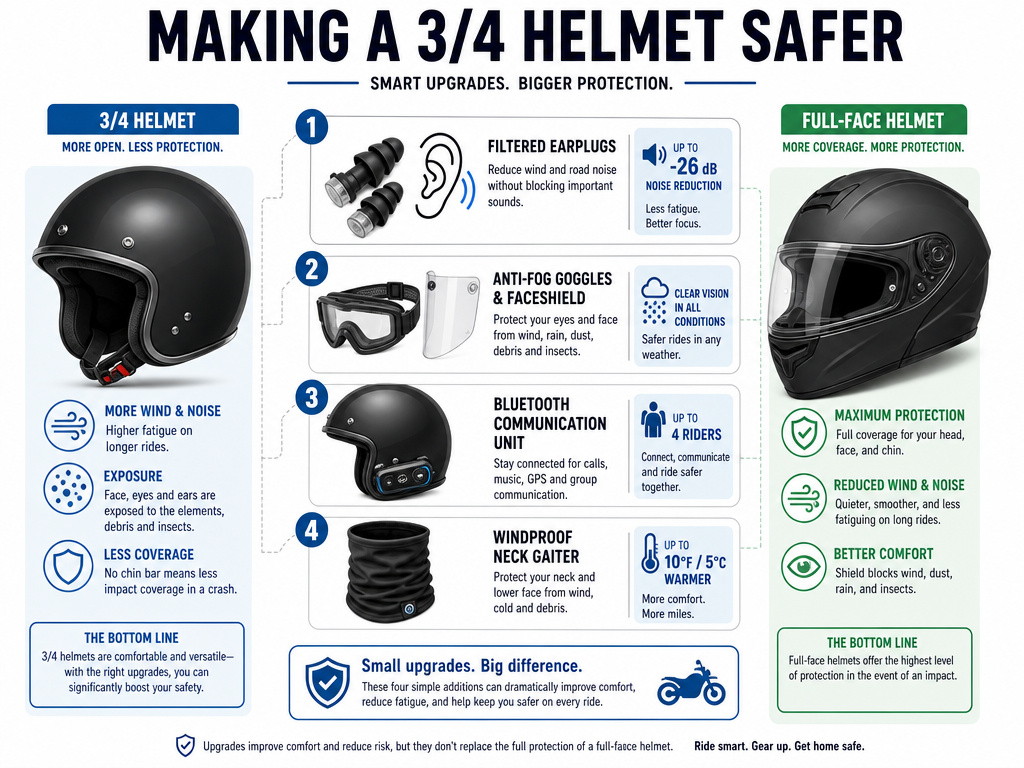
If your riding style genuinely suits a three-quarter helmet, you can’t just wear it and call it a day. You need to build a system around its weaknesses. This isn’t optional; it’s how you close the safety gap.
- Earplugs are not optional. This is the single most important add-on. Now, they go in before any ride longer than 30 minutes. Get the filtered, musician-style plugs that cut wind noise but let you hear horns and sirens.
- Quality eye protection is mandatory. A faceshield is better than goggles, but goggles are better than nothing. Look for eye protection with a secure fit and anti-fog treatment. Ordinary sunglasses can shatter on impact.
- Consider a communication system. It might seem counterintuitive, but a communication system allows you to hear navigation and music at a safe volume without cranking up the volume to overcome wind noise.
- Get a neck gaiter. In cool or wet weather, the exposed neck on a three-quarter helmet is a major chill point. A simple fleece or windproof gaiter makes a dramatic comfort difference.
These items add cost and complexity. Factor that in when you’re comparing the price of a three-quarter helmet to a full-face model. The true cost of the open-face helmet is the base price plus all the accessories needed to make it viable.
The Modular Middle Ground and Certification Decoder
Some riders look at the three-quarter vs full-face debate and ask: what about a modular (flip-up) helmet? It’s a fair question. Models like the Shoei Neotec 3 offer a locking chin bar that flips up, giving you the open-face convenience at stops with the full-face protection while riding.
They are a solid compromise, but with caveats. The hinge mechanism is a key component (though high-end models like the Neotec 3 are rigorously tested). They often carry a P/J double homologation, meaning they are certified as both a full-face and a jet (open-face) helmet, a significant engineering achievement.
When evaluating any helmet, the certification label is your first stop. Here’s what you’re looking for:
| Standard | What It Means | Key Insight |
|---|---|---|
| DOT (FMVSS 218) | U.S. Department of Transportation standard. Self-certified by manufacturer. | The legal minimum in the U.S. Look for it, but don’t consider it the final word. |
| ECE 22.06 | European standard, recently updated. Requires independent testing. | Currently the most rigorous common standard. Helmets like the Schuberth S3 are among the first full-face models to meet it. |
| Snell | Voluntary, non-profit standard focused on high-energy impacts. | Often found on racing helmets. Extremely rigorous, but some argue its testing is too hard for street crashes. |
The key is to buy a helmet that fits your head shape perfectly, then look for an ECE 22.06 certification you can afford within that fit. A mid-priced, perfectly fitting ECE 22.06 helmet is safer than an expensive, loose-fitting Snell helmet.
Helmet types and definitions
Motorcycle helmets are defined by their coverage. A full-face helmet has a fixed chin bar and visor, providing the most complete enclosure. A three-quarter helmet, or open-face helmet, lacks the chin bar but typically includes a face shield. A half helmet, or half-shell, only covers the top of the head. There are also modular helmets, sometimes called flip-up, which have a chin bar that can be pivoted open. Be aware of ‘3-in-1’ convertible models. Some are sold as a single certified unit with multiple configurations, while others are a certified base shell with add-on components that are for comfort only and do not add safety. Always verify the certification applies to the configuration you plan to ride in.
Risk of facial injuries
The choice between a full-face and a three-quarter helmet directly impacts your risk of facial injury. The chin and jaw area is the most common point of impact in a motorcycle accident. A full-face helmet’s integrated chin bar is structurally designed to manage this force. A three-quarter helmet offers no such protection for the lower face. In an accident, this leaves the jaw, chin, and teeth exposed to direct trauma from the road or other objects. This fundamental difference in coverage is why full-face helmets are consistently associated with lower rates of serious facial injury compared to open-face designs.
Frequently Asked Questions
Are 3/4 helmets worth it?
They can be, but only for a specific rider. If you exclusively ride a cruiser on leisurely backroad trips under 50 mph and value the classic look and feel, a three-quarter helmet like the Shoei J-Cruise 3 is a premium option. For anyone who rides on highways, commutes, or tours, the full-face helmet is a better value because it provides complete protection without requiring additional goggles, earplugs, and face coverings.
Which is more safe, a full-face helmet or a three-quarter helmet?
Full-face helmet is unequivocally safer. Crash data consistently shows the chin and jaw area is the most likely point of impact. A fixed chin bar is designed to absorb and distribute this force; the open face of a three-quarter helmet offers no protection there. No removable accessory changes this fundamental design difference.
What is the 2 2 2 rule for motorcycle helmets?
The 2-2-2 rule is a guideline for helmet replacement. A common guideline is to replace your helmet after a certain number of years or immediately after any impact. Consult the manufacturer’s recommendations. It’s a conservative rule. A better practice is to replace it every 5 years due to material degradation from sweat and UV exposure, or immediately after any crash.
What are the disadvantages of a full-face helmet?
The main complaints are reduced peripheral vision (though modern designs minimize this), a “closed-in” feeling that can cause claustrophobia for some, and less direct airflow, which can be warmer in hot weather. They are also typically more expensive than basic three-quarter models and can be slightly more cumbersome to put on and take off.
The Bottom Line
This is a risk-management calculation, not a style choice. A three-quarter helmet trades a massive amount of protection for a specific sensation of freedom. That trade only makes sense if your riding never exceeds the limits of that design.
For the overwhelming majority of riders, especially those covering real miles on highways, the full-face helmet is the default, sensible answer. Start your search there, with a focus on fit and a modern certification like ECE 22.06. If, after trying one on, you find the full-face design truly doesn’t work for your specific, low-speed riding life, then you can step down to a three-quarter helmet with your eyes wide open. You’ll know exactly what you’re giving up, and you’ll budget for the goggles, earplugs, and gaiter needed to make it work.
Buy the helmet that fits the ride you actually do, not the one you see in a magazine.
