
Motorcycle Helmet Head Shapes Explained: The 1-Inch Rule
This post contains affiliate links. As an Amazon Associate, we earn from qualifying purchases.
Motorcycle helmet head shapes are categorized as Long Oval, Intermediate Oval, or Round Oval. Your head is Long Oval if its front-to-back diameter exceeds its side-to-side diameter by more than 1 inch (25mm). It’s Round Oval if the difference is less than 0.5 inch (12mm). An Intermediate Oval head falls between those measurements. Matching your shape to a helmet’s interior design is more critical for comfort and safety than circumference alone.
That 1-inch threshold comes from gear fitting guides, not a government standard. The actual safety standards, like the U.S. DOT rule 49 CFR 571.218, use rigid test headforms to certify helmets, but they don’t categorize living human heads. Motorcycle helmet head shapes explained is a key part of finding the right fit. Your skull’ proportions are what you live with every ride. A mismatch creates pressure points in under twenty minutes and can let the helmet rotate on your head in a crash.
What follows: the tape-measure method to lock in your shape, a brand-by-brand map of which helmets are built for which oval, and how to use padding systems to dial in a near-perfect fit without buying the wrong size.
Key Takeaways
- Use a soft tape to measure your head’s front-to-back and side-to-side diameters. A difference greater than 1 inch (25mm) means Long Oval; less than 0.5 inch (12mm) means Round Oval.
- Intermediate Oval is the most common shape. Most helmet brands, including Shoei, AGV, and Arai’s main lines, design for this profile.
- Brands dictate shape. Arai’s Signet-X is for Long Ovals; its Quantum-X is for Round Ovals. Schuberth and HJC’s i-series lean Round Oval.
- Fit the crown first, then the cheeks. If the helmet won’t slide over your jaw, try a thinner cheek pad, not a larger shell size.
- Some sources, like commercial fitting guides, suggest a motorcycling helmet may take 15-20 hours of riding to bed in. Persistent hot spots after that mean the helmet’s interior shape is wrong for your skull.
How to Figure Out Your Head Shape (The 1-Inch Rule)
Forget guessing. The most reliable method uses a soft tailor’s tape measure and two simple measurements. You need your head’s front-to-back diameter and its side-to-side diameter, taken just above the eyebrows and ears.
Wrap the tape from the center of your forehead, over the crown, to the prominent bump at the back of your skull. Note that number. Then, measure across the widest part of your head, typically just above the ears. Subtract the smaller number from the larger.
The 1-Inch Rule: If the front-to-back measurement exceeds the side-to-side by more than 1 inch (25mm), your head is a Long Oval. If the two measurements are within 0.5 inch (12mm) of each other, your head is a Round Oval. A difference between 0.5 and 1 inch (12-25mm) classifies you as an Intermediate Oval.
This quantitative rule, central to the motorcycle helmet head shapes explained, turns a vague concept into a repeatable check. It’s the foundation every good helmet fitter uses before they even pull a lid off the shelf. Your circumference, which you use for a helmet sizing guide, tells you the shell size. These two diameters tell you which shell shape you need to look for.
Why Head Shape Matters More Than You Think
A helmet’s job is to stay put. 49 CFR 571.218, the U.S. DOT standard, requires a helmet to maintain “continuous contour” and survive severe impacts on standardized metal headforms. Those test headforms, small, medium, and large, are perfectly symmetrical. Your head isn’t.
When your skull’s shape doesn’t match the helmet’s interior, pressure concentrates on specific points. For a Long Oval head in a Round Oval helmet, the squeeze hits the temples. For a Round head in an Oval helmet, the pain focuses on the forehead and occipital lobe at the back. That’s more than an annoyance.
Where this goes sideways: Pressure points distract you. They also create gaps in the fit. If your temples are compressed but the forehead is loose, the helmet can pivot forward during a crash, potentially exposing your brow. A proper fit means even, snug contact all the way around.
The standards bodies know head shape varies. The Snell M2025 helmet standard references ISO 6220-1983, which defines multiple headform geometries (A, C, E, J, M, O) for global testing. Even the Indian headform standard for helmets (IS 7692) specifies different forms for different helmet circumferences. They use these proxies to ensure test consistency, but your fit relies on matching a manufactured shape to your unique one.
The Three Shapes: A Rider’s Guide
Long Oval
Think of a forward-pointing egg. This head is significantly longer front-to-back than it is wide. Riders with this shape often struggle with standard helmets, feeling immediate “hot spots” on the sides of their head above the ears. The market for dedicated Long Oval helmets is surprisingly small.
Brands & Models: Arai’s Signet-X is the canonical example, purpose-built for this shape. Some older Shoei models also cater to it, but most modern lines have shifted toward the more common Intermediate Oval.
Intermediate Oval
This is the default. The head is slightly longer front-to-back than side-to-side, but not dramatically so. Arai notes that its Intermediate Oval shape fits the majority of head shapes in the North American markets. Consequently, most helmet brands target it as their primary design.
Brands & Models: This is the largest category. It includes nearly all Shoei models (RF-Series, X-Fifteen), most Arai models (Corsair-X, Regent-X), AGV’s entire lineup (K6, Pista GP-RR), Bell’s race helmets, and Klim’s Krios Pro. If you’re unsure of your shape, start here.
Round Oval
The head’s front-to-back and side-to-side diameters are nearly equal, giving a more circular top-down profile. Pressure points for this shape appear at the forehead and the back of the skull in oval-shaped helmets.
Brands & Models: Schuberth (C5, S3) is a leader here. HJC’s i-series (i70, i90) is specifically designed for round heads, as are most LS2 models (Vector II) and Scorpion’s EXO modular helmets.
| Head Shape | Key Proportion | Common Pressure Points | Example Helmet Model |
|---|---|---|---|
| Long Oval | Front-to-back > Side-to-side by >1 in (25mm) | Temples, above ears | Arai Signet-X |
| Intermediate Oval | Front-to-back > Side-to-side by 0.5–1 in (12-25mm) | Even pressure, minor cheek | Shoei RF-1400 |
| Round Oval | Front-to-back ≈ Side-to-side (<0.5 in / 12mm diff) | Forehead, back of skull | Schuberth C5 |
A Brand-by-Brand Head Shape Map
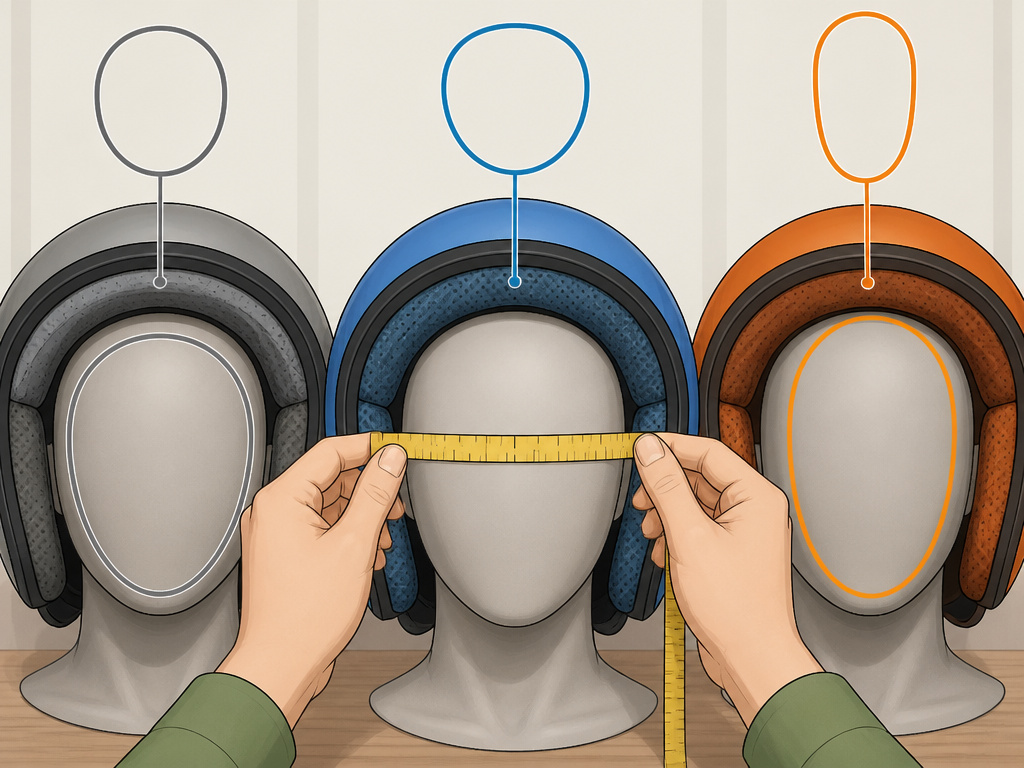
You can’t just buy a “medium Shoei.” You need to know which Shoei model fits your shape. Brands often have different interior designs across their product lines.
Arai is the most transparent, offering three distinct fit packages. Their 2024 catalog states the Quantum-X uses a Round Oval (R/O) shape, the Signet-X uses a Long Oval (L/O) shape, and all other models (like the Corsair-X) use the Intermediate Oval (I/O) shape. They note the I/O fits the majority of head shapes in North America.
Other brands have a dominant tendency but less explicit labeling. This table synthesizes data from manufacturer specs and fitter consensus.
| Brand | Dominant Head Shape | Model Examples | Notes |
|---|---|---|---|
| Arai | Mixed (by model) | Signet-X (Long), Quantum-X (Round), Corsair-X (Intermediate) | Explicitly markets three shapes. |
| Shoei | Intermediate Oval (leans long) | RF-1400, X-Fifteen, Neotec II | Newer models are more intermediate. |
| AGV | Intermediate Oval | K6 S, Pista GP-RR, Tourmodular | Consistent intermediate fit across line. |
| HJC | Varies by series | RPHA 11 Pro (Intermediate), i70 (Round) | i-series is specifically round. |
| Schuberth | Round Oval | C5, S3, SR2 | German brand known for round fit. |
| Bell | Intermediate Oval | Race Star Flex DLX, Star DLX | Sport models are intermediate. |
| Scorpion | Varies by type | EXO-R1 Air (Intermediate), EXO-AT960 (Round) | Full-face vs. Modular differ. |
This map is your first filter. If you measure as a Round Oval, start your search with Schuberth or HJC’s i-series. If you’re a Long Oval, the Arai Signet-X should be your first try. For everyone in the Intermediate middle, you have the widest choice, but you still must try them on.
The Professional Fit Test (Beyond the Tape Measure)
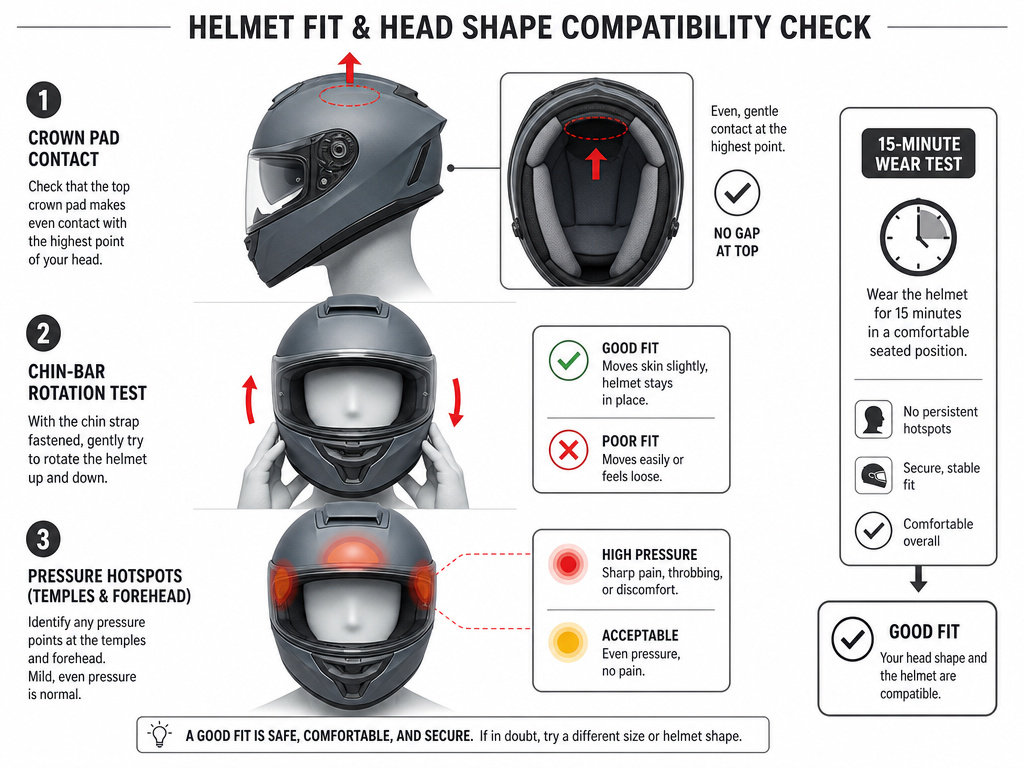
Tape measures give you a category. The real test happens on your head. A proper fit check takes 15 minutes and follows a specific sequence.
First, focus on the crown. The helmet should slide on with firm, even resistance, creating a “firm hug” around the entire perimeter of your head. The top pad should just kiss your skull, not bear the helmet’s full weight. This is the proper helmet fit.
Now, check for rotation. With the chin strap securely fastened, grip the chin bar and try to gently roll the helmet forward and back. Your skin and scalp should move with the shell. If the helmet slides over your skin or hair, it’s too loose. This simple helmet shake test has saved me from more bad purchases than any size chart.
Finally, assess pressure. Wear the helmet for a full 15 minutes. Walk around the shop. Pay attention to any developing hotspots. Forehead or back-of-head pressure suggests a Round head in an Oval helmet. Temple pressure suggests the opposite. If you feel squeezing at your cheeks only, that’s often solvable with a different cheek pad, not a different shell, a key distinction when you’re checking your helmet fit.
Common mistake: Choosing a larger size because the cheek pads feel tight. Your brain isn’t in your cheeks. Arai’s own fitting guide warns that riders often go two sizes too big because they can’t get the helmet past their jaw. The solution is a thinner cheek pad, not a bigger, looser shell.
Fine-Tuning with Pads and Liners
Even with a perfect shape match, you might need minor adjustments. This is where aftermarket padding systems shine. They let you customize the fit without compromising the critical crown contact.
Many Arai models feature removable cheek pads and head liners with a 5mm peel-away slice. You can remove this layer to gain a few millimeters of width at the temples, often letting you stay in your correct size. Other brands, like Shoei, sell optional pad kits in different thicknesses to fine-tune the fit.
This is the smart alternative to buying the wrong size. If a helmet is perfect everywhere but tight at one spot, a liner for pressure relief might solve it. If the helmet is generally loose, thicker pads rarely fix the fundamental problem of a mismatched shell shape.
Standards, Headforms, and Why Your Helmet Was Tested on a Metal Head
This is where the engineering meets the road. When a manufacturer certifies a helmet to DOT or Snell standards, they bash it on a metal headform. The U.S. Federal Motor Vehicle Safety Standards (49 CFR 571.218) specifies three headform sizes (small, medium, large) based on the helmet’s designated size.
The U.S. Standard 49 CFR 571.218 states a helmet sized 6 3/4 (54cm) or smaller is tested on the small headform, while the FIM FRHPhe-01 standard mandates helmets of Size 50 cm or smaller be tested with headform ‘A’.
There’s a documented conflict in procedure for intermediate sizes. The ISO/Snell standard says to use the “next lower headform.” The IIT Roorkee headform specification (IS 7692), citing the same ISO standard, contains a potential typo that creates ambiguity. It’s a niche conflict, but it highlights that even certification involves judgment calls.
These test headforms are perfectly symmetrical ovals. Your head isn’t. The standards ensure a baseline of impact protection, but they can’t guarantee that a certified helmet will fit your unique contours. That’s your job, using the shape-matching process.
What are the main motorcycle helmet styles?
Motorcycle helmets come in several distinct styles, each defined by its structure and coverage. A full-face helmet offers the most complete protection, with a chin bar and a face shield that forms a single, continuous contour around the head, as required by safety standards. Modular helmets feature a chin bar that can be flipped up, but when locked down, they must function like a full-face helmet. Other common styles include open-face helmets, which lack a chin bar, and off-road or motocross helmets, which have an elongated chin bar and visor for different riding conditions. Regardless of style, all helmets sold in the U.S. Must meet the federal DOT standard (49 CFR 571.218) for impact protection, peripheral vision, and shell integrity, though many also meet additional voluntary standards.
Frequently Asked Questions
What is the 2-2-2 rule for motorcycle helmets?
The “2-2-2 Rule” is a fit-check mnemonic. With the helmet on and strapped: 1) Only two fingers should fit under the chin strap. 2) The cheek pads should touch your cheeks with enough pressure that you can barely fit two fingers between your temples and the liner. 3) When you try to roll the helmet off with your hands, it should not move more than two inches on your head. It’s a good, quick field test after you’ve established the correct shape and size.
How long does it take to break in a new helmet?
Some sources, like commercial fitting guides, suggest it may take 15-20 hours of riding for a helmet to break in. The comfort liner and cheek pads will compress and mold to your specific shape, making the fit more comfortable. The helmet should not cause pain or sharp pressure points during this period. If it does, that’s not a break-in issue, it’s a shape mismatch. A helmet that’s too small will stay too small.
Can I change my helmet’s internal shape?
No. You cannot alter the fundamental EPS liner and shell geometry. You can only adjust the space between your head and that fixed shape using aftermarket comfort liners and cheek pads. This is for fine-tuning, not for converting a Round Oval helmet into a Long Oval one. For major shape changes, you need a different model.
My head is asymmetric. Which shape do I choose?
Most heads have slight asymmetry. Choose the shape that matches the majority of your head’s contour, then use adjustable padding to account for the smaller side. Many brands offer removable, asymmetrical thickness pads for this purpose. If the asymmetry is severe, a custom-fitted liner from a specialist may be the only solution for a perfect fit.
Before You Go
Ignore the graphic first. Find your shape with a tape measure, the 1-inch rule doesn’t lie. Then, use the brand map to narrow your search to two or three models built for your oval. Your head shape is fixed. The helmet’s interior shape is fixed. Your only job is to match them.
When you try one on, give it the full 15-minute test. If pressure builds at your temples, you need a rounder helmet. If it’s at your forehead, you need a longer oval. Cheek pressure is a pad issue; crown pressure is a shape issue. Get this right, and even a mid-priced helmet will outperform a loose, premium lid every time. That’s not an opinion. It’s how the physics of fit works.
