
Motorcycle Helmet Sizing Guide: Step-by-Step Fit Check
This post contains affiliate links. As an Amazon Associate, we earn from qualifying purchases.
A motorcycle helmet sizing guide starts with measuring your head’s circumference just above your eyebrows with a cloth tape, then matching that number to the specific brand’s size chart, not a generic “medium” or “large.” The correct fit is snug with even pressure, no painful points, and no movement when you shake your head. A DOT or ECE safety rating is only valid if the helmet fits correctly.
Ignore the label. One brand’s “medium” can feel like another’s “small” because shell shapes and padding differ. A number on a tape measure gets you into the right ballpark, but the real work happens when the helmet is on your head.
What follows: the right way to measure, how to match your head’s shape to a helmet’s internal shape, and a final test that takes ten seconds and catches most bad fits before you buy.
Key Takeaways
- Measure your head just above the eyebrows with a cloth tape, circling the thickest point at the rear. Compare this number only to the specific brand’s size chart.
- Your head shape, round oval, intermediate oval, or long oval, is as important as circumference. A mismatch creates pressure points no break-in can fix.
- A new helmet should fit snugly with even pressure. Expect the liner to break in 15 to 20 percent after the first 15–20 hours of riding.
- Before buying, wear the helmet for 30 to 45 minutes to find hidden pressure points that a quick try-on misses.
- The DOT FMVSS No. 218 or ECE 22.06 safety certification is void if the helmet doesn’t fit. A loose helmet can come off in a crash.
How to Measure Your Head for a Helmet
Grab a cloth measuring tape. If you don’t have one, use a piece of string and then measure it against a ruler. This isn’t the time for a metal carpenter’s tape.
Sources differ on the exact measurement protocol. The NHTSA advises starting just above the eyebrows and circling the thickest point at the rear, while Aegis Rider specifies measuring at the widest point, approximately 2.5 cm above the eyebrows. Circle it around the thickest point at the back of your head. Pull the tape snug, but don’t compress your skin. Write down the number in centimeters. Most charts use them.
The part nobody mentions: Your hair matters. Measuring over flat hair and then trying to stuff a bun under the helmet guarantees a bad fit.
Now you have a number. This is where most online guides stop and tell you to buy a size. Don’t. That number is a starting point for the motorcycle helmet sizing guide, not an answer. As Harley-Davidson points out, helmet sizes vary between manufacturers. Your 58cm head might be a medium in an Alpinestars SuperTech R7 but sit on the line between medium and large in another brand. You must check the specific brand’s size chart.
This table shows one common mapping, used by brands like Alpinestars and Aegis Rider. However, other brands like AFX use different ranges, for example mapping XS to 54–55 cm and S to 56–57 cm. A 58cm head might be a medium in one and a small in another. Trust the chart, not the letter.
Head Shape Is Your Secret Fit Weapon
Circumference tells you how much space the helmet needs to enclose, as noted in any motorcycle helmet sizing guide. Head shape tells you what kind of space it needs to fill. Get this wrong and you’ll have pressure points on your forehead or temples that no amount of break-in will solve.
The NHTSA breaks head shapes into three categories: round oval, intermediate oval (the most common), and long oval. To find yours, flatten your hair and have someone take a picture from directly above. Is your head nearly as wide as it is long? That’s round oval. Is it noticeably longer front-to-back than side-to-side? That’s long oval. Most people are somewhere in the middle: intermediate oval.
You’ll feel it within minutes.
This is why trying on helmets is essential. An online size chart can’t tell you if a Shoei’s intermediate-oval shell will cradle your long-oval head without a gap at the temples. If you must buy online, use a retailer with a return policy. Better yet, visit a shop. Let a trained person watch you try on different models. For a deep dive on this, our guide on motorcycle helmet head shapes breaks it down.
What to Do If You’re Between Sizes
Your measurement lands directly between two sizes on the chart. Now what? Manufacturers disagree on the best path.
The Alpinestars SuperTech R7 manual advises: “If your circumference falls in the middle between two sizes, then try the smaller helmet first.” The logic is that the liner will break in. The AFX manual, however, suggests testing one size smaller and one size larger than the chart recommends.
I side with Alpinestars on this. Start with the smaller size. A helmet that is slightly tight but evenly so will often break in perfectly. A helmet that is slightly loose on day one will only get looser. The caveat is pain. If the smaller size creates a sharp, focused pressure point, not general snugness, it’s the wrong shape, not the wrong size. In that case, try the larger size or a different model.
The Final Fit Test: More Than a Shake
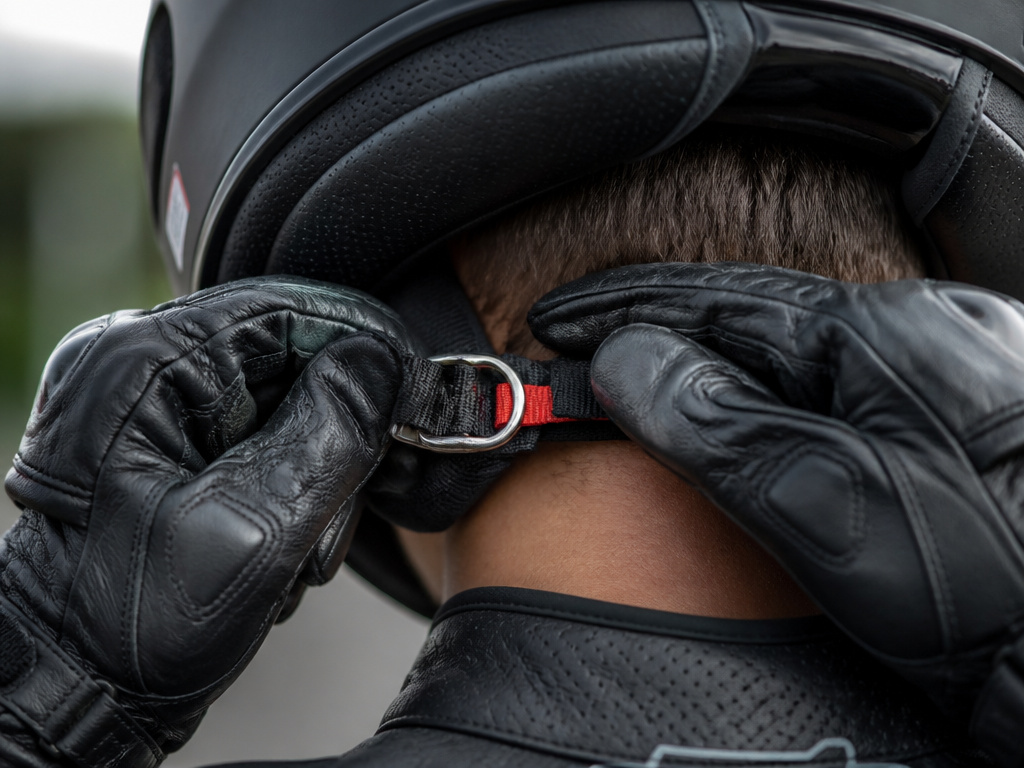
You have a helmet that matches your circumference and seems to match your shape. Now, the real test. Fasten the chinstrap securely. Fasten the chinstrap securely.
First, check for even pressure. The cushioning should contact your entire head, crown, cheeks, and brow, without gaps. Your helmet should feel equally snug around the crown and tight in the cheeks.
Common mistake: Testing fit without the chinstrap fastened. The strap pulls the helmet down and back, changing how it sits. Always buckle up.
The helmet should not move when you shake your head. According to Aegis Rider fit checks, with the chin strap closed, the helmet cannot be removed with significant force, and left/right rotation must not cause shift or wobble. This is the test I use on every helmet. It takes ten seconds and has saved me from a lot of bad purchases.
Finally, wear it. Sit with the helmet on for at least 30 minutes, as the NHTSA recommends. Read a book. Watch TV. Pressure points that seem minor at minute five can become deal-breaking headaches by minute thirty. This is your last chance to find them before you’re stuck on the highway.
How a Helmet Should Feel (And How It Breaks In)
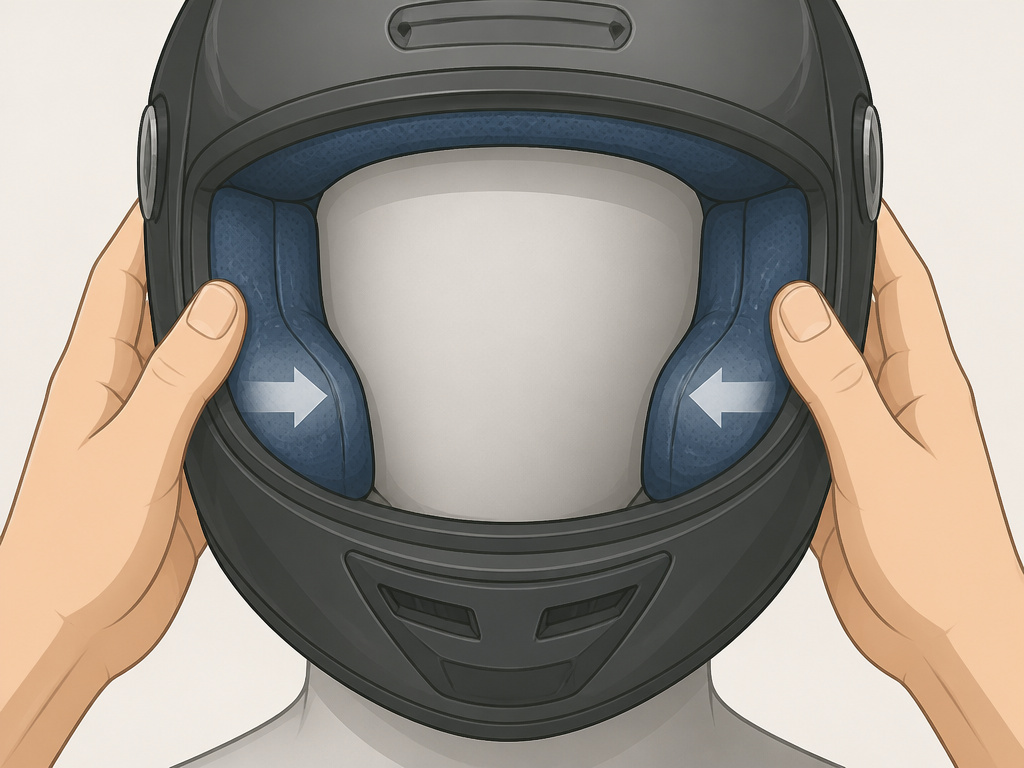
A new helmet should be snug. Not painful, not migraine-inducing, but firmly hugging your head. The NHTSA describes it as “a little tight, providing even pressure around your head without uncomfortable pressure points.”
The liner will compact. According to gear experts at RevZilla, most helmet liners break in 15 percent to 20 percent after the first 15 to 20 hours of riding. That slight tightness in the cheeks will ease. The overall grip will relax. But the shell will not stretch. If a helmet is so tight it causes a throbbing headache in the first twenty minutes, it’s not going to break in enough to be wearable.
This break-in period is why you should never buy a helmet that feels “just right” or slightly roomy in the store. It will be sloppy in a month. Buy the one that feels slightly too tight, with the confidence that it will mold to you. For more on diagnosing a bad fit, see our guides on how to tell if a motorcycle helmet is too big or how to tell if a motorcycle helmet is too small.
Adjusting Fit and When to Stop
Some helmets offer a path to fine-tuning. Many manufacturers sell replaceable cheek pads and crown liners in different thicknesses. If a helmet is perfect everywhere but a little loose in the cheeks, swapping for thicker pads can save the fit. The NHTSA notes this is an approved method.
But there’s a hard line. The NHTSA and Aegis Rider both warn that any alteration beyond swapping official, manufacturer-provided pads risks voiding the warranty and compromising the helmet’s safety. The helmet was tested in its original configuration. Shaving foam, adding aftermarket pads, or gluing in accessories changes how energy is managed in a crash. Don’t do it.
If you have a minor pressure point, sometimes it will wear in. If it’s significant, the helmet is the wrong shape. Return it. For persistent, small hot spots, our guide on how to fix pressure points in a motorcycle helmet has safe solutions.
Special Cases: Glasses, Hair, and Smart Helmets
Life isn’t simple. You wear glasses. You have long hair. You want a helmet with a built-in comms system. These things change the fit.
Always bring your riding glasses when trying on a helmet. The temple arms need to fit through the eye port and into the comfort liner without bending your ears or causing a pressure point behind them. Some helmets have dedicated channels for glasses arms.
For long hair, wear it how you’ll ride. A low ponytail can often sit in the neck roll. A high bun might require trying a size up, but be careful, you still need a secure fit around the crown. Don’t sacrifice safety for hairstyle.
Smart helmets like the Aegis Rider Vision add another layer. They have electronics, batteries, and speakers integrated into the liner. Follow the NHTSA’s advice on choosing the right motorcycle helmet for the basic fit, but also ensure the electronics don’t create new pressure points. These helmets often have less adjustable padding, so the shell size and shape are even more critical.
The Safety Stakes of a Bad Fit
This isn’t about comfort. It’s about the helmet working. The Shoei safety manual states plainly: “For maximum head protection, the helmet must be of proper fit and the retention system must be securely fastened under the chin.”
An Alpinestars manual warns that “an improperly sized or fitted helmet, even if the chinstrap has been correctly fastened, will provide reduced or no protection.” In a crash, a loose helmet can rotate, exposing your skull to impact. It can even come off entirely. Your expensive, top-rated helmet becomes a decorative plastic shell.
The DOT FMVSS No. 218 or ECE 22.06 certification on the label assumes a correct fit. It’s the foundation everything else is built on. A perfect-fitting mid-priced helmet always beats a loose premium one. For a list of models known for their fit systems, check our best motorcycle helmets recommendations.
Frequently Asked Questions
What is the 2 2 2 rule for helmet fitting?
How do I know my motorcycle helmet size?
You know your size when you have measured your head circumference, matched it to a brand’s specific chart, accounted for your head shape, and passed the final fit test (no rotation, no roll-off, even pressure, no pain after 30 minutes). The letter on the box is irrelevant until it passes those checks.
What size helmet for a 24-inch head?
24-inch head is 61 centimeters. According to common size charts from Alpinestars and Aegis Rider, that measurement corresponds to an XL size (61-62 cm). However, you must verify this on the specific brand’s chart you are buying, as some brands shift these ranges.
What is a 6-7-8 hat size in helmet sizing?
Hat sizes are different. A size 7 hat is about 22 inches, or 56 cm, which typically maps to a Small helmet. A size 7 1/8 hat is 22.5 inches (57 cm), on the line between Small and Medium. A size 7 3/8 hat is 23.25 inches (59 cm), a Large. Do not rely on hat size; use a tape measure.
Do different helmet types (full-face, modular) fit differently?
The internal shape and sizing should be consistent within a brand’s line. However, the feel can differ. A modular helmet has a heavier front, which can make it feel like it wants to tip forward if the fit isn’t secure. A half-helmet has no cheek pads, so it relies entirely on circumference fit. Always try on the exact style you plan to buy.
Before You Go
Fit first, features second. A hundred-dollar helmet that fits is safer than a thousand-dollar helmet that doesn’t. The process is simple: measure, match the chart, match the shape, and test. Wear it longer than you think you need to.
If you’re struggling, go to a dealer. A salesperson can spot a head shape from across the room and hand you the two helmets most likely to work. That service is free and worth more than any online discount.
Finally, replace a helmet every five to seven years, or immediately after any impact. A helmet that saved you once is done. Your head is worth starting over with a perfect fit.
