
How to Tell If a Motorcycle Helmet Is Too Big: Fit Tests
This post contains affiliate links. As an Amazon Associate, we earn from qualifying purchases.
A motorcycle helmet is too big if you can pull it onto your head without spreading the chin straps, if it moves independently of your skin during a shake test, or if it rolls off when pushed forward or backward with the chin strap snug. The helmet must be snug on all areas of your head, with the edge visible in your upper vision and the strap tight enough to be uncomfortable to open your mouth.
That’s the manufacturer’s line from Bell’s instruction manual. It’s not a gentle suggestion. A loose helmet lifts at speed, blocks your vision in a tuck, and can eject in a crash. The safety margin is gone before you even leave the driveway. Knowing how to tell if a motorcycle helmet is too big is therefore critical.
What follows are the two factory-recommended fit tests, the subtle signs most riders miss, and the one practical fix for a helmet that’s just a half-size off, all central to how to tell if a motorcycle helmet is too big.
Key Takeaways
- Pull the chin straps outward to don a full-face helmet. If it slides on without spreading, it’s too big and unsafe per Bell’s manual.
- The shake and roll-off tests are mandatory. Your skin must move with the liner, and the helmet must not roll off your head when pushed.
- Snug means uncomfortable to open your mouth. The chin strap must be tight against your throat, not resting on the point of your chin.
- Sizing charts are a starting point, not a guarantee. Head shape (round vs. Intermediate oval) decides final fit more than circumference.
- Thicker cheek pads are the first fix for a slightly loose fit, often solving lift and movement for under $50.
The Two Essential Bell Helmet Fit Tests
Bell’s own instruction manual specifies two mandatory checks. These aren’t comfort opinions; they’re pass/fail safety gates.
First, fasten the chin strap so it’s snug with your mouth closed and uncomfortable to open your mouth. Grab the helmet with both hands and try to move it forward, backward, and side-to-side.
The helmet does not fit right if your skin does not move with the liner of the helmet.
That’s the direct quote. You should feel your cheeks and forehead being pulled by the interior padding. If the helmet slides over your skin, the fit is broken. The liner is supposed to grip you.
Second, with the strap still snug, grab the helmet at the rear base and try to pull it forward over your head. Then, grab the front and try to roll it rearward off your head.
If the helmet comes off your head in either case, the helmet does not fit right and you should not wear it.
This roll-off test is the ultimate check for retention. It simulates the forces in an impact. Passing it means the shell and strap system can do their job. This is the single most important check in any proper fit evaluation.
How to Put a Helmet On Correctly (This Tells You Instantly)
The way a helmet goes on is a diagnostic. Bell’s manual is specific: “The best way to put on a full face helmet is to gently pull the chin straps outward just enough to spread the helmet as you ease it over your head.”
If you can pull the helmet onto your head without having to spread the helmet, the helmet is too big, will not fit right, and should not be worn.
That’s your first five-second test. A correctly sized full-face helmet requires a slight spreading motion at the chin bar to get your head past the padding. Half and three-quarter helmets do not need to be spread open, but for full-face helmets, it should be a firm, deliberate motion, not a casual drop onto your crown.
Where this goes sideways: New riders often mistake initial tightness for a bad fit. A new helmet should feel very snug, with noticeable pressure on your cheeks and forehead. That pressure is what creates the custom mold as the comfort liner compresses over time. If it’s roomy from day one, it will never fit right.
The Subtle Signs Most Riders Miss
Beyond the official tests, your body gives quieter feedback. Ignore these and you’ll fight the helmet every mile.
- Wind Lift at Highway Speed: A telltale sign of a too-big helmet is excessive lift. All helmets catch some wind, but a properly fitted one stays planted. If you feel a constant upward pull trying to lift the helmet off your head, or if you have to crank your neck down to keep your vision clear in a tuck, the fit is off. This is a precursor to the more severe helmet lift that becomes dangerous.
- Independent Movement When Shaking Your Head: With the strap secured, shake your head “no” vigorously. The helmet should move with you as one unit. If you feel it lagging, rotating, or bouncing on your skull, the inner fit is too loose. You’ll often hear a faint thunk-thunk as the shell hits the limits of the liner’s grip.
- Forehead Gap and Eyebrow Visibility: The helmet should sit low on your forehead. With it on, look upward. You should see the very bottom edge of the helmet’s eye port in your upper field of vision. If you can see a gap of your forehead or your eyebrows easily in a mirror, the helmet is sitting too high—a classic sign of a shell that’s too deep for your head.
- Cheek Pad Gaps: Press gently on your cheeks through the helmet. The cheek pads should be in constant, even contact. If you can easily slip a finger between the pad and your cheek, or if air flows freely there, the pads are too thin. This lack of contact is a major cause of helmet roll.
| Sign | What You Feel/See | What It Means |
|---|---|---|
| Easy Donning | Helmet slides on without spreading chin bar. | Shell is too large. |
| Forehead Gap | Can see eyebrows or forehead in mirror while wearing. | Helmet is sitting too high; wrong internal shape or size. |
| Cheek Airflow | Feel cool air on cheeks at speed; can slip finger between pad and cheek. | Cheek pads are undersized or worn. |
| Independent Movement | Helmet lags or shifts when you quickly turn your head. | Liner is not gripping your skin. |
| Constant Wind Lift | Upward pulling sensation at highway speeds. | Overall volume is too great; helmet is lifting off the crown. |
Head Shape vs. Head Size: The Real Fit Decider
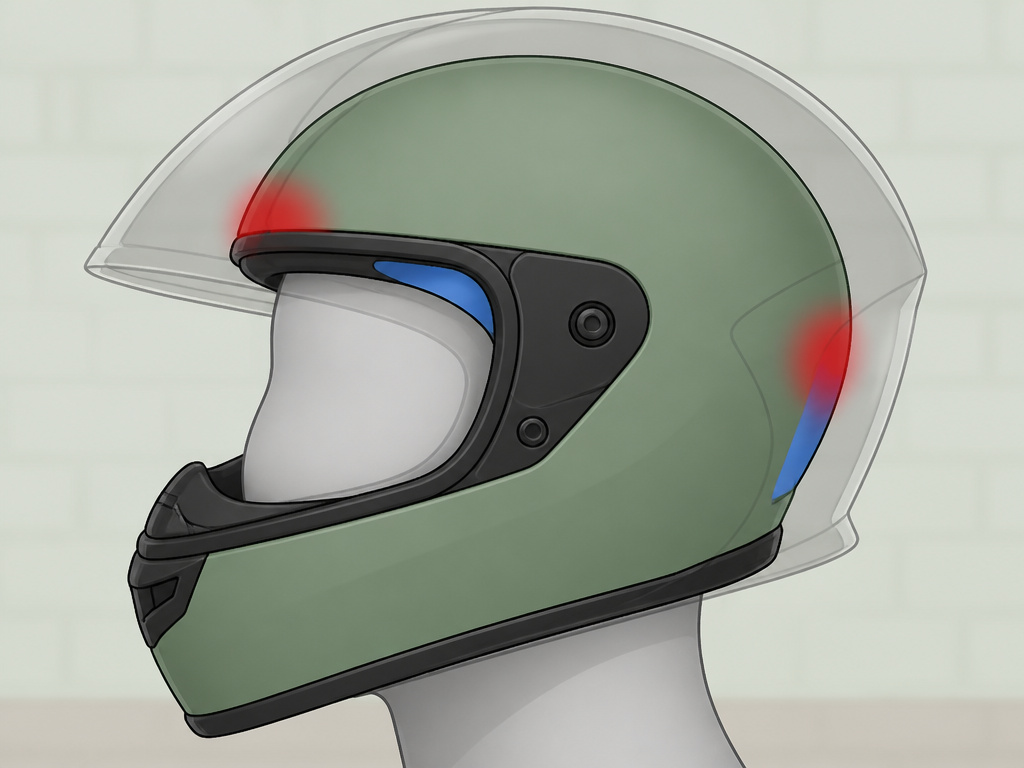
This is where online shopping fails. You can have the exact head circumference for a Medium, but if your head is a long oval and the helmet is a round oval, it will never fit correctly. You’ll get pressure points on your forehead and back of head, with gaping spaces at the temples.
Brands build helmets around specific head forms:
- Round Oval: HJC, many Bell models. Suits heads that are similarly wide from front-to-back and side-to-side.
- Intermediate Oval: Shoei, Arai. The most common shape, slightly longer front-to-back than side-to-side.
- Long Oval: Some Arai and AGV models. For heads that are noticeably longer front-to-back.
A helmet that’s the wrong shape will feel “too big” in the spots where it gaps, even if it’s crushing you elsewhere. This is why a motorcycle helmet sizing guide must start with shape. Your first stop should be our breakdown of motorcycle helmet head shapes to narrow the field.
Common mistake: Choosing a size up to relieve pressure points caused by the wrong head shape. This creates a helmet that is both uncomfortable and unsafe. Fix the shape first.
How to Fix a Slightly Too-Big Helmet
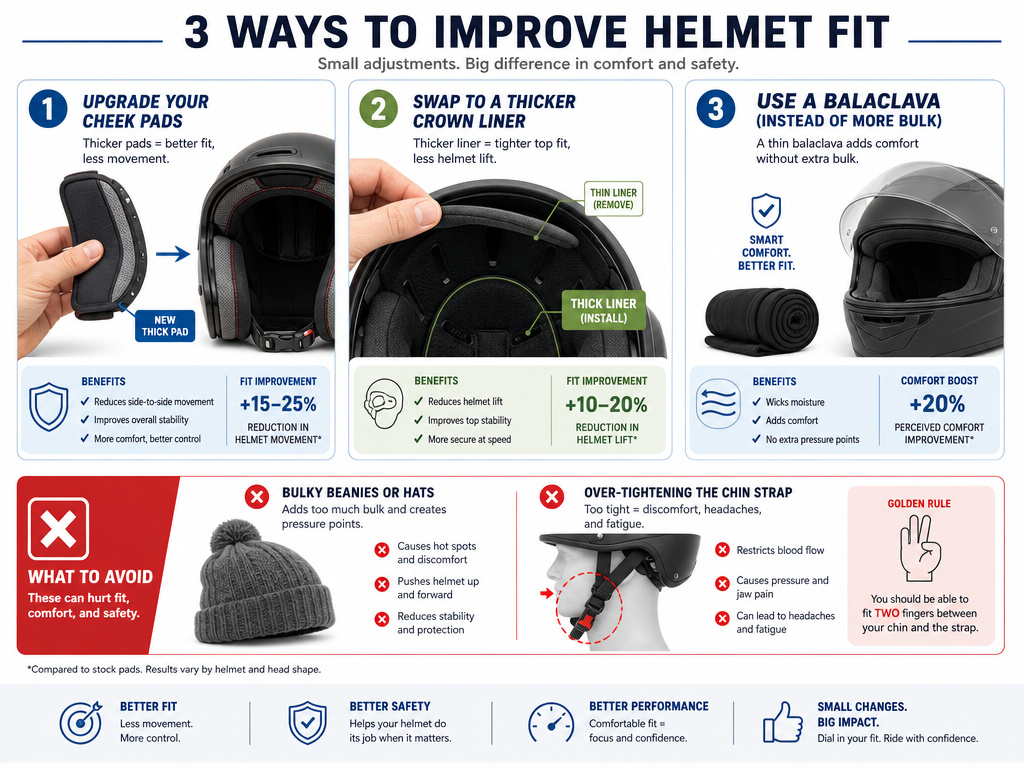
Maybe you’ve lost weight, your hair is shorter, or the liner has broken in a bit too much. Before you scrap a $500 helmet, try these fixes in order.
- Replace the Cheek Pads. This is the single most effective adjustment. Most manufacturers sell optional thicker cheek pads. Swapping to optional thicker cheek pads can take up volume, locking your cheeks in place and stabilizing the entire helmet. The process is simple; we have a guide on how to replace helmet cheek pads.
- Adjust the Top Liner. Some premium helmets (like certain Arai and Shoei models) come with removable top liner pads of varying thicknesses. Replacing a thin crown liner with a thicker one can lift the helmet slightly, improving the roll-off test result.
- Wear a Balaclava or Do-Rag. A thin, smooth balaclava adds a consistent layer of volume. It also wicks sweat and makes the helmet easier to put on and off. This is a legitimate trick used by riders in between sizes.
What won’t work: Adding aftermarket foam, wearing a bulky beanie, or cranking the chin strap to a painful tightness. These are temporary, inconsistent, and can create pressure points that distract you while riding. If the helmet fails the basic roll-off test, new pads might not save it.
The Chin Strap: Your Last Line of Defense
A perfect shell fit is useless if the strap is wrong. Bell’s manual is brutally clear: “The helmet chin strap must be securely fastened and snug under your chin and against your throat or the helmet may be more likely to eject in an accident.”
- Position: It must be against your throat, not on the point of your chin. A strap on the chin point acts as a pivot, helping the helmet roll off in a crash.
- Tightness: It should be “almost uncomfortable” and “uncomfortable to open your mouth.” The chin strap must be snug under your chin and against your throat.
- Check It: Straps can loosen with vibration and movement. Develop a habit of checking tightness every time you fuel up.
How to check if a helmet shield touches your face
A properly fitting full-face helmet should not let your nose or chin touch the face shield. If you feel the plastic or padding against your face, the helmet is likely too big. This contact is more than just an annoyance; it means the helmet’s internal shape is not correctly cradling your head, leaving dangerous space between your skull and the protective liner. A snug fit on all areas of your head prevents this. The helmet must be comfortable but also secure, with your skin moving with the liner when you try to move the helmet. If you feel contact, the helmet does not fit right and you should not wear it.
Frequently Asked Questions
What is the 2 2 2 rule when fitting a helmet on your head?
The “2-2-2 Rule” is a common fitting guideline. It’s a common fitting guideline, but the manufacturer’s roll-off and shake tests are more definitive.
Is it better for a motorcycle helmet to be tight or loose?
New motorcycle helmet should be snug to the point of tightness, not loose. Pressure points should even out, not cause pain. A loose helmet is dangerous and will not break in to fit correctly—it will only get looser as the liner compresses. If you’re between sizes, the smaller, tighter size is almost always the safer choice, provided it doesn’t cause acute pain or hot spots.
How does hairstyle affect helmet fit?
Hairstyle changes head circumference. A thick head of long hair can add to your head circumference. Always do your final fit check with your hair in its typical riding style—pulled back, braided, or under a thin balaclava. A helmet that fits perfectly with short hair may be dangerously tight when you grow it out, and one bought with a thick winter beanie may become too big in the summer. Fit to your most common riding condition.
My helmet fit has changed. Is this normal break-in?
Normal break-in involves the comfort liner compressing slightly, relieving even pressure across your forehead and cheeks over time. This is fine. Abnormal wear is when the helmet develops specific movement—it starts to roll, lift, or shift independently. That’s not break-in; that’s a liner that has worn out prematurely or was always too large. Energy-absorbing EPS foam should not compact significantly during normal use. If the fit changes dramatically, inspect the liner or consider replacement.
The Bottom Line
Fit first, features second. A premium helmet with a poor fit is a liability. Start with your head shape, then use a tape measure for your head circumference. When the helmet arrives, perform the two Bell tests: the shake test and the roll-off test. If it passes, you’re 90% there.
If it’s slightly off, try thicker cheek pads first. If it fails the core tests, send it back. Don’t try to rationalize a bad fit. The difference between “snug” and “too big” is the difference between a helmet that stays on and one that becomes a projectile. Your head only gets one shell.
