
Off Road Motorcycle Helmet vs Dual Sport Helmet
This post contains affiliate links. As an Amazon Associate, we earn from qualifying purchases.
An off-road (motocross) helmet is a lightweight, open-face shell built for maximum dirt ventilation and goggle use, while a dual-sport (ADV) helmet is a heavier, sealed full-face with a removable peak designed to handle both highway speed and trail dust. The choice isn’t about safety, both are DOT/ECE certified, but about where your miles actually happen: mostly dirt means off-road, mixed road and trail means dual-sport.
That certification baseline is the floor, not the ceiling. A helmet that passes the test can still be wrong for your ride if it fights you on the highway or cooks you on the trail. The real difference lives in the details that shape your day: the weight on your neck after three hours, the noise level at 70 mph, and how you manage dust when the trail turns to powder. This is a key point in the off road motorcycle helmet vs dual sport helmet comparison.
What follows breaks down the five trade-offs that decide the off road motorcycle helmet vs dual sport helmet choice: ventilation design, noise and aerodynamics, eye protection systems, weight and comfort, and the specific gear you’ll need for each. We’ll use real helmet specs and documented owner feedback to show where each type wins and where it costs you.
Key Takeaways
- Pick an off-road helmet if the majority of your riding is slow, technical dirt, its forward-projecting chin bar and massive vents move air when you need it most, at the cost of highway noise and zero weather sealing.
- A dual-sport helmet peak acts like a sail, creating buffeting and head-lift at highway speed; if your adventure bike has a tall windshield, it can deflect air over the peak and make this a non-issue.
- Goggles are mandatory with an off-road helmet; a dual-sport helmet lets you run a sealed shield on the road and swap to goggles at the trailhead by removing the face shield, a practical hybrid strategy.
- Weight differences are real: a premium off-road lid like the Bell Moto-10 Spherical hits 1,600g, while a dual-sport like the Shoei Hornet X2 runs over 1,800g, that extra mass translates to neck strain on long highway slogs.
- According to HelmetsAdvisor, for pure dirt performance, neither a full-face nor dual-sport helmet is the best tool; a dedicated motocross helmet is lighter and breathes harder. However, other sources implicitly endorse dual-sport models for off-road use.
The Core Differences at a Glance
The split starts with the job. Off-road helmets are dirt specialists. Dual-sport helmets are road-to-trail hybrids. This table lays out the essential trade-offs.
| Feature | Off-Road / Motocross Helmet | Dual-Sport / ADV Helmet |
|---|---|---|
| Primary Use | Pure dirt, motocross, enduro | Mixed on-road and off-road, adventure touring |
| Chin Bar | Projected forward, heavily perforated | Sealed, close-fitting, often with a breath guard |
| Eye Port | Massive, open, designed for goggles | Large, accommodates both a face shield and goggles |
| Peak / Visor | Fixed, large, for sun and roost deflection | Removable or fixed, smaller, aerodynamic |
| Ventilation | Maximum; 13+ intake vents (e.g., Alpinestars S-M7) | Moderate; tuned for highway airflow and silence |
| Highway Noise | Very loud; open design and peak cause buffeting | Louder than a street helmet, quieter than off-road |
| Best For | Riders who trailer to trails or ride dirt exclusively | Riders who ride paved roads to reach unpaved routes |
Off-road riding is anaerobic work. You’re standing, wrestling the bike, breathing hard at low speed. A dirt helmet’s chin bar is pushed forward and perforated to give that breath somewhere to go, a street helmet’s sealed, close chin bar would suffocate you on a technical climb.
The shape tells the story. Look at the chin bar. An off-road helmet juts out, covered in holes. A dual-sport helmet snugs in, smooth and sealed. That one geometry change dictates everything else about the helmet’s behavior.
Ventilation and Cooling: Where the Air Goes
This is the first deal-breaker. On a hot, slow trail, airflow isn’t a luxury; it’s what keeps you conscious. Off-road helmets win this category outright.
The system creates a high-volume flow across your head when forward motion is minimal. In contrast, a dual-sport helmet like the Klim Krios Pro has adjustable vents, but they’re tuned to balance airflow with wind noise at highway speed. They move less air because their primary mission includes highway comfort.
Where this goes sideways: Assuming a dual-sport helmet vents as well as a dirt lid. On a 90-degree day stuck in a rocky creek bed, you’ll feel the difference in under ten minutes. The dual-sport’s more restricted flow can’t dump heat as fast.
I learned this the hard way on a long, sandy climb. My dual-sport helmet felt fine for the first hour of mixed riding. When the trail slowed to a crawl, the ventilation couldn’t keep up. My visor fogged, and I was lifting the shield just to breathe, defeating its purpose. An off-road helmet with its gaping ports wouldn’t have broken a sweat.
Why the vent design differs:
- Off-Road: Needs massive, direct intakes because rider exertion is high and bike speed is low. There’s little ram-air effect.
- Dual-Sport: Must manage airflow to prevent whistling and buffeting at highway speeds. Vents are often channeled and smaller to keep noise down, sacrificing some peak flow.
If your rides are slow and physical, the off-road helmet’s ventilation is a critical advantage. For fire-road cruising and highway miles, the dual-sport’s compromise is acceptable.
Noise, Buffeting, and Aerodynamics
Once you point the front wheel toward pavement, the priorities flip. The off-road helmet’s greatest strengths become its biggest liabilities.
The fixed peak on a dirt helmet is a sail. According to gear testers, it can buffet or lift your head at highway speed. The large, open eye port and perforated chin bar let in a constant roar of wind and engine noise. A dual-sport helmet is designed to mitigate this. The Shoei Hornet X2 is noted as one of the quieter dual-sport options, with a shape refined in a wind tunnel to reduce lift and noise.
A dual-sport helmet peak that looks great in the parking lot becomes a wind-noise machine at 75 mph. If most of your miles are fast and on pavement, that loud, buffeting peak is a daily tax.
There’s a hidden variable here: your motorcycle’s windshield. A forum rider noted that on an adventure bike with a tall, well-designed windshield, the airflow is directed over the peak of a dual-sport helmet. This can dramatically reduce buffeting, making the dual-sport a much more viable option for long-distance touring. On a naked bike or a dirt bike with no wind protection, the peak will catch every bit of turbulence.
The noise penalty is measurable. You’re trading hearing comfort for breathing comfort. For a long highway stint to reach the trails, many riders find the dual-sport’s quieter, calmer ride worth the extra weight and reduced dirt ventilation.
Goggles vs. Integrated Face Shield
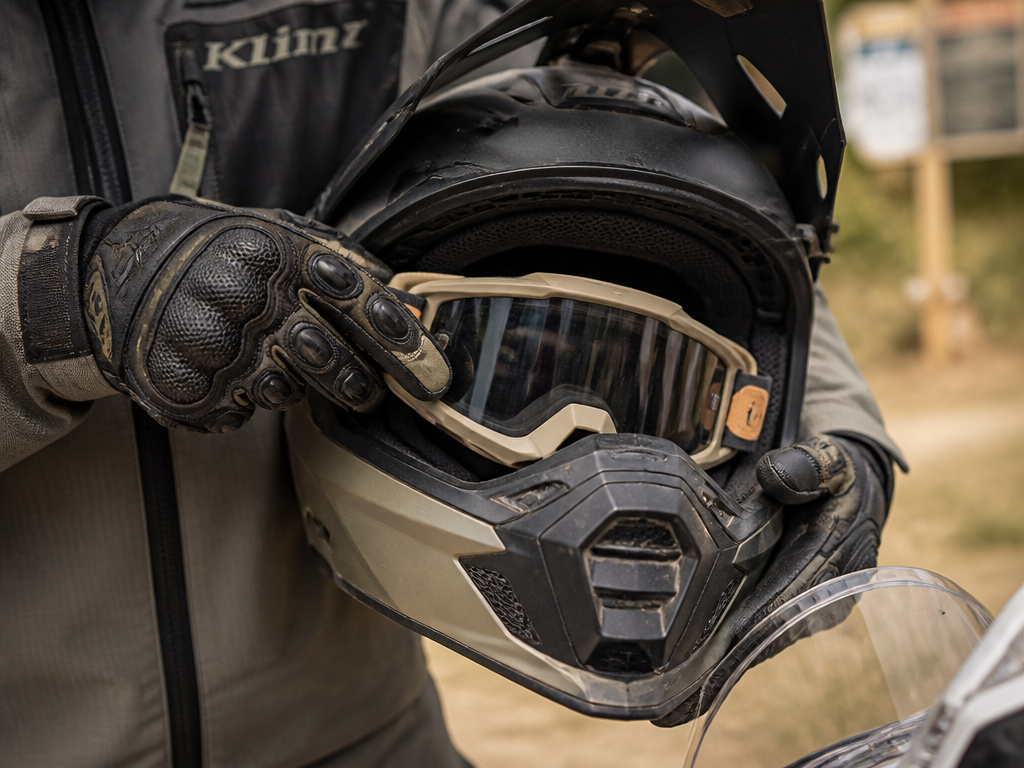
Your eye protection system is a commitment. An off-road helmet requires goggles. A dual-sport helmet offers a choice, and that flexibility is its killer feature.
Goggles are not an accessory for dirt riding; they are half the helmet. They keep out roost, dust, and bugs that an open port invites. The Fly Racing Kinetic Crest MX Helmet has a wide eye port specifically for this. The downside? Goggles can be cumbersome to put on/take off, straps mess with hair, and they don’t play well with most communication systems.
The dual-sport helmet’s genius is its modularity. The Klim Krios Pro and Shoei Hornet X2 are both off-road goggle compatible with the face shield removed. This enables a real-world strategy: ride to the trail with the sealed, fog-resistant shield down. At the trailhead, pop off the shield (often a tool-less operation), strap on your goggles, and head into the dirt. You get road convenience and dirt functionality.
Common mistake: Trying to wear goggles under a closed dual-sport face shield. It doesn’t work. The shield won’t close, or it will press the goggles into your face. You must remove the shield to use goggles properly.
The dual-sport’s integrated shield also brings built-in fog fighting. The Klim Krios Pro includes a Pinlock anti-fog insert lens, and the Shoei Hornet X2 uses its CNS-2 shield for clarity. For rainy road sections or cold morning commutes, a shield with a Pinlock insert or a CNS-2 shield beats goggles every time.
Weight, Fit, and Long-Ride Comfort
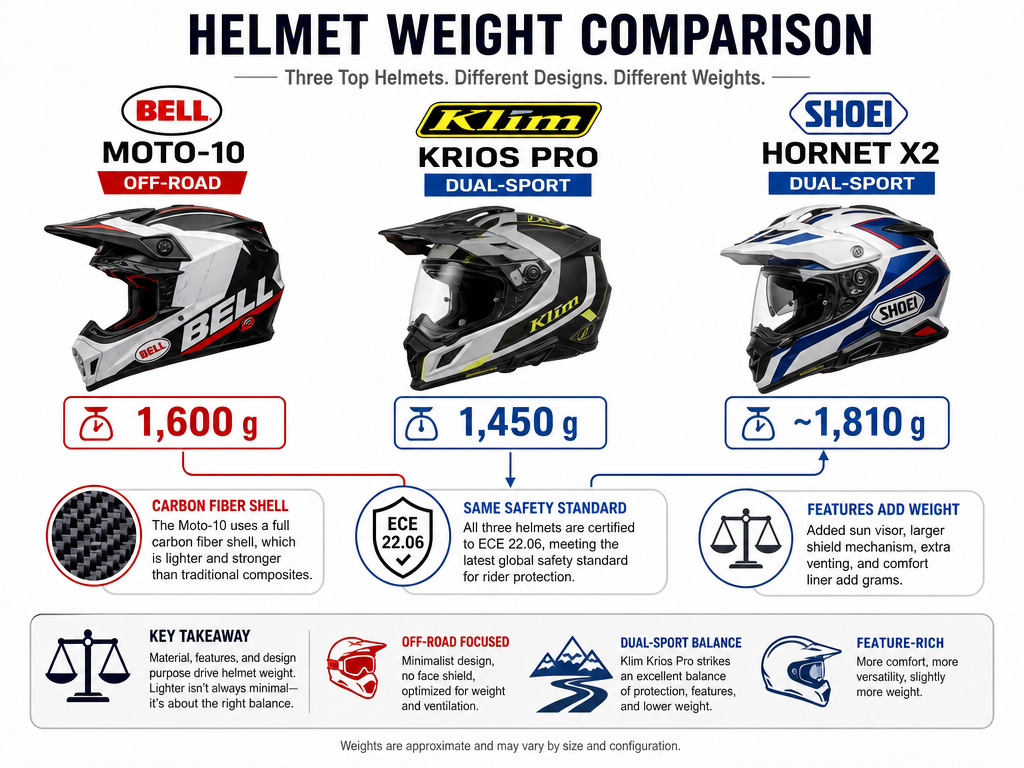
The scale doesn’t lie, but it doesn’t tell the whole story. Weight distribution and internal shape matter as much as grams.
Let’s look at the numbers from the fact sheet:
- Bell Moto-10 Spherical (Off-Road): 1,600 g ± 50 g (size M)
- Klim Krios Pro (Dual-Sport): 1,450 g (size L)
- Shoei Hornet X2 (Dual-Sport): ~1,810 g (approx. 3.99 lbs)
Wait. The Klim is lighter? Yes, because it uses a full carbon fiber hand-laid shell. The Shoei, built with a Multi-Ply Matrix AIM+ shell and carrying a Snell certification, is heavier. This highlights that technology and certification can outweigh the basic “off-road = light” rule.
I used to judge helmets by how light they felt in my hands. I abandoned that after a two-hour ride where a light helmet felt unbalanced and tugged at my neck in the wind. Now I judge balance and fit on the road, not on the scale.
Fit is another critical divergence. Off-road helmets often assume a more “neutral” or “intermediate oval” shape to accommodate goggles and a lot of head movement. Dual-sport helmets may borrow the fit profile from the brand’s street helmets. Always try before you buy, or order from a retailer with a return policy.
The Bell Moto-10 Spherical offers a head-size grid from XS to XXL. These specifics matter more than category generalizations. A helmet that doesn’t match your head shape will cause a hot spot that no amount of venting will fix.
Safety Standards and Real-World Concerns
Both types meet the baseline legal requirements, but the standards and real-world failure modes warrant a close look.
| Standard | What It Means | Common in Off-Road? | Common in Dual-Sport? |
|---|---|---|---|
| DOT FMVSS 218 | U.S. Department of Transportation minimum. | Yes (e.g., Fly Racing Kinetic Crest) | Yes (e.g., CKX DS24) |
| ECE 22.06 | Stricter European standard with oblique impact tests. | Increasingly yes (e.g., Klim Krios Pro) | Yes (e.g., ADN Duale Dakar) |
| Snell M2025D | Voluntary, rigorous U.S. Certification. | Less common | Yes (Shoei Hornet X2) |
| MIPS/Spherical | Adds rotational impact management layer. | Yes (Bell Moto-10 Spherical) | Sometimes as an option |
The presence of Snell M2025D on the Shoei Hornet X2 is a point in its favor for riders prioritizing top-tier impact certification. However, certification is a snapshot, not a guarantee of durability.
This is where we must address the documented CPSC recall of the Bell Moto-10 Spherical helmets. This is a sobering reminder that a helmet meeting standards at the test lab can have a critical design flaw. It highlights the importance of buying from reputable brands with strong quality control and staying informed about recalls.
For mixed riding, the dual-sport’s full-face, street-legal design provides facial protection on pavement in the off road motorcycle helmet vs dual sport helmet equation that an open-face off-road helmet with goggles does not. In a highway slide, the sealed chin bar and face shield provide full facial protection that goggles alone cannot match.
So, Which One Should You Buy?
Be brutally honest about your riding ratio. The math is simple but unforgiving.
Buy an off-road motorcycle helmet if:
- You trailer your bike to the riding area.
- Over 80% of your riding is on dirt, at lower speeds.
- You prioritize maximum cooling and goggle compatibility over all else.
- You own a dedicated dirt bike and rarely ride on public roads.
The Default Pick: For most riders in this category, a well-ventilated, properly fitting model like the Fly Racing Kinetic Crest MX (DOT/ECE 22.06) is a solid starting point. If you want advanced protection, the Bell Moto-10 Spherical (with MIPS) is a top-tier option, but verify your purchase is not from the recalled batch.
Buy a dual-sport motorcycle helmet if:
- You ride your adventure or dual-sport bike on roads to get to the trails.
- Your riding mix is anywhere from 50/50 to 80/20 road/dirt.
- You value a quieter, more aerodynamic ride for highway sections.
- You want the flexibility of a face shield for weather and goggles for dust.
The Default Pick: For the balanced adventurer, the Klim Krios Pro is a benchmark for its carbon lightness and photochromic shield. For those who value ultimate quiet and Snell certification, the heavier Shoei Hornet X2 is a top-shelf choice. Check our detailed reviews of the best dual sport motorcycle helmets for more options.
The Two-Helmet Solution:
For riders who are serious about both disciplines, the best answer is to own both a dedicated off-road helmet and a dedicated street helmet. This avoids all compromises. Use the money you’d spend on one ultra-premium dual-sport to buy a great helmet from our best dirt bike helmets list and a solid helmet from our best adventure bike helmets list. Your neck and your ears will thank you on long, varied days.
Bluetooth and Communication System Compatibility
Compatibility with communication systems varies by helmet design. Some dual-sport models are designed with specific systems in mind; for example, the Klim Krios Pro Helmet is listed as Sena 10U compatible. This indicates that certain helmets may have designated recesses or mounting points for electronics. Off-road helmets, with their open eye ports and focus on maximum airflow, typically lack integrated provisions for such systems. Their primary design goal is unimpeded breathing and goggle compatibility, not housing electronics. If you plan to use a communication system regularly, check the helmet’s specifications for explicit compatibility mentions or look for models designed with internal channels or prepared shells to accommodate speakers and microphones cleanly.
Frequently Asked Questions
Can I use an off-road helmet on the street?
Legally, maybe, if it’s DOT certified. Practically, it’s a bad idea. The peak will buffet dangerously at speed, the noise is extreme, and you have no protection from rain, cold, or bugs without goggles. For any sustained road riding, a dual-sport or street helmet is the correct tool.
What does “dual sport helmet” mean?
Dual-sport helmet is a hybrid designed for adventure (ADV) and dual-sport motorcycles. It blends features of a street full-face helmet (sealed chin bar, integrated face shield) with features of an off-road helmet (larger eye port, removable peak, goggle compatibility) to competently handle both paved and unpaved roads.
Which helmet is better for fogging?
Off-road goggles can fog, especially when you stop moving and ventilation drops.
Are dual-sport helmets safe for off-road?
Yes, when used as intended. They are DOT and often ECE certified, providing similar head protection to a full-face street helmet. However, they are heavier and less ventilated than a pure off-road helmet, which can lead to fatigue and overheating on extreme, slow-speed trails.
How do I clean and maintain these helmets?
For off-road helmets, focus on the interior liner and goggle strap area, which soak up sweat and dust. Most liners are removable and machine-washable. For dual-sport helmets, pay attention to the shield ratchet mechanism; grit can jam it. Clean the shield with lens-specific spray and a microfiber cloth to prevent scratches. Always check your owner’s manual.
