
Motorcycle Crash First Aid Guide
This post contains affiliate links. As an Amazon Associate, we earn from qualifying purchases.
Motorcycle crash first aid is about stabilizing life-threatening injuries and preventing further harm until emergency services arrive. One widely used protocol is the St John DRABC action plan (Danger, Response, Airway, Breathing, Circulation), though other sources recommend variations like DRSABC (adding Send for help) or ABCDE (Airway, Breathing, Circulation, Disability, Exposure). A full-faced helmet should only be removed if the airway is blocked and the rider needs resuscitation, and that requires two people to minimize neck movement.
The disagreement comes when you’re an hour from the nearest town. Official urban protocols say leave the helmet on unless the airway is blocked. Remote-area experts from organizations like NOLS argue that with long EMS response times, you may need to remove it to assess head injuries and keep the rider cool. Both positions have merit, and the right choice depends entirely on where you are and how long help will take. This is a key consideration in any motorcycle crash first aid guide.
What follows is a breakdown of the official steps, the hard-won insights from remote medics, and the gear you should carry to make any of this possible, as detailed in a complete motorcycle crash first aid guide. This focuses on knowing the critical actions that matter immediately after a crash, not on becoming a paramedic.
Key Takeaways
- Assume every motorcycle crash involves a spinal injury. Do not move the rider unless they are in immediate, life-threatening danger like fire or traffic.
- A full-faced helmet stays on unless the airway is blocked. If you must remove it for resuscitation, it is a two-person job to stabilize the head and neck.
- Control severe bleeding with direct pressure first. If significant blood is lost, lay the rider down and raise their feet to help direct blood to the brain.
- The Golden Hour is the target to get a trauma victim to a surgeon. Your actions at the scene directly impact whether that timeline is met.
- Riding leathers and textiles can hide burns and bleeding wounds. A small puncture in the gear does not indicate a small wound.
The Golden Hour: Why Your First Actions Matter
In the emergency medicine world, we have a goal called The Golden Hour. The idea, as noted by Roadracing World Magazine and the Jax Southern Cruisers club, is that trauma victims have the best chance of survival if they are in surgery within one hour of the injury.
Your job as a first responder, according to a motorcycle crash first aid guide, is to create the conditions that make that Golden Hour possible, rather than to diagnose or treat. That means securing the scene, managing immediate threats to life, and conveying accurate information to the 911 dispatcher. Every minute you save by acting decisively and correctly is a minute the medical team has to work with later.
The Golden Hour isn’t a guarantee. It’s a deadline. What you do in the first five minutes at the crash scene either adds time to the clock or burns it.
This changes how you think about “helping.” Fumbling with a helmet for ten minutes because you saw a YouTube video once burns time. So does rolling an unconscious rider onto their back without stabilizing their neck. The standard exists because trauma is a race against internal bleeding and swelling. You are the pit crew.
The DRABC Action Plan: Your First 60 Seconds
You pull over. The bike is down, the rider isn’t moving. Your adrenaline spikes. This is where a memorized checklist saves you from freezing. The St John Ambulance DRABC plan, cited by the NSW Government, is that checklist.
D – Danger: Is the scene safe for you? Oncoming traffic, fuel leaks, fire, or unstable machinery are your first concern. You are no help if you become a second casualty. If the rider is in a live lane, you must decide if moving them is less dangerous than leaving them. Usually, it’s not.
R – Response: Is the rider conscious? Shout. Give a simple command: “Squeeze my hand.” A groan or movement is a response. No response means they are unconscious, which immediately raises the priority of airway management.
A – Airway: An unconscious person’s tongue can block their airway. If they are not responding, you must open it. The NSW Government protocol says to roll them onto their side while supporting the head and neck, as a spinal injury must be assumed. Clear any visible obstructions like blood or broken teeth with a hooked finger.
B – Breathing: Look, listen, and feel. Is their chest rising? Put your ear near their mouth. If they are not breathing, you must begin CPR. Note that some guidelines, such as those cited by Motorcycle.com, suggest performing chest compressions only is as effective as traditional CPR with breaths.
C – Circulation: Stop any bleeding you can see. Use direct pressure with any cloth—your shirt, a bandana, a motorcycle towel. Elevate the bleeding limb above chest level if possible. For a rider who has lost significant blood, lay them down and raise their feet. This encourages the weakened circulatory system to prioritize blood flow to the brain. (Note: In the DRABC protocol, ‘C’ stands for Circulation, while another source, Motorcycle.com, uses a DRSABC structure where ‘C’ stands for CPR (compressions only).)
| DRABC Step | Your Immediate Action | If You Skip It |
|---|---|---|
| Danger | Scan for traffic, fire, hazards. | You or the rider get hit by a car. |
| Response | Shout, give a simple command. | Miss that the rider is unconscious and needs airway help. |
| Airway | Roll to side, support neck, clear mouth. | Rider suffocates from a blocked airway within minutes. |
| Breathing | Look, listen, feel for breaths. | Fail to start CPR on a rider in cardiac arrest. |
| Circulation | Apply direct pressure to bleeding wounds. | Rider bleeds out from a controllable injury. |
This sequence is linear for a reason. A blocked airway can lead to death very quickly. A bleed can take longer. You address the most immediate threat to life first. If you have a second person, send them to call 911 as soon as possible after ensuring the scene is safe. Give them clear details: “Motorcycle accident, one rider down, not responding, mile marker 83 on Highway 12.”
Helmet Removal: The Official Protocol vs. The Remote Reality
This is the single most debated first-aid procedure for motorcycle crashes. The official guidance from bodies like the NSW Government is unambiguous.
The NSW Government motorcycle first aid guide states a full-faced helmet should only be removed if the injured rider does not have a clear airway and cannot breathe. If removal is necessary for resuscitation, it must be done by at least two people, with one stabilizing the head and neck and the other carefully removing the helmet.
The logic is solid. In an urban setting, paramedics are minutes away. They have collars and boards. Your well-intentioned removal could turn a stable neck fracture into a spinal cord injury. The rule is: if they are breathing, leave it on.
Now, the conflict. Dave Craig, a Senior Instructor with NOLS Wilderness Medicine, presents a different calculus for remote areas. In a Rider Magazine interview, he framed it around response time, suggesting removal may be appropriate in remote areas to assess head injuries and for patient comfort, even if the airway is not immediately compromised, provided the head is supported.
So which is right? Both, given their context.
| Scenario | Helmet Protocol | Rationale |
|---|---|---|
| Urban/Suburban (EMS < 10 min) | Leave the helmet on unless airway is blocked. | Risk of neck injury during removal outweighs benefit. Paramedics will handle it. |
| Remote/Rural (EMS > 30 min) | Consider removal if needed to assess airway, breathing, or severe head trauma. | Benefit of assessment and cooling may outweigh risk, provided head is stabilized. |
| Modular/Flip-Up Helmet | Flip up the chin bar to assess airway and breathing. | Allows assessment without full removal, reducing neck movement risk. |
If you must remove a full-face helmet, it is a two-person drill. One person kneels behind the rider’s head, placing their hands on either side of the helmet and under the jaw to lock the head and neck in place. The second person, after unfastening the chin strap, gently expands the helmet opening and pulls it straight back and up, following the natural contour of the head. Any twisting or tilting is dangerous.
Assessing and Managing Specific Injuries
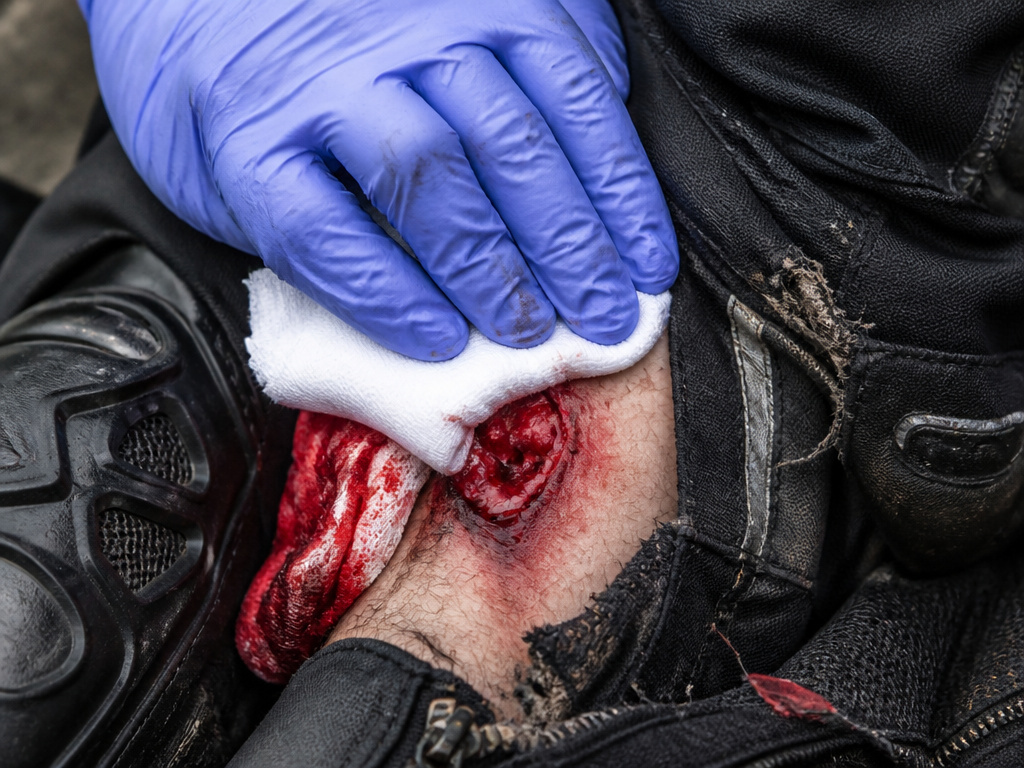
Once the immediate life threats are managed, you can look for other injuries. This is where motorcycle gear itself becomes a factor.
Severe Bleeding: The priority is always direct pressure. Use a clean cloth and push hard. If the cloth soaks through, add another on top—do not remove the first one. For a rider who has lost a lot of blood, keep them warm. Treating for shock, such as keeping the casualty warm after significant blood loss, is important.
Burns from Exhaust or Engine: The NSW Government notes a specific risk: leathers can conduct and contain extreme heat. A rider trapped against a hot engine can have severe burns hidden by their jacket.
- Expose the burn and cool it with running water until the skin returns to a normal temperature.
- Remove jewelry near the burn area before swelling makes it impossible.
- If clothing is stuck to the burn, cut around it. Do not pull it off.
- Cover the area with a sterile, non-stick dressing.
Road Rash: This is a severe abrasion. For severe abrasions like road rash, cover the area with a sterile dressing. Leave thorough cleaning for medical professionals.
Hidden Injuries: This is critical. That small tear in a rider’s leather pants might be hiding a deep laceration or a compound fracture. The NSW Government explicitly warns that a puncture in the leathers is not a true indication of wound severity. Assume any damage to the outer gear means there is a significant injury underneath.
Suspected Concussion: If a rider is disoriented, has a headache, nausea, or doesn’t remember the crash, assume a concussion. The FIM Concussion Guidelines provide a modern framework: relative rest for the first 48 hours is encouraged, but strict rest in a dark room is no longer recommended. Light activity is okay if it doesn’t severely worsen symptoms. Clearance to ride must come from a medical doctor, not a physiotherapist or chiropractor. For adults, the FIM mandates a minimum 10-day exclusion from sport.
Your Motorcycle First Aid Kit and Communication
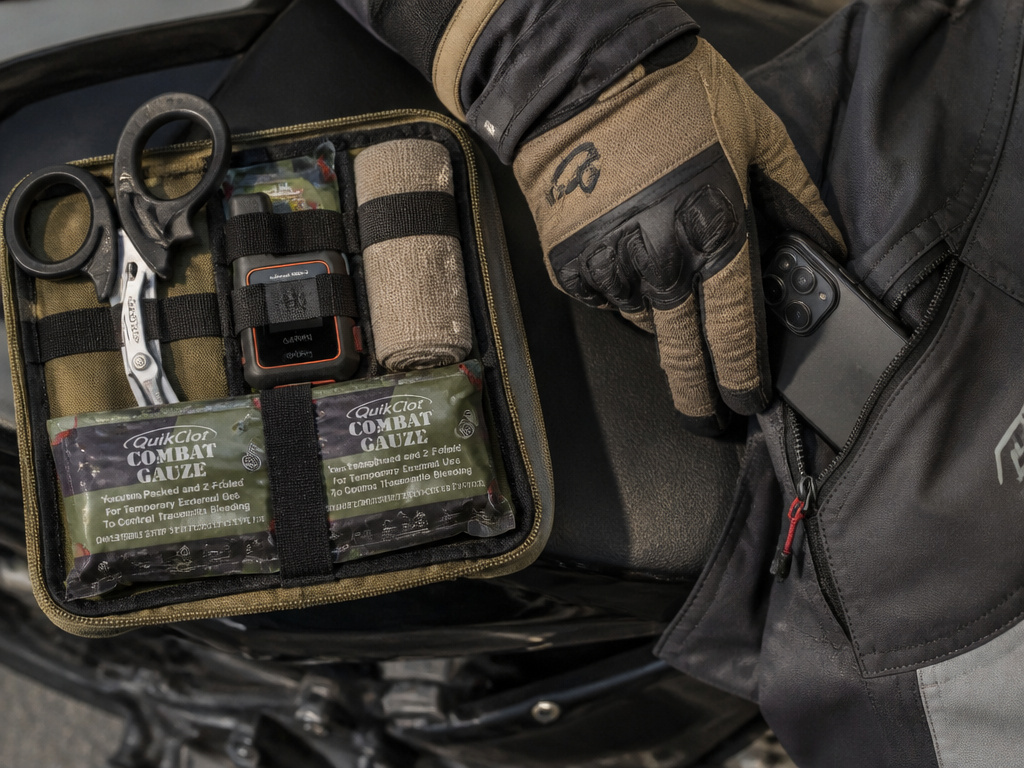
You can’t do any of this without the right tools. A standard car first-aid kit is nearly useless for trauma. You need a motorcycle-specific or trauma kit.
Kit Essentials should focus on trauma management and may include items like hemostatic gauze, pressure bandages, rolled gauze, adhesive tape, trauma shears, a space blanket, and a CPR face shield.
As Dave Craig from NOLS advised in Rider Magazine, at a minimum you should carry a cell phone. But for remote riding, a satellite communicator is a wise backup. They work anywhere and transmit your exact coordinates. His crucial tip: keep your phone or communicator in your pocket, not in a tank bag or saddlebag. If you and the bike separate in a crash, you’ll still have it.
Taking a certified first aid course, such as those offered by organizations like the American Red Cross or NOLS, teaches the hands-on skills and builds the muscle memory that reading an article cannot. Your confidence in a crisis is worth the weekend.
The Aftermath: Securing the Scene and Yourself
The rider is stable. EMS is on the way. Your job now shifts to scene preservation and self-care.
If it’s safe, turn off the motorcycle’s ignition and fuel petcock. Move debris out of traffic lanes, but try not to disturb the final resting positions of the bike and major parts for the police report. If you have to move the bike off the rider, lift it straight up with help—don’t drag it.
Then, check in with yourself. Adrenaline dump is real. You might shake. That’s normal. Take a few deep breaths. If you got blood on you, clean your hands when you can. The emotional weight of a crash scene often hits hours later. Talk to someone about it.
This is also when you think about the rider’s post-crash steps. They’ll need to know how to handle insurance, bike recovery, and the inevitable post-accident inspection of their gear for damage.
Frequently Asked Questions
Should you remove a motorcycle helmet after a crash?
Removing a motorcycle helmet is only necessary if the rider is not breathing and you need to perform CPR, and even then, it requires a two-person job to stabilize the neck. If the rider is conscious and breathing, leave the helmet on. Always assume a spinal injury. For a detailed protocol, see our guide on removing a motorcycle helmet after a crash.
What are the 3 C’s in basic first aid?
The 3 C’s are a simpler acronym: Check the scene (for danger), Call for help (911), and Care for the person. It’s a streamlined version of the more detailed DRABC or ABCDE protocols used by professional first responders.
What should be in a motorcycle first aid kit?
Focus on trauma: hemostatic gauze (QuikClot), an emergency pressure bandage, trauma shears to cut gear, rolled gauze, adhesive tape, nitrile gloves, a space blanket, and a CPR face shield. A standard adhesive bandage kit won’t help with serious bleeding.
How does gear affect injury severity?
Proper protective gear is your first layer of defense. Abrasion-resistant jackets and pants prevent road rash, while CE-certified armor absorbs impact energy to reduce broken bones and internal trauma. It doesn’t prevent the crash, but it drastically alters the outcome of the common injuries that follow.
How do you treat motorcycle road rash at the scene?
Rinse the area gently with clean water to remove loose debris. Do not scrub. Cover it with a sterile, non-stick dressing and secure it with a bandage. Leave deep cleaning and debris removal to medical professionals to prevent infection. Proper care for road rash happens at the hospital.
Before You Go
The hardest part of motorcycle crash first aid is the first step: deciding to pull over and get involved. The second hardest is remembering your training when your heart is pounding. Drill the DRABC steps until they’re automatic. Build a real trauma kit and take a weekend course—the American Red Cross or NOLS options are a solid investment.
One rule to internalize: if you’re ever in doubt about moving a rider or removing their helmet, and they are breathing, choose inaction. Securing the scene and calling 911 with precise details is often the most valuable thing you can do. Your role is to be the calm link between the crash and the Golden Hour. Everything else supports that.
