
Most Common Motorcycle Crash Injuries
This post contains affiliate links. As an Amazon Associate, we earn from qualifying purchases.
Brain damage is the leading cause of death. However, whether a rider suffers head trauma or limb fractures first depends heavily on one factor: helmet use.
That detail flips the script. It means the most common motorcycle crash injuries vary by a choice you make before you even start the engine.
What follows breaks down the data from trauma centers and systematic reviews. We’ll map the specific injuries to the crash mechanisms that cause them, explain the surprising stats around gear, and show how your motorcycle type changes your injury profile. This is about knowing exactly what you’re up against.
Key Takeaways
- Wear a helmet. Brain damage is the leading cause of death, and a 2021 orthopedic study found helmeted riders arrive at the hospital with less severe injuries overall, even if they have more arm injuries.
- Protect your limbs. Non-fatal limb injuries are the most frequent. The tibia is the most common fracture site, followed by the proximal femur. For riders, thumb carpometacarpal joint injuries are particularly common due to grip on the handlebars.
- Your bike type matters. Riders of light motorcycles (scooters, small-displacement bikes) are statistically more involved in accidents and are less likely to wear full protective clothing, making them the most vulnerable group.
- Gear has limits. A Turkish study found jackets, pants, and gloves were effective against soft-tissue injuries like road rash but were not effective against fractures or systemic injuries. Abrasion resistance doesn’t equal impact protection.
- Injuries travel in clusters. Trauma registry analyses show pelvic fractures often coincide with intra-abdominal injuries, and femur fractures frequently happen alongside tibia fractures. If you have one, doctors check for the other.
The #1 Most Common Injury Isn’t What You Think
Head and facial injuries are the most frequently observed injuries in motorcycle accidents. Brain damage is the leading cause of death. The most common head traumas are concussions, followed by brain contusions or haemorrhages, and then facial and skull fractures.
That’s the consensus from a systematic review in the International Journal of Legal Medicine. But it’s only half the story. Another major study in the journal Injury presented a crucial split: for helmeted riders, the most common injuries were to the lower and upper extremities. For non-helmeted riders, the most common injury was to the head.
The forensic review notes that in most cases, drivers were wearing helmets, whereas passengers more commonly did not, thereby increasing the passengers’ likelihood of severe traumatic brain injury.
So the “most common” injury is a conditional answer. Are you helmeted? If yes, your limbs are the primary target. If no, your head is. This reframes the entire purpose of protective gear. It’s not about avoiding injury altogether; it’s about shifting the point of impact from a lethal zone to a survivable one. A helmet is effective for preventing head and facial injuries, and helmeted riders have less severe injuries overall. That’s a trade any rider should take.
A Breakdown of the Most Frequent Injuries
Crash forces follow physics, not randomness. Your body’s position on the bike and the direction of impact create predictable injury patterns. Understanding these isn’t morbid, it tells you exactly what your gear needs to defend against.
Head and Brain Injuries
Beyond being the top cause of death, head injuries have a clear hierarchy of severity. Concussions are most frequent. These aren’t always a loss of consciousness; they can be confusion, dizziness, or headache that appears hours later. Next are brain contusions (bruising) and haemorrhages (bleeding), which are more serious and often require immediate neurosurgical intervention. Finally, fractures to the skull and facial bones, like the orbital socket or jaw, are common and painfully debilitating.
The link between facial trauma and intracranial injury is strong enough that in the emergency room, one triggers a search for the other. Your helmet’s job is to manage this sequence: the hard outer shell spreads impact force to prevent skull fracture, while the crushable EPS liner slows the deceleration of your brain to prevent contusion and haemorrhage.
Lower Extremity Injuries: The Tibia Rule
Your legs are exposed, unshielded projectiles in a crash. The data is specific: the tibia (shin bone) is the most common site of lower limb injury. It’s followed by the proximal femur (the top of the thigh bone, especially in lateral impacts), the patella (kneecap), and the foot.
Common mistake: Wearing short boots or sneakers. Foot and ankle injuries are incredibly common and can lead to permanent mobility issues. A boot that doesn’t cover and support the ankle is just a leather sneaker.
The tibia is the most common site of lower limb injury. This is why legit motorcycle boots have reinforced shanks, ankle cups, and toe sliders, they’re designed to deflect the bike away from your leg and absorb the crushing force.
Upper Extremity Injuries: Arms and the “Motorcyclist’s Thumb”
Upper extremity injuries are extremely common in motorcyclists. Hand lesions are more common in motorcycle drivers than in passengers.
This leads to a signature injury: damage to the thumb carpometacarpal joint. Your thumb’s position wrapped around the grip makes it a primary lever for impact force. The result can be anything from a painful sprain to a debilitating dislocation or fracture. Good motorcycle gloves have reinforced palm sliders and thumb crotch protection specifically to diffuse this energy and let your hand slide, rather than grip and break.
A study in SICOT-J on upper body injury patterns found a counterintuitive detail: helmeted patients had an increased incidence of upper extremity injuries compared to non-helmeted patients. Helmeted MCC patients have an increased incidence of upper extremity injuries compared to non-helmeted patients but overall have less severe injuries. The critical point was that despite more arm injuries, helmeted riders had less severe injuries overall.
Torso and Spine Injuries
While less frequent than limb injuries, damage to the torso is often more severe. The chest cavity houses your heart and lungs, and the abdomen contains vital organs prone to bleeding.
| Injury Cluster | Commonly Paired With | Why It Happens |
|---|---|---|
| Pelvic Fracture | Intra-abdominal injury (liver, spleen, bladder) | Direct impact with the motorcycle fuel tank (“fuel tank injury”). |
| Rib Fractures | Pulmonary contusion (lung bruise), pneumothorax (collapsed lung) | Direct blunt force from the handlebars, ground, or another vehicle. |
| Spinal Fracture | Spinal cord injury (risk of paralysis) | Axial loading (force down the spine) from landing on the head or buttocks. |
These clusters are why trauma teams perform systematic checks. A diagnosed pelvic fracture immediately prompts a search for internal bleeding. This is documented in a PMC trauma registry analysis.
Soft-Tissue Injuries: Road Rash and Muscle Trauma
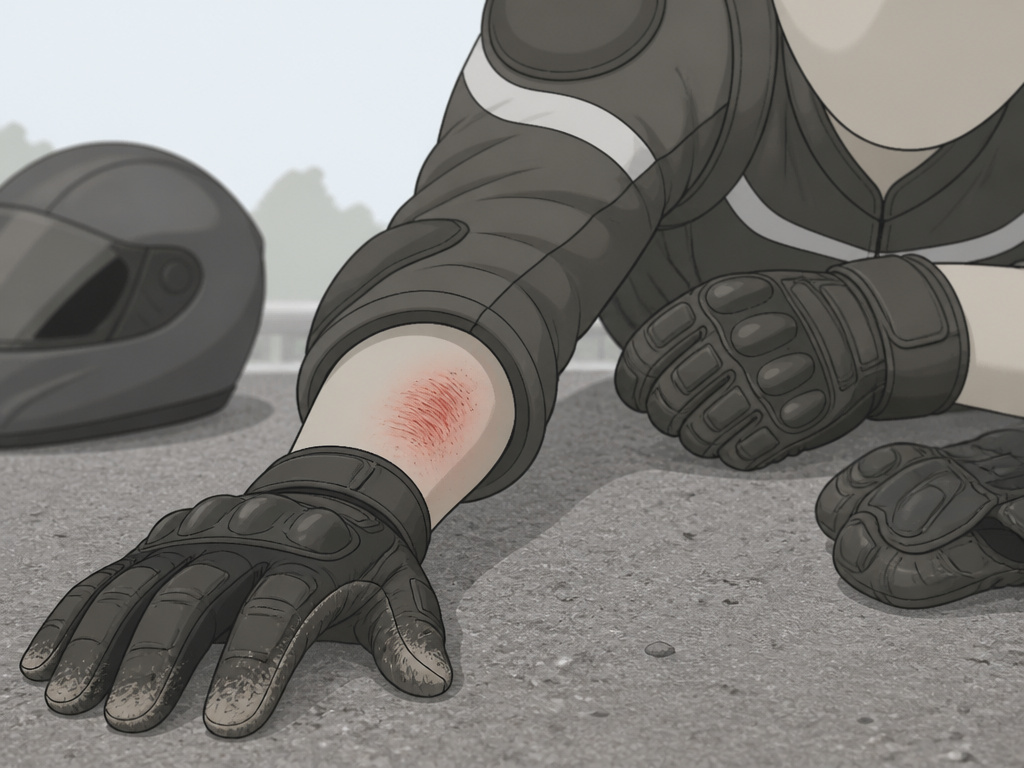
Road rash, the severe abrasion from sliding on pavement, is almost a universal experience in motorcycle crashes. It’s also one of the most preventable injuries. A Turkish gear and injury severity study confirmed that protective clothing like jackets and pants was effective against these soft-tissue injuries.
The damage goes deep. What looks like a surface scrape can remove multiple layers of skin, requiring painful debridement (scrubbing), skin grafts, and leaving permanent scarring. Muscle tears and ligamentous lesions (like torn ACLs in the knee) are also frequent under the umbrella of “non-fatal limb injuries.” Proper road rash treatment is critical to prevent infection and promote healing.
How Crash Mechanism Dictates Injury
A head-on collision doesn’t hurt the same way a slide-out does. Specific accident dynamics produce specific injuries.
- Limb Entrapment: The rider’s leg gets caught between the bike and a curb, guardrail, or other object. This is a primary mechanism for the tibia and femur fractures discussed above.
- Fuel Tank Injury: In a frontal impact, the rider’s pelvis slams into the fuel tank. This is a direct cause of pelvic fractures and associated bladder or internal organ damage.
- Direct Vertical Impact: Being thrown and landing directly on a shoulder or the head. This can cause brachial plexus injuries (nerve damage paralyzing the arm), scapular fractures, and severe spinal compression.
- Ejection and Tumbling: Separation from the bike followed by rolling or sliding. This distributes energy across multiple body parts, leading to the injury clusters seen in trauma registries, like combined forearm and lower leg fractures.
Understanding these mechanisms makes crash types like low-sides and high-sides more than just jargon. A low-side slide might primarily cause road rash and a broken collarbone from impact with the ground. A high-side catapult can lead to the direct vertical impacts and limb entrapment that cause the most severe orthopedic and internal injuries.
The Role of Gear and Rider Type
The research draws a stark line between two kinds of riders, and it has little to do with skill.
A study in Emergency Medicine International found that drivers of light motorcycles (scooters, small commuter bikes) were the most vulnerable riders. They were more commonly involved in crashes, were less likely to have a license, and did not prefer motorcycle protective clothing. Helmets, jackets, gloves, and pants were used significantly more often by heavy motorcycle riders.
Where this goes sideways: Riding a light motorcycle in regular clothes. This group is statistically overrepresented in accident statistics, and their lack of gear turns survivable crashes into serious ones.
Light motorcycle drivers did not prefer motorcycle protective clothing. The study’s conclusion was blunt: “Heavy motorcycles riders were safer than light motorcycle riders.” It wasn’t about the machine’s power, but the safety culture surrounding it.
So what does gear actually do? The same study was precise:
- Helmets: Effective for preventing head and facial injuries.
- Other Protective Clothes (jackets, pants, gloves): Not effective against fractures or systemic injuries, but were effective against soft-tissue injuries.
This is the vital nuance. Other protective clothes were not effective against fractures or systemic injuries but were effective against soft-tissue injuries. It shifts the injury from a debilitating, infection-prone wound to a clean bone break that heals more predictably. That’s why a comprehensive protective gear guide focuses on fit, armor placement, and abrasion-resistant materials.
First Response and Long-Term Impact

Knowing the most common injuries informs what to do in the critical moments after a crash. Your actions can prevent a bad injury from becoming a permanent disability.
Immediate first aid priorities are ABCs: Airway, Breathing, Circulation. Check if the rider is conscious and breathing. Do not attempt to remove a helmet unless it is absolutely necessary to maintain an airway, as improper removal can worsen a spinal injury. If the rider is conscious but complaining of back or neck pain, encourage them to stay still.
The part nobody mentions: The sound of a broken bone.
For long-term outcomes, the data is clear. The SICOT-J study found that riders who were not intoxicated and who wore a helmet not only had less severe injuries but were also hospitalized for shorter periods and accumulated a lower cost of care. A concussion can mean weeks of dizziness and cognitive fog. A complex tibia fracture can require multiple surgeries and a year of rehabilitation before walking normally again. The financial and personal toll of “common” injuries is anything but minor.
This is why the final step after any incident is a thorough gear inspection. A helmet that has absorbed an impact is compromised and must be replaced. Jacket armor that has been compressed may not protect again. Your gear took the hit so you didn’t have to; honor that by checking it before you ride again.
Burns in Motorcycle Crashes
Statistics on Injury Frequency or Fatality Rates
Head and facial injuries are the most frequently observed injuries in motorcycle accidents. Brain damage is the leading cause of death. Non-fatal limb injuries are the most frequent among the most common motorcycle crash injuries overall, encompassing ligamentous lesions, fractures, and dislocations. For helmeted riders, studies show the most common injuries shift to the lower and upper extremities. For non-helmeted riders, the most common injury is to the head. Light motorcycle drivers, who often do not wear protective clothing, are statistically more involved in road accidents. Passengers more commonly do not wear helmets, increasing the likelihood of severe traumatic brain injuries.
Frequently Asked Questions
What is the most common injury in a motorcycle accident?
The single most observed injury is to the head and face, with brain damage being the leading cause of death. However, for riders who wear helmets, the most common injuries shift to the limbs, specifically fractures of the tibia (shin) and injuries to the hands and thumbs.
What is the #1 cause of motorcycle crashes?
Where do 70% of motorcycle accidents occur?
Do helmets prevent broken arms?
No, helmets are designed to protect the head. In fact, one study found helmeted riders had a higher incidence of upper extremity injuries, likely because they survived crashes that would have otherwise been fatal. Helmets prevent head injuries; jackets, gloves, and pants with armor are what help mitigate arm and leg injuries.
What should I do first after a motorcycle crash?
First, ensure your own safety and check for immediate threats. Then, follow the steps after a crash: call for emergency services, do not remove your helmet unless necessary for breathing, and try to remain still if you suspect a back or neck injury. Exchange information and document the scene once it is safe to do so.
The Bottom Line
The data strips away the guesswork. If you crash without a helmet, you will likely injure your head. If you crash with a helmet, you will likely injure your limbs. That’s the brutal calculus.
This is the blueprint for smarter riding. Invest in a full-face helmet that meets modern safety standards. Wear a jacket and pants made of abrasion-resistant material with CE-rated armor at the shoulders, elbows, knees, and back. Get boots that cover your ankles and gloves with palm sliders. This head-to-toe system is the only thing that addresses the full spectrum of “most common” injuries documented in trauma centers worldwide.
Your gear choices directly influence which column you end up in on the trauma surgeon’s chart. Choose the survivable one.
