
How to Get Motorcycle License in Ohio: Step-by-Step
This post contains affiliate links. As an Amazon Associate, we earn from qualifying purchases.
How to get motorcycle license in Ohio, in order: pass the knowledge test and vision screening, buy a TIPIC permit (minimum age 15 years, six months), then pass the BMV skills test or a Motorcycle Ohio course. Buy the endorsement at a deputy registrar within 60 days or before the permit expires, whichever comes first.
That 60-day window shows up twice in Ohio’s process, and it’s the part that trips new riders. You get 60 days to buy the permit after the knowledge test. Then you get another 60 days to buy the endorsement after your skills test or course, and that second clock dies early if your permit expires first.
What follows: the permit and its paperwork, the rules you ride under, the BMV test versus the Motorcycle Ohio course, the extra road for riders under 18, and the spots where even the sources disagree with each other.
Key Takeaways
- Adults with a valid Ohio driver license can take the knowledge test online; everyone else tests at a driver exam station.
- A Motorcycle Ohio Basic Course card waives the BMV skills test for 60 days from issue.
- Permit holders ride solo, in daylight, with a helmet and eye protection, and stay off limited-access highways.
- Riders under 18 hold the permit at least six months and finish the same driver-ed and 50-hour driving requirements as a car license.
- Two wheels, three wheels and a scooter each need their own endorsement or license.
The TIPIC Comes First: 15 Years, Six Months and Two Tests
Ohio sets the minimum starting age at fifteen years and six months. Before that, the BMV won’t issue a motorcycle or motor scooter TIPIC, which stands for Temporary Instruction Permit Identification Card. It’s Ohio’s name for a learner permit.
The Ohio motorcycle TIPIC requires a minimum age of 15 years, six months, plus a passed motorcycle or motor scooter knowledge test and a vision screening. The permit is bought at a deputy registrar within 60 days of passing the test and stays valid for one year from the date of issue, according to Ohio DPS.
The BMV names two study sources: the Ohio Motorcycle Operator’s Manual and section four of the Digest of Ohio Motor Vehicle Laws. I’d read the manual cover to cover before touching a practice quiz. The written knowledge test rewards slow reading more than speed.
Fail it and you wait at least 24 hours before retesting. There’s no cap on attempts.
Fail on Monday, retest Tuesday. That’s the whole penalty.
The test comes in text and audio in Arabic, Chinese, English, French, Japanese, Russian, Somali, Haitian Creole and Spanish, plus American Sign Language in text and video. One catch: you still have to understand directions and read traffic signs printed in English, even with a proctored interpreter.
In Person or Online?
Adults who already hold a valid Ohio driver license can take the endorsement knowledge test online through BMV Online Services. The Ohio BMV motorcycle license requirements page spells this out, and it adds a step people miss. You still do the vision screening in person, at a deputy registrar, when you buy the permit.
Teens and anyone without an Ohio license go to a driver exam station for both the test and the vision screening.
One law-firm summary, from Charles E. Boyk Law, describes a written test at a BMV licensing office and never mentions the online option. I go with the BMV here. It runs the test.
What to Bring to the Deputy Registrar
The deputy registrar wants proof of:
- Full legal name
- Date of birth
- Social Security number, if you’ve ever been assigned one
- Ohio residency
- Citizenship or legal presence. The BMV’s Acceptable Documents page lists which papers count, and it has an interactive tool that builds the list for you.
Under 18? A parent or guardian has to show a driver license or ID card and co-sign for the TIPIC.
Easy to miss: Passing the knowledge test doesn’t hand you a permit. You have 60 days to buy the TIPIC at a deputy registrar, so don’t let a passed test sit in a drawer for a season.
What Can You Legally Do on an Ohio Motorcycle Permit?
Not much, and that’s the point. You ride alone, in daylight, in a helmet and eye protection, and off limited-access highways.
The Ohio DPS motorcycle laws booklet (MOP 0051) lists the permit restrictions under R.C. 4511.53:
- No passengers.
- Daylight hours only.
- No limited access highways, and no congested roadways since 1/1/17.
- Helmet and eye protection on every ride.
- The permit is good for one year from the date of issue, so the clock starts the day you buy it.
Eye protection means glasses, goggles or a face shield on the helmet. A transparent windscreen counts too, if it’s permanently attached and tall enough to actually protect you. I’d run a face shield anyway.
Helmet fit matters more than most riders think on a permit. A helmet one size too big gives itself away on the first shoulder check: it lags behind your head, and the wind roars in at the cheek pads. Buy one with the DOT symbol on the back, then wear it until it feels snug on day one. Fit beats price tag.
The night rule has a wrinkle. Ohio DPS says “daylight hours only.” Bensinger Legal describes it as no riding “between sunset and sunrise.” Those two readings split right at dusk, when the light is going but the sun hasn’t technically set. Daylight-only is stricter, so I’d have the bike parked before the light fades.
Where this goes sideways: Giving a friend a ride on a permit. Passengers are banned outright for permit holders.
Riding with no permit or endorsement at all is a separate offense under R.C. 4510.12. Ohio DPS lists a first offense as an unclassified misdemeanor with a fine, community service or both. A second offense is a first-degree misdemeanor with a fine, up to 6 months in jail, or both.
BMV Skills Test or Motorcycle Ohio Course: Which Path Wins?
For a true beginner, the Motorcycle Ohio course wins, even though adults aren’t forced to take it. Bensinger Legal’s summary says you must finish a riding course before you apply for an endorsement. According to the Ohio BMV page, you can pass either the BMV skills test or a Motorcycle Ohio course, and the course card waives the skills test.
I trust the BMV page on this. But I’d still take the class.
The BMV motorcycle skills test gets booked through BMV Online Services under the “Schedule a Driving or Skills Test” tile. Charles E. Boyk Law describes it as an on-bike exam.
| Factor | BMV Skills Test | Motorcycle Ohio Basic Riding Skills |
|---|---|---|
| How to book | BMV Online Services skills test tile | ODPS course registration portal |
| Time involved | One test session | 16 hours: 4 classroom, 12 riding |
| Bike and helmet | Not listed on the BMV page | Motorcycle and DOT helmet provided |
| What you walk away with | A pass toward the endorsement | Card that waives the skills test for 60 days |
My call: if you’ve never ridden, take the course. If you’ve ridden dirt bikes for years and own a street-legal bike, the BMV test is a fair shortcut.
You sign up through the Motorcycle Ohio training course registration portal. ODPS lists these options:
- Basic Riding Skills: 16 hours (4 classroom, 12 riding). You need an M1 two-wheel TIPIC or M endorsement at the start of class, and you have to be able to balance and ride a bicycle.
- Basic Riding Skills, online classroom: 4-6 hours self-paced online plus 12 hours in person.
- Returning Rider: 8 hours. Built for riders over 18 with more than 1,000 miles on a permit, or experienced riders coming back after years away.
- Basic Riding Skills 2: 7 hours, range only, on your own street-legal bike. Bring insurance, registration and a Personal Vehicle Inspection Checklist.
ODPS lists the same flat fee for all four, with an added per-passenger fee on Basic Riding Skills 2. Can’t find an open class? Motorcycle Ohio’s line is (800) 837-4337.
If you’ve never sat through a motorcycle safety course of any kind, the format is simple: classroom first, then the range. Learning the clutch is where it clicks. You feel a small tug through the bars as the bike starts to creep, and finding that tug without looking down is most of the early battle.
What to Wear to Class (the Course Only Covers Your Head)
The first gloves I rode in were thin, fashion-cut things I bought because they looked right. A slow parking-lot tip-over scuffed straight through the palm, and I spent that night picking grit out of my hand. Cheap lesson. Painful one.
The course hands you a DOT helmet and a motorcycle. Everything else is yours to bring, and the registration site has a Proper Riding Gear page you should read before class day.
For gloves, I’d start with full-finger leather and buy whichever pair fits without bunching at the fingertips. For your feet, an over-the-ankle riding boot beats any sneaker. When you shop for your own helmet later, flip each one over and find the DOT symbol before you pay. Flip each one over and find the DOT symbol before you pay.
I’d rather see a new rider show up to class in modest full-finger gloves and real boots than in a fancy jacket and sneakers. Hands go out first in a fall, and a parking-lot drop is plenty fast to prove it.
How to Get Motorcycle License in Ohio, Start to Finish
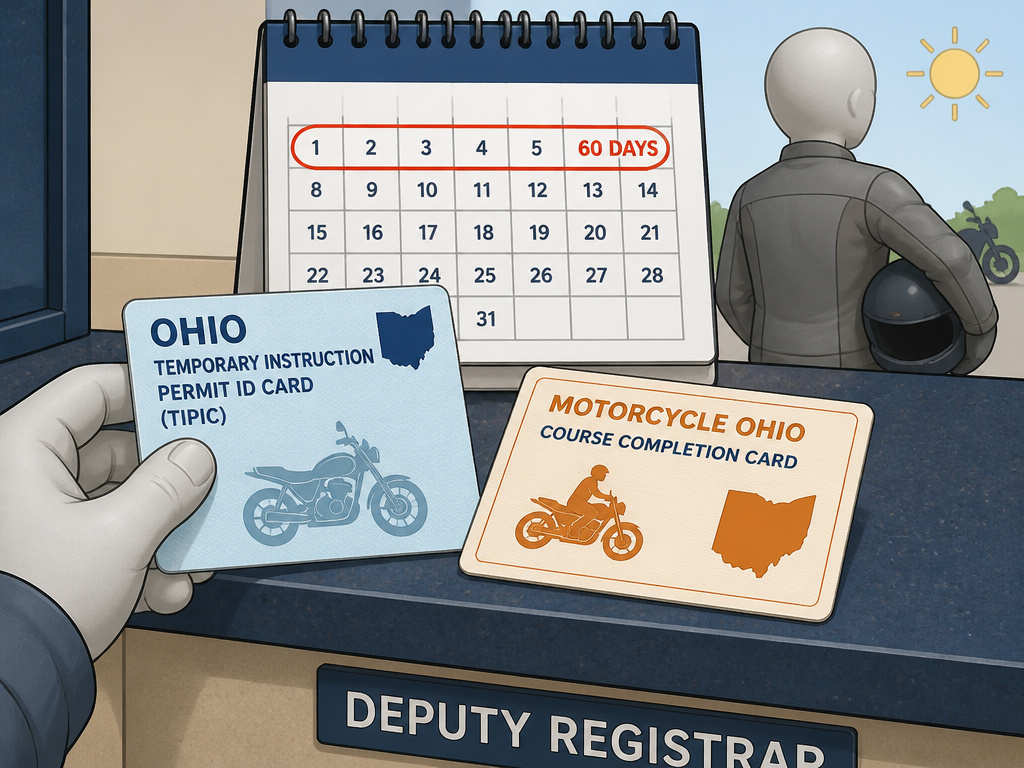
Four stops, in this order: an exam station or the BMV website, a deputy registrar, a test or a class, then the deputy registrar again. Most states share the same broad motorcycle licensing steps. Ohio’s twist is how tightly the deadlines stack.
Before you start: Three hazards catch permit riders. First, riding home from the registrar after dark breaks the daylight-only rule, so buy your permit in the morning. Second, a permit that expires partway through a Motorcycle Ohio class has to be renewed before you can continue (per a Feb 2018 Motorcycle Ohio FAQ), so check the date before booking. Third, passengers are banned on a permit, so the “quick lap with a buddy” waits until you’re endorsed.
- Study the manual and the Digest. Read the Ohio Motorcycle Operator’s Manual and section four of the Digest of Ohio Motor Vehicle Laws. Skip this and you’ll burn days on 24-hour retest waits.
- Pass the knowledge test and vision screening. Go to a driver exam station, or test online if you’re an adult with a valid Ohio license. Online testers who forget the in-person vision screening get stuck at the registrar counter.
- Buy the TIPIC within 60 days. Bring your documents, plus a co-signing parent if you’re under 18. Wait too long and you’re past the window the BMV sets.
- Practice under the permit rules. Daylight, solo, helmet, eye protection, no limited-access highways. Breaking them puts you outside the conditions your permit allows.
- Pass the BMV skills test or a Motorcycle Ohio course. The course card waives the skills test for 60 days from issue.
- Buy the license or endorsement. Do it at a deputy registrar within 60 days or before your TIPIC expires, whichever comes first. Let the card lapse and you’re back to scheduling the BMV skills test.
Think of these windows like glue with an open time. Wood glue gives you a few minutes to clamp the joint; miss it and nothing holds. Ohio’s 60-day windows work the same way, except you can’t scrape off a waiver card and re-glue it.
| Clock | Starts When | How Long |
|---|---|---|
| Buy the permit | You pass the knowledge test | 60 days |
| Knowledge retest | You fail the test | At least 24 hours |
| Permit life | Date of issue | One year |
| Course waiver | Completion card issued | 60 days |
| Buy the endorsement | Skills test or course passed | 60 days or permit expiry, whichever first |
| Under-18 permit hold | Permit issued | At least six months |
Book your class only when your permit has more than 60 days left on it. A completion card is worth 60 days, and a permit that dies 30 days after class cuts that window in half.
I’d book the course the same week I bought the permit. Classes fill, and the permit’s one-year clock doesn’t pause while you wait.
Under 18? Add Six Months, Driver Ed and 50 Practice Hours

A 16-year-old with a fresh permit and years of dirt-bike riding shows up expecting to test next month. Ohio’s graduated licensing rules say otherwise.
Before testing for a motorcycle license or endorsement, the BMV says riders under 18 must:
- Hold the TIPIC for at least six months.
- Finish driver education at an approved driving school: 24 hours of classroom or online instruction plus 8 hours of driving time.
- Log 50 hours of driving, with at least 10 at night, on top of driver ed.
- Get a parent or guardian to co-sign for the license. Probationary driver license restrictions apply after that.
Ohio DPS also says riders under 18 must wear a helmet, whatever their endorsement status.
Does a Minor Have to Take the Course First?
Honestly, the sources don’t line up cleanly. Ohio DPS (MOP 0051) says riders under 18 must take an approved motorcycle basic rider training program under R.C. 4507.21(G). Charles E. Boyk Law says minors must take the Motorcycle Ohio Basic Course before they’re even eligible for the skills test. The BMV’s own under-18 checklist doesn’t list a course at all.
I can’t settle that from what I have. My advice for a parent is simple: plan on the course. It’s required by at least one state agency’s reading, and it’s where a teenager learns clutch control on someone else’s bike.
There’s also a bill to watch. Ohio SB 419, as introduced in the 136th General Assembly, would lower the minimum permit age from 15 1/2 to 15 and stretch the permit holding period from 6 months to 1 year. When I checked for this article, I found no sign it had passed. Check before your teen applies.
Who’s Right About Night Riding, Helmets and Course Requirements?
The Ohio BMV page and the Ohio DPS booklet win every tie in my book, because those agencies run the licensing and the training. Law-firm summaries are useful for the big picture. For procedure, skip them.
| Question | Official Source Says | Law-Firm Summary Says |
|---|---|---|
| Night riding on a permit | Daylight hours only (Ohio DPS) | No riding sunset to sunrise (Bensinger Legal) |
| Course required for adults? | No; the card only waives the skills test (BMV) | Yes, before applying (Bensinger Legal) |
| Course for under 18 | Required training program (Ohio DPS); not on BMV list | Required before the skills test (Charles E. Boyk Law) |
| Online knowledge test | Yes, for adults with an Ohio license (BMV) | Written test at a BMV office (Charles E. Boyk Law) |
| Who wears a helmet | Permit holders, first-year riders, under 18 (Ohio DPS) | Same three groups (Bensinger Legal) |
The helmet row is the one place everybody agrees. Ohio doesn’t require a helmet once an adult rider is past the novice year.
I wouldn’t ride without one. Safe gear only works if you actually wear it.
The Year After: Novice Status, Registration and Three-Wheel Rules
Your new license prints a date on it: the day your novice status ends, one year after you’re licensed. Ohio DPS requires a helmet for that first year of endorsement. Bensinger Legal says the same.
What you get depends on what you already carry. With no valid driver license, Ohio issues a standalone motorcycle license. With one, the endorsement shows up on your driver license.
Vehicle type matters too. A two-wheeled motorcycle, a three-wheeled motorcycle and a motor scooter each need their own valid endorsement or license. Trike riders, take note: Basic Riding Skills calls for an M1 two-wheel TIPIC, so check the course list before you book.
Common mistake: Buying the bike before sorting the paperwork. Ohio DPS requires registration, a valid plate and proof of liability insurance on every ride, permit or not.
You’ll need to register a motorcycle before it’s legal on the road, and the bike itself has to meet Ohio’s equipment rules. Per Ohio DPS, that means:
- A rearview mirror, horn and muffler. Charles E. Boyk Law adds that the horn has to be audible from at least 200 feet.
- One or two headlights with high and low beams.
- One red tail light with a brake lamp.
- At least one brake, front or rear, hand or foot.
- Turn signals on any motorcycle made after 01/01/68.
- Handlebars no higher than your shoulders when you’re seated.
That last one catches owners of tall-bar custom builds. I’d measure before the plate goes on.
What Is the Ohio Motorcycle Skills Test and Do I Need My Own Bike?
The skills test is the on-bike part of getting your endorsement. You schedule it through BMV Online Services using the Schedule a Driving or Skills Test tile. You can skip it if you hold a Motorcycle Ohio Basic Course completion card, which waives the test for 60 days from the date it was issued.
The sources don’t spell out the layout of the test course, so ask when you book what to expect on the day. If you take a Motorcycle Ohio course instead, a motorcycle and a DOT helmet are provided for the Basic Riding Skills class. Basic Riding Skills 2 works differently. There you bring your own street-legal bike, plus insurance, registration and a Personal Vehicle Inspection Checklist.
A street-legal bike means a registered machine with a valid plate and proof of liability insurance. It also needs a rearview mirror, horn, muffler, at least one brake, a headlight with high and low beams, and a red tail light with a brake lamp. Check all of it before test day.
How Long Do I Wait to Retake the Ohio Motorcycle Tests?
Failing the knowledge test is not the end of the road. You have to wait at least 24 hours before you try again, and Ohio puts no limit on the number of attempts. Use that day to go back through the Ohio Motorcycle Operator’s Manual and section four of the Digest of Ohio Motor Vehicle Laws, since those are the BMV’s recommended study materials.
The skills test is a different story. The BMV page in our sources gives no retest waiting period for it, so the one-week figure you may have heard is not something we can confirm. Check with the BMV when you reschedule through BMV Online Services.
There is also a backup plan. Passing a Motorcycle Ohio course can stand in for the BMV skills test, and the completion card is good for 60 days. If the road test keeps tripping you up, a course may be the easier route.
Frequently Asked Questions
How hard is it to get a motorcycle license in Ohio?
The tests aren’t the hard part; the deadlines are. None of the sources I checked publish pass rates, so I won’t guess at them. You can retake the knowledge test as often as you need after a 24-hour wait, which takes most of the pressure off.
Can I take my motorcycle permit test online in Ohio?
Only if you’re an adult with a valid Ohio driver license. You take the endorsement knowledge test through BMV Online Services, then do the vision screening at a deputy registrar when you buy the permit. Teens and anyone without an Ohio license test at a driver exam station.
Can I carry a passenger on an Ohio motorcycle permit?
No. Ohio DPS bans passengers for permit holders. Wait until you’re endorsed, and even then, make sure the bike has a firmly attached seat for the passenger.
Do I need a separate endorsement for a trike or a scooter?
Yes. The Ohio BMV requires a separate valid endorsement or license for a two-wheeled motorcycle, a three-wheeled motorcycle and a motor scooter. One doesn’t cover the others.
What happens if my permit expires during the Motorcycle Ohio class?
Feb 2018 Motorcycle Ohio FAQ says you have to renew the permit before you can continue the class. Check your expiry date before you book, not on the first range day.
I have a motorcycle endorsement from another state. Do I start over in Ohio?
An archived version of ORC 4507.05, in force until 1/1/2017, let holders of a valid out-of-state license or endorsement skip the permit and exams. They had to pass vision screening, surrender the other license and meet the other requirements. That version is no longer current, so confirm the present rule with a deputy registrar before you go.
The Bottom Line
Here’s the threshold that matters most: if your permit has fewer than 60 days left when you look at class dates, renew or plan around it before you book. The completion card is only worth what your permit’s remaining life allows.
Your first step this week is simple. Download the Ohio Motorcycle Operator’s Manual and read it once before you think about testing. Adults with an Ohio license can then take the knowledge test online the same week.
One concession. Everything here assumes a two-wheel bike and an adult rider. If you’re under 18 or riding three wheels, the sources are thinner and sometimes contradict each other, so call Motorcycle Ohio before you commit to a plan.
That’s how to get motorcycle license in Ohio without losing a deadline. Bottom line: take the Motorcycle Ohio course if you’ve never ridden on the street, and take the BMV skills test only if you already ride well and own a street-legal bike.
