
How to Get Motorcycle License in NY: Step-by-Step
This post contains affiliate links. As an Amazon Associate, we earn from qualifying purchases.
To get a motorcycle license in NY, pass the written test for a Class M or MJ learner permit, practice under a licensed rider 21 or older, then pass the DMV road test or finish an approved New York rider course that waives it. The DMV recommends at least 30 hours of practice first.
That waiver is where the path splits. Two courses can earn it, and the DMV and one of its course providers describe one of them differently. Your pick depends on how much street riding you’ve already done.
What follows: the permit and who has to ride with you, the course-versus-road-test call, what to haul to test day, and the paperwork that turns a temporary license into a real card.
Key Takeaways
- Applying for a car permit too? Get the Class D permit first, then apply for the motorcycle permit.
- On a permit, your supervisor is your only legal passenger, and they have to stay within 1/4 mile of you the whole time.
- The road test waiver needs a valid NY driver license, so first-time NY drivers take the DMV road test.
- Fresh permit and thin street time? HVCC’s own advice is to take the BRC instead of the BRC2-LW, because riders who can’t keep up get counseled out without a refund.
- Road test riders need two vehicles and a second driver 21 or older to carry the examiner.
How to Get Motorcycle License in NY: The Permit Comes First
The NY Motorcycle Operator’s Manual, form MV-21MC, is your study book for the written test. It covers only part of what’s on it.
New York requires a Class M or Class MJ learner permit before any motorcycle license. The written permit test draws on two books: the NYS Motorcycle Operator’s Manual (MV-21MC) and the general NYS Driver’s Manual. Applicants seeking both a car permit and a motorcycle permit must obtain the other learner permit first, then apply for the motorcycle permit.
Study both manuals. The DMV’s motorcycle manual says outright that the written test pulls from the Driver’s Manual too. Read only the bike book and you’re guessing on every question that came from the car book.
I’d budget a couple of evenings for the Driver’s Manual even if you’ve had a car license for years. Rules you learned at 16 drift. For a question-by-question way to prep, the tactics in passing the motorcycle permit test carry over well to New York’s version.
Paperwork trips up more applicants than the test does when learning how to get motorcycle license in ny. The NYS DMV motorcycle license guide is the place to check the DMV’s current application requirements before you go to the counter. Run the pre-screen before you drive anywhere.
If You Already Hold a NY Driver License
This is the easy lane. Your Class A, B, C, D, DJ or E license makes you eligible for the road test waiver, and you skip the pre-licensing course. When you pass, the motorcycle class gets added to your existing card, so one document reads something like Class DM.
If a Motorcycle Is Your First NY License
One rule rarely gets printed in large letters. The waiver requires a valid New York license, so a rider with no other NY license class takes the DMV road test. No course gets you around it.
You’ll also need an original, unexpired MV-278 or MV-285 certificate from a pre-licensing or driver ed course. Copies get refused. If you took the online pre-licensing course, the provider reports your completion to the DMV automatically. A driving school’s distance-learning class still means bringing the MV-278 to the examiner.
My take: start from zero and I’d still sit through a Basic RiderCourse if a provider will enroll you. Ask first, because waiver eligibility and course enrollment are separate questions. If you’re reading this from outside New York, the general motorcycle licensing steps follow the same rough shape, but the forms and waiver rules differ.
What Can You Legally Do on a NY Motorcycle Permit?
Less than you’d hope.
A New York motorcycle permit is a training license with short leashes on it. Here’s what the DMV’s rules boil down to:
- Ride only when supervised by someone 21 or older with a valid motorcycle license from any state.
- Keep that supervisor within 1/4 mile at all times.
- No passengers. The supervisor is the one exception.
- Class MJ holders (under 18) stack the junior rules on top.
That last bullet carries a lot of weight. The NYS DMV learner permit restrictions say a junior permit holder in upstate New York can drive only between 5 AM and 9 PM, under direct supervision. One serious traffic violation, or two lesser ones, suspends junior permit privileges for 60 days.
Easy to miss: Your supervisor doesn’t have to ride on your bike, but the 1/4-mile limit never relaxes. Lose them at a red light and keep going, and you’re an unsupervised permit holder from that block on.
Now the part I can’t fully untangle. One of the DMV’s regional junior permit rule sets requires the vehicle to have dual controls (dual brakes). Motorcycles don’t come with a second set of brakes. The DMV page doesn’t explain how that rule applies to bikes, so if you’re under 18, call the DMV before practicing in a region with that requirement.
I’d rather a new rider’s supervisor follow on their own bike than sit on the back seat. A passenger changes how the bike brakes and leans. That’s a lot to learn on a permit.
Riding in from another state? New York honors a valid motorcycle license from your home state or country. Under 18, you obey both sets of restrictions, theirs and New York’s.
30 Hours, 10 in Traffic: The Practice Number Nobody Checks
Thirty hours. That’s the DMV’s recommended minimum before you schedule a road test, with or without formal instruction. At least 10 of those hours should come in medium to high-volume traffic (the manual words it “moderate to heavy”).
Nobody logs those hours for you. Adults don’t hand in a practice sheet, which makes the number easy to shortchange.
Traffic hours feel nothing like parking-lot hours. The first time a box truck rolls past at speed, the wind wake shoves the bike sideways and your hands clamp the grips on their own. You want that surprise to happen with a supervisor nearby.
My rule: if you can’t ride a slow, tight circle in both directions with your eyes up and your feet on the pegs, you aren’t ready to book anything. Fix that first.
Why does any of this matter beyond passing? NHTSA’s 2006 data (report DOT HS 810 806) found that 1 in 4 motorcycle riders in fatal crashes had an invalid license. That’s old data, and I’d like a newer federal number. It still says plenty about who ends up in the worst crashes.
Road Test or Rider Course: Which Route Fits Your Riding?
The BRC2-LW gets talked up as the shortcut. For a rider with thin street time, it’s the harder path. Three routes lead to the license, and each one has a catch.
| Route | Best fit | Bike used | The catch |
|---|---|---|---|
| DMV road test | First NY license, or no course seat | Registered, inspected motorcycle | Second vehicle and driver 21+ |
| Basic RiderCourse (BRC) | New riders holding a NY license | Supplied 100-350cc bike, off-street | 16 hours of class and riding |
| BRC2-LW | Permit holders with street seasons | Your own motorcycle | No refund if counseled out |
Both courses end with a completion card instead of a road test. The DMV accepts it only if it was issued within two years of finishing the course, and only if the course ran in New York. Out-of-state courses don’t count.
The Basic RiderCourse: 16 Hours on Someone Else’s Bike
The Motorcycle Safety Foundation built the BRC, and the NYS DMV approved it. It runs 16 hours of combined classroom and riding instruction on lightweight 100-350cc motorcycles the course supplies, used off-street only. The DMV manual says every instructor is MSF-certified with 80+ hours of instructor training.
You need a USDOT-approved helmet. Some sites keep loaners, so ask before you show up bareheaded. To find a course, call MSF at 1-800-446-9227 or check nysmsp.org. The structure and the classroom side are laid out in the MSF Basic Rider Course breakdown.
I’d send almost every new rider to the BRC first, even ones who already own a bike. Tipping over a small training bike in class costs you some pride. Tipping over your own bike costs you a lever, a mirror, and maybe your confidence for the season.
No bike yet? The BRC solves that. It’s the only route here where you don’t need to own, borrow, or register a motorcycle first.
The BRC2-LW: A Fast Track With a Skills Gate
Hudson Valley Community College, one of the course providers, describes the BRC2-LW as a course for the motorcyclist who has held a learner’s permit for more than one year. Its Hudson Valley Community College rider course page lists at least one season of on-road permit riding as a requirement. HVCC calls it a fast-track to the license and says plainly it’s not a beginner course.
The gate is real. You demonstrate basic street skills before the course continues. Can’t do it, and you’re counseled out with no refund. HVCC’s own advice: if you just got your permit and have limited street time, take the BRC.
Prep work, per HVCC:
- An MSF eCourse completion certificate dated within the 30 days before class. It takes several hours and costs nothing extra. Use only the link the college sends.
- The original and one copy of your NYS driver license (Class D or higher) and your motorcycle permit.
- No license restrictions from driving-while-impaired convictions. HVCC cites DMV policy barring those riders from any NYSMSP RiderCourse until the restrictions lift.
A waiver card earned without real street miles is a dovetail that looks tight on the bench and pulls apart the first time it takes load. The card gets you a license. It doesn’t make you a rider.
Skip this if: you got your permit this spring and have a handful of weekend rides behind you. The exercises assume street skills you don’t have yet, and you’ll lose the course fee finding that out in the first hour.
Where the DMV and HVCC Don’t Line Up
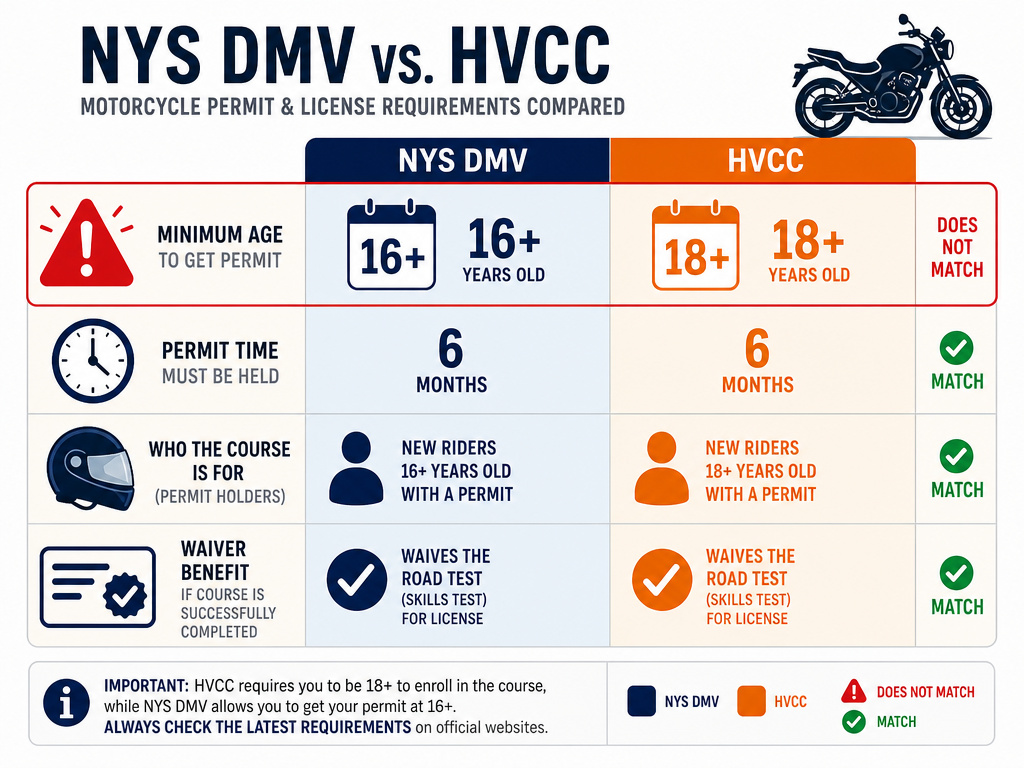
Two official-looking sources describe the BRC2-LW differently, and you should know both versions before you register.
| Question | NYS DMV says | HVCC says |
|---|---|---|
| Minimum age for the waiver | 16+, with a BRC or BRC2-LW card | 18+ for BRC2-LW; no junior license holders |
| Required permit time | None stated | Designed for 1+ year; one riding season |
| Who BRC2 is for | Older manual: already-licensed riders, half day | Permit holders seeking a license |
| Which course earns the waiver | License page: BRC or BRC2-LW; manual: BRC | BRC2-LW issues a waiver card |
The age gap is the one that bites. The two statements fit together only if the standard BRC is open from 16 and the BRC2-LW starts at 18. That’s my reading, and no source says it in one sentence.
The BRC2 description in the DMV manual’s safety program chapter reads like older material. The DMV’s current license page treats BRC2-LW as a waiver route for permit holders, and HVCC agrees.
Under 18? Plan on the BRC or the road test, and confirm age rules with the course provider before you pay.
Road Test Day: The Two-Vehicle Rule That Trips Up Solo Riders
Picture it: your bike is registered, inspected and fueled in the driveway. Then you remember the examiner can’t ride along on it, and your only friend with a motorcycle license is busy.
The examiner follows you in a separate registered, inspected car or truck, driven by someone 21 or older licensed for that vehicle. No other passengers ride along. And if that driver lacks a motorcycle endorsement, your bike has to arrive by trailer or pickup truck.
Before you start: New York requires every rider and passenger to wear a helmet meeting FMVSS 218; buckle it before the bike leaves the trailer, not at the start line. Eye protection meeting ANSI Z87.1 is required even with a windshield, so bring goggles or close your face shield. And motorcycles fall outside NY no-fault insurance, so confirm your liability coverage is active before the test bike touches a public street.
Here’s what to bring, in the order you’ll want to check it:
- Your photo learner permit. It’s on the DMV’s required list, and without it you don’t test.
- Your original MV-278 or MV-285, if you have no other license class. A photocopy gets refused, and you rebook.
- A parent-completed MV-262, if you’re under 18. You hand over a fresh one at every attempt, including retests.
- A properly working, registered and inspected motorcycle. A dead signal or lapsed inspection ends the day before you ride.
- The second vehicle and its 21+ driver. Missing either one means no examiner ride, which means no test.
- Your glasses or contacts, if your permit says you need them.
The test itself includes left and right circles and figure-eights on public streets, done while you watch for other traffic. In a slow figure-eight the bike feels like it wants to fall into the turn. Drop your eyes to the pavement and the front wheel follows them; keep your head up and turned toward the exit, and the bike comes around. The drills in passing the road skills test are worth a few practice sessions.
One more thing. Test on a three-wheeler and your license gets restricted to three-wheelers.
Where this goes sideways: Riding the bike to the test site with a non-endorsed friend following in the car. The DMV’s rule says the bike arrives by trailer or pickup in that case, so you’ve broken the setup before the examiner even walks out.
From Temporary License to Class DM: Paperwork, Timing and Fees
Three things happen after you pass: a temporary license, a wait, and a fee. Which version you get depends on whether you already carry a NY license.
No Other NY License: Wait for the Mail
The examiner hands you a temporary motorcycle license on the spot. Your photo license arrives by mail about two weeks later. No DMV office visit required.
Already Licensed: The MV-44 Trip
Wait at least 7 days after the road test. Then go to a DMV office with form MV-44, mark the “Change” box, and write “Add Class M (or MJ)” in the “Other Change” box. Bring your temporary motorcycle license, your permit and your current photo license, then pay the small amendment fee.
You leave with a temporary license without a photo. The new card shows up by mail in about two weeks. HVCC’s account of the BRC2-LW path is quicker: bring your waiver card, license and permit to the DMV, pay the fees, and the M gets added to your license immediately.
| Step | Timing | Source |
|---|---|---|
| Recommended practice | 30+ hours, 10 in traffic | NYS DMV |
| MSF eCourse before BRC2-LW | Within 30 days of class | HVCC |
| Waiver card validity | Two years from course completion | NYS DMV |
| Adding M to an existing license | Wait 7+ days after road test | NYS DMV |
| Photo license by mail | About two weeks | NYS DMV |
No source gives a full start-to-finish timeline, and I won’t invent one. Test slot and course seat availability decide most of it.
Cost works the same way. The DMV says it can’t calculate your exact fee until you apply. The total depends on your age when you apply, whether you already hold another NY license class, and whether you live in the Metropolitan Commuter Transportation District, which adds a small surcharge for every six months the license runs.
A few cost notes from the DMV fee chart:
- The 17 to 17½ age band pays the most of any Class M/MJ bracket.
- An Enhanced license costs extra on top of the base fee.
- Part of every Class M and MJ fee funds the NYS Motorcycle Safety Program, the same program behind the rider courses.
Plates, Inspection and the Gear the Law Requires
New York registers motorcycles for one year, and every motorcycle registration expires April 30, no matter when you bought the bike. Plan your first registration knowing the clock resets every spring. The steps to register a motorcycle cover the counter visit itself.
Inspection runs at least every 12 months at a licensed station. Buy privately and you get 10 days from registration to get it inspected.
Insurance is where New York riders get surprised. The motorcycle ownership and special rules chapter says motorcycles aren’t covered by the state’s no-fault provisions. You can drop liability coverage for winter storage without turning in your plate. You can’t ride one public mile without it.
Now the part I care about most. Every operator and passenger needs a helmet meeting FMVSS 218, and the DMV recommends at least four square inches of reflective material on both sides. Whichever you pick, find the DOT certification label on the back of the shell before you buy.
Fit beats price tag. A helmet one size too big rocks when you shake your head in the store, and at highway speed it lifts, buffets and whistles around the cheek pads. A snug one stays put and goes quiet.
After the helmet, I’d buy gloves before a jacket. Your hands go out first in a fall. A summer glove beats bare palms by a mile, and you’ll actually wear it in July. Same logic for boots: sneakers aren’t boots, so skip them for anything faster than a parking lot.
Eye protection has to meet ANSI Z87.1, windshield or not. The DMV recommends goggles or a face shield for full coverage.
What Are the Age and Eligibility Requirements for Class M vs MJ in New York?
New York splits motorcycle licensing into two classes. Class M is the standard motorcycle license, and Class MJ is the junior version for riders under 18. Either way, you start with a learner permit of the matching class before you can ride.
If you’re also applying for another permit, such as Class D, get that one first. The motorcycle permit comes after it.
The junior class carries extra rules. MJ permit holders must follow the under-18 restrictions, and anyone under 18 has to bring a parent or guardian-completed Certification of Supervised Driving (MV-262) to every road test.
For everyone, a learner needs a supervisor who is 21 or older and holds a valid motorcycle license from any state. That person stays within 1/4 mile of you and is the only passenger allowed.
The road test waiver sets a floor of age 16 or older, plus a valid NY license and a valid M or MJ permit. Some course providers set their own stricter age limits, so check with yours before you book.
Frequently Asked Questions
How long does it take to get a motorcycle license in New York?
There’s no fixed timeline, because course seats and test slots decide most of it. The DMV recommends at least 30 hours of practice before a road test. After passing, a first-time license arrives by mail in about two weeks, and adding M to an existing license means waiting at least 7 days before the MV-44 visit.
How much does a motorcycle license cost in NY?
The DMV won’t quote an exact fee until you apply. Your total depends on your age band, whether you already hold another NY license class, and whether you live in the Metropolitan Commuter Transportation District. Adding Class M to an existing license costs only a small amendment fee, and an Enhanced license adds more.
Can I carry a passenger on a NY motorcycle permit?
No. The only passenger allowed on a learner’s motorcycle is your supervising rider. Everyone else waits until you’re licensed.
Will a rider course from another state waive the NY road test?
No. The DMV only accepts completion cards from approved courses given in New York State, and the card has to be issued within two years of finishing the course.
Do I need to own a motorcycle to get licensed?
For the BRC, no, since the course supplies small training bikes. For the DMV road test, you need a registered, inspected motorcycle in working order, plus a second vehicle and a driver 21 or older to carry the examiner.
Before You Go
Do one thing this week: download the MV-21MC and the Driver’s Manual, then run the DMV pre-screening tool. That alone tells you whether you’re on the waiver path or the road test path, before you spend a dime on a course.
If you’re weighing the BRC2-LW, use this trigger. Under one full riding season on your permit, book the BRC. HVCC itself steers newly permitted riders there, and its fast track charges you for finding out you weren’t ready.
Here’s the stance I’ll defend. Even if the BRC2-LW is open to you, I’d rather see a new rider take the full 16-hour BRC on a borrowed small bike. Knowing how to get motorcycle license in NY is the easy part. Riding well after the card shows up is the hard part.
Bottom line: licensed car drivers with little street time should take the BRC and skip the road test; first-time NY drivers should plan for the DMV road test and line up that second vehicle now.
