
How to Get Motorcycle License in Florida: Step-by-Step
This post contains affiliate links. As an Amazon Associate, we earn from qualifying purchases.
How to get motorcycle license in Florida: hold at least a Class E license, pass the 15-hour Basic RiderCourse with an FLHSMV-authorized sponsor, then add the endorsement at a driver license or tax collector office within one year. No car license? The same course, plus the Class E knowledge test, gets you a Motorcycle Only license.
That one-year window is where plans fall apart. FLHSMV voids the course completion if the endorsement isn’t added in time. A rider who passes in spring and puts off the office visit sits through the whole course again.
What follows: the three license paths, the four steps in order, what the course covers, where the official fee pages disagree, the Alabama transfer catch, and what I’d wear to the range.
Key Takeaways
- The endorsement covers any two- or three-wheel motorcycle over 50 cc. Smaller scooters still need a Class E or Motorcycle Only license, and you must be 16.
- Book the course before you buy a bike. Bike, helmet, insurance and handbook come with the standard BRC.
- Under 18 with no car license? You need one year on a learner’s license with no traffic convictions first.
- Moving from Alabama? Florida honors that endorsement only with an MSF BRC completion card.
- BRC2 won’t get you endorsed. It’s a one-day refresher for riders who already are.
Which Florida License Path Fits You?
Your current license decides your route, and Florida has three of them.
Florida requires a motorcycle endorsement or a Motorcycle Only license to operate any two- or three-wheel motorcycle with an engine larger than 50 cc. The endorsement is added to a Class E license after the Basic RiderCourse. Vehicles of 50 cc or less need no endorsement, but the operator must be at least 16 and hold a license.
The FLHSMV motorcycle endorsement requirements put it flatly: anyone driving a motorcycle without an endorsement is violating the law. The legal basis is s. 322.12(5)(a), F.S., which requires new riders to pass the BRC before the endorsement goes on.
Scooters sit on the other side of the line. Under Florida license law, a vehicle of 50 cc or less is not a motorcycle, so no endorsement is needed. License law still counts it as a motor vehicle. That’s why you must be 16 and hold at least a Class E or Motorcycle Only license to ride one on the street.
Florida bars anyone under 16 from operating motorcycles, mopeds, motorized scooters or electric helper-motor bicycles on public roads. No workaround.
| Path | Who it fits | Required course | What your license shows |
|---|---|---|---|
| Motorcycle Also endorsement | Class E holders | BRC or BRCu | Class E plus motorcycle endorsement |
| Motorcycle Only license | Age 16+, no Class E | BRC or BRCu plus knowledge test | “Motorcycles Only” restriction |
| Three-wheel endorsement | Trike or sidecar riders | 3WBRC or S/TEP | “S” restriction, 3+ wheels only |
If you already drive a car, I’d take the standard endorsement every time. It rides on a license you already carry, and it covers two and three wheels.
The Trike and Sidecar Route Has Strings Attached
The 3-Wheel Basic RiderCourse (3WBRC) and the Sidecar/Trike Education Program (S/TEP) both lead to an “S” restriction. That limits you to motorcycles with more than two wheels, plus attached sidecars on the S/TEP route. S/TEP is an Evergreen Safety Council curriculum, while the 3WBRC comes from the MSF.
The 3WBRC asks more of you up front than the standard course. Per the FLHSMV FAQ, you need:
- A learner’s license and age 16+.
- Proof of liability insurance on the 3-wheel motorcycle used in class.
- Your own helmet and protective gear.
- Your own trike, or written permission to use someone else’s, if the provider can’t supply one. Call before you book.
Skip the S route if a two-wheeler is anywhere in your future. The restriction stays on your license until you earn the full endorsement.
How to Get Motorcycle License in Florida: 4 Steps and a Clock
The order matters more than the paperwork. Get it wrong and you pay for the course twice.
Before you start: Riding a motorcycle over 50 cc on public roads before the endorsement is on your license breaks Florida law. If you buy a bike during the process, trailer it home or have an endorsed rider move it. Also, an operator charged in an injury crash with no liability coverage must buy liability insurance and keep it for three years to avoid or lift a license and registration suspension.
- Confirm you hold a Class E license. A learner’s license lets you enroll in the course at 16, but the endorsement can only be added to a Class E. Without one, you’re on the Motorcycle Only path, and that path also requires the knowledge test.
- Pass the BRC or BRCu with an FRTP-authorized sponsor. Find one on the FLHSMV safety course locations list. A refresher like BRC2 doesn’t count for licensure, so booking the wrong class means starting over.
- Write down your pass date. The sponsor submits your results to FLHSMV electronically. Your one-year clock starts the day you pass. Lose track of it and the deadline sneaks up on you.
- Visit a driver license or tax collector office within one year. Tell them you completed the course, show proper ID and pay the fees. Miss the year and the completion card and “PASS” waiver status go invalid.
Treat the completion card like milk with a date stamped on it. Twelve months after you pass, it’s spoiled, and you’re back on the range.
How long does the whole thing take? The course is 15 hours and the office visit is one trip. The real variable is how soon a sponsor near you has an open seat. No official source publishes wait times, so I won’t guess at one.
Easy to miss: “PASS” is a waiver status tied to your course results, not a permanent credential. Let the year lapse and FLHSMV treats you like you never took the class.
What Happens During the 15-Hour Basic RiderCourse?
Fifteen hours. That’s how Florida Administrative Code rule 15A-12.002 defines the BRC. It’s a standard beginner course adopted by the Motorcycle Safety Foundation and “required for licensure to operate a motorcycle.”
Florida doesn’t write its own curriculum. The FRTP runs the MSF Basic Rider Course material, and the state’s Florida Rider Training Program courses page notes the newer version has taken over. In FLHSMV’s words: “Most Sponsors in Florida are now providing the BRCu.”
RiderCoaches build skills in order. Per FLHSMV, the range work covers:
- Straight-line riding.
- Stopping.
- Turning and shifting, which is where clutch control either clicks or doesn’t.
- Then the harder stuff: quick stops, cornering and swerving.
The clutch work is physical before it’s mental. As you ease the lever out, the clutch plates start to grip. The engine note sags and the bike creeps forward before you’ve touched the throttle. That creep is the friction zone, and the slow-speed drills live there.
Course format is where sources split. A Clearwater law firm, Roman Austin, describes three days: a classroom day ending in a written exam, then two riding days ending in a riding skills test. FLHSMV only states 15 hours and gives no day split. Ask your sponsor for the exact schedule before you pay.
Is it hard? Honestly, I can’t give you a pass rate. No official Florida source publishes one, and anyone quoting a number owes you a citation.
I’d book the course before shopping for a bike. The sponsor hands you a training motorcycle, so you learn what a clutch, a seat height and a tight turn feel like before you spend real money on your own.
Courses That Won’t Get You Endorsed
Several FRTP classes sound similar but serve already-licensed riders:
- BRC2: a one-day course for endorsed riders. You bring your own bike, insurance proof and gear. The administrative rule says it isn’t required for licensure.
- Ultimate Bike Bonding RiderCourse: partial day, police-style low-speed precision and tight turns.
- Returning Rider BRC: for riders coming back after time off. FLHSMV says it isn’t meant for first-timers.
Motorcycle Only License Rules If You Don’t Drive a Car

Picture a 17-year-old with a learner’s license and zero interest in driving a car. The endorsement route is closed to them, because it needs a Class E. The Motorcycle Only license is their door.
Per FLHSMV and the Pinellas County Tax Collector, you need to:
- Be at least 16.
- If under 18, hold a learner’s license for one year with no traffic convictions.
- Pass the same written knowledge test that Class E applicants take.
- Complete the BRC or BRCu, then visit a driver license or tax collector office with proper ID and the fees.
Your license then reads “Motorcycles Only.” That’s exactly what it means.
Roman Austin’s blog states that a learner’s license holder can’t get an endorsement and must apply for a Motorcycle Only license instead. That fits the FLHSMV rules. The FAQ allows learner’s license holders to enroll in the BRC, while the endorsement itself requires a valid Class E. Enroll on the learner’s license, then license as Motorcycle Only.
Endorsement vs Motorcycle Only: if you’ll ever drive a car, the Class E plus endorsement wins. The Motorcycle Only license makes sense for riders who truly won’t drive, or for under-18 riders on the learner’s year.
Where this goes sideways: A traffic conviction during the learner’s year means you no longer meet the requirement. Your course pass still expires one year from its date. Don’t book the course until the learner’s year is clean and nearly done.
What Does the Endorsement Cost? Two Official Pages, Two Fee Lists
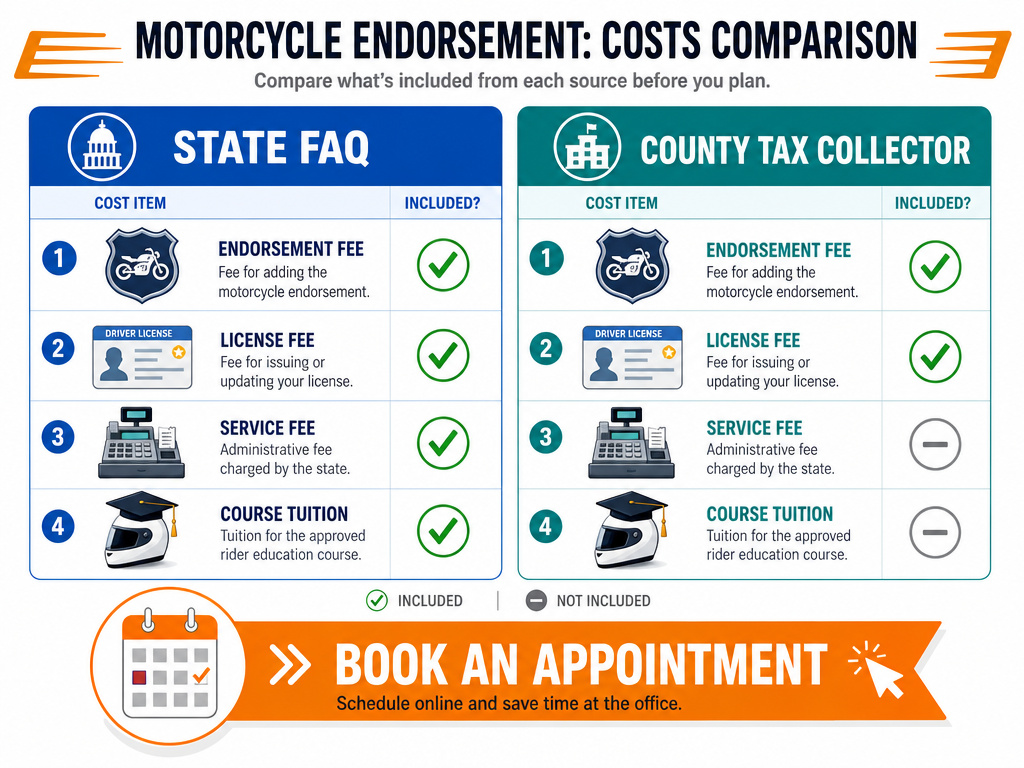
Every quick guide quotes one tidy fee. The state and a county office list different add-ons.
The FLHSMV motorcycle endorsement FAQs list four pieces: the endorsement fee, a license fee, a separate service fee at county tax collector offices, and the course provider’s tuition. The Pinellas County motorcycle endorsement guide lists two: the endorsement fee plus a replacement license fee. It doesn’t mention a separate service fee.
| Cost item | FLHSMV FAQ | Pinellas Tax Collector |
|---|---|---|
| Endorsement fee | Listed | Listed |
| License fee | Varies by license transaction | Listed as replacement fee |
| Tax collector service fee | Listed separately | Not mentioned |
| Course tuition | Paid to course provider | Not mentioned |
My guess is that Pinellas folded the service fee into its replacement figure. Neither page says so, though. I’m not printing figures here because fee schedules change. Check your county’s current page the week you go.
Tuition works differently. Each sponsor sets its own, and no state source lists it. Call two or three sponsors from the FLHSMV locations list and compare.
Pinellas also says appointments are encouraged and prioritized for adding the endorsement. Book one.
Moving to Florida With an Endorsement? The Alabama Catch
Alabama is the one state Florida treats differently. Per FLHSMV and the Volusia County Tax Collector, an endorsement from any other state carries over with no course required. An Alabama endorsement counts only if you also present an MSF BRC completion card.
FLHSMV doesn’t explain why. Roman Austin supplies a likely reason: Alabama doesn’t require license holders to pass a motorcycle safety course. The motorcycle license steps differ state to state, and that blog notes every state except Alabama requires either a safety course or a road test run by the licensing agency.
The wording differs slightly too. Roman Austin says Alabama transplants need a “safety course certificate of completion.” FLHSMV and Volusia name the MSF BRC card specifically. Bring the MSF card. That’s what the state’s own page asks for.
The part nobody mentions: An Alabama rider who never took an MSF course has no card to show. In practice that puts them at the start of the line, booking a BRC like any new rider.
What Should You Wear to the Range?
Do you need your own gear for the standard course? FLHSMV says the sponsor provides the helmet, along with the bike, insurance and student handbook. The state’s page doesn’t list anything else, so ask your sponsor what they expect you to show up in.
The Helmet: Loaner for the Range, Your Own for the Road
A loaner helmet on an open asphalt range in Florida sun gets damp at the forehead pad fast. It also smells like every student before you. It’s fine for the course. Buy your own before your first ride home.
Fit is what I care about most. A helmet that’s too big rolls forward when you glance down at the gauges, and the cheek pads stop touching your face. Air slips in through that gap at speed, so the helmet buffets and roars. A well-fitting helmet feels snug at the cheeks with no pressure points after a long wear.
The chin strap works like a clamp on a glue-up. Snug enough that nothing slides, not cranked until it bites.
If you want one answer for a first helmet: try on several back to back and buy whichever matches your head shape. Fit beats price tag. In my experience, premium-tier lids charge plenty for the badge and the paint.
Gloves and Boots Before Anything Else
After the helmet, I’d spend on gloves before a jacket. Hands go out first in a fall. A well-ventilated pair of riding gloves is where I’d start a summer rider in Florida.
Sneakers are not boots. A low shoe leaves the ankle bone exposed. For anything past parking-lot speed, an over-the-ankle riding boot is the minimum I’d ride in.
After the Endorsement: Insurance, Registration and a Three-Year Penalty
Three facts matter once you’re legal:
- Florida doesn’t require insurance to register a motorcycle, per the FLHSMV FAQ.
- Get charged in an injury crash with no liability coverage, and you must buy that coverage and keep it for three years to avoid or reverse a license and registration suspension.
- FLHSMV says course graduates may be entitled to premium discounts through participating insurers. Ask yours by name.
Skip the no-insurance gamble. The registration rule saves you a bill until the day it doesn’t, and then the state picks your coverage for three years.
FLHSMV also cites crash studies showing rider course graduates have lower injury and fatality rates than untrained riders. The unlicensed side is murkier. Roman Austin estimates up to 222 of the 584 Florida motorcyclists killed in 2021 had no license or endorsement. The firm admits Florida doesn’t report that figure and built the estimate from outside studies. Treat it as a rough signal, not a count.
For scale, the same blog puts Florida’s endorsed or Motorcycle Only operators at 1,441,932 in 2023.
Frequently Asked Questions
What do I need to get a motorcycle license in Florida?
You need at least a Class E license, a passed BRC or BRCu from an FRTP-authorized sponsor, proper ID and the fees. Without a Class E, you’ll go the Motorcycle Only route, which adds the Class E knowledge test. Under 18, you also need a year on a learner’s license with no traffic convictions.
How long does it take to get your motorcycle license in Florida?
The course runs 15 hours, and the office visit is one trip. The biggest variable is how soon a sponsor near you has a seat open. For under-18 Motorcycle Only applicants, the one-year learner’s period sets the earliest finish.
Is the MSF course difficult to pass?
Official Florida sources don’t publish pass rates, so treat any number you see with suspicion. The course starts with straight-line riding and stopping before moving to quick stops, cornering and swerving. Ask your sponsor how they handle a student who doesn’t pass the first time.
Do I need an endorsement for a 50cc scooter?
No. Florida license law doesn’t classify vehicles of 50 cc or less as motorcycles. You still must be 16 and hold at least a Class E or Motorcycle Only license to ride one on public roads.
I passed the course more than a year ago. Can I still get endorsed?
No. Once the one-year grace period passes, FLHSMV treats the completion card and “PASS” waiver status as invalid. You’ll need to complete another RiderCourse before the endorsement can be added.
Before You Go
The step to take this week is a phone call. Pick two sponsors from the FLHSMV safety course locations list and ask three things: BRC or BRCu, how the 15 hours are scheduled, and what gear they expect you to bring.
If you passed the course a while back and never went to the office, check your date today. A course pass creeping toward the one-year mark is the most expensive mistake in this whole process.
One limitation: everything here assumes a two-wheel rider with a clean record. Under 18 with no car license, the learner’s year sets your timeline, not the course calendar. That’s how to get motorcycle license in Florida without paying for the course twice.
Bottom line: if you already drive, take the BRCu and add the full endorsement within the year; if you’re under 18 without a car license, finish your clean learner’s year first, then book the course.
