
How to Get Motorcycle License in Texas: Step-by-Step
This post contains affiliate links. As an Amazon Associate, we earn from qualifying purchases.
The answer to how to get motorcycle license in Texas is a TDLR-approved motorcycle operator training course, then a trip to DPS to add Class M to your license or get a Class M-only card. Riders under 18 also need the classroom phase of driver education and parent or guardian authorization. Full Class M starts at 16. A 250cc-restricted license starts at 15.
That 250cc limit matters more than it looks. A 15-year-old who passes the restricted course can legally ride small bikes only. What happens on the 16th birthday is one of the places where Texas law and newer proposed rules don’t line up, so plan for it now.
What follows: the three license types, the six steps from signup to card, what the completion certificate really proves, a plain table of where sources contradict each other, the fee picture, and what riding without Class M does to an injury claim.
Key Takeaways
- Take the course even if you could test at DPS. A school only issues the certificate after you pass both a knowledge exam and a riding skills test.
- A three-wheel course gets you a three-wheel-only certificate. It won’t cover a two-wheeled bike.
- Lose your certificate? A school can reissue it for up to three calendar years after you finish. After that, you’re looking at retaking the course.
- DPS proposed replacing the Form MSB-8 with a TDLR-issued certificate in June 2026. Check whether it was adopted before you go.
- Riding without Class M gives an insurer an easy comparative fault argument after a crash, even when the other driver caused it.
Which Class M Path Fits Your Age and License Status?
Three things decide your route: your age, whether you already hold a Texas license, and how many wheels the bike has. Get those straight and the rest is paperwork.
Texas splits motorcycle licensing between two agencies. The Texas Department of Licensing and Regulation approves rider schools and has run the training program since Sept. 1, 2020. The Department of Public Safety issues the license itself. A school issues a signed completion certificate only after a student passes both a knowledge exam and a riding skills test.
Class M is the motorcycle classification on a Texas license. Under proposed 37 TAC 15.6, a driver who also qualifies for Class A, B or C gets one card with any restrictions printed on it. Your Class C alone doesn’t let you ride a motorcycle. Reyes Law says so plainly, and Stephens Law says riding without the Class M classification violates state law.
The proposed rule sets out three versions of the motorcycle credential:
| License | Minimum age | Course required | What you can ride |
|---|---|---|---|
| Full Class M | 16 | TDLR course plus driver ed classroom phase | All motorcycles and three-wheelers |
| Three-wheel only | 16 | TDLR course specific to three-wheelers | Three-wheeled motorcycles only |
| 250cc or less | 15 | TDLR course specific to 250cc or less | Bikes of 250cc or smaller |
Every row comes from proposed 37 TAC 15.6, published in the Texas Register on June 26, 2026. The 250cc version traces back to HB 1492, which raised the old restricted limit from 125cc to 250cc in 1999.
Adults With a Class A, B or C License
This is the easy lane. Reyes Law says an adult 18 or older with a valid Class C can take a state-approved course instead of testing at DPS. The motorcycle gets added to the license you already carry.
Honestly, I’d take the course even if the DPS-only route were faster. You get range time on a school bike with an instructor watching.
Riders 15 to 17
Under-18 applicants need parent or guardian authorization under the proposed rule, plus the classroom phase of driver education. Reyes Law says riders under 18 must complete the course no matter which testing route they’d prefer.
Schools add their own gates. El Paso Community College asks applicants aged 15 to 17 for proof of 32 hours of driver education, plus written permission from a parent and the instructor. Call your school before you pay anything.
No Texas License Yet
Riders without a Texas license go for a standalone Class M-only card, per Reyes Law. If you’re comparing notes with a friend in another state, the general motorcycle licensing steps will look familiar. The two-agency split is the Texas wrinkle.
New residents get a deadline. Reyes Law says you need a Texas motorcycle credential within 90 days of establishing residency.
How to Get Motorcycle License in Texas in 6 Steps
The course is the spine of the whole process, and the school you pick has to be TDLR-approved. Under the 16 TAC 98.112 curriculum standards, an entry-level course must meet the Model National Standards for Entry-Level Motorcycle Rider Training (August 2011), a document from NHTSA, the federal highway safety agency. The rule also ties every course to Texas Transportation Code Chapter 662.
That federal link is why the old Motorcycle Safety Foundation (MSF) reference is on its way out of the DPS rule. The proposed 15.6 swaps it for a citation to 98.112.
- Book a TDLR-approved school. A certificate from an unapproved course doesn’t count as proof of completion, so you’d be paying twice.
- Finish any online portion first. Victoria College, for one, requires a 5-hour MSF online eCourse before its two-day range course. Show up without it and you’re not ready for the range days.
- Gather under-18 paperwork early (driver ed proof plus signed permission). Missing pages here stall enrollment, not just licensing.
- Pass the knowledge exam and riding skills test at the course. Schools can allow more than one attempt. A rider the instructor judges an “unmanageable danger” on the range gets removed and gets no more tries at the skills test.
- Check your certificate before you leave. It must carry the signature of an instructor who taught the course or the school’s appointed representative.
- Take the certificate to DPS with your identity and residency documents. Take the certificate to DPS with your identity and residency documents, and check with your local office about how to schedule your visit.
The range itself is a painted parking lot. Cones, faded lines, small bikes idling in first gear, and a lot of slow figure-eights that feel harder than any highway on-ramp.
Want a head start? Read up on the riding skills test so the range exercises aren’t a surprise. If you skip the course as an adult and test at DPS, you’ll face the motorcycle written knowledge test and a riding test with an examiner instead.
What 16 TAC 98.106 Says Your Certificate Proves
16 TAC 98.106 is the TDLR rule that governs completion certificates. TAC stands for Texas Administrative Code, the state’s book of agency rules. The rule is short, and every line of it matters to you.
The Texas course completion verification rule says a school can only issue the certificate after you pass both the knowledge examination and the riding skills test. That’s the mechanism behind the whole system. DPS accepts the paper because the testing already happened on the range, graded by a TDLR-approved instructor.
Think of the certificate as the glue joint between the school and DPS. If the joint fails, nothing you built on top of it holds.
Easy to miss: A course built for three-wheeled motorcycles produces a certificate restricted to three-wheelers. Sign up for the trike course to save time, and you’ll need the standard two-wheel course before a regular bike is legal for you.
The duplicate window is the other trap. A school can reissue a lost certificate for up to three calendar years from your completion date, with the same certificate number and date. Past that window, the rule gives the school no path to reissue it.
I’d photograph the certificate the day you get it and stash the paper with your title. Losing it in year one costs a phone call. Losing it in year four sends you back to the range, and nobody enjoys repeating cone drills.
Two loose ends. First, you may see claims online that the Form MSB-8 expires after a set period, but the rule I checked, 98.106, sets only the three-year duplicate window.
Second, the paper itself is changing. Proposed 37 TAC 15.6 would replace the Form MSB-8 with a certificate issued by TDLR. It would also accept completion cards from state or military rider programs that meet or exceed 98.112. Military riders, that clause is for you.
Where Official Sources Contradict Each Other
The tidy checklists on most license guides hide a mess. Statutes, proposed rules and law-firm blogs disagree on at least five points, and a couple of them change what a teenager should plan for.
| Question | One source says | Another source says |
|---|---|---|
| Is the 250cc limit lifted at 16? | HB 1492 (1999): yes, no new course | Proposed 15.6: full M at 16 needs a course |
| Does the course waive the written test? | Reyes Law: waives written and skills tests | Stephens Law: written test still required |
| Must minors still take a DPS skills test? | A Fort Worth law firm: yes | Other secondary guides: course replaces both tests |
| Does an out-of-state license waive the course? | Reyes Law: it can | No primary source found confirming it |
| What’s the new Class M-only fee? | DPS fee page lists its own figure | Reyes Law lists a lower figure |
Row one is the big one. The 1999 HB 1492 text told DPS to remove the 250cc restriction on the holder’s 16th birthday with no extra course. The research behind this article flags that subsection as possibly repealed in 2019, and the proposed rule describes a course for full Class M at 16.
I can’t settle that row for you. Neither can the blogs.
So here’s my stance: plan as if your 16-year-old needs the full course. If DPS lifts the restriction without one, you’ve lost nothing but a booking you can cancel.
Where this goes sideways: Buying a bigger bike for a 16th birthday on the strength of the 1999 statute. If the automatic removal no longer applies, that rider is on an unlicensed motorcycle from the first ride home.
Two smaller gaps. The proposed rule mentions the classroom phase of driver education without a detailed age breakdown, so ask DPS how it applies to your age. Some summaries describe a mail-in route that seems to apply only to adding M to an existing license. Ask DPS directly on both.
The proposed rule took public comments by email at DLDrulecomments@dps.texas.gov within 30 days of publication. That window has passed. Whether the rule was adopted is the next thing to check in the Texas Register.
How Much Does a Texas Motorcycle License Cost?
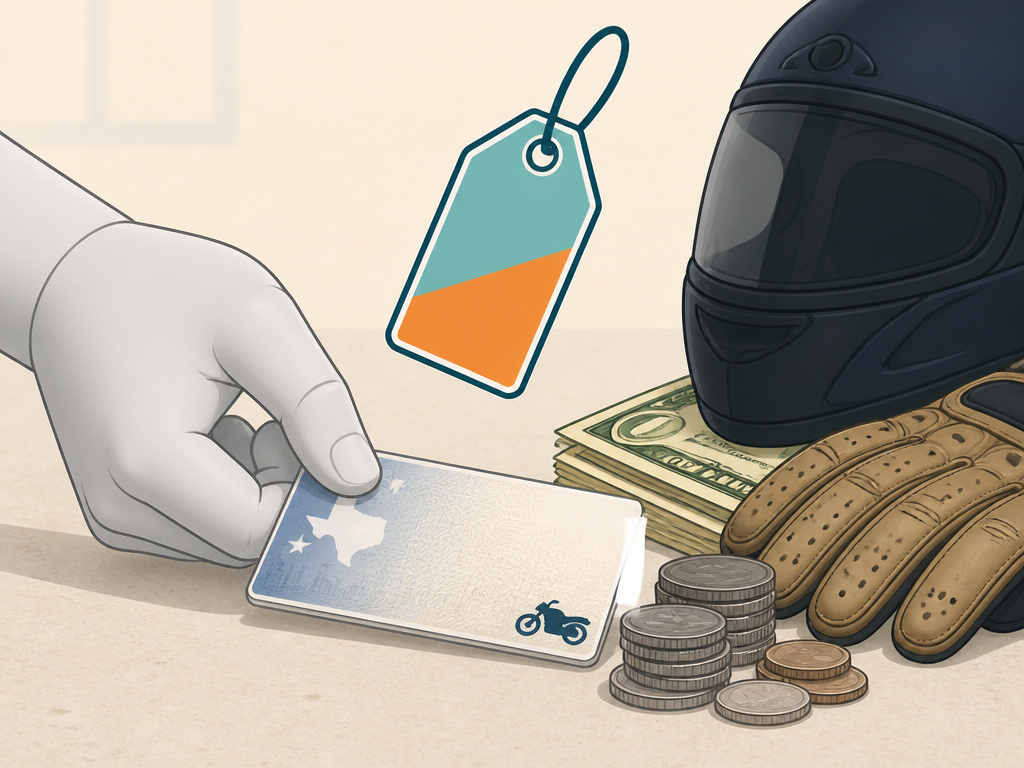
Fees are the cheap part. The Texas DPS driver license fees page lists every motorcycle line, and here’s how they stack up against each other:
- Adding motorcycle to an existing license is the low line, and your expiration date stays put.
- Adding motorcycle to an existing CDL matches that add-on line, and the CDL expiration doesn’t change either.
- A new Class M-only license costs more than the add-on.
- Getting a new Texas license with motorcycle added in the same visit is the highest motorcycle line on the page. It expires with your driver license.
- The under-18 motorcycle learner license sits at the low end and expires on your 18th birthday.
- A replacement card, including a test to remove a restriction, is the cheapest line of all.
DPS sets those fees. Course tuition is a separate bill, and each school prices its own course, so ask before you book.
Reyes Law’s fee figures don’t match the DPS page. Go with DPS; it’s the agency collecting the money.
The real spend comes after the card. You’ll need to register a motorcycle before it’s street legal, and you’ll need gear that survives a slide. In my book, gear is where new riders under-budget every time.
Show Up to the Range Course Dressed for a Fall
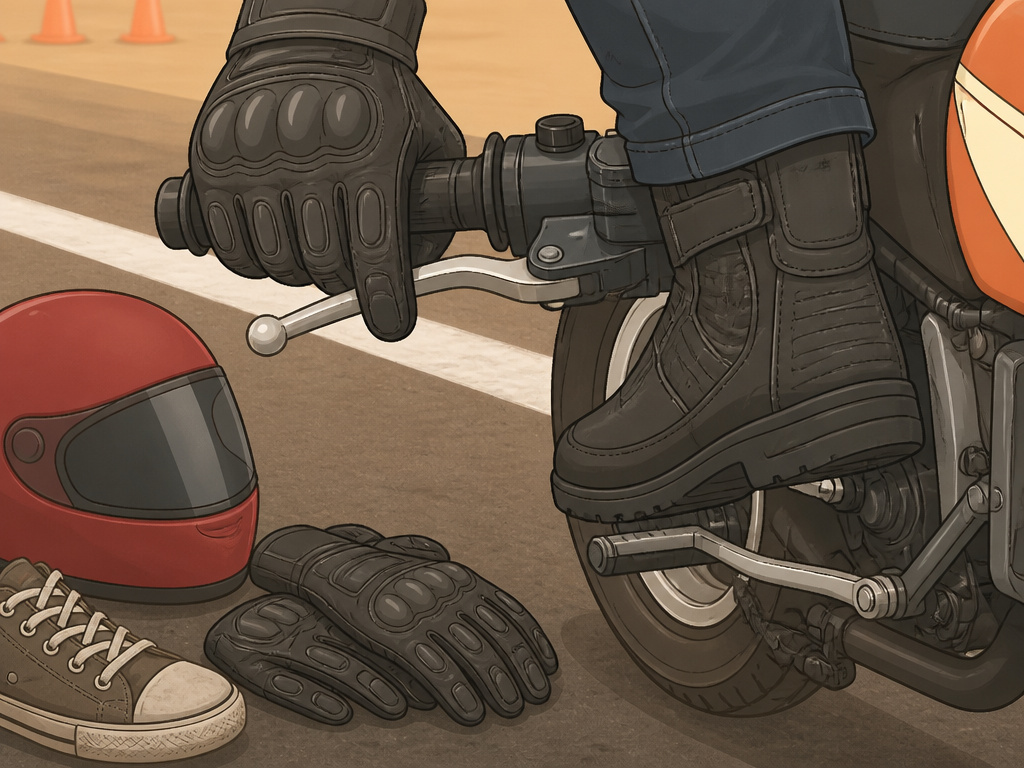
Picture the second morning of a range course. The asphalt’s already warm, a row of small bikes idles at the line, and someone in canvas sneakers drags a toe through the first stop.
Ask your school for its gear list before day one; each school sets its own. Then dress above that list. Here’s my order of priority for beginner riders buying their first kit:
- A helmet that fits snugly and stays put when you shake your head with the strap fastened.
- Real motorcycle gloves. Your hands go out first in a fall, every time.
- Over-the-ankle boots with a stiff sole. Sneakers flex at the shift lever, and you’ll feel the peg teeth through the sole by lunch.
- A jacket with armor. Mesh is fine for Texas heat if you’ll actually zip it up.
Helmet first, gloves second, everything else after. Hands hit the ground before anything else does.
Fit beats price tag. A loose helmet buffets and lifts at speed, and a loose glove bunches at the lever. Cheap gloves also go slick with sweat on a hot range, and you feel the clutch lever slide under your fingers.
Riding Without Class M Costs More Than a Ticket
Fifty-one percent is the number Stephens Law points to. Texas uses modified comparative fault: you can recover damages as long as you’re not found 51 percent or more at fault. Reyes Law puts the same line as “over 50%.”
Here’s the mechanism. Your recovery shrinks by your share of fault. If an insurer convinces a jury your unlicensed status makes you 20 percent at fault, Stephens Law says the payout drops by that same 20 percent.
Riding without the Class M classification violates state law, per Stephens Law. Mopeds are the one easy exception it notes: a moped capped at 30 mph with an engine of 50cc or less can be ridden on a Class A, B or C license. Bigger scooters need Class M.
I’m a gear guy, not a lawyer. Talk to one if a crash already happened.
Do I need an Impact Texas Drivers certificate if I don’t have a Texas license?
The sources behind this article don’t spell out how the Impact Texas Drivers (ITD) certificate applies to motorcycle applicants, so treat it as a question to settle with DPS before you book anything. Whether it applies to you usually depends on your license history and your situation, such as whether you are new to driving or moving in from another state.
Keep it separate from the motorcycle paperwork. The ITD certificate is a different document from the course completion certificate a motorcycle school issues after you pass the knowledge exam and the riding skills test. Having one does not replace the other.
A practical order of operations: check the DPS site or call for your exact case, ask whether ITD must be finished before you can start a license application, complete it if so, and keep the certificate with your other documents. Bring everything to the office in one folder so a missing page does not send you home for a second trip.
Frequently Asked Questions
How easy is it to get a motorcycle license in Texas?
For an adult with a Class C, it’s mostly scheduling: book a TDLR-approved course, pass the knowledge exam and riding skills test there, then visit DPS. Riders under 18 have more paperwork, including driver ed and parent or guardian authorization. The range course is the only part that takes real effort.
Is a motorcycle license harder to get than a car license?
The riding skills test is the hard part, because low-speed control on a bike takes practice. A school lets you retry the knowledge exam or skills test more than once, which helps. A rider removed for unsafe riding, though, gets no more skills attempts at that course.
How much does it cost to get a motorcycle license in Texas?
You pay two bills: the school’s course tuition and the DPS fee. Adding motorcycle to an existing license is the lowest DPS motorcycle line, while a new license with motorcycle added costs the most. Check the current DPS fee page before you go, since figures in older blog posts don’t always match it.
Do I need a motorcycle license for a scooter or moped in Texas?
Moped capped at 30 mph with an engine of 50cc or less can be ridden on a Class A, B or C license, according to Reyes Law. Anything above those limits needs Class M. Check the bike’s speed cap and displacement before you assume.
I just moved to Texas with a motorcycle license. What now?
Reyes Law says you have 90 days after establishing residency to get a Texas motorcycle credential. It also says a valid out-of-state motorcycle license can waive the course requirement, but no primary source confirmed that. Ask DPS before you skip the course.
What happens if I fail the range course?
Schools can allow multiple attempts at the knowledge exam and riding skills test. If an instructor judges your riding an unmanageable danger, though, you’re removed and can’t retake the skills test in that course. Practice clutch control in a quiet lot before you re-enroll.
Before You Go
The steps above cover how to get motorcycle license in Texas as the rules read today. “Today” is the catch: proposed 37 TAC 15.6 was published in June 2026, and its adoption status is the first thing to confirm.
Your first step this week: pick one TDLR-approved school, call it, and ask two questions. Which certificate does it issue now, and does it require an online portion first? Those answers set your whole timeline.
One concession. If you’re 15 or 16, or you hold a license from another state, the advice above leans on sources that disagree. For you, a phone call to DPS beats any guide, this one included.
Bottom line: adults with a Class C should take the course and add M at DPS, and parents of 15-year-olds should budget for a second course at 16 until DPS says otherwise.
