
How to Get Motorcycle License in Michigan: Step-by-Step
This post contains affiliate links. As an Amazon Associate, we earn from qualifying purchases.
Learning how to get motorcycle license in Michigan means adding a CY endorsement to your driver’s license. Take an approved rider course and bring the certificate to a Secretary of State office, or get a Temporary Instruction Permit, practice for up to 180 days, and pass the rider skills test. Riders under 18 must take the course.
That split between the course and the permit is where the real decision sits. One route puts you on a training range with coaches watching every turn. The other leaves you practicing on public roads with a friend for months, under rules most new riders never read.
What follows: both routes side by side, the permit limits that quietly push people into the course anyway, the gear you need on test day, and the age and residency cases that change the whole path.
Key Takeaways
- Take the course if you can. It handles the training and the endorsement paperwork in one go, and it counts toward the helmet exemption right away.
- A permit holder gets two permits in 10 years, and two failed skills tests force you into the course regardless.
- The skills test has a mandatory gear list: DOT-approved helmet, eye protection, ankle-covering boots, long sleeves and full-fingered gloves.
- Riders under 18 need a Level 2 or 3 license plus a completed rider course. The permit-and-test route alone won’t do it.
- Published endorsement fees conflict between sources, so confirm the current fee with the Secretary of State before you go.
Michigan Has No Motorcycle License, Only a CY Endorsement
The Secretary of State adds a CY endorsement to the driver’s license you already carry. There’s no separate motorcycle card in your wallet.
A Michigan motorcycle endorsement, coded CY, is added to an existing driver’s license through the Secretary of State. Two routes lead there: completing a state-recognized rider course such as the Basic RiderCourse, or holding a Temporary Instruction Permit for up to 180 days and passing the rider skills test. Either route ends with the Secretary of State adding the endorsement.
That wording matters more than it sounds. If you’ve read a general guide on how to get a motorcycle license somewhere else, Michigan’s paperwork will look slightly off. Everything here hangs off your car license, so a suspended driver’s license takes the CY down with it.
Riding without the endorsement carries real teeth. A Kryder Law summary citing the Secretary of State puts a first offense at a fine and up to 90 days in jail. I’d rather you hear that here than from a deputy on the shoulder of US-127.
The state police answer the basic questions directly in their Michigan motorcycle endorsement FAQs, including the plain fact that you don’t need a course to get endorsed. You can walk into a branch, take the vision and written knowledge tests, and leave with a permit.
Whether you should is a different question.
Course or Skills Test: Which Route Should You Take?
Take the course. For a new rider it’s the better route on almost every line of the table below, and the permit route only wins if you already own a registered bike and have a patient endorsed rider in the family.
| Factor | Rider Course (BRC) | Permit + Skills Test |
|---|---|---|
| Bike needed | Not for the BRC | Registered motorcycle required |
| Who teaches you | Coaches on a closed range | An endorsed rider you find |
| Riders under 18 | Required route | Not allowed alone |
| Helmet exemption (21+) | Counts once you pass | Must hold CY two years |
| Second chances | Course is the fallback | Two failed tests, then course |
The last two rows are the ones that tip it for me. The permit route has a built-in ceiling, and when you hit it, you end up in the class anyway. Months later. With habits a coach now has to undo.
I’d steer every first-time rider to the course, including the ones who swear they already know how. Learning from a buddy means learning the buddy’s habits, and a coach catches a lazy head check before it sets into muscle memory.
The Basic RiderCourse and Its Siblings
The Basic RiderCourse mixes classroom time with range riding, according to Kryder Law’s breakdown of the Michigan program. No bike is required, and you pass a written test and a riding test to finish. Our walkthrough of the MSF Basic Rider Course covers what the range exercises look like hour by hour.
Michigan runs several course types through its rider education program:
- BRC: the starting point for new riders. Bike provided.
- BRC2, also called the Intermediate Rider License Waiver, for riders who already have some miles and their own bike.
- Returning Rider BRC.
- 3-Wheel BRC, a course that Kryder Law says limits you to three-wheelers only. I couldn’t confirm that restriction on a state page, so ask the sponsor before you book it expecting a full two-wheel endorsement.
- Advanced Rider Course (ARC), a skills course for riders who are already licensed.
The Lansing Community College motorcycle safety courses page spells out the entry rules well. You must be able to balance and support a two-wheeled motorcycle and work the manual hand and foot controls. BRC2 and ARC students bring their own bike. LCC won’t take cash, and payment is due when you register.
The Permit and Skills Test Route
This path suits one rider: someone with a registered bike, a reliable endorsed riding partner, and the discipline to practice the test maneuvers on their own. Everyone else is gambling one of two permits. The full sequence sits in the next section.
How to Get Motorcycle License in Michigan Through the Permit Route
Three things happen in order on this route: a permit, supervised practice, and a skills test. Each one has a limit that bites if you treat it casually.
Before you start: Practice only in daylight; the TIP conditions in the Michigan Vehicle Code bar night riding, and dusk is when car drivers already struggle to spot a single headlight. Ride solo, because permit holders can’t carry passengers, and a second body on the seat changes how the bike brakes and turns. Wear the full test-day gear from your first parking-lot session, since a low-speed tip-over on bare hands still takes skin off your palms.
- Pass the vision and knowledge tests at a Secretary of State branch to get your Temporary Instruction Permit. Study the Michigan Motorcycle Operator Manual before the written test; fail it and you’re back in the branch line another day.
- Practice with an endorsed motorcyclist for up to 180 days. Let the permit expire without testing and you’ve burned one of your two permits.
- Schedule the rider skills test with an approved testing business. Show up with a registered motorcycle and the full gear list, or you’re not testing.
- Take your skills test certificate to an SOS branch to get the CY endorsement. Until it’s on your license, you’re still a permit holder with permit limits.
Here’s where riders get caught:
| Permit Rule | Limit | What It Means for You |
|---|---|---|
| Permit length | Up to 180 days | Test before it runs out |
| Permits allowed | Two in 10 years | Third try means the course |
| Failed skills tests | Two | The course becomes mandatory |
| Night riding | Not allowed | Daylight practice only |
| Passengers | Not allowed | Solo practice only |
Easy to miss: The two-permit cap runs over 10 years. A rider who let a permit lapse years ago, then fails twice on a new one, finds out at the counter that the course is now the only way forward.
One honest wrinkle. The current state police FAQ says the permit lasts up to 180 days. Trust the number printed on your permit.
Think of the permit like a bar clamp on a glue-up. It holds things steady while the joint sets. Nobody leaves the clamp on as the finished furniture.
What to Wear to the Michigan Rider Skills Test

The gear list is the easiest part of the test, and riders still show up wrong. Kryder Law lists what the skills test requires:
- A DOT-approved helmet
- Eye protection
- Boots that cover your ankles
- A long-sleeve shirt or jacket
- Full-fingered gloves, and yes, that rules out the fingerless pair from the gym bag
Sort the gear before you drill the maneuvers for the road skills test. New gear needs a few rides to break in, and stiff boots on test day change how you feel the shift lever.
Sneakers aren’t boots. Neither are the “riding shoes” sold as a boot substitute. If the top doesn’t wrap your ankle bone, it fails the test list, and on the highway a low-cut shoe offers nothing when the bike lands on your foot.
If the boot doesn’t cover your ankle bone, it doesn’t count. Not on test day, not on any day after.
Helmets are my soapbox. A helmet that’s a size too big rocks forward over your eyebrows when you nod, and at highway speed the wind roars past loose cheek pads. Retention matters for a mechanical reason: a shell that rotates on impact can slide back and expose your forehead. A plain full-face that fits snug beats a pricier shell that wobbles. Fit beats price tag.
Gloves come right after the helmet on my list, ahead of a jacket. Your hands go out first in a fall because that’s what the reflex does, and a thin fashion glove shreds at the palm seam before the leather around it wears through. For a first pair, I’d pick a street glove with a reinforced palm.
The Motorcycle Safety Foundation, as cited in the state’s crash report, recommends a light-colored helmet, eye protection, bright high-visibility clothing, leather or thick protective clothing, long sleeves, pants, over-the-ankle boots and gloves. Few riders follow the visibility part. A 2017 Michigan State University survey put high-visibility gear use at 3.6 percent statewide. That survey is the most recent one available, so treat the number as old.
Under 18, Over 21, or Moving In: Rules That Change the Path
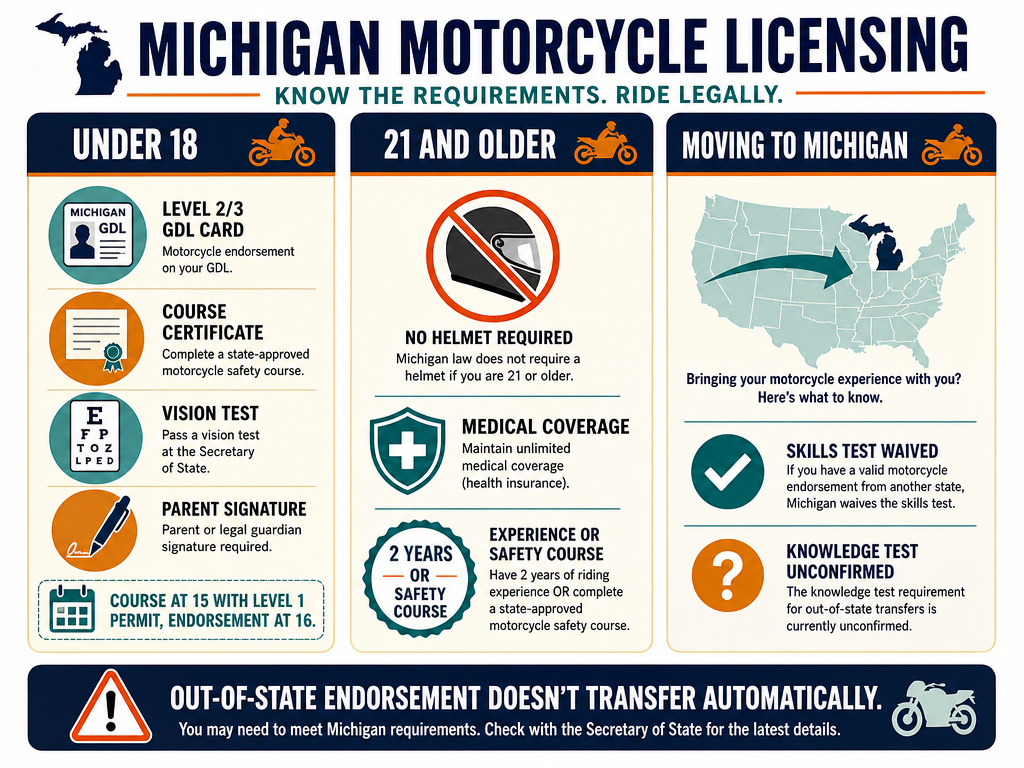
A 15-year-old signs up for a summer rider class at a community college. Her cousin, freshly moved from another state, wants to know whether his old endorsement carries over. Same office, completely different rules.
Riders Under 18
Teens have one route. Kryder Law’s summary says applicants under 18 need a valid Level 2 or Level 3 Graduated Driver’s License, a course certificate, a vision test, and a parent or guardian signature. The permit-and-test route alone isn’t an option.
The minimum age is where sources disagree:
- Kryder Law says you must be at least 16 to operate a motorcycle.
- Lansing Community College accepts course students at 15 with a Level 1 learner’s permit.
Both can be true at once. A 15-year-old can take the class, then wait to be old enough for the endorsement itself. Call the course sponsor and SOS before you plan around either number.
Riders 21 and Older Who Want the Helmet Exemption
Michigan required helmets for about 40 years, according to a 2011 House bill analysis, which also notes that two earlier repeal bills passed the Legislature and were vetoed by Governor Granholm.
The state police FAQ now says an operator can ride without a helmet only if they’re at least 21, carry a minimum level of first-party medical benefits, and have held the endorsement for at least two years or passed an approved safety course. Passengers need to be 21 and carry their own additional coverage on top of the operator’s.
That course clause matters for a reason the permit route hides. The statute treats course completion as the alternative to two years of endorsement, so passing the course satisfies that piece immediately. Permit-route riders wait the full two years.
My take: wear the helmet anyway. That’s opinion, though, and the law leaves the choice to qualified adults.
Out-of-State Riders and Other Odd Cases
- Moving to Michigan: statute text indicates the skills test may be waived if you hold a valid motorcycle endorsement from another state. I couldn’t confirm whether the knowledge test is waived too. Ask at the branch.
- Autocycles don’t need an endorsement.
- Adding a CY by mail at renewal isn’t allowed, per a secondary source. Plan on an in-person visit.
- Insurance: Michigan’s No-Fault law doesn’t classify motorcycles as motor vehicles, but Kryder Law notes that Section 3103(1) still requires liability coverage, often called PLPD.
Where this goes sideways: Assuming an out-of-state endorsement transfers automatically. Sources only clearly support a skills-test waiver, and nothing I found confirms the rest of the process gets skipped. Bring your old license and expect to test for vision at minimum.
22.4 Deaths per 100 Million Miles: Michigan’s 2024 Crash Math
Michigan’s 2024 motorcyclist death rate was 22.4 per 100 million vehicle miles, against 1.1 for all traffic, according to Michigan Traffic Crash Facts from the state’s Office of Highway Safety Planning. Motorcycles showed up in only 1.1 percent of crashes. They don’t stay small in the death count.
The 2024 totals:
- 3,187 motorcycle-involved crashes
- 168 motorcyclists killed
- 2,460 injured
- 249,464 motorcycles registered, per the Department of State
One number confuses riders. Of the 168 killed, 90 (53.6 percent) wore helmets, 64 (38.1 percent) didn’t, and helmet use was unknown for 14. That doesn’t mean helmets fail. Most riders wear them (the 2017 MSU survey estimated 71.4 percent use), so helmeted riders show up in every column. Honestly, without newer helmet-use data, nobody can do clean math on that split.
Impairment is clearer. Alcohol showed up in 31.0 percent of motorcyclist deaths, and drugs in 22.0 percent.
None of these figures tell you who had an endorsement. I found no 2023 or 2024 breakdown by license status. What they do show is how thin the margin is, which is the whole argument for learning on a range before you learn on Woodward Avenue.
When Should You Book a Michigan Rider Course?
Book the moment you decide to ride. If the class you want is full, call the local sponsor anyway.
The state police FAQ says some sponsors hold spots for walk-ins, and cancellations open seats for other riders. The SOS motorcycle training sites map lists sponsors by distance. Have a debit or credit card ready, since LCC takes payment at registration and won’t accept cash.
Fees are messier. The endorsement fee comes on top of your regular license fee, and the two third-party figures I found don’t match each other. Neither came from a state page. Ask for the current fee at the counter or on the SOS site.
Download the state motorcycle safety and endorsement brochure too, and compare it with the live SOS motorcycle pages before your visit. State documents get revised. Your branch appointment shouldn’t be where you find that out.
How do I renew my motorcycle endorsement or reinstate it after it lapses?
Your CY lives on your driver’s license, so renewing the license is how you keep the endorsement. When your license comes up for renewal, confirm the motorcycle endorsement carries over before you leave the counter. A quick look at the new card is cheap insurance.
Let things lapse and the picture gets murkier. A suspended or expired license takes the endorsement with it, and riding without a valid CY brings the same penalties as never having one. Don’t ride while you sort it out.
How you get it back depends on how long it has been and why it lapsed. Some riders only need to renew. Others may be asked to retest or complete a safety course again. Call or visit your local SOS branch, tell them your exact situation and ask what they require before you book anything. Get their answer first, then plan your time and money around it.
Frequently Asked Questions
How hard is it to get a motorcycle license in Michigan?
The paperwork is simple; the riding is the real test. The Basic RiderCourse ends with a written test and a riding test, and the permit route ends with a skills test at an approved testing business. No source I found publishes a statewide pass rate.
What happens if you get pulled over without a motorcycle endorsement in Michigan?
First offense can bring a fine and up to 90 days in jail, according to a law firm summary citing the Secretary of State. You’d also be riding without the endorsement your insurer expects, which creates its own problems after a crash.
Do I need my own motorcycle for the course?
Not for the Basic RiderCourse, which provides a bike. The BRC2 and the Advanced Rider Course require you to bring your own motorcycle.
Can I carry a passenger on a Temporary Instruction Permit?
No. Permit holders ride solo and in daylight only. Wait until the CY is on your license before anyone climbs on the back.
How much does a Michigan motorcycle endorsement cost?
The endorsement fee is charged on top of your license fee, but the published amounts disagree between third-party sites, and none come from a state page. Check the current fee with the Secretary of State before your visit.
The Bottom Line
One trigger decides the route for a lot of riders. If you’re under 18, have already used a permit in the last 10 years, or have failed one skills test, skip the permit route and book a course this week. You’re one mistake from being required to take it anyway.
For adults with a registered bike and a patient endorsed rider in the family, the permit route works. It just asks for discipline the course hands you for free, plus a two-year wait on the helmet exemption.
Whichever path you pick, the steps for how to get motorcycle license in Michigan end at the same SOS counter. Show up with the certificate, the right gear habits, and a helmet that actually fits.
Bottom line: new riders, teens and anyone who has failed a test should take the course; experienced riders with their own bike can test on a permit if they practice in daylight and test before it expires.
