
How to Get Motorcycle License in California: Step-by-Step
This post contains affiliate links. As an Amazon Associate, we earn from qualifying purchases.
Knowing how to get motorcycle license in California starts with your age. Riders 21 and over need no permit and can either finish a CMSP training course or pass the DMV motorcycle driving test. Riders under 21 must complete the CMSP course and hold an instruction permit for at least six months before the DMV issues an M1 or M2 license.
That six-month permit clock is where under-21 riders lose the most time. Under the Vehicle Code, the clock starts only once the permit is issued, and the permit itself requires the safety course first. Book the course late and the whole timeline slides with it.
What follows: the three age brackets, the gear that gets you sent home from a training range, the deadlines that quietly expire on you, and the spots where the DMV website and the actual statute say different things.
Key Takeaways
- Under 21, take the CMSP course first, then apply for the permit. That order satisfies the statute, the DMV page, and the training sites at once.
- Your DL 389 course certificate only waives the DMV skills test if you use it within 12 months of issue.
- Show up to a range day without full-finger gloves or ankle-covering pants and you get refused and dropped from the class.
- The application fee covers three tries at the riding test. Fail a third time and you start the application over.
- A bill that would have let riders 21+ take only a course skills test (AB 3102) failed in committee in 2024, so no shortcut exists.
Which Path Fits Your Age? Under 18, 18 to 20, or 21 and Over
Three brackets, three rule sets. California Vehicle Code Section 12509.5 splits permit applicants at 18 and at 21, and each step up in age drops a requirement.
California has two motorcycle license classes. Class M1 covers any two-wheeled motorcycle plus all M2 vehicles. Class M2 covers mopeds, motorized bicycles, and bicycles with an attached motor. Applicants under 21 must complete the CMSP training course and hold an instruction permit for at least six months; applicants 21 and over may substitute a DMV driving test for the course.
Here’s how the brackets line up, pulled from the statute and the California DMV motorcycle licensing page:
| Age | To get the permit | Before the license |
|---|---|---|
| 15 and a half to 17 | Class C or driver ed and training, safety course, written exam | Hold permit 6+ months, show DL 389 |
| 18 to 20 | Safety course, written exam | Hold permit 6+ months, show DL 389 |
| 21 and over | Written exam only | CMSP course or DMV riding test |
The class question is simpler than it looks. M2 only covers mopeds and motorized bicycles. If there’s any chance you’ll want a real motorcycle within the next few years, apply for the M1. It covers everything M2 does anyway.
Other states’ motorcycle license requirements differ, so rely on California’s own rules for the under-21 steps.
The Under-21 Order of Operations Nobody Agrees On
The statute and the DMV’s own website describe the under-21 sequence in different orders. Section 12509.5 makes the safety course a condition of getting the permit itself, for anyone from 15 and a half up to 20. The DMV page frames it differently: hold a permit for six months AND finish the course before you apply for the license.
Cabrillo College, a CMSP training site, sides with the statute. Its course page says riders under 21 must finish approved training before the DMV issues a permit.
My advice? Take the course first. That order works under every reading. If you get the permit backwards and the DMV enforces the statute, you’re back at the start with nothing to show for it.
Riders 15 and a half to 17
This group carries one extra requirement. Under the statute you need a valid Class C license or completed driver education and training before the permit. The DMV page backs this up: if you don’t hold a valid California license, bring proof of both driver ed and training.
Gather that paperwork before you book a course seat.
Riders 18 to 20
Two requirements for the permit: the safety course and the written exam. Then the six-month hold.
One gap I couldn’t close. If you turn 21 while holding a permit, does the six-month hold still apply? The statute ties the hold to your bracket at application, but I found no DMV guidance on that exact case. Call the DMV before you assume either way.
Age also locks in your course price at some sites. Cabrillo sets its under-21 rate based on your age at the first class meeting, so turning 21 mid-course doesn’t move you to the other tier. The motorcycle safety course format differs by state, but that age-at-first-class rule is worth asking any California site about.
Easy to miss: The DL 389 certificate from your course only waives the skills test within 12 months of issue. Stall your permit hold past that window and you’ll ride the full DMV test anyway.
How to Get Motorcycle License in California at 21 and Over: Course or DMV Test
Say you’re 24, you’ve ridden a friend’s bike in a parking lot a few times, and you want a license before summer. You have two roads. Finish a CHP-approved CMSP course, or pass a motorcycle driving test at a DMV office.
The DMV says the course runs under the California Highway Patrol rider training program, which administers CMSP as the state’s official training program. CMSP says it has over 100 locations across California and more than 1.5 million riders trained.
The CMSP course route
The course supplies the motorcycle and a DOT-approved helmet, per CMSP. You bring the rest of the gear. At Cabrillo, the format is an online eRider course (4 to 6 hours, six chapters) followed by two range sessions, each running 8:00 am to 2:00 pm.
Riders 21+ with basic skills have a faster option. CMSP’s 1-Day Premier Course gives unlicensed riders the DMV skills-test waiver in one day, but you have to pass an entry skills exam to get in. It also requires a real motorcycle riding jacket, not just a long-sleeve shirt.
Course versus DMV test, then. If you’ve never ridden on the street, the full CMSP course wins. You get coached range time on a bike you didn’t have to insure. If you already ride competently, the Premier course wins on time. The DMV test only makes sense if you already have an insured bike and solid low-speed control.
And no, there’s no cheaper middle option. AB 3102 would have let riders 21+ complete only the skills-testing portion of training and use that certificate in place of the DMV test. CalMatters’ Digital Democracy tracker lists it as failed, held under submission in committee on August 15, 2024.
The DMV riding test route
Before you start: The DMV won’t test you without proof of financial responsibility that meets California insurance requirements, so confirm your policy before the appointment. If you’re riding to practice beforehand on a permit, stay off full-access freeways and out of the dark; both are illegal for permit holders under Section 12509.5. Wear full gear on practice rides even though the law doesn’t force it, because the slow-speed drills are exactly where low-side tip-overs happen.
- Complete the DL/ID application form. Without it the DMV has no file to attach a test result to.
- Present acceptable residency documents if you’ve never held a California DL or ID card. Skip this and the clerk stops you before you reach the test lot.
- Book an appointment online or at 1-800-777-0133. The DMV gives no driving tests without one, so a walk-in means a wasted morning.
- Bring proof of insurance. No proof, no test, and you’re rebooking.
- Ride the test: pre-trip inspection, track paths, slow riding, and gear shifting. If you fail, you retest on another day and pay a retest fee. A third failure voids the application.
Slow riding is the piece that catches riders off guard. Under walking pace the bars go light and twitchy, and the bike drifts toward wherever your eyes drop. Practice it more than anything else on the DMV skills test list.
One wrinkle. The DMV says applicants with no other driver’s license might also need to perform an observation test, even on this route.
What Does the CMSP Range Day Actually Demand From Your Gear?

Gear is where range days end before they start. Cabrillo’s course page is blunt about it: show up missing any required protective item and you’re refused admittance to the range and dropped from the class.
This is my home turf, and the CMSP list is better than most of what you’ll hear at a dealership. Here’s what CMSP requires:
- Full-finger gloves, street-motorcycle specific or durable leather. Nothing open on the back of the hand.
- No mechanics gloves, batting gloves, dishwashing gloves, or surgical gloves. CMSP names every one of those.
- Long, durable pants with no holes that cover your ankles while seated on the bike. Denim, textile, or leather jeans are preferred; spandex and cotton leggings get rejected.
- Boots.
- A durable leather or textile jacket, or a long-sleeve shirt that covers the wrist. Premier course students need an actual riding jacket.
- Eye protection.
That seated-ankle rule trips up a lot of students. Sit on a kitchen chair, lift one foot like it’s on a peg, and look down. Jeans that brushed your shoe while standing now show a stripe of sock. That’s a fail at the range gate.
I’d buy gloves before a jacket. The CMSP glove rule is the strictest line on the list, a long-sleeve shirt will get you through the basic course, and your palms are what reach for the ground when a slow-speed drill tips over. Fit beats price tag here: a glove that bunches at the fingertips makes clutch work harder.
Gloves are a lot like cabinet joinery. The leather can be fine and the glove still fails where it’s stitched together, so look hard at the seams across the palm. Thin fashion gloves with a single line of stitching there are the ones I’d skip.
Where this goes sideways: Wearing sneakers because “it’s only a parking lot.” CMSP lists boots for a reason, and a skate shoe with a soft collar gives your ankle nothing when a bike falls on it during a slow drill. Plan for boots on both range days.
Helmets are the one item you can leave home. CMSP provides a DOT-approved helmet. If you own one that fits snug with the strap done up, bring it. A loaner that rocks on your head at walking pace is just a distraction you didn’t need.
Section 12509.5 Puts Three Limits on Every Permit
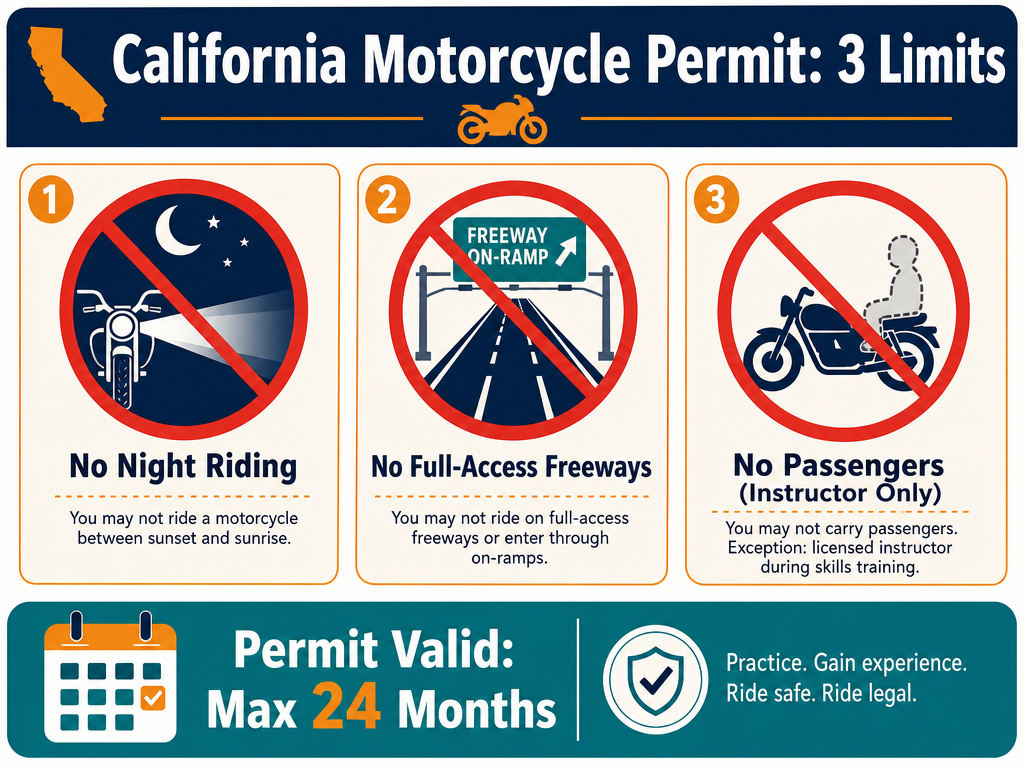
Vehicle Code Section 12509.5 sets the permit rules, and they apply at every age. Get these wrong and you’re riding unlicensed in the eyes of a CHP officer.
What the permit forbids
- No riding during hours of darkness.
- No freeways with full control of access. In plain terms: the kind you can only enter by on-ramp, with no cross streets.
- No passengers, except a licensed or qualified instructor.
The statute also says the permit lasts no more than 24 months from the date of application.
Dark, on-ramp freeway, or a passenger on the back: the permit says no to all three. There’s no “just this once” clause.
Do you even need a permit at 21+?
Here’s where the sources get murky. The statute says a person needs a permit before operating a motorcycle or being issued an M1 or M2 license. The DMV page says riders over 21 don’t need a permit before they apply.
My read, and I’ll flag it as a read: you can skip the permit if you go straight from course to DMV counter. If you want to practice on public roads before you’re licensed, get the permit. For 21+, that means passing the motorcycle written test and nothing else.
The DMV points applicants to its Motorcycle Handbook for the written exam. Study the permit restrictions above closely. They’re short, they’re testable, and they’re the rules you’ll live under right after you pass.
What to bring to the DMV counter
Pulled from the DMV’s own list:
- A completed DL/ID application. Missing it means no file gets opened.
- Residency documents, only if you’ve never had a California DL or ID card. Without them, a first-time applicant can’t proceed.
- Your DL 389, or a booked driving test. The DMV can’t skip the skills portion without one or the other.
- For under-21 applicants, the permit itself, to prove six months of holding. Leave it home and you can’t show the hold.
Sixty Days, Twelve Months, Twenty-Four Months: The Clocks That Run Out
Sixty days. That’s how long your temporary license lasts after the DMV signs off, while the real card comes in the mail. If it hasn’t arrived by then, the DMV says to check your license status online.
Several other clocks run alongside it:
| Deadline | Length | Source |
|---|---|---|
| Under-21 permit hold | At least 6 months | Vehicle Code 12509.5 |
| DL 389 skills waiver | Within 12 months of issue | CA DMV |
| Permit validity | Up to 24 months from application | Vehicle Code 12509.5 |
| Temporary license | 60 days | CA DMV |
| New resident deadline | 10 days | CA DMV |
The new-resident line is tighter than most riders expect. Visitors over 18 with a valid home-state or home-country motorcycle license can ride here as long as that license stays valid. Once you become a California resident, you have 10 days to get a California motorcycle license.
Some unofficial guides contradict the official sources, and I’d rather show you where than pick a winner quietly:
| Question | Official position | Conflicting claim |
|---|---|---|
| How long the permit lasts | Up to 24 months (statute) | One year (dmvcalifornia.us, unofficial) |
| Does DL 389 replace all testing? | Waives skills test; observation test possible (DMV) | Replaces skills test entirely (dmvcalifornia.us) |
| Under-21 course timing | Before the permit (statute, Cabrillo) | Before the license (DMV page) |
Go with the official column. On the third row, take the course first, as covered above.
Licensing and the bike’s paperwork run on separate tracks. Once your temp license is in hand, you’ll still need to register a motorcycle you buy, and that has its own DMV process.
How Much Does the Whole Thing Run?
Want one total figure? Nobody can honestly give you one, and the reason is in the law. Vehicle Code Section 2932 bars the CHP commissioner from setting a maximum fee for courses under the premier training program, starting January 1, 2008. The same section does contemplate a maximum for the novice rider course. In practice, training sites set their own prices.
So the course is your biggest variable. Cabrillo charges riders under 21 less than riders 21 and older, based on age at the first class.
The DMV side is fixed and published. The California DMV licensing fees list shows the original M1/M2 application costs the same as adding M1/M2 to a Class C license. Adding it to a commercial license costs more.
Retests cost extra, and here the DMV contradicts itself. Its motorcycle page and its fee schedule list two different retest amounts. I’d budget for the fee schedule figure, since it’s the dedicated fees page.
Two cost-savers worth checking. Cabrillo notes that completing the course may qualify you for insurance discounts, so ask your insurer before you buy a policy. And skip the DMV riding test entirely if you don’t already own an insured bike. The course supplies one.
Frequently Asked Questions
What are the requirements to get a motorcycle license in California?
It depends on your bracket. Under 21, you need the CMSP course, the written exam, and a permit held at least six months; under 18 adds a Class C license or driver ed and training. At 21 and over, you need either a CMSP course certificate or a passed DMV riding test, plus the application and residency documents.
Can I take the CA motorcycle test online?
The riding test is in person only, at a DMV office, by appointment. You can book that appointment online or by phone at 1-800-777-0133. Part of the CMSP course itself runs online at some sites, like Cabrillo’s eRider module, but I found no official source confirming an online option for the motorcycle written exam, so check the DMV site directly.
How much is a motorcycle license in CA?
The DMV fees are fixed and listed on its fee schedule, and they’re the small part of the bill. The training course costs the most and varies the most, since state law allows premier program providers to set their own prices. Riders under 21 pay a lower rate at some sites, such as Cabrillo College.
Is the CA motorcycle permit test hard?
I couldn’t find an official pass rate or question count from the DMV. The DMV directs applicants to the California Motorcycle Handbook, and that’s the right study material. Learn the permit restrictions cold, since they’re short and easy to test.
Can I ride in California with an out-of-state motorcycle license?
Yes, if you’re a visitor over 18 and your home license stays valid. Once you become a resident, the DMV gives you 10 days to get a California motorcycle license.
Before You Go
Here’s a first step for this week: check how many seats are open at your nearest CMSP site, or call the CMSP info line at 1-877-743-3411. Courses come before almost everything else in this process, especially under 21, and the date you take one sets your DL 389 clock.
One limitation I’ll own. Two questions here have no clean official answer I could verify: whether the six-month hold ends when you turn 21, and whether the written exam can be taken online. Get those from the DMV directly before you plan around them.
That’s the cleanest answer to how to get motorcycle license in California: course first, gear sorted before range day, certificate used within 12 months.
Bottom line: anyone under 21 should book the CMSP course before applying for a permit, riders 21+ with real street skills should look at the 1-Day Premier Course, and the DMV riding test is only worth it if you already own an insured bike and can ride slow without putting a foot down.
