
What Is Cornering ABS on a Motorcycle? How It Cuts Crashes
This post contains affiliate links. As an Amazon Associate, we earn from qualifying purchases.
Cornering ABS is an advanced anti-lock braking system that uses a lean-angle sensor to prevent wheel lock while you are leaned over in a turn. It reduces severe single-vehicle crashes in curves by 70% compared to standard ABS. The system adds one critical sensor, an Inertial Measurement Unit (IMU), to a conventional ABS setup, allowing it to modulate brake pressure based on the bike’s angle and stability.
That 70% figure comes from a 2024 study of Swedish police crash reports, and it reframes the whole conversation from a nice feature to a legitimate lifesaver on winding roads. A key question for riders is what is cornering ABS on a motorcycle. The technology landed a decade ago on the 2014 KTM 1190 Adventure, and it’s now filtering down from premium models.
What follows is the breakdown: how the IMU and algorithm actually work, the hard numbers from real-world crashes, the practical limits every rider should know, and how your technique changes, or doesn’t, when you have it.
Key Takeaways
- Cornering ABS cuts severe and fatal single-vehicle crashes in curves by 70% compared to regular ABS, according to a 2024 Swedish crash data study.
- The entire system hinges on one added sensor: an Inertial Measurement Unit (IMU) that measures accelerations and angles in three spatial directions.
- Harley-Davidson states motorcycles equipped with ABS must always use Harley-Davidson tires and wheels; changing sizes can upset the system’s calibration.
- On some models, like Harley-Davidson, the system has activation thresholds (e.g., no front ABS below 3 mph/5 km/h); low-speed wheel lock is normal and not a fault.
- Maintain pressure, don’t pump the brakes during an ABS event; the system’s rapid modulation works only if you keep the lever or pedal applied.
How Cornering ABS Works: The IMU and the Algorithm
Forget the idea of a completely different braking system. The Spanish Directorate-General for Traffic (DGT) puts it plainly: Cornering ABS comprises the same components as a conventional motorcycle ABS system, with one additional sensor. That sensor is an Inertial Measurement Unit.
An Inertial Measurement Unit (IMU) measures accelerations and angles in three spatial directions: longitudinal, lateral, and vertical acceleration, plus roll, pitch, and yaw angles. This data is the essential dynamic variable for motorcycle stability.
Think of the IMU as the bike’s inner ear. While standard ABS uses wheel speed sensors to detect an impending lock-up, it’s blind to whether the bike is upright or cranked over. The IMU provides that missing context. KTM’s system uses an IMU with a 6D lean angle sensor. The control unit takes data from both the standard wheel speed sensors and the IMU, then runs it through an algorithm that estimates the bike’s stability in real time.
The algorithm has three jobs: interpret the rider’s braking input, assess the risk of wheel lock, and evaluate the motorcycle’s stability status, which is central to understanding what is cornering abs on a motorcycle. If you grab a handful of brake while leaned over, the system knows two things: the tire’s traction is already partly used for cornering, and a lock-up now would be catastrophic. Its response isn’t just on/off. As KTM notes, the ABS kicks in gradually, modulating braking pressure on a scale appropriate for the lean angle. Less available traction means lower brake pressure thresholds before intervention.
This is the core of the safety leap. Standard ABS might prevent a lock-up, but it could do so with a braking force that overwhelms the reduced grip mid-corner, causing the tire to slide. Cornering ABS aims to keep you braking and turning.
The Real-World Numbers: How Much Safer Is It?
Theoretical benefits are one thing. Real-world crash outcomes are another. A 2024 study by Rizzi et al., published by the Institute for Motorcycle Safety (ifz), analyzed Swedish police crash data from 2015-2023. It compared crashes involving bikes with Cornering ABS to a control group of similar bikes with only regular ABS (at least 650cc, less than 8 years old). The results are specific and significant.
| Crash Severity & Type | Reduction with Cornering ABS vs. Regular ABS | Notes |
|---|---|---|
| All injury crashes | 35% reduction | |
| Severe & fatal crashes | 44% reduction | |
| Severe/fatal single-vehicle crashes in curves | 70% reduction | The system’s primary use case |
| Rear-end crashes | No statistically significant reduction | Not the crash type it addresses |
The 70% figure for severe curve crashes is the headline. It tells you exactly where this technology earns its keep: when a rider misjudges a bend, enters too fast, or encounters an unexpected hazard and must brake while leaned. The study also found no statistically significant reduction in rear-end crashes for Cornering ABS compared to regular ABS.
Where this goes sideways: Assuming Cornering ABS makes braking in a turn completely safe. The study’s control group still had regular ABS, which is itself a major safety upgrade over no ABS. Cornering ABS is a significant improvement on an already-good system, not a force field.
It’s also crucial to see what the system doesn’t prevent. The crash type with the highest involvement of motorcycles with Cornering ABS in the dataset was head-on collisions (34% to 50%). Technology can’t fix poor lane positioning or an oncoming car crossing the centerline.
Cornering ABS vs. Regular ABS and Linked Braking
It’s helpful to see where this fits in the evolution of motorcycle braking tech. The table below lays out the progression.
| System | Core Function | Key Sensor | Primary Benefit | Limitation |
|---|---|---|---|---|
| Standard ABS | Prevents wheel lock under hard braking. | Wheel speed sensors. | Maintains steering control and stability in a straight-line panic stop. | Cannot adjust for reduced traction while leaned over. |
| Combined / Linked ABS | Applies braking force to both wheels when one control is used. | Wheel speed sensors + pressure modulator. | Optimizes stability for less experienced riders; shorter stopping distances. | Still lacks lean-angle awareness. |
| Cornering ABS | Prevents wheel lock while leaned, modulating pressure based on angle. | Wheel speed sensors + IMU (lean angle). | Allows safer braking mid-corner; dramatically reduces severe curve crashes. | More complex; requires OEM tires/wheels; has low-speed activation limits. |
Harley-Davidson’s implementation shows how these systems layer. Their Cornering Enhanced Electronic Linked Braking (C-ELB) alters the proportioning of brake pressure between the front and rear brakes when braking while cornering. So you get linked braking that is also lean-angle sensitive. This is a step beyond basic brake balance intuition.
The practical difference for you is in the lever feel. With regular ABS, a mid-corner brake application that nears the lock-up point might trigger a jarring, full-pressure release as the system detects a spinning wheel stopping. With Cornering ABS, the intervention starts sooner and is more nuanced, a scaled pulsing meant to keep you near the traction limit without going over it. You might feel a gentle surge or pulse, not a sharp kick.
Practical Limits and What You Still Have to Do
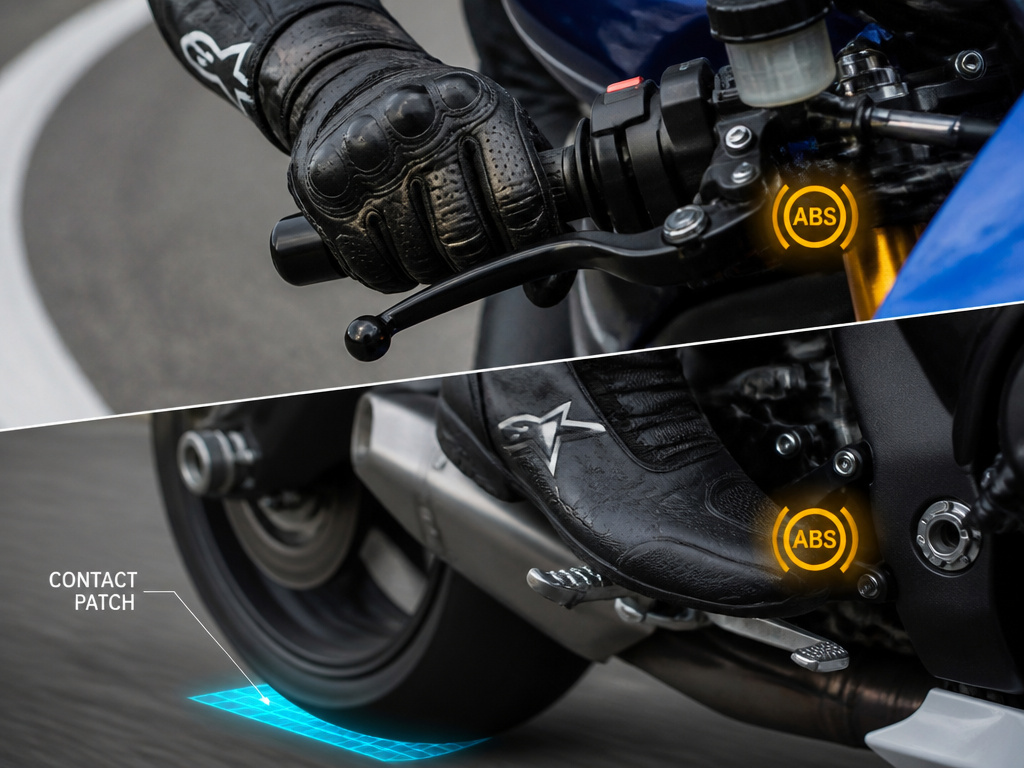
Cornering ABS is a powerful aid, but it’s not autonomous. Its effectiveness is bounded by physics, calibration, and your own inputs. The manufacturer manuals are blunt about the edges.
Tires and Wheels Are Non-Negotiable. Harley-Davidson states it unequivocally: motorcycles equipped with ABS “must always use Harley-Davidson tires and wheels.” Changing to different diameter wheels or tire sizes can upset the ABS calibration because the system monitors rotational speed. Operating at non-specified tire pressures can also reduce ABS braking performance. This isn’t brand loyalty; it’s physics. The algorithm is tuned for a specific rolling circumference.
Low-Speed Lock-Ups Are Normal. The system has minimum speeds for activation. On a Harley-Davidson, ABS does not activate on the front wheel below 5 km/h (3 mph) or on the rear below 8 km/h (5 mph). A wheel lock while maneuvering in a parking lot is not a malfunction. The ABS light may also flash slowly at these speeds as part of its normal self-diagnostics.
You Must Use Proper Technique. The technology assists your braking; it doesn’t replace skill. The Harley-Davidson manual is clear: “The safest way to stop a motorcycle is using both brakes.” During an emergency stop with ABS, “maintain pressure on the brakes through all ABS events. Do not modulate or ‘pump’ the brake controls.” This is the most common mistake, feeling the pulse and releasing. You have to fight that instinct and hold steady pressure.
Furthermore, the system cannot increase the total traction available. If you’re leaned over hard on cold tires over painted lines, the traction circle is tiny. Cornering ABS will help modulate brake pressure within that tiny circle, but it can’t create grip. This is why understanding traction control systems, which manage acceleration slip, is a complementary skill. Your fundamental cornering technique and smoothness are still the first line of defense.
The Rider’s Role: Technique With and Without the Aid
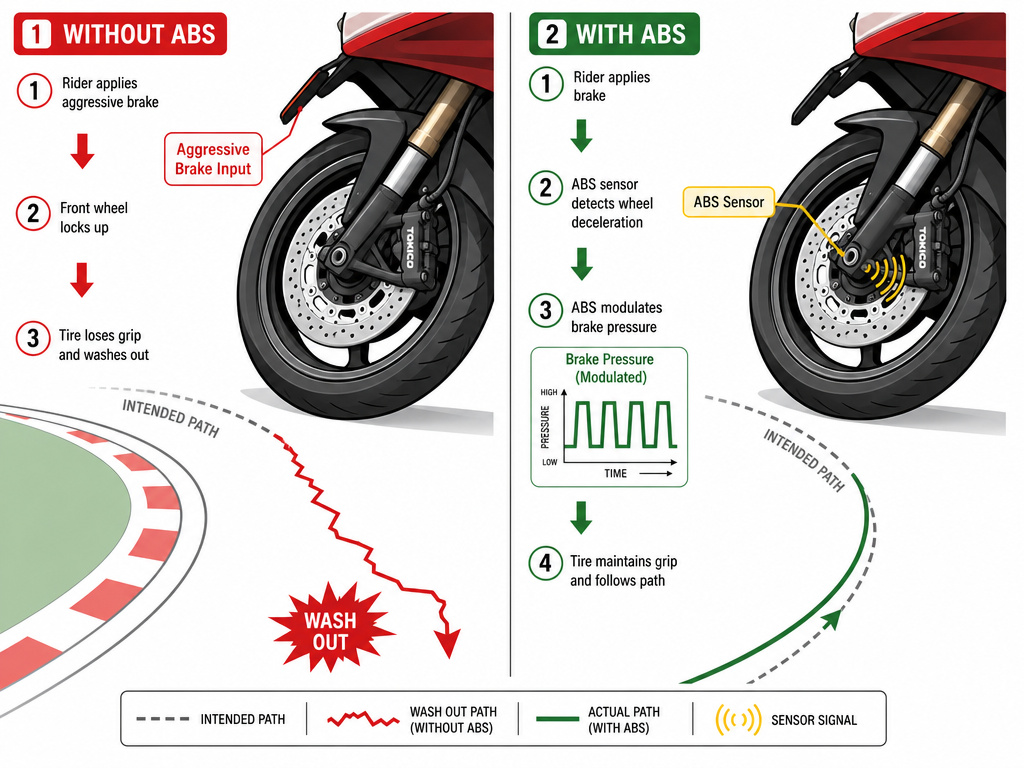
Does Cornering ABS change how you should ride? Yes and no. It doesn’t change the fundamentals of smooth inputs, proper vision, and trail braking technique. In fact, it makes executing advanced techniques like trail braking more forgiving and less risky for everyday riders.
What it changes is the consequence of a mistake. Without it, a too-aggressive brake application while leaned, especially with a less experienced hand, can lead directly to a low side crash as the front tire washes out. The system acts as a buffer, potentially saving that front-end slide by reducing pressure the moment it senses instability.
You should not rely on it to brake later into every corner. That’s a fast track to overwhelming the system and the tires. Instead, view it as a critical safety net for the unpredictable: gravel in the apex, a decreasing-radius turn you misread, or the sudden need to scrub speed when an obstacle appears. Your job is still to set your corner speed early, be smooth, and look where you want to go. The system’s job is to keep a small error from becoming a life-altering crash.
This mindset is important because the system is not universal. Many used bikes, especially older or smaller-displacement models, won’t have it. If you switch between a bike with Cornering ABS and one without, your muscle memory for available braking mid-corner must adjust. The safety net is gone.
How Tire Traction Splits Between Braking and Cornering
Your motorcycle’s tires have a finite amount of grip. This grip must be shared between the forces needed for cornering and the forces needed for braking. When you are leaned over in a turn, a significant portion of the tire’s traction is already being used to change your direction. This leaves less grip available for braking. A conventional ABS system, which only knows if a wheel is locking, cannot account for this split. It might allow too much brake pressure for the available cornering grip, potentially causing a slide. Cornering ABS uses its IMU sensor to understand this balance in real-time, knowing that the brake pressure required to limit wheel slip when cornering is typically lower than the pressure required under straight line operation.
Frequently Asked Questions
What’s the difference between Cornering ABS and regular ABS?
Regular ABS only knows if a wheel is about to lock. Cornering ABS adds an IMU sensor that knows the bike’s lean angle, pitch, and acceleration. It reduces brake pressure before a lock-up happens while you’re leaned over, because traction is already being used for turning. It’s a more proactive, nuanced intervention.
Which motorcycles have Cornering ABS?
It started on high-end models like the 2014 KTM 1190 Adventure (using Bosch MSC) and has since proliferated. Most major manufacturers now offer it on many of their mid-to-high-tier models, often under proprietary names. It’s less common on entry-level bikes.
Can I add Cornering ABS to my older motorcycle?
True, integrated OEM-level Cornering ABS retrofit is virtually impossible. It requires an IMU, a new ABS modulator, and integration with the bike’s main wiring harness, ECU, and instrument cluster. A true, integrated OEM-level Cornering ABS retrofit is virtually impossible. It requires an IMU, a new ABS modulator, and integration with the bike’s main wiring harness, ECU, and instrument cluster. Aftermarket solutions do not exist for this specific function.
Does Cornering ABS work with traction control?
Yes, and they are highly complementary. Both systems often share data from the same IMU. Traction control manages acceleration slip to prevent the rear wheel from spinning, while Cornering ABS manages deceleration slip to prevent locking. Together, they form a core part of modern electronic rider aids and riding modes.
Will Cornering ABS prevent a high-side crash?
It can help reduce the risk, but it’s not guaranteed. A high-side often starts with a rear-wheel slide that is then abruptly caught. If Cornering ABS prevents the rear wheel from fully locking under braking, it can avoid initiating that initial slide. However, high-sides can also be caused by traction control errors or throttle-induced rear wheel spin, which are outside the scope of the braking system.
The Bottom Line
Cornering ABS is the most significant advancement in motorcycle braking safety since the introduction of standard ABS. The data is unequivocal: a 70% reduction in severe single-vehicle crashes in curves is not a marginal gain. It targets the exact scenario that claims experienced riders.
But it is an aid, not an autopilot. Its performance is tied to correct tires, proper tire pressure, and your willingness to use both brakes and hold pressure during a panic stop. It works within the laws of physics, not outside them.
When you’re bike shopping, especially for a used model, prioritize finding one with Cornering ABS if you ride twisty roads regularly. For commuters, standard ABS remains a massive safety upgrade over nothing. But if you have the choice, the extra sensor and algorithm are worth the step up. Just remember, the best safety feature on any motorcycle is still the rider’s judgment, smoothness, and skill. The electronics are there to back that up, not replace it.
