
Motorcycle Traction Control Explained
This post contains affiliate links. As an Amazon Associate, we earn from qualifying purchases.
Motorcycle traction control is an electronic rider aid that uses wheel speed sensors to detect rear wheel slip. When slip exceeds a preset threshold, the system intervenes by reducing engine power through ignition timing, fuel cut, or electronic throttle control to restore traction. It’s not a substitute for skilled riding and has specific activation rules that vary by manufacturer.
That description is the textbook version. In practice, the system’s behavior, when it cuts in, how hard it intervenes, even whether you can turn it off while moving, is dictated by a patchwork of factory calibrations and hardware dependencies most guides gloss over. This is motorcycle traction control explained.
What follows is a walkthrough of traction control not as a generic concept, but as a collection of specific, brand-documented systems, which is the real motorcycle traction control explained. The explanation details how the sensors communicate with the computer, the clear difference between a Ducati’s level 1 and level 8, and the single modification that can make the system unreliable. This is the anatomy of a modern rider aid, traced from the twist grip to the contact patch.
Key Takeaways
- Traction control cannot prevent front wheel slip or loss of traction from excessive speed in a corner, its job is managing rear wheel spin under acceleration.
- Tire size and model directly affect calibration; Ducati explicitly states that using non-OE tire sizes may mean no system level works well, forcing you to deactivate it.
- Manufacturers disagree on when you can toggle the system: Yamaha requires a complete stop, while KTM allows switching while riding.
- You’ll know it’s working by a flashing dash light and often a subtle chopping or pulsing sensation in the throttle response, not a violent cut.
- If you get stuck in sand or mud, turn traction control off; the system’s job is to limit wheel spin, which is the opposite of what you need to rock free.
How Motorcycle Traction Control Works (The Sensors & Logic)
Forget the marketing terms. At its core, the motorcycle traction control explained is a simple comparison exercise performed dozens of times per second.
The system uses wheel speed sensors. The ECU monitors the signals from the front and rear wheel sensors. Under normal acceleration, both wheels should speed up at roughly the same rate. If the ECU calculates that the rear wheel is rotating significantly faster than the front, indicating it’s spinning and losing grip, it triggers an intervention.
This intervention isn’t a single action. The ECU can reduce engine power through ignition timing, fuel cut, or electronic throttle control to restore traction. The goal is to let just enough slip happen for acceleration without letting it build into a loss of control.
You feel this as a rider in two ways. First, a dedicated indicator light on your instrument panel will flash while the system is actively intervening. Second, you might notice a slight change in engine sound or a gentle, rhythmic pulsing at the throttle as power is modulated. It’s rarely a harsh, sudden drop, that would be unstable. The system’s job is to be a subtle, fast-acting co-pilot.
Crucially, this system only cares about the rear wheel spinning faster than the front. It cannot do anything if the front wheel locks under braking (that’s ABS‘s job), and it cannot save you if you enter a corner too fast and lose front-end grip. Traction control cannot prevent loss of traction due to excessive speed when entering turns.
The Role of the IMU and “Cornering” Traction Control
More advanced systems, often called “cornering” traction control, add an Inertial Measurement Unit (IMU) into the mix. This sensor measures the motorcycle’s lean angle, roll rate, and pitch. With this data, the ECU can tailor its intervention. It might allow a little more rear wheel slip when the bike is upright for a hard launch, but become more sensitive and intervene earlier when the bike is leaned over in a corner, where any slip is riskier.
More advanced systems, often called “cornering” traction control, add an Inertial Measurement Unit (IMU) which measures lean angle, allowing the ECU to tailor its intervention. However, it also notes this advanced function is not active when in Off-road mode, a critical detail for adventure riders.
Brand-Specific Rules: On/Off Switches and Defaults
Here’s where the generic explanation ends and the owner’s manual fine print begins. The interaction with traction control, including when it can be used, varies by brand as a non-standardized decision. Getting it wrong can range from frustrating to disabling.
| Brand | Can You Switch While Riding? | Default State at Ignition | Key Activation Notes |
|---|---|---|---|
| Yamaha | No. Motorcycle must be stopped, main switch ON. | Automatically turns on. | Push “TCS” button for at least 2 seconds to turn off. |
| KTM | Yes. Manual states it “can be switched on or off during the ride.” | Presumably on (system dependent). | |
| Ducati | Procedure involves entering a menu and holding a button; the fact sheet does not specify if the motorcycle must be stationary. | Complex. If engine stops with DTC on, it stays on at next key-on. If battery is cut, it defaults off. | Enter menu, set “DTC” to On/Off by holding a button for 3 seconds. |
| BMW | Yes/No. Procedure implies stationary operation, but fault detection occurs while moving. | Self-diagnosis requires riding over 5 km/h before DTC is available. | Press and hold button until DTC indicator light changes status. |
The part nobody mentions: These aren’t suggestions. On a Yamaha, if you try to turn the system off while rolling, nothing will happen. You must come to a complete stop. Meanwhile, a KTM rider can reach down and toggle their system mid-corner if conditions change. This discrepancy matters for riders who switch between brands or buy used bikes without the manual.
System Resets and Fault Detection
Systems can glitch. Yamaha’s protocol is specific: if the traction control system has been disabled (often indicated by both the TCS light and an engine trouble light), you must turn the main switch to OFF, wait at least one second, then turn it back to ON. The system should reset. BMW’s fault detection is even more procedural: a DTC fault is indicated if the warning light shows after the motorcycle accelerates to a speed over 5 km/h following an ignition cycle. The system isn’t fully awake until you move.
Traction Control Levels and Settings: What the Numbers Mean
Not all traction control is created equal. Most systems offer multiple levels or modes, but the scale and philosophy vary wildly between a sport-touring bike and a hyper-naked.
Ducati’s system (DTC) is the most granular, famously offering eight different levels. Their Hypermotard 950 SP manual explains the spectrum:
- Level 8: Intervention begins at “the slightest hint” the rear wheel is starting to spin. This is for maximum safety in poor conditions.
- Level 1: Designed for “off-road use and very expert riders.” Intervention is softer and less sensitive, allowing more slip.
Where this goes sideways: Ducati states that with levels 1 and 2, the DTC control unit “allows both rear tyre spinning and sliding sideways when exiting a turn.” They recommend using these levels only on track and to very experienced riders. This isn’t a gentle aid; it’s a performance tool with a high skill floor.
Some systems offer multiple levels or modes, but the scale and philosophy vary by manufacturer.
Why-Layer: The different levels work by changing the ECU’s preset slip threshold. A higher level (like Ducati’s 8) means the ECU triggers an intervention when it detects a very small difference between front and rear wheel speeds. A lower level (like Ducati’s 1) allows that speed difference to grow much larger before cutting in, giving an expert rider more control over slip angle for faster corner exits.
The Critical Role of Tires and Calibration
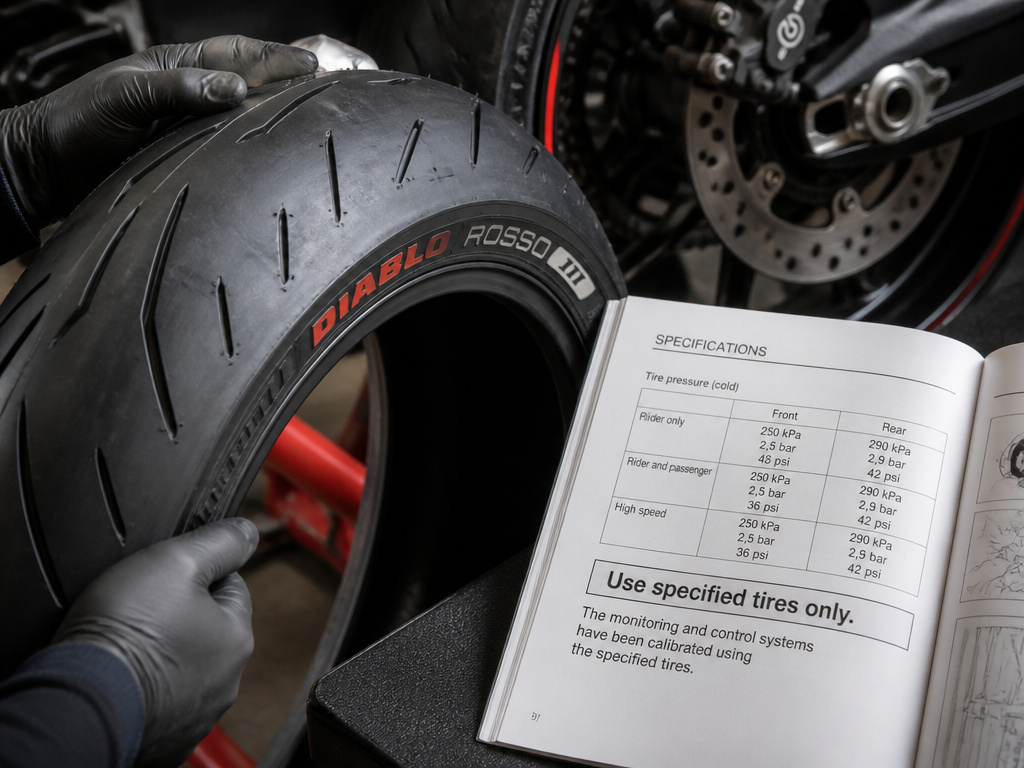
This is the most important non-commodity insight, straight from the factory service manuals: your traction control system is calibrated for a specific tire.
Not just any “sport tire.” The exact make, model, and size.
Ducati’s documentation is unequivocal. The eight levels of the DTC on a Hypermotard 950 SP were calibrated using specific original equipment (OE) tires: the Pirelli Diablo Rosso III (120/70 ZR17 front, 180/55 ZR17 rear) and the Pirelli Supercorsa SP v3 (same sizes). Yamaha’s manual is just as direct: “Use only the specified tires. Using different sized tires will prevent the traction control system from controlling tire rotation accurately.”
What happens if you ignore this?
| Scenario | Likely System Behavior | Manufacturer Recommendation |
|---|---|---|
| Same size, different brand/model tire | System may work but intervention points will be off. You might need to adjust the sensitivity level. | Experiment with level settings to find one that works satisfactorily. |
| Different tire size class (e.g., changing width/aspect ratio) | System calculations for wheel rotation become inaccurate. Intervention may be too early, too late, or erratic. | Ducati explicitly advises: “deactivate the traction control system.” |
| Severely worn OE tire | Circumference changes, slightly affecting calibration. System remains functional but may be less precise. | Be aware that intervention points may differ from a fresh tire. |
If you switch to a significantly different tire size, manufacturers’ recommendations differ: Ducati advises deactivating the system, while Yamaha states to use only the specified tires to ensure accurate control. This isn’t a minor footnote; it’s a fundamental limitation of a system that relies on precise rotational measurements.
When to Use Traction Control (And When to Turn It Off)
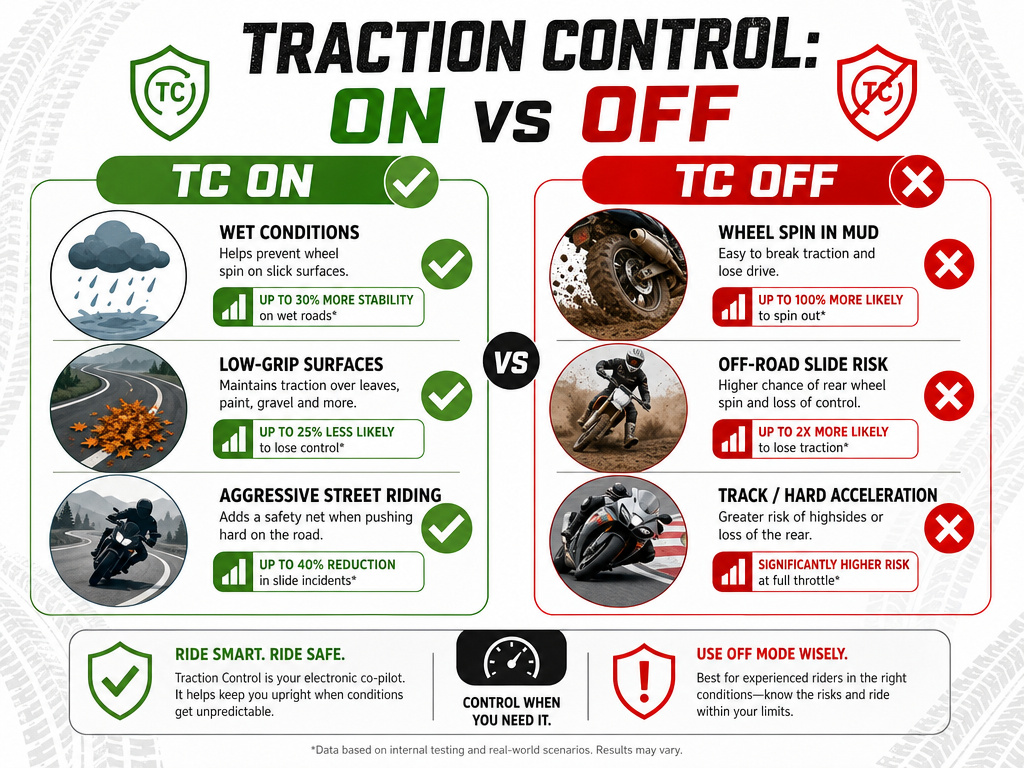
The system’s purpose is to enhance safety and confidence, but it’s not universally optimal. Your decision should change with the pavement and your goal.
Use traction control ON for:
- Wet, greasy, or otherwise slippery roads. This is its primary design purpose.
- Loose surfaces like gravel or wet leaves where rear grip is unpredictable.
- Aggressive street riding where you want a safety net against over-enthusiastic throttle application.
- Any situation where you’re unsure of the available traction.
Turn traction control OFF for:
- Getting unstuck. The Yamaha manual is clear: “Turn the traction control system off to help free the rear wheel if the motorcycle gets stuck in mud, sand, or other soft surfaces.” You need wheel spin to dig out.
- Deliberate off-road riding where sliding the rear wheel is a necessary part of control (though some adventure bike “Off-road” modes do this automatically).
- Track riding by very experienced riders seeking the fastest possible exit speeds using controlled slip (e.g., Ducati DTC level 1 or 2).
- If you’ve installed tires that differ significantly from OE specs, as the system may behave unpredictably.
After starting your bike, take a moment for all electronic systems to complete their self-checks before riding off aggressively. BMW’s DTC function is not available until self-diagnosis has completed, which requires the motorcycle to reach a defined minimum speed.
Common Problems and System Limitations
Traction control is a mechanical and electrical system, which means it can fail or be compromised.
Common issues include:
- Faulty wheel speed sensors. Since TC shares these with ABS, a failure often triggers warnings for both systems.
- Damaged or corroded sensor wiring. This can cause intermittent faults.
- System calibration errors after a tire change or major service.
Inherent limitations mean traction control cannot:
- Overcome the laws of physics. If you enter a corner with too much speed or brake too hard, TC will not save you.
- Prevent front wheel slippage or lock-up.
- Function correctly if the ABS system has a major fault (as noted by Triumph).
- Replace rider skill, judgment, and appropriate speed for conditions.
Easy to miss: The system’s warning light is your best diagnostic tool. A steady light typically means the system is turned off. A flashing light means it’s actively intervening. A steady light accompanied by an engine trouble light (often after a fault) means the system is disabled and needs a reset or service.
Frequently Asked Questions
Should I ride with traction control on or off on the street?
For the vast majority of street riding, leave it on. Its primary function is to provide a safety margin during unexpected loss of traction, like hitting an oil patch or accelerating over painted road lines. Turning it off on public roads generally only makes sense if you’ve modified your tires in a way that confuses the system.
What does it feel like when traction control kicks in?
You’ll typically see a light flash on your dashboard. Physically, you might feel a slight hesitation or pulsation in the throttle response as the system momentarily cuts ignition or fuel. It’s not a violent jerk; it’s designed to be as seamless as possible while doing its job. In some cars, it feels like pressing the brakes. On modern motorcycles, it feels more like a quick, soft burp in the power delivery.
Can I add aftermarket traction control to my older bike?
Yes, but it’s a complex and expensive undertaking. Aftermarket systems require installing wheel speed sensors, a new ECU or piggyback module, and extensive tuning. It’s rarely a cost-effective upgrade compared to simply riding a newer bike that has factory-fitted TC, which is integrated into the design from the ground up.
Does traction control work with aftermarket exhausts and tunes?
Usually, yes. Since traction control operates primarily by reading wheel speeds and (if equipped) lean angle, basic engine modifications like an exhaust and fuel tuner won’t directly interfere. However, if the tune radically changes engine response (making it very jerky), it could make the TC’s job harder, potentially leading to more frequent or less smooth interventions. The system itself will still function.
Before You Go
Traction control is a powerful tool, but it’s a tool with a manual written in brand-specific fine print. The biggest practical takeaway concerns what traction control needs to work correctly, not how it works.
If you change your tires, remember that you might also be changing your traction control’s effectiveness. Sticking to the original equipment sizes isn’t just about handling; it’s about preserving a calibrated safety system. If you ever find yourself spinning in place on a soft shoulder, the first thing to reach for is the TCS button to turn the system off, not the throttle. That single action does more to free a stuck wheel than any amount of horsepower.
Ride it before you trust it. Find an empty, wet parking lot and practice gentle acceleration with the system on, feeling for that subtle dash light and power pulse. That physical feedback, knowing what the intervention feels like before you need it, is worth more than any generic explanation.
