
How Motorcycle ABS Works: Key Takeaways and Limits
This post contains affiliate links. As an Amazon Associate, we earn from qualifying purchases.
Motorcycle Anti-lock Braking System (ABS) prevents wheel lock-up by using wheel speed sensors to detect a rapid deceleration, then a hydraulic control unit rapidly pulses brake pressure, often in under 10 milliseconds, to keep the tire rotating at the optimal slip ratio for maximum stopping force and steering control.
That is the textbook definition. The real-world version is a system that works brilliantly until it doesn’t, with hard limits set by physics, tire grip, and a few critical numbers the manual hides on page 42. Understanding how motorcycle ABS works clarifies these limits.
What follows breaks down the components, the rider’s experience, the manufacturer-specific rules that break it, and the one braking technique that actually works with it.
Key Takeaways
- ABS does not activate below specific low speeds. Harley-Davidson states front-wheel ABS cuts out below 5 km/h (3 mph), and rear below 8 km/h (5 mph).
- During an ABS event, maintain constant pressure on the brake lever or pedal; pumping the brakes disengages the system and increases stopping distance.
- The system requires OEM-specified tires and wheels; changing sizes or running incorrect tire pressure can degrade or disable ABS performance.
- A flashing ABS light at startup is usually normal self-diagnostics, but a steady light indicates a fault that often deactivates the system.
- Cornering ABS and linked systems represent the next evolution, using lean-angle data to modulate braking force while the bike is leaned over.
How ABS Works: The Basic Cycle
Forget the idea of a simple on/off switch when learning how motorcycle ABS works. ABS is a rapid-fire loop of measurement, calculation, and hydraulic intervention. It happens faster than you can react.
The cycle starts at the wheel speed sensors, typically a toothed ring and a magnetic or Hall-effect sensor. These measure rotational speed many times per second. The ABS control unit, a dedicated computer, constantly compares the speeds of the front and rear wheels. It’s looking for a discrepancy that indicates one wheel is decelerating much faster than the other, a sign it’s about to lock up.
When that threshold is crossed, the unit commands the hydraulic control unit to act. This module contains solenoid valves for each brake circuit. To release pressure, an outlet valve opens, diverting a small amount of brake fluid into a reservoir. This causes the familiar pulsation in the lever. Once the wheel speeds back up, the inlet valve re-pressurizes the line. Ducati’s workshop manual notes its system’s outlet valve can pulse in less than 10 milliseconds between cycles.
A standard motorcycle ABS hydraulic control unit contains a pump, solenoid valves, and fluid reservoirs. The Electronic Control Unit (ECU) monitors wheel speed sensors repeatedly. When a wheel deceleration rate indicates impending lock-up, the ECU signals the corresponding solenoid valve to open, releasing brake pressure for milliseconds before reapplying it. This cycle repeats until the lock-up risk passes.
This isn’t about preventing a skid. It’s about maintaining tire grip at the peak of the friction curve, where the tire is slowing down but still rolling slightly. This “slip ratio” is where maximum braking force exists. Lock a wheel, and that force drops dramatically, and you lose steering control.
What ABS Feels and Sounds Like When It Activates
Your first ABS event can be startling if you aren’t expecting it. It is not a gentle nudge.
You’ll feel a rapid, mechanical pulsation through the brake lever or pedal, a distinct buzz-buzz-buzz that can be strong enough to make your hand vibrate. Simultaneously, you’ll likely hear a rapid clicking or grinding noise from under the seat or near the fuel tank. That’s the sound of the hydraulic unit’s solenoid valves firing and the pump motor running. Harley-Davidson’s service info explicitly lists both the pulsation and the clicking sound as normal conditions.
The sensation is often described as a “surge” or a momentary reduction in deceleration as the system momentarily releases pressure. This is most noticeable when braking with only one brake. The key is to not fight it. Your instinct will be to release the lever. That is the wrong move.
Common mistake: Pumping the brakes during an ABS event. Harley-Davidson’s manual is clear: “During an emergency stopping situation, maintain pressure on the brakes through all ABS events. Do not modulate or ‘pump’ the brake controls.” Releasing pressure forces the system to restart its cycle, adding feet to your stop.
The Critical Low-Speed Limit (Where ABS Stops Working)

ABS is not designed for parking-lot speeds. Every system has a lower threshold below which it will not activate or is completely disabled. This is a major point of confusion and a place where manufacturers disagree on the exact number.
| Manufacturer / Source | Low-Speed Threshold | What Happens |
|---|---|---|
| Harley-Davidson | Front: Below 5 km/h (3 mph) Rear: Below 8 km/h (5 mph) |
ABS does not activate. Wheel lock is possible and considered normal. |
| Ducati (M1100 Model) | Below 5 km/h | ABS system is automatically disabled. |
| Honda (CRF1000L) | Below 10 km/h (6 mph) | ABS control unit performs pre-start self-diagnosis. |
This discrepancy matters. If you’re practicing low-speed maneuvers and grab a handful of brake expecting ABS to save you, it might not be there. That rear wheel can lock at a walking pace, which is why Harley-Davidson lists “wheel lock at low speed” as a normal condition in its diagnostic table.
ABS Warning Lights: Reading the Dashboard
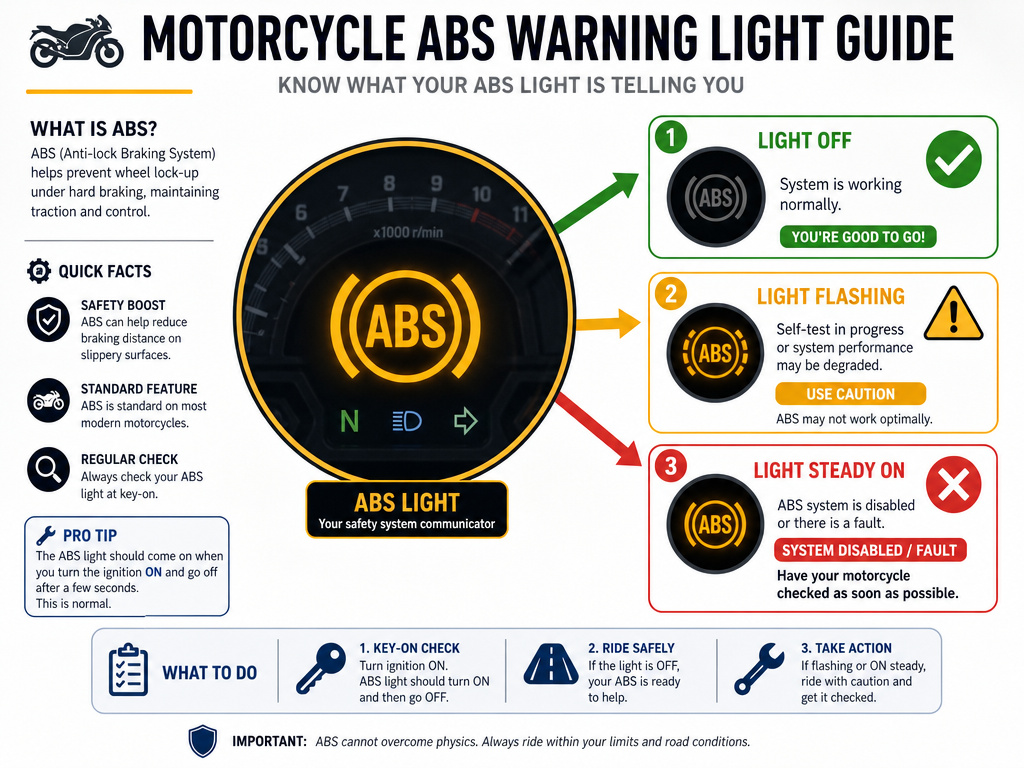
The ABS telltale on your dash is your direct line to the system’s status. According to U.S. Regulation FMVSS No. 122, this warning lamp must light with the ignition as a bulb check and then turn off after the diagnostic cycle completes. What it does after that tells the story.
- Light Off: System is enabled and functioning normally.
- Light Flashing: This can mean two things. A slow flash at startup while moving under ~5 km/h is a normal self-test according to Harley-Davidson. Ducati states a flashing light indicates the system is in self-diagnosis and/or functioning with degraded performance, which is not necessarily tied to startup.
- Light Steady On: This is the critical one. According to Ducati, a steady ABS light indicates the system is disabled and/or not functioning due to a fault. You have conventional brakes only.
FMVSS No. 122 specifies that if text is used for the ABS telltale instead of a symbol, it must use the words “Antilock,” “Anti-lock,” or “ABS” in letters at least 3/32 inch (2.4 mm) high.
ABS Levels and Modes: From Street to Track
Modern ABS isn’t a one-setting-fits-all system. Many bikes, especially from European manufacturers, offer selectable ABS modes that change its intervention characteristics.
Ducati’s owner’s manuals provide a clear example of this philosophy. On a model like the Monster 1200, you might find three levels:
-
Level 3: Designed for less experienced riders. It provides maximum stability, includes rear-wheel lift-up control, and features active cornering ABS.
-
Level 1: For expert riders. ABS is active only on the front wheel, with no lift-up or cornering intervention, prioritizing ultimate braking performance on track.
The manual explicitly recommends Level 3 for less expert riders, stating the system will help keep the motorcycle stable in an emergency.
The Rules That Keep ABS Working (And What Breaks It)
ABS is a calibrated system. Mess with the calibration, and its effectiveness plummets. Manufacturers are not subtle about this in their official documentation.
- Tires and Wheels: This is the essential rule. Harley-Davidson states: “Motorcycles equipped with ABS must always use Harley-Davidson tires and wheels.” Ducati warns that “excellent operation of the ABS system is ensured only with the OE brake system and with OE tyres and/or with the ones recommended by Ducati.” Why? The ABS computer is calibrated for the specific rolling diameter and grip characteristics of the OEM tire. A different size or profile changes the wheel speed sensor readings, confusing the system.
- Tire Pressure: Running under- or over-inflated tires doesn’t just hurt handling. Harley-Davidson notes that “operating at tire pressures other than those specified can reduce ABS braking performance.”
- Hydraulic Faults: The ABS computer is smart, but it’s not a mechanic. Ducati’s workshop manual points out a key limitation: “Hydraulic faults (e.g., worn brake pads) cannot be detected by the ABS control unit.” A steady brake pedal with no stopping power won’t necessarily trigger an ABS warning light. The system only monitors its own electronic components.
This is why treating your front and rear brakes as a complete, maintained system is critical for safety.
Where ABS Falls Short: The Physical Limits
No system can override physics. ABS needs a rotating wheel and consistent tire contact with the road to do its job. Several edge cases can defeat it.
- Loose Surfaces (Gravel, Dirt): ABS can actually increase stopping distance on loose surfaces because a locked wheel can sometimes “plow” and build up a wedge of material in front of it. This is why many adventure and dual-sport bikes have an “ABS Off” switch for the rear wheel.
- Surface Irregularities: BMW’s rider’s manual highlights this perfectly: “humps and surface irregularities can cause wheels to lose contact with the road, dropping transmissible braking force to zero.” If the wheel is in the air, ABS cannot prevent a lock-up that happens milliseconds after it touches down again.
- Track Use: BMW is equally clear about its Integral ABS Pro: it is “not optimised for special requirements that apply under extreme competitive conditions off-road or on the track.” The system is tuned for street tires and pavement, not for the extreme lean angles and brake pressures of track riding.
- Signal Loss: The system needs data. Ducati notes its ABS will deactivate if the speed signal from either wheel is missing. A damaged sensor or wiring harness can take the system offline.
These limitations underscore that ABS is a fantastic safety aid, not an invincibility shield. Your braking techniques and situational awareness are still the primary tools.
Advanced Systems: Cornering ABS and Linked Braking
The next evolution integrates an Inertial Measurement Unit (IMU). This adds pitch, roll, and yaw data to the equation. Cornering ABS (also called lean-angle ABS) uses this data to understand how far the bike is leaned over.
The available grip for braking decreases as lean angle increases. A basic ABS system, unaware of lean angle, might apply too much brake force for the available grip mid-corner. Cornering ABS calculates a lean-angle-appropriate pressure limit, allowing you to brake harder while leaned over than a traditional system would permit, without inducing a low-side crash.
These are less about preventing lock-up and more about optimizing stability and shortening stopping distances by using both brakes optimally, even if the rider only uses one control.
How to Actually Use Your ABS
The technique is simple, but it fights every instinct. It’s a one-step process: Apply firm, progressive pressure to the brake lever and/or pedal and hold it.
Do not pump. Do not modulate. Do not release because the lever is pulsating. The system is working as designed. Your job is to apply the initial braking force and let the computer manage the threshold. This is the core of effective emergency braking.
Practice this in a safe, empty parking lot. Get up to 30 mph and perform a hard, straight-line stop using both brakes. Get familiar with the pulsation and noise so it doesn’t surprise you on the road. Remember the low-speed limit, practice slow-speed control separately, knowing the ABS safety net has been withdrawn.
Frequently Asked Questions
Does ABS really make motorcycles safer?
Yes, overwhelmingly. Studies and real-world data consistently show that ABS significantly reduces fatal crash rates for motorcycles. It prevents the most common panic-braking error, locking the front wheel, which almost always results in a crash. It also allows you to brake and steer simultaneously, which can be the difference between hitting an obstacle and avoiding it.
Can I disable my motorcycle’s ABS?
It depends on the model. Many adventure and dual-sport bikes have a switch to disable rear-wheel ABS for off-road use. Some sport bikes with selectable modes may have a “track” setting that reduces intervention. However, most standard street motorcycles do not have a simple disable switch. Tampering with or disabling ABS may also violate the terms of your insurance or local vehicle regulations.
Is ABS effective in the rain?
ABS is particularly effective in wet conditions where traction is reduced and wheels lock more easily. It prevents hydroplaning lock-ups and helps maintain directional stability. However, overall stopping distances will be longer on wet pavement regardless of ABS, so increased following distance is still crucial.
What’s the difference between ABS and traction control?
They are complementary but opposite systems. ABS prevents wheel lock-up under braking by modulating brake pressure. Traction control prevents wheel spin under acceleration by modulating engine power or applying brake force to the spinning wheel. Both use wheel speed sensors to detect undesirable slip.
Why does my ABS light stay on?
Steady ABS light indicates a detected fault. Common causes include a failed wheel speed sensor, a problem with the hydraulic control unit, low battery voltage, or a blown fuse. When the light is steady, the ABS is typically disabled. You should have the system diagnosed by a qualified technician. The Federal Motor Vehicle Safety Standards mandate this telltale to alert the rider to a system malfunction.
Before You Go
ABS is a brilliant piece of engineering that has saved countless riders. But it’s a component, not a force field. Its performance is tied directly to your tire choice, your tire pressure, and the condition of your brake system. It has a hard, numerical limit below walking speed, and it can be confused by broken pavement or loose surfaces.
Trust the pulsation. Practice the panic stop. And remember that the best braking system on any motorcycle is still the aware, trained rider who knows both the machine’s capabilities and its very real limits.
