
Synthetic vs Conventional Motorcycle Oil: Key Differences
This post contains affiliate links. As an Amazon Associate, we earn from qualifying purchases.
Synthetic vs conventional motorcycle oil comes down to three things: the correct JASO rating for your wet clutch, the temperature your engine runs, and the maintenance interval you follow. For most modern bikes, a JASO MA/MA2-rated synthetic oil is the default choice. For a vintage air-cooled machine with frequent oil changes, a conventional oil is a perfectly valid, cost-effective option.
The JASO rating is the essential part. That certification, not the base oil type, is what keeps a wet clutch from slipping. Once you have the right spec, the synthetic vs conventional motorcycle oil debate shifts to your bike’s age, your riding style, and your wallet.
What follows is a breakdown of the specifications you must match, the performance differences you can expect, and a clear decision guide based on your bike and habits. We’ll cut through the forum myths and stick to sourceable facts.
Key Takeaways
- The JASO MA or MA2 rating is mandatory for any oil in a bike with a wet clutch; the API donut alone is not a guarantee of clutch safety.
- Synthetic oils maintain their protective viscosity under sustained high heat better than conventional oils, a critical factor for air-cooled engines.
- For vintage motorcycles with frequent oil changes, conventional oil is often recommended by specialists to avoid potential seal compatibility debates.
- Always check your owner’s manual for the required viscosity (like 10W-40) and any manufacturer-specific approvals (e.g., Harley-Davidson’s Formulation 1010).
- The Petroleum Quality Institute of America (PQIA) shows conventional oils can meet the same high-temperature shear specs as synthetics, but they degrade faster under that heat.
The One Spec That Matters More Than “Synthetic”
Open your owner’s manual. Before you see a brand name, you’ll see a viscosity grade and a set of letters. For most motorcycles, the crucial one is JASO MA or MA2.
The Japanese Automotive Standards Organization (JASO) MA and MA2 classifications certify that an oil’s friction characteristics are safe for use in a motorcycle’s wet clutch system. Oils without this rating, particularly automotive oils labeled “Energy Conserving,” contain friction modifiers that can cause clutch slippage.
This isn’t about quality—it’s about chemistry. Your clutch plates bathe in the same oil that lubricates your engine. The wrong additives make them slip. I learned this after a friend used a bargain automotive synthetic in his Suzuki SV650. The clutch started slipping under hard acceleration within 200 miles. The oil met the viscosity spec but lacked the JASO MA stamp. We drained it, refilled with a JASO MA oil, and the clutch grabbed normally again.
The American Petroleum Institute (API) SP rating denotes the latest gasoline engine protection standards, providing increased protection against low-speed pre-ignition, timing chain wear, and improved sludge control. It’s important, but secondary to JASO for motorcycles. The JASO MA stamp is your clutch’s guarantee. For a deep dive on this critical rating, read our guide on JASO MA ratings.
The High-Temperature Reality Check
This is where the molecular difference in a synthetic vs conventional motorcycle oil plays out. Both types are graded by the SAE J300 standard for viscosity (e.g., 10W-40). A 10W-40 oil must flow a certain way when cold and maintain a certain thickness when hot, regardless of its base stock.
The Petroleum Quality Institute of America (PQIA) publishes lab data showing that a conventional 10W-40 motorcycle oil can meet the same high-temperature high-shear (HTHS) viscosity specification as a synthetic 10W-40. On paper, at that moment of testing, they perform the same.
Where this goes sideways: A conventional oil’s simpler hydrocarbon chains break down faster under sustained high heat. In an air-cooled V-twin on a summer highway, the oil near the cylinder can reach very high temperatures. The synthetic’s engineered molecules resist thermal breakdown longer.
The result isn’t immediate failure. It’s a gradual loss of that protective viscosity over the course of a long, hot ride. The oil thins out more than its grade suggests, leading to increased wear on bearings and cam surfaces. You won’t hear a noise. You’ll just accumulate microscopic wear at a faster rate.
| Oil Type | Best For | Risk If Pushed |
|---|---|---|
| Full Synthetic | High-performance, air-cooled, turbocharged, or extended-interval engines. | Higher cost; potential (debated) seal compatibility in very old engines. |
| Conventional | Vintage bikes, frequent change intervals, cool-running liquid-cooled engines. | Faster thermal degradation during prolonged high-stress operation. |
| Synthetic Blend | A middle ground, offering some synthetic stability at a lower cost point. | Performance ceiling is lower than full synthetic under extreme duress. |
For most riders, the thermal stability of a full synthetic from a brand like Motul 7100 or Castrol Power1 is worth the premium. It’s the difference between oil that protects at the end of a long, hot ride and oil that degrades prematurely.
Oil Change Intervals: What the Manual Says vs. What You Should Do
Manufacturers base their recommended intervals on controlled testing with specific oils. BMW Motorrad, for example, approves certain synthetics for its extended Longlife service intervals. If you use that exact oil, you can follow that schedule.
Most of us don’t.
For conventional oil, the gap between manual and reality is wider. Forum owners of air-cooled Harleys and vintage UJMs routinely report changing conventional oil at intervals shorter than the manual suggests. They cite visible darkening and a perceived loss of viscosity from heat cycling.
Your interval should be dictated by your oil type and your riding:
- Full Synthetic (JASO MA): Can safely follow the manufacturer’s upper interval under normal riding. For severe use (heat, dust, short trips), significantly reduce that interval.
- Conventional (JASO MA): Start with the manual’s lower interval or 3,000 miles, whichever comes first. For an air-cooled bike in hot climates, a more frequent change interval is a conservative, safe target.
The best practice is to check our guide on motorcycle oil change intervals and stick to a schedule. Changing conventional oil frequently is better than stretching a synthetic too far.
What About Your Old Bike?
The debate gets loudest in vintage circles. The concern is that synthetic oils’ detergent packages and smaller molecules can swell or shrink old rubber seals, leading to leaks.
Sources disagree directly on this point. The Motorcycle Industry Council (MIC) notes potential incompatibility with certain older seal materials. Conversely, lubricant manufacturers like AMSOIL state flatly that synthetic oils will not cause seals to leak.
Common mistake: Switching to synthetic to fix an already-tired engine. If an old engine has varnish buildup holding seals in place, powerful synthetic detergents can clean that varnish away, revealing pre-existing leaks. The oil didn’t cause the leak; it uncovered it.
The consensus among classic bike specialists, as noted in Motorcycle Consumer News, is to use a high-quality conventional oil and change it often. It’s a conservative, proven approach that eliminates the compatibility question entirely. For a 1970s Honda or Triumph that sees limited use, this is the pragmatic path.
If you want to switch an old bike to synthetic, do it on a fresh engine rebuild with modern seals. Or, be prepared to monitor and possibly replace seal components. This is one area where the simpler, traditional choice might be best, as explored in our guide to choosing motorcycle oil.
The Wet Clutch Compatibility Deep Dive
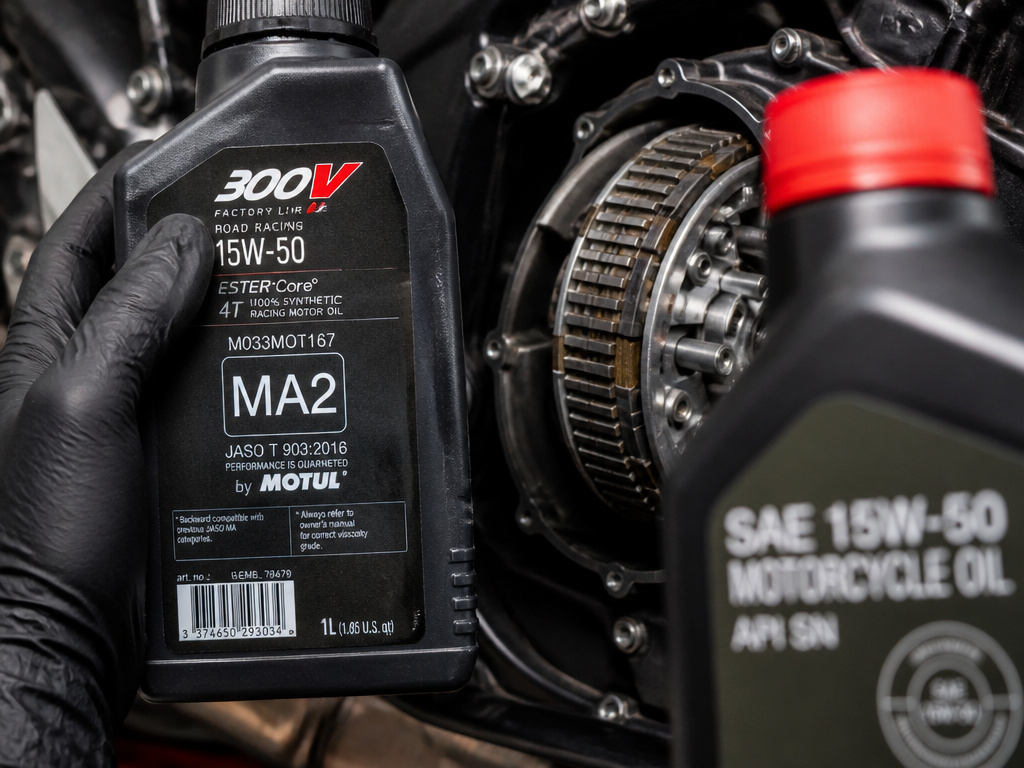
We touched on JASO MA, but the “why” matters. Motorcycle wet clutches need a specific coefficient of friction to operate correctly—enough bite to engage, not so much that they drag or chatter.
The JASO T 903 test standard measures this. Oils that pass get the MA (standard friction) or MA2 (higher friction) label. Automotive oils are designed to reduce friction for fuel economy—the exact opposite of what your clutch needs.
I won’t recommend automotive oil in a wet-clutch bike. The risk of a slipping clutch, which can glaze plates and necessitate a costly replacement, outweighs the few dollars saved per quart. The JASO stamp is a cheap insurance policy.
Always physically check the back of the bottle for the JASO MA or MA2 symbol. Don’t rely on the API service donut alone. For a complete explanation of why the lubrication needs are different, see our comparison of motorcycle oil vs car oil.
Can You Mix or Switch Between Types?
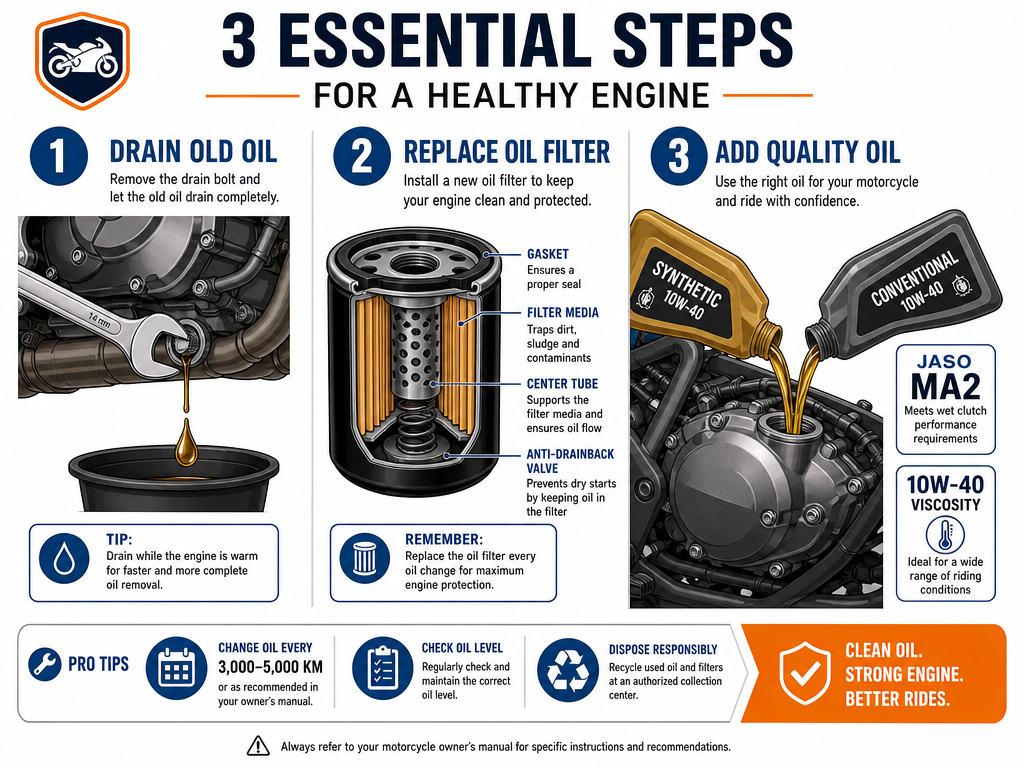
In a pinch, you can mix synthetic and conventional oils. They are compatible. A top-up with a different type to get you home won’t cause a chemical reaction or sludge.
Switching types permanently is also fine. There’s no need for a special flush. The best practice is straightforward:
- Drain the old oil completely.
- Replace the oil filter.
- Fill with the new oil of your choice, ensuring it meets the correct JASO and viscosity specs.
The idea that switching will cause leaks is, again, tied to pre-existing seal condition, not the oil itself. Just make the switch at your next normal oil change. If you’re doing it yourself, our step-by-step oil change guide walks you through the process.
Synthetic vs Conventional: Your Decision Checklist
Stop thinking about which oil is “better.” Start asking which oil is better for your specific situation. Run through this list.
- What does your owner’s manual mandate? (Viscosity & Specifications)
- Viscosity (e.g., 10W-40): Defined by the SAE J300 standard. It is mandatory.
- Special Approvals: Does it call for something like Harley-Davidson’s Formula+ or SYN3 (Formulation No. 1010)? If so, use an oil that meets that spec.
- Do you have a wet clutch? (Almost certainly yes)
- Yes: The oil MUST have a JASO MA or MA2 rating. Full stop.
- What’s your bike’s age and condition?
- Vintage (Pre-1990s) / High Mileage / Known Seepage: Lean toward a quality conventional oil with the correct JASO rating. Change it frequently (under 3,000 miles).
- Modern, Healthy Engine: Full synthetic is the optimal choice for thermal protection.
- How do you ride?
- Short Trips, Commuting: Either type works. Synthetic handles inconsistent warm-up cycles better.
- Long Distance, High Heat, High Performance: Full synthetic is strongly recommended for its sustained stability.
- What’s your maintenance personality?
- “I change it every spring regardless of miles.” A good conventional oil is cost-effective.
- “I follow the manual’s interval to the mile.” Use a full synthetic to ensure protection for the entire interval.
Once you’ve checked these boxes, you can choose a trusted brand like Motul, Castrol, or Liqui Moly with confidence. The goal is informed, intentional maintenance, not following a generic trend.
Pros and Cons of Synthetic and Conventional Oil
Synthetic oil provides superior protection under sustained high heat, with a molecular structure that degrades slower than conventional oil. This makes it a strong choice for air-cooled engines or high-performance riding. Sources disagree on this point: the Motorcycle Industry Council (MIC) notes potential incompatibility with some older seal materials, while lubricant manufacturers like AMSOIL state synthetic oils will not cause seals to leak. For vintage motorcycles without catalytic converters, conventional oil changed at short intervals is often perfectly adequate and recommended by specialists. Regardless of type, always verify the oil carries the correct JASO MA or MA2 stamp for wet clutch safety.
Frequently Asked Questions
Can I put regular 10W-40 in my motorcycle?
You can put a 10W-40 oil in your motorcycle only if it carries the correct JASO MA/MA2 rating for wet clutches. A “regular” 10W-40 automotive oil lacks this rating and risks clutch slippage. The viscosity is right, but the additive package is wrong for your bike.
What is the best oil to use in a motorcycle?
The best oil is the one that exactly matches the viscosity and specification requirements in your owner’s manual (especially JASO MA/MA2). For most modern motorcycles, that will be a full synthetic motorcycle oil from a brand like Motul, Castrol, or Mobil 1 Racing 4T. For vintage bikes, a conventional motorcycle oil with the correct rating is often the specialist-recommended choice.
Is synthetic oil better for my bike than regular oil?
Synthetic oil provides better thermal and oxidative stability, meaning it protects better under sustained high temperatures and can maintain its protective properties for longer intervals. For a modern engine, it is objectively better at resisting breakdown. However, a conventional oil that meets all the same specifications (JASO, API) and is changed frequently provides excellent protection at a lower cost.
Should I use fully synthetic or semi-synthetic oil for my motorcycle?
Semi-synthetic (or synthetic blend) offers a middle ground—some of the stability benefits of synthetic at a price closer to conventional. It’s a perfectly good choice for riders who want a step up from conventional without the full cost of synthetic. For extreme conditions (track use, desert riding), full synthetic remains the top tier.
Can synthetic oil cause leaks in my old motorcycle?
Sources disagree directly: the Motorcycle Industry Council (MIC) notes potential incompatibility with certain older seal materials, while AMSOIL states synthetic oils will not cause seals to leak. Industry guides note potential incompatibility with some old seal materials, while oil manufacturers state synthetics do not cause leaks. The pragmatic approach for vintage bikes is to use a high-quality conventional oil. If you switch to synthetic, be aware that its detergents may clean away deposits that were sealing minor leaks, revealing pre-existing issues.
The Bottom Line
Stop worrying about synthetic versus conventional. Start with the specification.
Find the JASO MA stamp on the bottle. Match the viscosity grade on your dipstick. For a modern bike you ride hard, the added high-temperature protection of a synthetic like Motul 7100 is a smart investment. For a classic bike you cherish and maintain meticulously, a conventional JASO MA oil changed every 2,000 miles is a perfectly sound, traditional approach.
The biggest mistake isn’t choosing the “wrong” base oil type. It’s using an oil that doesn’t protect your wet clutch. Get the spec right first. Everything else is a matter of degrees.
