
How to Lead a Motorcycle Group Ride: Step-by-Step
This post contains affiliate links. As an Amazon Associate, we earn from qualifying purchases.
To lead a motorcycle group ride safely, you organize a pre-ride briefing, assign an experienced lead and sweep rider, keep the group to five to seven riders, and ride in a staggered formation on straight roads. The leader rides in the left third of the lane, with the next rider one second behind in the right third. Switch to single-file with a two-second gap for curves, poor visibility, or when the group cannot maintain the posted speed.
That’s the official baseline from the Motorcycle Safety Foundation and government handbooks. It works until the first curve, the first rider who can’t keep up, or the first time you have fifteen bikes instead of five. Then the simple rules splinter into a dozen different opinions from seasoned clubs and touring associations, which is why many riders seek advice on how to lead a motorcycle group ride.
What follows is a leader’s manual that doesn’t just repeat the basics. It shows you where the official guides disagree, how to choose a system that fits your group’s skill, and the one briefing item that prevents many problems when you compare a how to lead a motorcycle group ride.
Key Takeaways
- Hold a mandatory pre-ride briefing covering the route, hand signals, and the exact plan if a rider gets separated.
- Keep the core group between five and seven riders; split larger groups into separate units with their own lead and sweep.
- Ride in a staggered formation on straight roads, with a one-second gap between bikes in opposite lane tracks.
- Switch to single-file with a two-second gap for curves, poor roads, or when the group cannot maintain traffic speed.
- Designate an experienced sweep rider equipped with tools and a first-aid kit—their job is to ensure no one is left behind.
The Pre-Ride Briefing That Cuts the Chaos
Skip this, and you’re herding cats on two wheels. The briefing is the contract, not a suggestion.
Start with the absolute non-negotiables everyone must hear. The route, planned fuel stops, and the final destination. Then move to the mechanics: review standard hand signals for turns, stops, and hazards. This is where you establish the single most important rule: what to do if you get separated. Do you pull over at the next safe spot? Do you proceed to the next planned stop? Decide and state it clearly.
Common mistake: Assuming everyone knows the plan. A rider who misses a turn and doesn’t know the regroup procedure will ride beyond their skill trying to catch up, which is exactly what the Motorcycle Safety Foundation warns against.
Your pre-ride briefing checklist must also cover rider preparedness. According to the MSF, at least one rider in each group should carry a first-aid kit and a full tool kit, and every rider must have a cell phone. As the leader, you should visually confirm this isn’t just talk, a key part of how to lead a motorcycle group ride. A quick “tools and phone?” check saves a 30-minute roadside scramble later.
Choosing Your Lead, Sweep, and Group Size
The people matter more than the bikes. Your lead and sweep (or tail) riders are your lieutenants. Both need to be experienced, patient, and familiar with group ride etiquette. The leader sets a pace everyone can maintain, not a personal best. The sweep is the guardian—their job is to ensure no one is left behind with a mechanical issue or gets lost.
Now, where do you put the newest rider? Here’s your first major source disagreement.
| Source | Recommended Position for Inexperienced Riders | Rationale |
|---|---|---|
| Ontario Ministry of Transportation | Directly behind the leader (Position #2) | So they can be watched by the experienced lead rider. |
| Common Informal Practice | At the back, in front of the sweep rider. | Less pressure to keep up, easier for sweep to assist. |
| Motorcycle Safety Foundation | Lead and sweep riders must be experienced; does not specify placement for others. | Implies placement is less critical than having competent leaders. |
The Ontario MTO’s logic is sound for instruction. But for a casual group ride, placing a nervous beginner up front can amplify their anxiety. My stance? Assess the rider. If they’re competent but new to groups, the back is kinder. If they need coaching, put them behind the leader as the MTO advises and have the lead rider monitor them via mirror.
Group size is the other critical lever. The MSF’s ideal is five to seven riders. Beyond that, the formation stretches, communication breaks down, and the chance of separation skyrockets. The solution is simple: split into multiple sub-groups of five to seven, each with its own lead and sweep, departing a few seconds apart. The Vintage Motor Cycle Club notes that for very large groups (more than 20 riders), splitting is essential, or you should appoint a support rider behind the sweep for extra help.
Staggered vs. Single-File: The Formation Rules
Formation is your primary risk-management tool. Get it wrong, and you remove everyone’s escape route.
The default for straight, open roads is the staggered formation. It keeps the group compact while preserving a safety cushion.
The leader rides in the left third of the lane. The second rider stays at least one second behind in the right third of the lane. As outlined by the Gold Wing Touring Association and Ontario MTO, the third rider would be in the left third, two seconds behind the leader, and the pattern continues. This is the standard from the MSF, Ontario MTO, and the Gold Wing Touring Association.
This staggered riding formation blocks the lane efficiently and discourages cars from cutting in. But it has strict exit criteria. You must switch to single-file when:
- The road curves or you’re navigating mountain switchbacks.
- Visibility is poor (rain, fog, glare).
- Road surfaces are broken or slippery.
- Entering or leaving a highway.
- The group cannot maintain the posted speed limit.
That last one is from the Ontario MTO handbook and is often missed. If you’re on a scenic ride and moving slower than traffic, abandon the stagger. Ride single-file, as close to the right side of the lane as is safe, to let cars pass. Holding a staggered formation while impeding traffic is arrogant and dangerous.
On curves, the following distance debate opens up again. The MSF recommends a minimum two-second gap in single-file. The Gold Wing Touring Association advises allowing “a little more room (12 seconds)”. The GWTA’s figure is significantly larger than other sources; the principle is correct: on tight curves, you need more space than on a straightaway. Two seconds is the safe, verifiable minimum; add more as the corners tighten.
Navigating Curves, Highways, and Passing
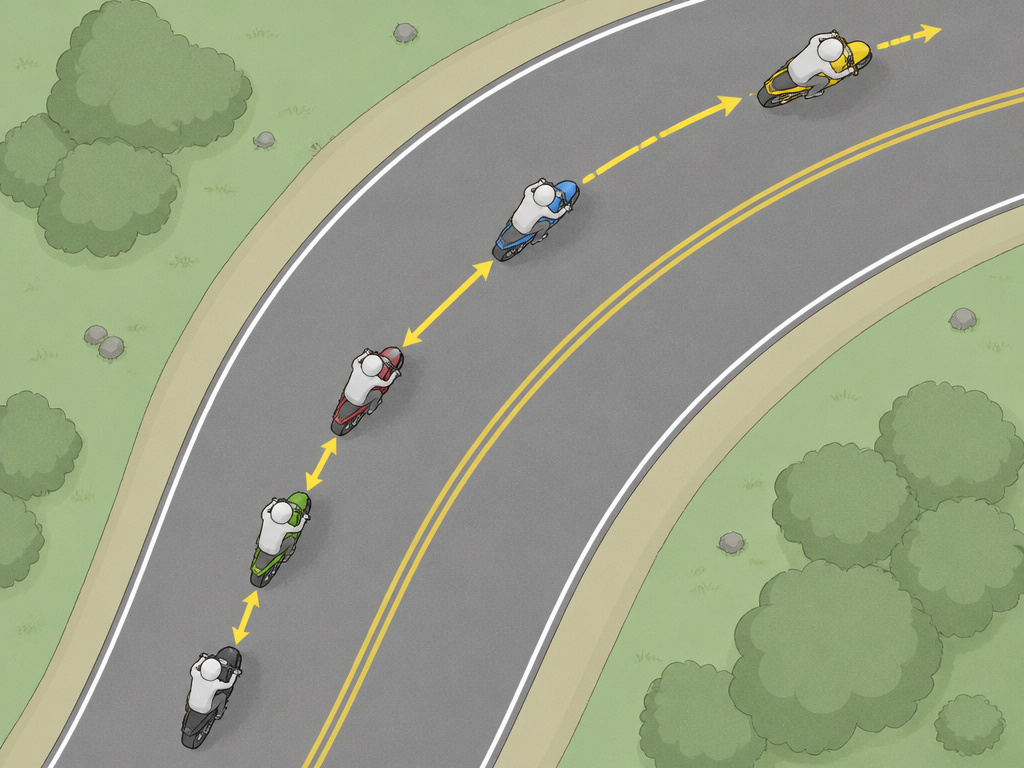
This is where leading becomes active management, not just setting a pace.
On a curvy road, the single-file rule is about line choice. Every rider gets to use the lane position that’s safest and most comfortable for them through each bend. The leader shouldn’t hug the center line if the rider behind needs a wider entry. This requires the increased gap we just talked about.
Highway merges are a coordination test. The leader should signal the lane change early and execute it smoothly, trusting the group to follow one at a time. Don’t rush. A frantic merge is how bikes get separated.
Passing a slow vehicle is a one-at-a-time operation. The leader goes first, completes the pass, and returns to the left third of the lane. They must then hold that position to create a gap for the second rider. The second rider moves to the left, passes, and returns to the right third to open a gap for the third. This sequential criss-cross is slow and deliberate. It prevents two riders from being side-by-side in adjacent lanes, which the Ontario MTO explicitly forbids.
The Sweep Rider: Your Most Important Partner
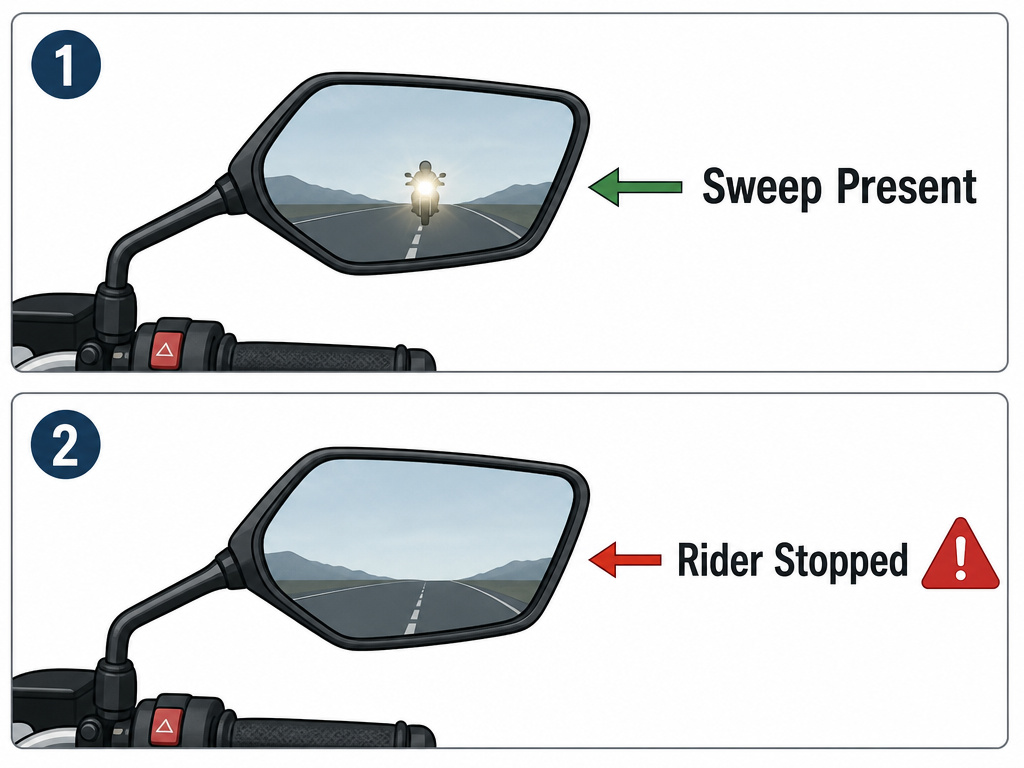
If the leader is the brain, the sweep rider’s role is the immune system. Their role is essential and often under-equipped.
A proper sweep rider needs more than just experience. They should have the group’s toolkit, the first-aid kit, and a phone with the leader’s number. Their primary duty is to never pass a stopped rider from their group. If someone pulls over, the sweep stops with them. They handle the issue or call the leader to inform them of the delay.
This creates a critical protocol: if the leader sees the sweep is no longer in the mirror, they know someone has stopped. The leader should then slow the group and start looking for a safe place to pull over within a reasonable distance, not immediately. This avoids the dangerous “convoy” stopping the VMCC warns against.
What if a rider needs to leave the group mid-route? The procedure from the MSF is specific: the remaining riders should criss-cross into the next vacant position in the stagger. Do not have the rider directly behind the missing person simply move up, as this involves a risky same-lane pass.
What to Do When the Plan Falls Apart
Separation is a when, not an if. A missed light, a hesitant merge, a wrong turn—it happens.
The single greatest tool you have is the separation plan you outlined in the briefing. If a rider vanishes, the sweep rider is the last to lose sight of them and may know what happened. The group should proceed to the next pre-planned regrouping point—a gas station, a restaurant, a specific mile marker. This is far safer than the leader U-turning on a highway or riders speeding to catch up.
The Vintage Motor Cycle Club advocates for a more structured “Drop-Off System” for complex routes. At turns where the route isn’t obvious, the leader signals a rider to stop and act as a marker. That rider waits until the sweep arrives, then rejoins. This eliminates the need for the group to ever stop on the road to regroup, which the VMCC strongly discourages. For a simple day ride, the next-stop plan works. For a complex backroad tour, consider the Drop-Off System.
Where this goes sideways: The leader panics and makes an illegal U-turn. The separated rider rides beyond their skill to catch up. Now you have two emergencies.
After the ride, a quick debrief is invaluable. Ask what worked. Was the pace okay? Were the stops well-timed? This process aims to make the next ride better, not serve ego. It’s also the time to privately address any issues, like a rider consistently riding unsafely.
Frequently Asked Questions
What is the 12-second rule for motorcycles?
The Gold Wing Touring Association mentions allowing “a little more room (12 seconds)” on curvy roads. This appears to be an outlier or a typo; the widely accepted standard from the Motorcycle Safety Foundation and the Ontario Ministry of Transportation is a minimum two-second following distance, increased further for curves. For practical leading, use the two-second rule as your baseline and add more time as corner severity increases.
What are the etiquette rules for group riding?
Core rules of group ride etiquette include attending the pre-ride briefing, maintaining your position in the formation, using hand signals, keeping a steady pace, and communicating if you need to stop or leave the group. The overarching principle is to ride predictably and not endanger the group with sudden maneuvers.
What should a leader do if a rider falls behind?
Official sources disagree. The MSF says the leader should slow down so the rider may catch up. The VMCC’s Drop-Off System philosophy is to avoid stopping or slowing the convoy; a rider who is falling behind should signal others to pass and settle in at the back. As a leader, you must choose based on context. On a highway, a gentle slowdown is safe. On a tight, technical road, having the rider drop to the back may be less disruptive.
How do you manage a group with vastly different skill levels?
The primary tool is splitting the group by pace. Let a faster subgroup ride ahead, with its own sweep, departing a few minutes before a slower subgroup. Trying to force a single pace on a mixed group frustrates the fast riders and pressures the slow ones. The Ontario MTO’s advice to put less experienced riders directly behind the leader is also a useful technique for providing a visible, calming pace-setter.
Is a communication system necessary for group leading?
Helmet communication systems are helpful but not necessary. They are a supplement to, not a replacement for, a clear plan and visual hand signals. A communication system between the lead and sweep rider can help with coordinating stops or hazards. For the whole group, they can reduce stress but also become a distracting chatterbox.
The Bottom Line
Leading a group ride is a volunteer job that carries real responsibility. Your primary tools are a clear briefing, a sensible formation, and a trusted sweep rider. The official Motorcycle Safety Foundation group riding guide is your rulebook, but the art is in navigating the gaps—like whether to slow down for a straggler or let them find their own place.
One threshold decides your approach: if your route has frequent, tricky turns, adopt the Vintage Motor Cycle Club’s Drop-Off System to avoid roadside regrouping. For most highway and main-road rides, the standard MSF staggered formation with planned stops works perfectly.
The goal is getting everyone home with the same grin they started with, not a military parade. That happens when the leader thinks about the last rider as much as the road ahead.
