
How to Countersteer a Motorcycle: Step-by-Step
This post contains affiliate links. As an Amazon Associate, we earn from qualifying purchases.
To countersteer a motorcycle, you press forward on the handlebar grip in the direction you want to turn. Press left, lean left, go left. This steering input works above walking speed to initiate a lean, using the bike’s own geometry and gyroscopic forces to make turning intuitive and stable. The key is a firm, deliberate press, not a shove.
That press is the physical action. The mental shift is trusting that pressing away from your intended turn is correct. Most riders do this unconsciously; bringing it into conscious practice is how you gain precise control, especially for mid-corner corrections or emergency swerving. A key part of this conscious practice is learning how to countersteer a motorcycle.
What follows breaks down why this counterintuitive move works, a parking-lot drill to lock in the muscle memory, and how to apply it to fix the most common cornering mistake: running wide.
Key Takeaways
- Countersteering is press left, go left. The press initiates the lean; the bike’s geometry does the rest.
- The technique becomes necessary above walking speed. Below that, direct steering works.
- The most common error is staring at the outside curb instead of where you want to go. Your vision directs your press.
- Practice the input in a safe lot with a deliberate, then relaxed press-and-hold sequence to build feel.
- Running wide in a corner is fixed with more countersteering pressure, not less. Panic and freezing the bars is the actual danger.
The Physics in One Sentence: Why Pressing Left Makes You Go Left
You don’t need a degree to get this. When you press forward on the left grip, you momentarily steer the front tire a tiny amount to the right. This shifts the bike’s contact patches out from under its center of mass. The bike begins to fall to the left. As it falls, the front wheel naturally turns into the direction of the fall, left, to catch it. That catch is the lean, and the bike now follows a left-turning arc.
This is a non-conscious process for experienced riders. Bringing it to consciousness is purely for skill development: to make corrections deliberate and to override the instinct to steer directly away from a hazard, which at speed will do the opposite.
The bike’s own stability wants this to happen. Gyroscopic forces from the wheels and the rake/trail geometry of the front end are designed to convert that small, initial opposite steer into a stable, self-correcting lean. Your job is just to give the command.
What Does Countersteering Feel Like? (The Parking Lot Drill)
The feeling is a gentle, firm pressure, not a jerk. If you’ve ever weaved slightly while cruising down a straight road, you’ve already done it.
Here’s a drill to isolate the sensation. Find a empty, flat parking lot.
- Get to a safe speed. Roll on steady throttle in second gear to a safe, moderate speed. Keep your arms relaxed, elbows slightly bent.
- Press, don’t turn. Look straight ahead at a distant point. Now, with your right hand, press forward on the right handlebar grip. Don’t pull the left side back, just push the right side away from you. Do it deliberately.
- Hold and observe. Hold that pressure for a full second. The bike will lean right and begin a gentle turn to the right. Feel the bike drop into the lean.
- Relax and straighten. Relax the pressure. The bike will naturally stand back up. Now press the left grip to lean left.
The sensation you’re after is the bike falling into the lean with minimal body movement. Your body positioning should stay neutral; let the bike move under you. If you find yourself heaving your shoulders or hips, you’re trying too hard. The input is in the hands.
Common mistake: Trying to “help” by leaning your body first. This delays the steering input and feels awkward. Do the drill with your torso quiet. The press does the work.
Low-Speed vs. High-Speed Steering: When Countersteering Takes Over
Below walking speed, you steer a motorcycle like a bicycle: turn the handlebars in the direction you want to go. This is direct steering. It’s essential for low speed control in parking lots and U-turns.
As speed increases, the wheels’ gyroscopic stability and the bike’s geometry make direct steering ineffective. The front end feels heavy and resists.
| Speed Range | Primary Steering Method | What It Feels Like | Common Error |
|---|---|---|---|
| 0–10 mph | Direct Steering | Turning bars like a bicycle. Heavy effort at very low speed. | Using body weight instead of handlebar input and clutch control. |
| 12–15+ mph | Countersteering | Light pressure on grip makes bike fall into lean. Feels effortless. | Trying to direct steer, causing instability and slow, wide turns. |
The transition isn’t a hard line at a specific speed. You’ll feel it. Around 12-15 mph, the bike starts to respond better to a press than to a turn. This is why practicing the drill in the 20-25 mph range removes all doubt about how to countersteer a motorcycle, you’re solidly in countersteering territory.
The Link Between Vision, Fear, and Running Wide
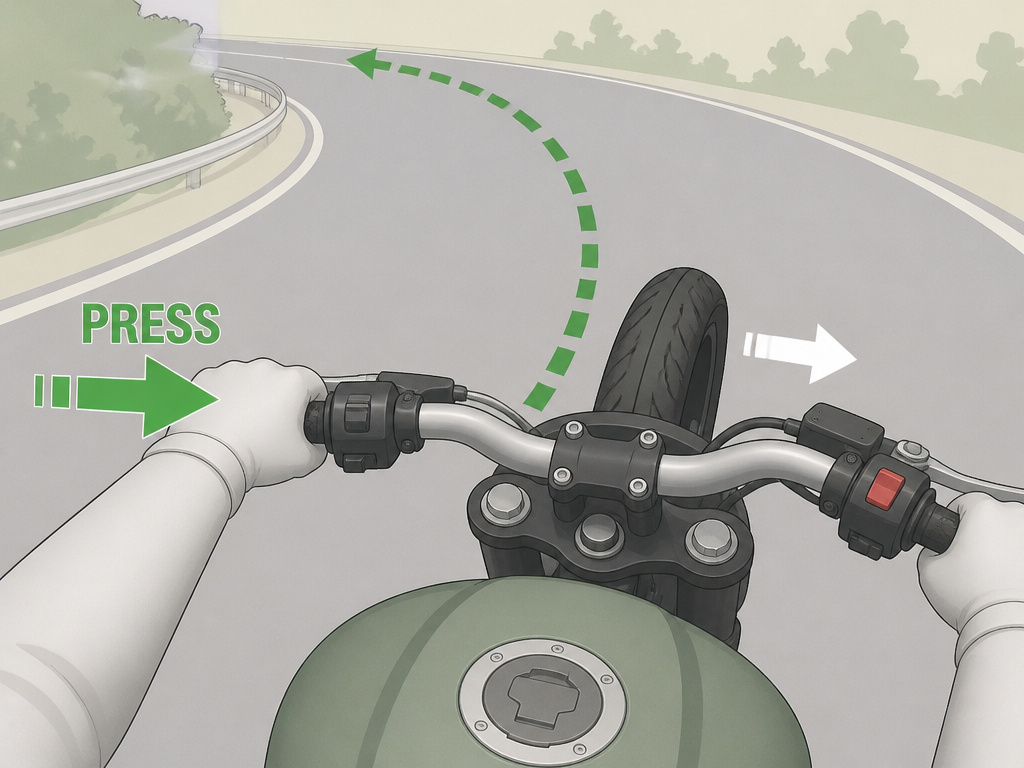
This is where theory meets the road. You’re in a left-hand turn, and you feel the bike drifting toward the outside lane or shoulder. The instinct is to panic, stiffen up, and either freeze the handlebars or try to steer directly left (which, at speed, actually stands the bike up and sends you wider).
The fix is more countersteer, which is the core of how to countersteer a motorcycle. Look through the turn to where you want to go, and press the left grip harder.
Where this goes sideways: Staring at the outside curb or oncoming lane. Your vision controls your direction. If you fixate on the hazard, you will unconsciously steer toward it. This is target fixation in action, and it’s the root cause of most running-wide incidents.
The sequence for correcting a wide line:
- LOOK. Force your eyes to the inside of the turn, down your desired path.
- PRESS. Increase forward pressure on the inside grip (left grip for a left turn).
- TRUST. The bike will lean more and tighten its line. You may feel a quickening sensation, that’s normal.
This feels counterintuitive because leaning more feels like committing to the mistake. It’s not. It’s the only physical way to change the bike’s arc once you’re leaned over. Trying to stand it up with direct steering input guarantees you’ll run wide.
How Bike Type Changes the Feel (Cruiser vs. Sportbike)
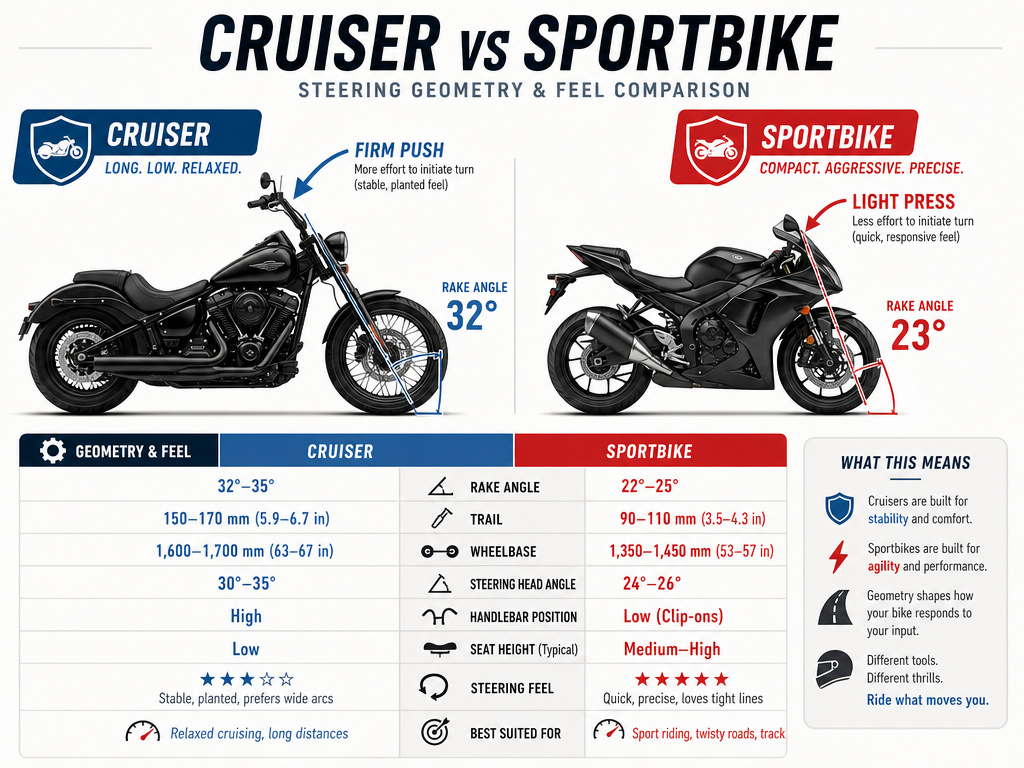
The principle is identical on all two-wheeled motorcycles. The feel varies.
A heavy cruiser has more inertia, a longer wheelbase, and more relaxed steering geometry. The countersteering input needs to be firmer and more deliberate. The response feels slower, like guiding a ship. Once it’s leaned, it’s stable.
A sportbike has aggressive geometry, less weight, and a shorter wheelbase. It flicks into a lean with a whisper of pressure. The response is immediate, almost twitchy. This is why sport riders talk about “steering with your pinky.”
| Bike Type | Typical Steering Geometry | Countersteering Feel | Practice Tip |
|---|---|---|---|
| Cruiser/Touring | High rake, long wheelbase | Slow, deliberate, heavy. Requires firm input. | Use more positive pressure. Don’t be afraid to really push. |
| Standard/Naked | Moderate rake (~25°), mid wheelbase | Neutral, predictable. The “textbook” feel. | Good platform to learn the basic press. |
| Sportbike/Supersport | Low rake, short wheelbase | Immediate, light, sensitive. Minimal input needed. | Use subtle pressures. Over-pressing can cause abrupt lean changes. |
Yamaha owner’s manuals emphasize checking wheel and spoke condition before each ride because a damaged or unbalanced wheel can introduce a wobble or weave, especially under the steering loads of countersteering. The feel is always through the handlebars, so any front-end issue gets amplified.
Advanced Application: Swerving and Mid-Corner Adjustments
Countersteering is the core of emergency maneuvers. The classic quick swerve around a road hazard is two rapid countersteering inputs: press right to lean right and go right, then immediately press left to stand up and straighten, or press left to lean left and swerve back to your original lane.
For mid-corner adjustments, like tightening your line for a decreasing-radius turn, it’s the same press-more principle. The bike is already leaned. Adding more inside bar pressure increases the lean angle and tightens the turn. Easing pressure allows the bike to stand up and run wider.
This interacts with braking. The old rider wisdom, from manuals like the 2009 Honda CBR1000RR‘s, was to “avoid braking while turning.” Modern motorcycles with Cornering ABS, like the Ducati Multistrada V4, are designed to allow braking while leaning. The principle remains: smooth inputs are everything. A ham-fisted brake grab while leaned over, even with advanced electronics, can overwhelm traction.
Practice Drills to Build Unconscious Competence
Move beyond the basic press drill. These build the skill into a reflex.
- The Weave: In a clear lane, practice gentle, continuous left-right-left weaves using only countersteering. Focus on smooth transitions. This builds a feel for how little input is needed.
- The Lane Change: Pick a spot ahead to change lanes. Look at the new lane, then execute a single, decisive press-swerve-press-straighten sequence. Make it one smooth motion.
- The Increasing Lean Circle: In a large lot, set up a wide circle. Go around, gradually increasing lean angle by adding gentle inside bar pressure each lap. Feel the relationship between pressure and lean.
Always practice in a safe, controlled environment first. The Motorcycle Safety Foundation (MSF) Basic RiderCourse drills these fundamentals for a reason, they work.
What is the difference between low-speed and high-speed steering?
At very low speeds, like in a parking lot, you steer a motorcycle directly. You turn the handlebars the way you want the front wheel to go, and the bike follows. At higher, road-going speeds, this direct steering feels too heavy and slow. Instead, you countersteer. You press forward on the handlebar grip in the direction you want to turn. This brief, opposite input makes the bike lean, and it falls smoothly into the turn. The motorcycle’s own geometry and the gyroscopic effect of the wheels make this the natural and stable way to initiate a lean at speed. Practice this in a safe area to build your skills and get accustomed to how your motorcycle handles.
How do you straighten the motorcycle after a turn?
To exit a turn and bring the bike upright, you reverse the countersteering input. Gently press forward on the handlebar grip on the outside of the turn. If you are in a left turn, press forward on the right grip. This input will begin to lift the motorcycle out of its lean. As the bike comes upright, you will naturally steer it to follow a straight path. The process is smooth and progressive; you don’t need to jerk the bars. Avoid braking sharply while you are still leaned over. When possible, complete any major speed adjustments before you begin to straighten up, allowing you to focus on a controlled exit.
Frequently Asked Questions
How does motorcycle countersteering work?
It uses the bike’s geometry and gyroscopic forces. Pressing the left grip steers the front wheel slightly right, causing the bike to fall left. As it falls, the front wheel turns into the fall (left) to catch it, establishing a lean and a left-turning arc. It’s a self-stabilizing process.
At what speed does countersteering work?
Countersteering becomes the effective steering method above walking speed. Below that, direct steering (turning the bars) is used, especially for low-speed maneuvers. The transition isn’t abrupt; you’ll feel the bike respond better to pressure as speed increases.
What is the 12 second rule on a motorcycle?
This is a visual lead-time rule, not directly related to countersteering. It means you should consistently scan the road ahead, focusing on where you’ll be in the next 12 seconds. This gives you time to plan smooth inputs, whether that’s for a cornering line or an emergency swerve.
I’m scared to press more when I run wide. What do I do?
This is the most critical hurdle. The fear is natural. The solution is practice in a low-risk environment. Go back to the parking lot, set up a cone or marker, and practice deliberately running a bit wide, then looking through the turn and pressing to tighten your line. Your brain needs to experience the correction working safely before it will trust the technique at speed.
Before You Go
The goal isn’t to think about countersteering on every bend. It’s to practice the deliberate press until it becomes the unconscious, default response. That’s when you stop fighting the bike and start working with it.
One threshold rule: if you’re in a turn and not happy with your line, your first mental cue should be “look and press,” not “brake and panic.” The brakes change your speed; the handlebars change your direction. In a corner, direction is usually the more urgent problem.
Master this, and the more advanced skills, like trail braking or refining your cornering lines, become layers you add on top of a solid, automatic foundation. The bike is designed to do this. Your job is just to give it a clear command.
